A student raises his hand and says, “मैं तैयार हूँ” (I am ready). His teacher replies, “आप शुरू कर सकते हैं” (You may begin). A classmate then points towards a notebook and says, “वह मेरी है” (That one is mine). Three short sentences, but each uses a different pronoun to identify someone or something.
In Hindi grammar, these words are called personal pronouns (पुरुषवाचक सर्वनाम). They replace nouns and refer to the speaker, the listener, or someone being discussed. Common examples include मैं (I), हम (we), तुम (you), and वह (he, she, or that).
Hindi pronouns have an interesting feature: choosing between तू, तुम, and आप depends on familiarity and respect. Similarly, यह and वह can refer to people or objects without separate masculine and feminine pronoun forms. Their types, grammar rules, and sentence patterns reveal how these differences work.
Personal Pronouns Types in Hindi
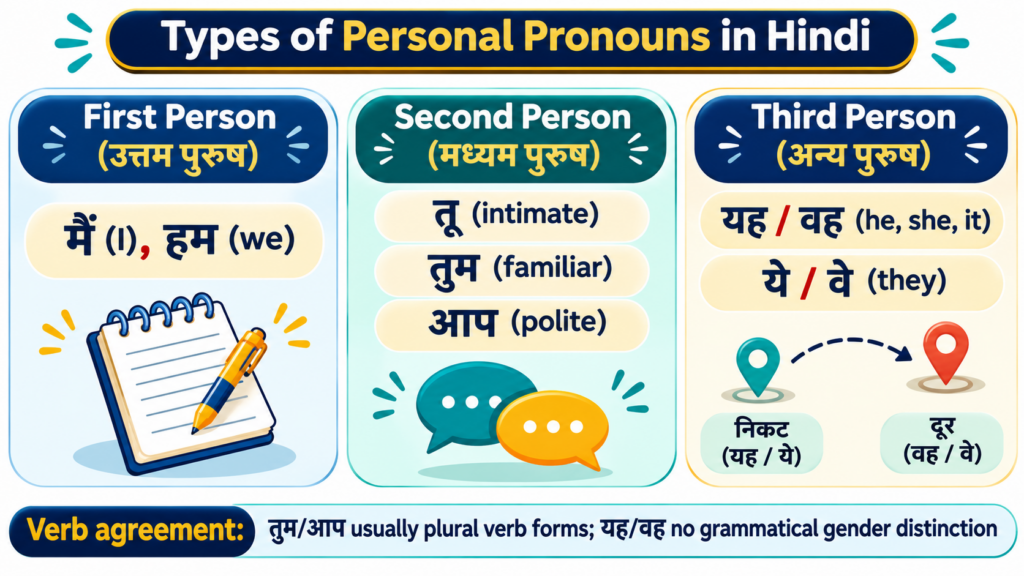
Hindi personal pronouns are divided into First Person, Second Person, and Third Person according to their role in communication.
Second-person pronouns also express familiarity and politeness, while third-person forms often distinguish nearby and distant referents.
1. First Person Pronouns (उत्तम पुरुष)
First-person pronouns refer to the speaker or a group that includes the speaker.
| Hindi Pronoun | English Meaning | Number | Example |
|---|---|---|---|
| मैं | I | Singular | मैं पढ़ता हूँ। |
| हम | We | Plural | हम पढ़ते हैं। |
मैं normally refers to one speaker. हम refers to a group, although it can also be used for one speaker in certain regional, modest, or formal styles.
2. Second Person Pronouns (मध्यम पुरुष)
Second-person pronouns refer to the person or people being addressed.
Hindi uses three common forms to express different levels of familiarity and respect.
| Hindi Pronoun | English Meaning | Level of Formality | Example |
|---|---|---|---|
| तू | You | Very intimate | तू कहाँ है? |
| तुम | You | Familiar / Informal | तुम कहाँ हो? |
| आप | You | Formal / Respectful | आप कहाँ हैं? |
आप is generally the safest choice when speaking politely to adults or unfamiliar people.
तू is appropriate only in certain close relationships or cultural contexts. It may sound disrespectful if used carelessly.
3. Third Person Pronouns (अन्य पुरुष)
Third-person pronouns refer to people or things being discussed rather than the speaker or listener.
Hindi commonly uses demonstrative forms to distinguish nearby and more distant referents.
| Hindi Pronoun | English Meaning | Reference |
|---|---|---|
| यह | He / She / It / This | Nearby singular |
| ये | They / These | Nearby plural |
| वह | He / She / It / That | More distant singular |
| वे | They / Those | More distant plural |
Example: यह मेरी किताब है। (This is my book.)
Example: वे मेरे दोस्त हैं। (They are my friends.)
The forms ये and वे can also refer respectfully to a single person in honorific usage.
Personal Pronoun Types Comparison
| Person | Hindi Name | Main Pronouns | English Meaning |
|---|---|---|---|
| First Person | उत्तम पुरुष | मैं, हम | I, We |
| Second Person | मध्यम पुरुष | तू, तुम, आप | You |
| Third Person | अन्य पुरुष | यह, ये, वह, वे | He, She, It, They |
Personal Pronoun Grammar Rules in Hindi
Hindi personal pronouns change according to grammatical person, number, respect, and their role in the sentence.
Their forms may also change before postpositions or when used as objects.
Rule 1: First-Person Pronouns Use Different Verb Forms
मैं commonly takes हूँ, while हम generally takes हैं in the present tense.
| Singular | Plural |
|---|---|
| मैं विद्यार्थी हूँ। | हम विद्यार्थी हैं। |
| मैं जाता हूँ। | हम जाते हैं। |
| मैं लिख रहा हूँ। | हम लिख रहे हैं। |
Verb forms also reflect gender where the verb or participle requires it.
Example: मैं पढ़ रही हूँ। (I am studying, spoken by a female speaker.)
Rule 2: तू, तुम, and आप Require Different Verb Agreement
Hindi second-person pronouns use different verb endings according to familiarity and respect.
| Pronoun | Correct Sentence | English |
|---|---|---|
| तू | तू पढ़ता है। | You study. |
| तुम | तुम पढ़ते हो। | You study. |
| आप | आप पढ़ते हैं। | You study. |
The examples use masculine agreement. Feminine forms include पढ़ती है, पढ़ती हो, and पढ़ती हैं.
Rule 3: Hindi Third-Person Pronouns Do Not Encode He and She Separately
Unlike English, Hindi does not ordinarily have separate third-person subject pronouns for he and she.
The verb or surrounding context usually indicates the intended gender.
| Hindi Sentence | English Meaning |
|---|---|
| वह जा रहा है। | He is going. |
| वह जा रही है। | She is going. |
| यह पढ़ रहा है। | He is reading. |
| यह पढ़ रही है। | She is reading. |
The pronoun stays the same while the participle changes.
Rule 4: Near and Far Reference Affects Pronoun Choice
यह / ये generally refer to nearby people or things, while वह / वे generally refer to more distant people or things.
Examples:
- यह मेरा बैग है। (This is my bag.)
- वह मेरा बैग है। (That is my bag.)
- ये मेरी किताबें हैं। (These are my books.)
- वे मेरी किताबें हैं। (Those are my books.)
Actual usage also depends on context, discourse, and register.
Rule 5: Pronouns Change in Object and Oblique Forms
Personal pronouns often have different forms when used as objects or with postpositions.
| Subject Form | Common Object Form | Example |
|---|---|---|
| मैं | मुझे | मुझे बुलाओ। |
| हम | हमें | हमें बताओ। |
| तू | तुझे | तुझे पता है। |
| तुम | तुम्हें | तुम्हें बुलाया। |
| आप | आपको | आपको धन्यवाद। |
| यह | इसे | इसे रख दो। |
| वह | उसे | उसे बुलाओ। |
| ये | इन्हें | इन्हें देखो। |
| वे | उन्हें | उन्हें बुलाओ। |
Rule 6: ने Appears with Many Perfective Transitive Verbs
In standard Hindi, the postposition ने commonly marks the agent of a perfective transitive clause.
| Pronoun | Form with ने |
|---|---|
| मैं | मैंने |
| हम | हमने |
| तू | तूने |
| तुम | तुमने |
| आप | आपने |
| यह | इसने |
| वह | उसने |
| ये | इन्होंने |
| वे | उन्होंने |
Example: मैंने किताब पढ़ी। (I read the book.)
Example: उसने पत्र लिखा। (He or she wrote a letter.)
Not every past-tense sentence takes ने. Its use depends on the verb and grammatical construction.
Rule 7: Possessive Forms Express Ownership
Personal pronouns have related possessive forms.
| Personal Pronoun | Possessive Form | English |
|---|---|---|
| मैं | मेरा / मेरी / मेरे | My / Mine |
| हम | हमारा / हमारी / हमारे | Our / Ours |
| तू | तेरा / तेरी / तेरे | Your |
| तुम | तुम्हारा / तुम्हारी / तुम्हारे | Your |
| आप | आपका / आपकी / आपके | Your |
| वह | उसका / उसकी / उसके | His / Her / Its |
| यह | इसका / इसकी / इसके | His / Her / Its / This one’s |
| वे | उनका / उनकी / उनके | Their |
Example: यह मेरी किताब है। (This is my book.)
Example: वह उनका घर है। (That is their house.)
Rule 8: आप Can Refer to One Person or Several People
आप uses respectful or honorific verb agreement whether it addresses one person or multiple people.
Example: आप कैसे हैं? (How are you?)
The same sentence can address one respected person or a group.
Personal Pronoun Examples in Hindi with English Meaning
Personal pronouns have several subject, object, possessive, and postpositional forms.
These examples show how pronoun forms change according to their grammatical function.
Personal Pronoun Forms with Hindi Meanings
| No. | Hindi Form | English Meaning |
|---|---|---|
| 1 | मैं | I |
| 2 | हम | We |
| 3 | तू | You (intimate) |
| 4 | तुम | You (familiar) |
| 5 | आप | You (polite) |
| 6 | यह | This / He / She / It |
| 7 | ये | These / They |
| 8 | वह | That / He / She / It |
| 9 | वे | Those / They |
| 10 | मुझे | Me / To me |
| 11 | हमें | Us / To us |
| 12 | तुझे | You / To you (intimate) |
| 13 | तुम्हें | You / To you (familiar) |
| 14 | आपको | You / To you (polite) |
| 15 | इसे | This person or thing / To this |
| 16 | उसे | That person or thing / To that |
| 17 | इन्हें | These people or things / To these |
| 18 | उन्हें | Those people or things / To those |
| 19 | मैंने | I (with ergative marker) |
| 20 | हमने | We (with ergative marker) |
| 21 | तुमने | You (with ergative marker) |
| 22 | आपने | You, polite (with ergative marker) |
| 23 | इसने | This person (with ergative marker) |
| 24 | उसने | That person (with ergative marker) |
| 25 | इन्होंने | These people / honorific person (ergative) |
| 26 | उन्होंने | Those people / honorific person (ergative) |
| 27 | मुझसे | From me / With me |
| 28 | हमसे | From us / With us |
| 29 | तुमसे | From you / With you (familiar) |
| 30 | आपसे | From you / With you (polite) |
Note: English translations vary with the sentence. For example, मुझसे may mean from me, than me, or with me, depending on the verb and construction.
Personal Pronoun Examples in Sentences
Personal pronouns appear in everyday conversations, questions, requests, and descriptions.
These sentences show how the speaker, listener, and third-person forms work with Hindi verbs and postpositions.
First Person Pronoun Examples
| No. | Hindi Sentence | English Meaning |
|---|---|---|
| 1 | मैं घर जा रहा हूँ। | I am going home. |
| 2 | मैं किताब पढ़ रही हूँ। | I am reading a book. |
| 3 | मैं हिंदी सीखता हूँ। | I learn Hindi. |
| 4 | मैं रोज़ लिखती हूँ। | I write every day. |
| 5 | मैं आज व्यस्त हूँ। | I am busy today. |
| 6 | मुझे पानी चाहिए। | I need water. |
| 7 | मुझे यह गीत पसंद है। | I like this song. |
| 8 | मैंने काम पूरा किया। | I completed the work. |
| 9 | मेरे पास एक कलम है। | I have a pen. |
| 10 | मुझसे यह प्रश्न पूछो। | Ask me this question. |
| 11 | हम विद्यालय जाते हैं। | We go to school. |
| 12 | हम साथ पढ़ते हैं। | We study together. |
| 13 | हम समय पर पहुँचे। | We arrived on time. |
| 14 | हम आज खुश हैं। | We are happy today. |
| 15 | हमें मदद चाहिए। | We need help. |
| 16 | हमने नया पाठ सीखा। | We learned a new lesson. |
| 17 | हमारे पास समय है। | We have time. |
| 18 | हमसे बात करो। | Talk to us. |
| 19 | मैं कल आऊँगा। | I will come tomorrow. |
| 20 | मैं जल्दी उठती हूँ। | I get up early. |
| 21 | मुझे उत्तर पता है। | I know the answer. |
| 22 | मैंने दरवाज़ा खोला। | I opened the door. |
| 23 | मैं यहाँ रहता हूँ। | I live here. |
| 24 | हम बाहर खेल रहे हैं। | We are playing outside. |
| 25 | हमने खाना बनाया। | We cooked food. |
| 26 | हमें यह जगह पसंद है। | We like this place. |
| 27 | हम अगली बस लेंगे। | We will take the next bus. |
| 28 | मैंने एक पत्र लिखा। | I wrote a letter. |
| 29 | हमारा घर पास है। | Our house is nearby. |
| 30 | हम फिर मिलेंगे। | We will meet again. |
Second Person Pronoun Examples
| No. | Hindi Sentence | English Meaning |
|---|---|---|
| 1 | तू कहाँ है? | Where are you? (intimate) |
| 2 | तू जल्दी आ। | Come quickly. (intimate) |
| 3 | तू क्या कर रहा है? | What are you doing? (intimate, masculine) |
| 4 | तू मेरे साथ चल। | Come with me. (intimate) |
| 5 | तुझे यह पसंद है? | Do you like this? (intimate) |
| 6 | तू अभी बैठ। | Sit down now. (intimate) |
| 7 | तू बहुत अच्छा गाता है। | You sing very well. (intimate, masculine) |
| 8 | तू यहाँ रह। | Stay here. (intimate) |
| 9 | तूने सही कहा। | You said the right thing. (intimate) |
| 10 | तेरा बैग कहाँ है? | Where is your bag? (intimate) |
| 11 | तुम कैसे हो? | How are you? (familiar) |
| 12 | तुम कहाँ रहते हो? | Where do you live? (familiar) |
| 13 | तुम अच्छी हिंदी बोलते हो। | You speak good Hindi. (familiar, masculine) |
| 14 | तुम आज जल्दी आए। | You came early today. (familiar, masculine) |
| 15 | तुम्हें कौन-सी किताब चाहिए? | Which book do you need? |
| 16 | तुमने दरवाज़ा बंद किया। | You closed the door. |
| 17 | तुम कल आओगे? | Will you come tomorrow? (familiar, masculine) |
| 18 | तुम मेरे मित्र हो। | You are my friend. |
| 19 | तुम्हारा घर सुंदर है। | Your house is beautiful. |
| 20 | तुमसे मिलकर खुशी हुई। | It was nice meeting you. |
| 21 | आप कैसे हैं? | How are you? (polite) |
| 22 | आप कहाँ रहते हैं? | Where do you live? (polite, masculine) |
| 23 | आप कृपया बैठिए। | Please sit down. |
| 24 | आप क्या पढ़ रहे हैं? | What are you reading? (polite, masculine) |
| 25 | आपको चाय चाहिए? | Would you like tea? |
| 26 | आपने बहुत मदद की। | You helped a lot. |
| 27 | आपका नाम क्या है? | What is your name? |
| 28 | आप यहाँ आ सकते हैं। | You may come here. (polite, masculine) |
| 29 | आपसे एक प्रश्न पूछ सकता हूँ? | May I ask you a question? (male speaker) |
| 30 | आपका बहुत धन्यवाद। | Thank you very much. |
Third Person Pronoun Examples
| No. | Hindi Sentence | English Meaning |
|---|---|---|
| 1 | यह मेरी किताब है। | This is my book. |
| 2 | यह नया बैग है। | This is a new bag. |
| 3 | यह बहुत उपयोगी है। | This is very useful. |
| 4 | यह यहाँ रहता है। | He lives here. |
| 5 | यह अच्छा गाती है। | She sings well. |
| 6 | इसे मेज़ पर रखो। | Put this on the table. |
| 7 | इसने काम पूरा किया। | This person completed the work. |
| 8 | इसका रंग नीला है। | Its color is blue. |
| 9 | ये मेरी चाबियाँ हैं। | These are my keys. |
| 10 | ये किताबें नई हैं। | These books are new. |
| 11 | ये मेरे दोस्त हैं। | These are my friends. |
| 12 | इन्हें अंदर बुलाओ। | Call them inside. |
| 13 | इन्होंने हमारी मदद की। | They helped us. |
| 14 | इनका घर पास है। | Their house is nearby. |
| 15 | ये कल आए थे। | They came yesterday. (masculine/mixed group) |
| 16 | वह मेरा विद्यालय है। | That is my school. |
| 17 | वह बाहर खड़ा है। | He is standing outside. |
| 18 | वह पुस्तक पढ़ रही है। | She is reading a book. |
| 19 | वह पेड़ बहुत ऊँचा है। | That tree is very tall. |
| 20 | उसे मदद चाहिए। | He or she needs help. |
| 21 | उसने पत्र लिखा। | He or she wrote a letter. |
| 22 | उसका कमरा साफ़ है। | His or her room is clean. |
| 23 | वे मैदान में खेल रहे हैं। | They are playing in the field. |
| 24 | वे मेरे शिक्षक हैं। | He or she is my teacher. (honorific) |
| 25 | वे दूर खड़े हैं। | They are standing far away. |
| 26 | उन्हें यह पुस्तक पसंद है। | They like this book. |
| 27 | उन्होंने नया घर खरीदा। | They bought a new house. |
| 28 | उनका विद्यालय बड़ा है। | Their school is large. |
| 29 | वे कल यहाँ आएँगे। | They will come here tomorrow. |
| 30 | उनसे बात करना आसान है। | It is easy to talk to them. |
Personal Pronouns vs Possessive Pronouns in Hindi
Personal pronouns identify participants in a sentence, while possessive forms express ownership or association.
These functions are closely related, but they are not grammatically identical.
| Personal Pronoun | Possessive Form | Example |
|---|---|---|
| मैं | मेरा / मेरी | मेरी किताब |
| हम | हमारा / हमारी | हमारा विद्यालय |
| तुम | तुम्हारा / तुम्हारी | तुम्हारी कलम |
| आप | आपका / आपकी | आपका घर |
| यह | इसका / इसकी | इसकी चाबी |
| वह | उसका / उसकी | उसका कमरा |
| वे | उनका / उनकी | उनकी दुकान |
Personal pronoun: वह यहाँ है। (He or she is here.)
Possessive form: उसका बैग यहाँ है। (His or her bag is here.)
Common Mistakes with Personal Pronouns in Hindi
Hindi pronoun errors often arise from incorrect verb agreement, unsuitable levels of politeness, and confusion between direct and object forms.
Understanding these differences makes conversation clearer and more respectful.
Mistake 1: Using तू in Formal Situations
Using तू with an unfamiliar adult may sound rude.
In polite conversation, prefer आप unless the relationship and context clearly justify another form.
Mistake 2: Using Singular Verb Agreement with आप
Incorrect: आप अच्छा है।
Correct: आप अच्छे हैं। (Masculine)
Correct: आप अच्छी हैं। (Feminine)
Mistake 3: Mixing तुम and आप Verb Endings
Incorrect: तुम कहाँ हैं? (When addressing a single familiar person using ordinary तुम agreement.)
Standard familiar form: तुम कहाँ हो?
Respectful form: आप कहाँ हैं?
Mistake 4: Using the Wrong Object Form
Incorrect: मैं बुलाओ। when the meaning is Call me.
Correct: मुझे बुलाओ।
Mistake 5: Assuming वह Always Means He
वह can mean he, she, it, or that, depending on the context.
Compare वह आया (he came) and वह आई (she came).
Mistake 6: Confusing यह and इस
यह is a common direct form, while इस appears before various postpositions and grammatical markers.
Example: यह किताब है।
Example: इस किताब में चित्र हैं।
Mistake 7: Confusing Their and Them
उन्हें is used in object or indirect-object constructions, while उनका / उनकी / उनके express possession.
Example: उन्हें बुलाओ। (Call them.)
Example: उनकी किताब लाओ। (Bring their book.)
Personal Pronoun Worksheet
Practice first, second, and third-person pronouns through exercises on person, number, politeness, verb agreement, and oblique forms.
The activities help learners choose the correct Hindi pronoun in everyday sentences.
⋮⋮⋮⋮Download Personal Pronoun Worksheet with Answers PDF
Practice personal pronouns with exercises on grammatical person, verb agreement, and correct pronoun usage.
The printable PDF includes an answer key for self-assessment.
Frequently Asked Questions
Can हम refer to only one speaker?
Yes. In some regional, formal, or stylistic contexts, हम can refer to a single speaker. In standard everyday usage, it usually means we.
Why do आप and तुम use different verb endings?
Hindi distinguishes familiar and respectful forms of address. तुम generally takes हो, while respectful आप takes हैं in the present tense.
Is वह a demonstrative or a personal pronoun?
वह can function as a demonstrative or a third-person pronoun depending on context. Hindi commonly uses the same pronominal forms for both functions.
Why does मैंने contain ने?
ने is an ergative marker used in many perfective transitive constructions. मैंने combines मैं with this marker to identify the agent.
Download Personal Pronoun in Hindi Study Notes PDF
Keep the important personal pronoun types, grammar rules, Hindi meanings, and sentence examples together in one PDF.
These notes are useful for offline reading, revision, and exam preparation.
Conclusion
A pronoun can change the tone of an entire Hindi sentence. तू, तुम, and आप may all translate as you, yet they express different relationships between speakers.
Try describing the same action using मैं, तुम, आप, and वह. Notice how the verb endings change. Then share two sentences using मुझे and उन्हें in the comments.
Leave a Reply