The teacher writes “राहुल विद्यालय जाता है। राहुल किताब पढ़ता है। राहुल मेहनत करता है।” on the classroom board. A student notices that Rahul’s name appears three times. He changes the second and third sentences to “वह किताब पढ़ता है। वह मेहनत करता है।” Suddenly, the writing sounds much more natural.
The word वह (he) replaces the repeated name. In Hindi grammar, such words are called pronouns (सर्वनाम). They help us refer to people, objects, and ideas without repeating the same nouns. Other familiar examples include मैं (I), तुम (you), कोई (someone), and कौन (who).
But Hindi pronouns do more than replace names. तू, तुम, and आप express different levels of familiarity and respect, while यह and वह indicate proximity. Some pronouns ask questions, others connect ideas, and a few refer back to the subject itself. Understanding these differences makes everyday Hindi easier to read, speak, and write.
How Many Types Of Pronoun In Hindi
Lets explore the types of pronoun in Hindi with examples. A commonly taught school-level classification identifies six types of pronouns.
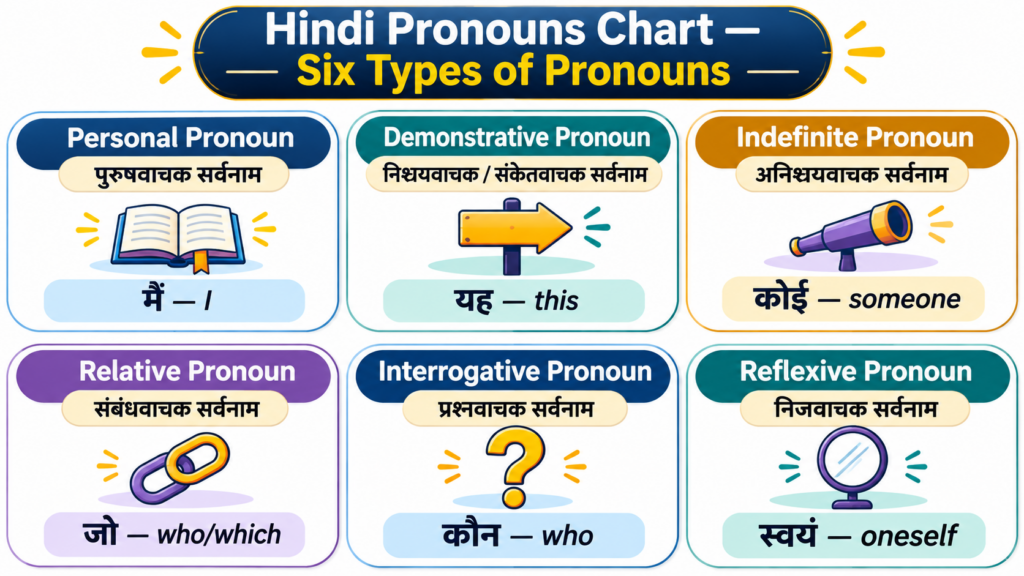
These categories describe personal reference, indication, indefinite reference, relationships, questions, and self-reference. Some words can belong to different categories depending on their use.
1. Personal Pronoun (पुरुषवाचक सर्वनाम)
Personal pronouns refer to the speaker, the listener, or someone being discussed.
Examples: मैं (I), हम (we), तुम (you), आप (you), वह (he/she).
2. Demonstrative Pronoun (निश्चयवाचक सर्वनाम)
Demonstrative pronouns point to particular people or things, often indicating whether they are nearby or farther away.
Examples: यह (this), वह (that), ये (these), वे (those).
3. Indefinite Pronoun (अनिश्चयवाचक सर्वनाम)
Indefinite pronouns refer to people or things without identifying them precisely.
Examples: कोई (someone), कुछ (something), किसी (someone, in an oblique form).
4. Relative Pronoun (संबंधवाचक सर्वनाम)
Relative pronouns introduce clauses that identify or provide information about someone or something.
Examples: जो (who/which/that), जिसने (who did), जिसका (whose).
5. Interrogative Pronoun (प्रश्नवाचक सर्वनाम)
Interrogative pronouns are used to ask about people, things, identity, or ownership.
Examples: कौन (who), क्या (what), किसने (who did), किसका (whose).
6. Reflexive Pronoun (निजवाचक सर्वनाम)
Reflexive expressions refer back to the subject or emphasize that someone performed an action personally.
Examples: स्वयं (oneself), खुद (self), अपने आप (by oneself).
Important: Hindi grammar books sometimes use different labels or subdivisions.
The six types above provide a useful learning framework, but some classifications also discuss reciprocal and other pronominal forms separately.
Pronoun in Hindi Grammar Rules
Hindi pronouns change according to grammatical person, number, respect, and sentence structure.
Their object, possessive, and postpositional forms are especially important for correct communication.
Rule 1: A Pronoun Refers to or Replaces a Noun
Pronouns help avoid unnecessary repetition.
Without pronoun: सीमा आई। सीमा बैठ गई।
With pronoun: सीमा आई। वह बैठ गई।
English: Seema arrived. She sat down.
Rule 2: Personal Pronouns Have Three Persons
| Person | Hindi Pronouns | English |
|---|---|---|
| First Person | मैं, हम | I, We |
| Second Person | तू, तुम, आप | You |
| Third Person | यह, वह, ये, वे | He, She, It, They |
First person refers to the speaker. Second person refers to the listener, and third person refers to someone or something else.
Rule 3: Formality Changes Second-Person Verb Agreement
Hindi uses different pronouns and verb forms according to familiarity and respect.
| Pronoun | Usage | Example |
|---|---|---|
| तू | Very intimate | तू कहाँ है? |
| तुम | Familiar | तुम कहाँ हो? |
| आप | Polite / Respectful | आप कहाँ हैं? |
Use आप when speaking politely to an unfamiliar person or someone you wish to address respectfully.
Rule 4: Hindi Third-Person Pronouns Do Not Separately Mark He and She
The forms यह and वह do not themselves distinguish masculine and feminine gender.
The verb and context often clarify the intended meaning.
| Hindi Sentence | English Translation |
|---|---|
| वह जा रहा है। | He is going. |
| वह जा रही है। | She is going. |
| यह पढ़ रहा है। | He is reading. |
| यह पढ़ रही है। | She is reading. |
Rule 5: Pronouns Change Before Postpositions
Pronouns frequently take oblique forms with expressions such as को, से, में, पर, and के लिए.
| Direct Form | Common Modified Form | Example |
|---|---|---|
| मैं | मुझे / मुझसे | मुझसे पूछो। |
| हम | हमें / हमसे | हमें बताओ। |
| तुम | तुम्हें / तुमसे | तुमसे मिलकर खुशी हुई। |
| आप | आपको / आपसे | आपको क्या चाहिए? |
| यह | इसे / इससे | इसे रख दो। |
| वह | उसे / उससे | उसे बुलाओ। |
| ये | इन्हें / इनसे | इन्हें देखो। |
| वे | उन्हें / उनसे | उनसे बात करो। |
Rule 6: Pronouns Have Related Possessive Forms
Possessive forms express ownership, association, or a relationship.
| Pronoun | Possessive Form | English |
|---|---|---|
| मैं | मेरा / मेरी / मेरे | My / Mine |
| हम | हमारा / हमारी / हमारे | Our / Ours |
| तुम | तुम्हारा / तुम्हारी / तुम्हारे | Your |
| आप | आपका / आपकी / आपके | Your |
| यह | इसका / इसकी / इसके | This person’s / Its |
| वह | उसका / उसकी / उसके | His / Her / Its |
| वे | उनका / उनकी / उनके | Their |
Example: यह मेरी किताब है। (This is my book.)
Rule 7: Relative Pronouns Often Form Correlative Pairs
Hindi commonly connects relative and main clauses using pairs such as जो–वह, जिसका–उसका, and जैसा–वैसा.
Example: जो मेहनत करेगा, वह सफल होगा।
English: Whoever works hard will succeed.
Rule 8: Reflexive Expressions Refer Back to the Subject
Use खुद, स्वयं, or अपने आप when the subject performs an action personally or without help.
Example: मैंने यह काम स्वयं किया।
English: I did this work myself.
Rule 9: Pronouns Can Appear with the Ergative Marker ने
Many perfective transitive sentences use ने with the agent.
| Pronoun | Form with ने |
|---|---|
| मैं | मैंने |
| हम | हमने |
| तुम | तुमने |
| आप | आपने |
| यह | इसने |
| वह | उसने |
| वे | उन्होंने |
Example: उसने पत्र लिखा। (He or she wrote a letter.)
Not every past-tense sentence requires ने. Its use depends on the verb and grammatical construction.
Pronoun in Hindi Examples with Pictures
Pictures can help learners connect pronouns with pointing, questioning, relationships, and self-reference.
For instance, यह may identify a nearby book, while कौन asks about an unknown person. A pronoun’s exact meaning still depends on context.
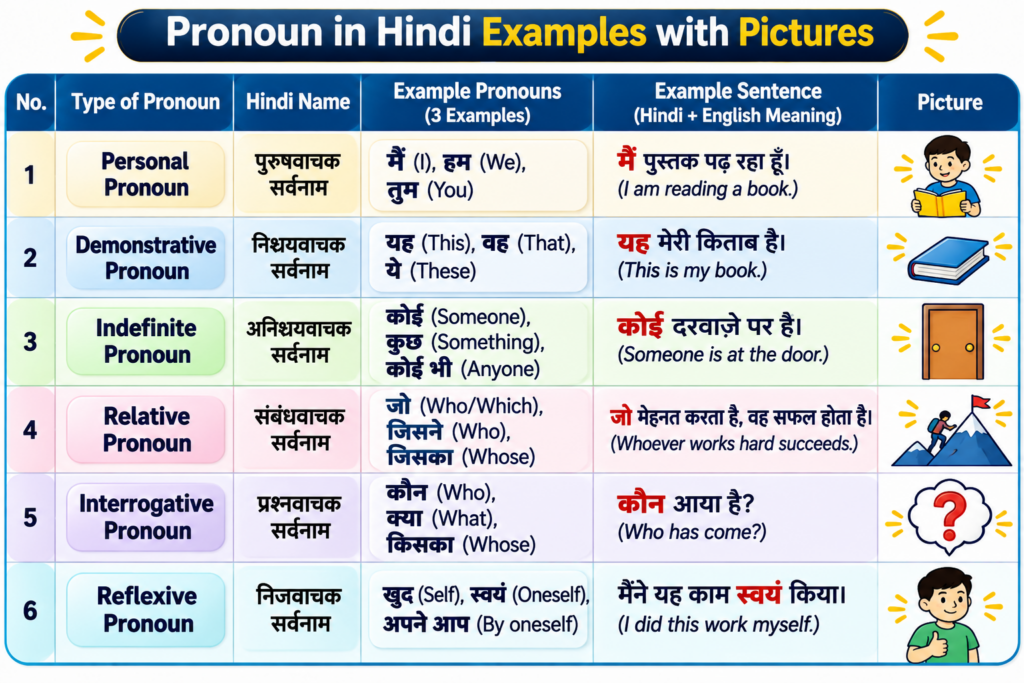
Hindi Pronouns Examples by Type
The following tables provide practical Hindi pronoun forms and phrases with English meanings.
They include subject forms, object forms, possessives, relative constructions, and self-reference expressions.
Personal Pronoun Examples in Hindi
Personal pronouns include first-, second-, and third-person forms.
Their endings and associated words change according to grammatical function.
| No. | Hindi Form or Phrase | English Meaning |
|---|---|---|
| 1 | मैं | I |
| 2 | हम | We |
| 3 | तू | You, intimate |
| 4 | तुम | You, familiar |
| 5 | आप | You, polite |
| 6 | यह | This / He / She |
| 7 | वह | That / He / She |
| 8 | ये | These / They |
| 9 | वे | Those / They |
| 10 | मुझे | Me / To me |
| 11 | हमें | Us / To us |
| 12 | तुझे | You, intimate object |
| 13 | तुम्हें | You, familiar object |
| 14 | आपको | You, polite object |
| 15 | इसे | This person or thing, object |
| 16 | उसे | That person or thing, object |
| 17 | इन्हें | These / Them, object |
| 18 | उन्हें | Those / Them, object |
| 19 | मैंने | I, with ergative marker |
| 20 | हमने | We, with ergative marker |
| 21 | तूने | You, intimate ergative |
| 22 | तुमने | You, familiar ergative |
| 23 | आपने | You, polite ergative |
| 24 | इसने | This person, ergative |
| 25 | उसने | That person, ergative |
| 26 | इन्होंने | These people / Honorific person, ergative |
| 27 | उन्होंने | Those people / Honorific person, ergative |
| 28 | मुझसे | From / With me |
| 29 | तुमसे | From / With you |
| 30 | आपसे | From / With you, polite |
Demonstrative Pronoun Examples in Hindi
Demonstrative pronouns point towards particular people or things.
Their meanings may involve distance, number, grammatical case, or context.
| No. | Hindi Form or Phrase | English Meaning |
|---|---|---|
| 1 | यह | This |
| 2 | ये | These |
| 3 | वह | That |
| 4 | वे | Those |
| 5 | इसे | This one, object |
| 6 | उसे | That one, object |
| 7 | इन्हें | These ones, object |
| 8 | उन्हें | Those ones, object |
| 9 | इसका | Of this one |
| 10 | उसका | Of that one |
| 11 | इनका | Of these |
| 12 | उनका | Of those |
| 13 | इसमें | In this |
| 14 | उसमें | In that |
| 15 | इनमें | In these |
| 16 | उनमें | In those |
| 17 | इससे | From / With this |
| 18 | उससे | From / With that |
| 19 | इनसे | From / With these |
| 20 | उनसे | From / With those |
| 21 | इस पर | On this |
| 22 | उस पर | On that |
| 23 | इन पर | On these |
| 24 | उन पर | On those |
| 25 | इसी को | This very one |
| 26 | उसी को | That very one |
| 27 | यही है | This is the one |
| 28 | वही है | That is the one |
| 29 | ये दोनों | These two |
| 30 | वे सभी | All those |
Indefinite Pronoun Examples in Hindi
Indefinite pronouns refer to people or things whose identity or number is not precisely specified.
Some forms change depending on the sentence and the postposition used.
| No. | Hindi Form or Phrase | English Meaning |
|---|---|---|
| 1 | कोई | Someone / Anyone |
| 2 | कुछ | Something / Some |
| 3 | किसी ने | Someone, as agent |
| 4 | किसी को | To someone |
| 5 | किसी से | From / With someone |
| 6 | किसी का | Someone’s |
| 7 | किसी के लिए | For someone |
| 8 | कोई भी | Anyone / Any one |
| 9 | कुछ भी | Anything |
| 10 | कोई नहीं | Nobody |
| 11 | कुछ नहीं | Nothing |
| 12 | कोई और | Someone else |
| 13 | कुछ और | Something else |
| 14 | हर कोई | Everyone |
| 15 | हर किसी को | To everyone |
| 16 | सब कोई | Everybody |
| 17 | सब कुछ | Everything |
| 18 | कुछ लोग | Some people |
| 19 | कई लोग | Several people |
| 20 | कोई एक | Any one person |
| 21 | दूसरा कोई | Someone else |
| 22 | कुछ न कुछ | Something or other |
| 23 | कोई न कोई | Someone or other |
| 24 | किसी भी व्यक्ति को | To any person |
| 25 | किसी और को | To someone else |
| 26 | कुछ में से | From among some |
| 27 | सबमें से | From among all |
| 28 | कुछ के लिए | For some |
| 29 | किसी के पास | With someone / Someone has |
| 30 | और कोई नहीं | Nobody else |
Some rows contain indefinite pronouns within larger phrases rather than being standalone pronouns. For example, कई functions as a quantifier in कई लोग.
Relative Pronoun Examples in Hindi
Relative pronouns connect information about a person or thing with another part of the sentence.
Hindi frequently uses जो and its forms in relative constructions.
| No. | Hindi Form or Phrase | English Meaning |
|---|---|---|
| 1 | जो | Who / Which / That |
| 2 | जिसने | Who did |
| 3 | जिसको | Whom / To whom |
| 4 | जिसे | Whom / Which |
| 5 | जिससे | From / With whom |
| 6 | जिसका | Whose, masculine possessum |
| 7 | जिसकी | Whose, feminine possessum |
| 8 | जिसके | Whose, plural/oblique possessum |
| 9 | जिसमें | In which |
| 10 | जिस पर | On which |
| 11 | जिसके लिए | For whom / For which |
| 12 | जिसके पास | With whom / Who has |
| 13 | जिन्होंने | Who did, plural/honorific |
| 14 | जिन्हें | Whom, plural/honorific |
| 15 | जिनसे | From / With whom, plural |
| 16 | जिनका | Whose, plural owners |
| 17 | जिनकी | Whose, plural owners |
| 18 | जिनके | Whose, plural owners |
| 19 | जिनमें | Among / In which |
| 20 | जिन पर | On whom / Which |
| 21 | जो भी | Whoever / Whichever |
| 22 | जिसे भी | Whomever |
| 23 | जिसने भी | Whoever did |
| 24 | जिसका भी | Whosever |
| 25 | जिन्हें भी | Whomever, plural |
| 26 | जिसके साथ | With whom |
| 27 | जिसके बिना | Without whom / Which |
| 28 | जिनके साथ | With whom, plural |
| 29 | जिनके बीच | Among whom / Which |
| 30 | जो कुछ | Whatever |
Interrogative Pronoun Examples in Hindi
Interrogative pronouns ask about identity, people, objects, or ownership.
Forms such as कौन, क्या, किसने, and किसका help learners frame questions.
| No. | Hindi Form or Phrase | English Meaning |
|---|---|---|
| 1 | कौन | Who |
| 2 | क्या | What |
| 3 | किसने | Who did |
| 4 | किसको | Whom / To whom |
| 5 | किसे | Whom |
| 6 | किससे | From / With whom |
| 7 | किसका | Whose, masculine |
| 8 | किसकी | Whose, feminine |
| 9 | किसके | Whose, plural/oblique |
| 10 | किसमें | In what / In which |
| 11 | किस पर | On what / On whom |
| 12 | किसके लिए | For whom |
| 13 | किसके पास | Who has / With whom |
| 14 | किन्होंने | Which people did |
| 15 | किन्हें | Whom, plural |
| 16 | किनसे | From / With whom, plural |
| 17 | किनका | Whose, plural |
| 18 | किनकी | Whose, plural |
| 19 | किनके | Whose, plural |
| 20 | किनमें | In which ones |
| 21 | किन पर | On which ones |
| 22 | कौन-कौन | Who all |
| 23 | क्या-क्या | What all |
| 24 | किस-किस ने | Which people did |
| 25 | किस-किस को | To which people |
| 26 | किस-किस से | From / With which people |
| 27 | किसका भी | Whose at all |
| 28 | कौन-सा | Which one, masculine |
| 29 | कौन-सी | Which one, feminine |
| 30 | कौन-से | Which ones / Which one, oblique |
Forms such as कौन-सा can function as interrogative determiners before nouns or pronominally when the noun is understood.
Reflexive Pronoun Examples in Hindi
Reflexive expressions show that the subject refers to itself or performs an action independently.
Hindi uses खुद, स्वयं, अपने आप, and related expressions in this role.
| No. | Hindi Expression | English Meaning |
|---|---|---|
| 1 | खुद | Self / Personally |
| 2 | स्वयं | Oneself |
| 3 | अपने आप | By oneself |
| 4 | अपने आप को | Oneself, object |
| 5 | खुद को | Oneself, object |
| 6 | स्वयं को | Oneself, object |
| 7 | खुद से | By oneself / From oneself |
| 8 | अपने आप से | With oneself / By oneself |
| 9 | स्वयं से | With oneself |
| 10 | मैं खुद | I myself |
| 11 | हम खुद | We ourselves |
| 12 | तू खुद | You yourself, intimate |
| 13 | तुम खुद | You yourself, familiar |
| 14 | आप स्वयं | You yourself, polite |
| 15 | वह खुद | He / She himself/herself |
| 16 | वे स्वयं | They themselves |
| 17 | यह खुद | This person himself/herself |
| 18 | ये खुद | These people themselves |
| 19 | खुद ही | Personally / On one’s own |
| 20 | स्वयं ही | Oneself, emphatic |
| 21 | अपने आप ही | By itself / Automatically |
| 22 | खुद के लिए | For oneself |
| 23 | अपने लिए | For oneself |
| 24 | खुद पर | On oneself |
| 25 | अपने आप पर | On oneself |
| 26 | खुद की मदद | Helping oneself |
| 27 | स्वयं की पहचान | One’s own identity |
| 28 | खुद का काम | One’s own work |
| 29 | अपना निर्णय | One’s own decision |
| 30 | अपनी ज़िम्मेदारी | One’s own responsibility |
अपना, अपनी, and अपने are reflexive possessive forms. They are related to self-reference but are not interchangeable with independent expressions such as स्वयं.
Pronoun in Hindi Sentences with English Meaning
Pronouns make Hindi sentences clearer by replacing repeated nouns and identifying people, objects, or ideas.
The following sentences cover all six pronoun types, with pronouns highlighted in bold and English translations for easy understanding.
| No. | Hindi Sentence | English Translation |
|---|---|---|
| 1 | मैं आज विद्यालय जा रहा हूँ। | I am going to school today. |
| 2 | हम साथ पढ़ते हैं। | We study together. |
| 3 | तुम कहाँ रहते हो? | Where do you live? |
| 4 | आप कैसे हैं? | How are you? |
| 5 | वह किताब पढ़ रही है। | She is reading a book. |
| 6 | यह मेरा बैग है। | This is my bag. |
| 7 | ये मेरी किताबें हैं। | These are my books. |
| 8 | वे मैदान में खेल रहे हैं। | They are playing in the field. |
| 9 | मुझे मदद चाहिए। | I need help. |
| 10 | हमें समय चाहिए। | We need time. |
| 11 | आपको क्या पसंद है? | What do you like? |
| 12 | उसे घर जाना है। | He or she needs to go home. |
| 13 | इन्हें अंदर रख दो। | Put these inside. |
| 14 | उनसे बात करो। | Talk to them. |
| 15 | यह बहुत उपयोगी है। | This is very useful. |
| 16 | वह मेरा नहीं है। | That is not mine. |
| 17 | ये नए हैं। | These are new. |
| 18 | वे पुराने हैं। | Those are old. |
| 19 | कोई दरवाज़े पर है। | Someone is at the door. |
| 20 | कुछ मेज़ पर रखा है। | Something is on the table. |
| 21 | किसी ने घंटी बजाई। | Someone rang the bell. |
| 22 | यहाँ कोई नहीं है। | There is nobody here. |
| 23 | सब कुछ ठीक है। | Everything is fine. |
| 24 | कोई भी आ सकता है। | Anyone can come. |
| 25 | जो मेहनत करेगा, वह सफल होगा। | Whoever works hard will succeed. |
| 26 | जिसने यह लिखा, वह अच्छा लेखक है। | Whoever wrote this is a good writer. |
| 27 | जिसका बैग खो गया है, वह यहाँ आए। | Whoever lost their bag should come here. |
| 28 | जिसे मदद चाहिए, वह पूछ सकता है। | Whoever needs help may ask. |
| 29 | जो तुमने कहा, वह सही है। | What you said is correct. |
| 30 | जो कुछ चाहिए, बता दो। | Tell me whatever you need. |
| 31 | कौन आया है? | Who has come? |
| 32 | क्या हुआ? | What happened? |
| 33 | किसने किताब उठाई? | Who picked up the book? |
| 34 | किसकी चाबी यहाँ है? | Whose key is here? |
| 35 | कौन-सा तुम्हारा है? | Which one is yours? |
| 36 | मैंने यह काम स्वयं किया। | I did this work myself. |
| 37 | उसने खुद को संभाला। | He or she composed themselves. |
| 38 | बच्चा अपने आप चलने लगा। | The child started walking on their own. |
| 39 | हमें अपना काम खुद करना चाहिए। | We should do our own work ourselves. |
| 40 | आप स्वयं निर्णय ले सकते हैं। | You can make the decision yourself. |
Grammar Tip: Some Hindi pronouns change their form according to their grammatical role.
For example, मैं becomes मुझे in certain object constructions, while वह changes to उसे, उसने, or उससे depending on the sentence.
Common Mistakes with Pronouns in Hindi
Hindi pronoun mistakes often involve formality, oblique forms, gender agreement, and confusion between demonstrative and interrogative expressions.
The following table compares common errors with corrected usage.
| Common Mistake | Incorrect | Correct / Explanation |
|---|---|---|
| Using intimate address in a formal setting | तू कहाँ है? | Prefer आप कहाँ हैं? when respectful address is appropriate. |
| Incorrect agreement with आप | आप आता है। | आप आते हैं। |
| Incorrect familiar verb ending | तुम जाते हैं। | तुम जाते हो। in ordinary familiar usage. |
| Mixing first-person verb endings | मैं पढ़ता है। | मैं पढ़ता हूँ। |
| Using an incorrect object form | मैंको बुलाओ। | मुझे बुलाओ। |
| Incorrect oblique construction | वह से बात करो। | उससे बात करो। |
| Wrong plural object form | वे को बुलाओ। | उन्हें बुलाओ। |
| Treating वह as always masculine | वह means only he. | It can refer to he, she, it, or that, depending on context. |
| Confusing possession with object forms | उसे किताब for his book | उसकी किताब |
| Confusing pronoun with question adverb | Calling कहाँ an interrogative pronoun in every sentence | कहाँ typically functions as an interrogative adverb; कौन and क्या are common interrogative pronouns. |
Pronoun in Hindi Worksheet
Practice recognizing all six pronoun types, choosing correct Hindi forms, completing sentences, and identifying pronouns by meaning.
This Hindi pronouns worksheet also covers formality, possession, and object forms through interactive exercises.
Download Pronoun in Hindi Worksheet PDF
Use the printable worksheet to revise personal, demonstrative, indefinite, relative, interrogative, and reflexive pronouns.
It includes multiple-choice practice and an answer key to help learners check their understanding independently.
Download Pronoun in Hindi PDF Study Notes
Keep the six pronoun types, important grammar rules, Hindi meanings, and example sentences together in one reference document.
The notes are designed for offline revision, classroom use, and quick review before grammar exercises.
Frequently Asked Questions
Can the same Hindi pronoun belong to two types?
Yes. यह and वह can function as personal or demonstrative pronouns depending on how they are used.
Does Hindi have separate pronouns for he and she?
Not in the same way as English. वह can refer to either, while verb agreement and context often indicate gender.
Is अपना a personal pronoun?
अपना is generally a reflexive possessive form. It refers back to an appropriate subject or antecedent and changes according to the noun it modifies.
Can आप refer to more than one person?
Yes. आप can address one person respectfully or several people. It uses honorific or plural-style verb agreement.
Conclusion
A sentence becomes easier to follow when its pronouns are chosen carefully. मैं identifies the speaker, आप shows respectful address, कौन asks about identity, and स्वयं adds self-reference.
For a quick challenge, write one sentence using कोई, another using जो, and a third using अपने आप.
Then check whether each pronoun matches its intended meaning. Share your sentences in the comments.
Leave a Reply