A child who can already read three-letter Hindi words often feels a real sense of progress when longer words start making sense. Suddenly, everyday things like अदरक, बरतन, and शरबत are no longer confusing clusters of letters. They become familiar, readable words that connect directly with the world around the learner.
Hindi four letter words help children move from very short word patterns to more developed reading practice. Words such as उपवन, अदरक, बरगद, and कसरत are useful because they feel meaningful, practical, and easy to remember. They also help both English and Hindi readers connect sound, spelling, and meaning more naturally.
In this lesson, you will learn Hindi four letter words, their English meanings, picture-based vocabulary ideas, sentence examples, and worksheet practice. You will also find a section on hindi 4 letter words with pictures, common mistakes, and simple activities that make reading and vocabulary practice easier for beginners.
Hindi Four Letter Words with English Meaning
This section groups useful vocabulary by theme so learners can remember meanings more easily.
Everyday Objects, Places, and Nature
These are practical four-letter words learners may connect with daily life, school, food, and the environment.
| Hindi Word | Pronunciation | English Meaning |
|---|---|---|
| अदरक | Adarak | Ginger |
| बरगद | Bargad | Banyan tree |
| उपवन | Upvan | Garden |
| शलगम | Shalgam | Turnip |
| कटहल | Kathal | Jackfruit |
| बरतन | Bartan | Utensils |
| थरमस | Tharmas | Thermos |
| शरबत | Sharbat | Sweet drink |
| उबटन | Ubtan | Herbal paste |
| पनघट | Panghat | Waterside steps |
| दमकल | Damkal | Fire engine |
| मखमल | Makhmal | Velvet |
Hindi Four Letter Words Without Matra
This section gives a practical list of commonly used four-letter Hindi words that do not use dependent vowel signs.
A matra, or मात्रा, is a dependent vowel sign such as ा, ि, ी, ु, ू, े, or ो. In this section, the focus is on words formed without those dependent signs.
Many four-letter words are still beginner-friendly even though they are longer than two-letter or three-letter words. They help learners improve recognition, reading flow, and spelling confidence.
| No. | Hindi Word | Pronunciation | English Meaning |
|---|---|---|---|
| 1 | अदरक | Adarak | Ginger |
| 2 | बरगद | Bargad | Banyan tree |
| 3 | शरबत | Sharbat | Sweet drink |
| 4 | कसरत | Kasrat | Exercise |
| 5 | उपवन | Upvan | Garden |
| 6 | करवत | Karvat | Side turn |
| 7 | उबटन | Ubtan | Herbal paste |
| 8 | उठकर | Uthkar | After getting up |
| 9 | जखम | Jakham | Wound |
| 10 | नरवन | Narvan | Forest-like place, uncommon/literary |
| 11 | जलचर | Jalchar | Aquatic creature |
| 12 | खटमल | Khatmal | Bedbug |
| 13 | अफसर | Afsar | Officer |
| 14 | पलटन | Paltan | Platoon / troop |
| 15 | बचपन | Bachpan | Childhood |
| 16 | धड़कन | Dhadkan | Heartbeat |
| 17 | उलझन | Uljhan | Confusion |
| 18 | सरकस | Sarkas | Circus |
| 19 | थरमस | Tharmas | Thermos |
| 20 | बरतन | Bartan | Utensils |
| 21 | शलगम | Shalgam | Turnip |
| 22 | कटहल | Kathal | Jackfruit |
| 23 | दमकल | Damkal | Fire engine |
| 24 | अजगर | Ajgar | Python |
| 25 | झरझर | Jharjhar | Falling continuously |
| 26 | टपटप | Taptap | Dripping sound |
| 27 | झनझन | Jhanjhan | Jingling sound |
| 28 | भनभन | Bhanbhan | Buzzing sound |
| 29 | चमचम | Chamcham | Shining brightly |
| 30 | गरगर | Gargar | Gargling sound |
| 31 | सनसन | Sansan | Whizzing sound |
| 32 | झटपट | Jhatpat | Quickly |
| 33 | फलवन | Phalvan | Fruit garden, rare/literary |
| 34 | धरधर | Dharadhar | Streaming continuously |
| 35 | हलचल | Halchal | Movement / activity |
| 36 | दहशत | Dahshat | Fear / terror |
| 37 | अलबम | Alabam | Album |
| 38 | मखमल | Makhmal | Velvet |
| 39 | मतलब | Matlab | Meaning |
| 40 | करकमल | Karkamal | Lotus-like hands, literary |
| 41 | जनमत | Janmat | Public opinion |
| 42 | पनघट | Panghat | Waterside steps |
| 43 | चरभर | Charbhar | Full of movement, rare |
| 44 | अनपढ़ | Anpadh | Illiterate |
| 45 | अकबर | Akbar | Proper name |
| 46 | अमरक | Amarak | Rare/literary form |
| 47 | जगमग | Jagmag | Sparkling |
| 48 | खटरपटर | Khatarpatar | Clattering noise |
| 49 | गपशप | Gapshap | Casual talk |
| 50 | रसभर | Rasbhar | Full of juice |
| 51 | कमकर | Kamkar | Worker, uncommon form |
| 52 | फसलकट | Fasal-kat, nonstandard compound | Harvest cutting |
| 53 | धनपत | Dhanpat | Proper name |
| 54 | रजतक | Rajatak | Silvery, uncommon |
| 55 | जनगण | Jangan | People / public |
| 56 | पथकर | Pathkar | Road tax |
| 57 | सरपत | Sarpat | Reed grass |
| 58 | झटकल | Jhatkal | Sudden jerk |
| 59 | दबदब | Dabadab | Dominance / pressure-like effect |
| 60 | बलवन | Balvan | Strong, variant of बलवान |
| 61 | घनघन | Ghanghan | Loud ringing |
| 62 | टनटन | Tantan | Metallic ringing |
| 63 | भभक | Bhabhak | Sudden flame burst |
| 64 | धमधम | Dhamdham | Heavy thumping |
| 65 | सरपट | Sarpat | Very fast |
| 66 | गड़बड़ | Gadbad | Mess / confusion |
| 67 | तड़तड़ | Tadtad | Crackling sound |
| 68 | चरमर | Charmar | Creaking sound |
| 69 | घरघर | Gharghar | Rumbling / wheezing |
| 70 | धकधक | Dhakdhak | Fast heartbeat |
| 71 | कसमस | Kasmas | Restless movement |
| 72 | थपथप | Thapthap | Patting sound |
| 73 | झमझम | Jhamjham | Heavy rain sound |
| 74 | दनदन | Dandan | Rushing forcefully |
| 75 | खलबल | Khalbal | Disturbance |
| 76 | उज्ज्वल | Ujjval | Bright |
| 77 | वचनबद्ध | Vachanbaddh | Bound by promise |
| 78 | मनभर | Manbhar | To one’s fill |
| 79 | निडरपन | Nidarapan | Fearlessness |
| 80 | दमभर | Dambhar | For a moment |
| 81 | समझद | Samajhd, incomplete/avoid in teaching | |
| 82 | बरबस | Barbas | Forcefully / involuntarily |
| 83 | अथकपन | Athakpan | Tirelessness |
| 84 | उलटफेर | Ulatpher | Reversal |
| 85 | धनबल | Dhanbal | Financial strength |
| 86 | जनबल | Janbal | Manpower |
| 87 | मतभेद | Matbhed | Difference of opinion |
| 88 | धर्मपथ | Dharmapath | Path of duty |
| 89 | रंगमंच | Rangmanch | Stage |
| 90 | लघुपथ | Laghupath | Short route |
| 91 | कमतर | Kamtar | Lesser |
| 92 | समतल | Samatal | Flat / level |
| 93 | वटवृक्ष | Vatvriksh | Banyan tree |
| 94 | झगमग | Jhagmag | Glittering |
| 95 | बरबस | Barbas | Against one’s will |
| 96 | धनगर | Dhangar | Shepherd community name |
| 97 | मजबूत | Majboot | Strong |
| 98 | असरदार | Asardar | Effective |
| 99 | धनधान्य | Dhandhaanya | Wealth and grain |
| 100 | उपक्रम | Upakram | Beginning / initiative |
Important note: some four-letter examples commonly found in beginner charts are literary, regional, sound-based, borrowed, or less frequent in daily speech.
That is normal in early Hindi vocabulary lists. Teachers can first focus on the most useful everyday words such as अदरक, बरगद, उपवन, बरतन, कटहल, शलगम, अफसर, and बचपन.
Children remember words better when they can link them to something visible or familiar. For example, show real अदरक in the kitchen, a picture of a बरगद tree, or a थरमस bottle from home.
Animals, People, and Living Things
This group helps learners connect four-letter words with people, roles, and living creatures.
| Hindi Word | Pronunciation | English Meaning |
|---|---|---|
| अजगर | Ajgar | Python |
| खटमल | Khatmal | Bedbug |
| जलचर | Jalchar | Aquatic creature |
| अफसर | Afsar | Officer |
| पलटन | Paltan | Platoon / group |
| जनगण | Jangan | Public / the people |
| धनगर | Dhangar | A shepherd community name |
| करकमल | Karkamal | Lotus-like hands, literary phrase |
A word does not need to be used every day to be worth learning. Some words are useful because they appear in textbooks, poems, stories, or general knowledge lists.
Actions, States, and Ideas
These four-letter words help learners express actions, conditions, sounds, and abstract ideas.
| Hindi Word | Pronunciation | English Meaning |
|---|---|---|
| कसरत | Kasrat | Exercise |
| बचपन | Bachpan | Childhood |
| उलझन | Uljhan | Confusion |
| धड़कन | Dhadkan | Heartbeat |
| हलचल | Halchal | Movement |
| दहशत | Dahshat | Fear |
| मतलब | Matlab | Meaning |
| जनमत | Janmat | Public opinion |
| गड़बड़ | Gadbad | Confusion / disorder |
| समतल | Samatal | Flat / level |
| उपक्रम | Upakram | Beginning / initiative |
| मतभेद | Matbhed | Difference of opinion |
Words like उलझन, धड़कन, हलचल, and गड़बड़ are especially useful because children hear similar ideas in daily conversation.
Hindi 4 Letter Words with Pictures
This section is especially useful for young learners who remember vocabulary better through images.
A picture chart works best when it includes familiar and concrete words.
For this topic, the most effective picture-based set would include words such as अदरक, बरगद, उपवन, शलगम, कटहल, बरतन, थरमस, शरबत, अजगर, खटमल, दमकल, and कसरत.
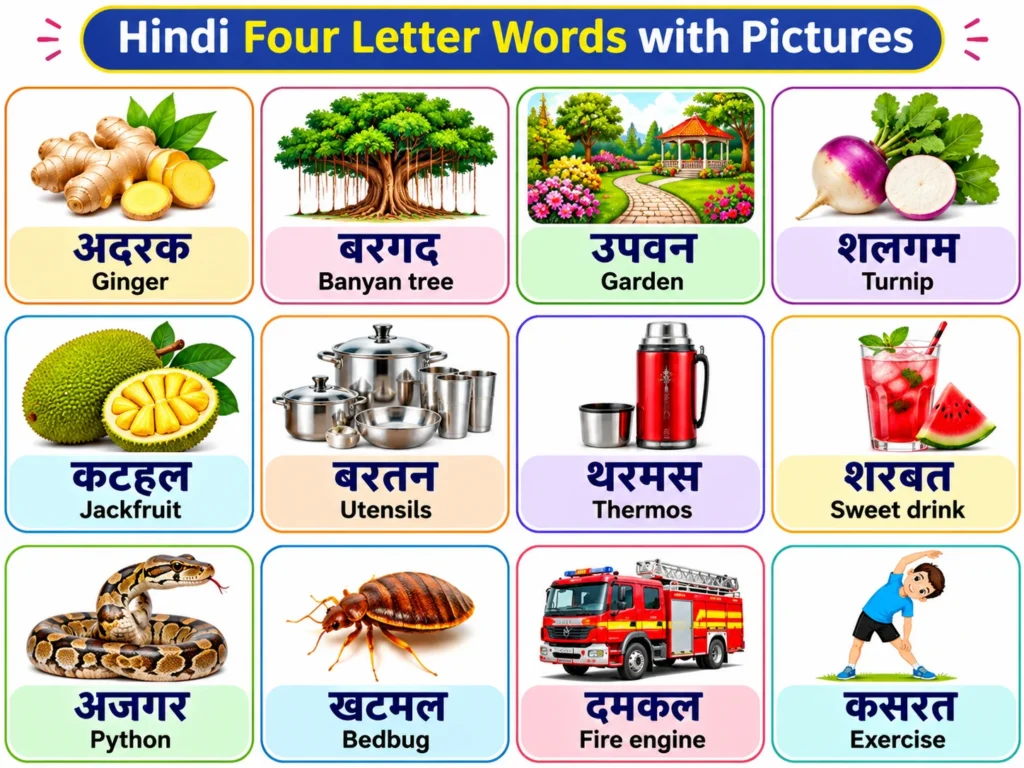
Here is how picture learning becomes more effective:
- Show the picture first.
- Ask the learner to name or guess the object.
- Reveal the Hindi word.
- Read the word slowly, letter by letter.
- Then read the whole word aloud.
For example:
अ + द + र + क = अदरक
English Meaning: Ginger
उ + प + व + न = उपवन
English Meaning: Garden
क + स + र + त = कसरत
English Meaning: Exercise
Picture-based learning helps children connect spelling, sound, and meaning at the same time.
How to Form Hindi Four Letter Words
This section shows how four Hindi letters come together to form meaningful words.
Practical Letter Combinations
Use these combinations for step-by-step reading practice.
| Letter Combination | Formed Word | English Meaning |
|---|---|---|
| अ + द + र + क | अदरक | Ginger |
| ब + र + ग + द | बरगद | Banyan tree |
| श + र + ब + त | शरबत | Sweet drink |
| क + स + र + त | कसरत | Exercise |
| उ + प + व + न | उपवन | Garden |
| ब + र + त + न | बरतन | Utensils |
| थ + र + म + स | थरमस | Thermos |
| श + ल + ग + म | शलगम | Turnip |
| क + ट + ह + ल | कटहल | Jackfruit |
| अ + फ + स + र | अफसर | Officer |
| ज + ल + च + र | जलचर | Aquatic creature |
| प + ल + ट + न | पलटन | Platoon |
| ब + च + प + न | बचपन | Childhood |
| उ + ल + झ + न | उलझन | Confusion |
| ध + ड़ + क + न | धड़कन | Heartbeat |
The order of Hindi letters matters. If the letters are rearranged, the word may change completely or stop making sense.
Hindi Four Letter Words in Simple Sentences
This section helps learners see how these words are used in natural Hindi sentences.
| No. | Hindi Sentence | English Meaning |
|---|---|---|
| 1 | मेरे पास थरमस है। | I have a thermos. |
| 2 | माँ ने चाय में अदरक डाली। | Mother added ginger to the tea. |
| 3 | गाँव में पुराना बरगद है। | There is an old banyan tree in the village. |
| 4 | हम सुबह कसरत करते हैं। | We do exercise in the morning. |
| 5 | यह सुंदर उपवन है। | This is a beautiful garden. |
| 6 | रसोई में बहुत से बरतन हैं। | There are many utensils in the kitchen. |
| 7 | गर्मी में ठंडा शरबत अच्छा लगता है। | Sweet drink feels nice in summer. |
| 8 | किसान ने खेत से शलगम निकाला। | The farmer pulled a turnip from the field. |
| 9 | पेड़ के नीचे खटमल नहीं, चींटियाँ थीं। | There were ants under the tree, not bedbugs. |
| 10 | चिड़ियाघर में हमने अजगर देखा। | We saw a python in the zoo. |
| 11 | बच्चों का बचपन बहुत प्यारा होता है। | Childhood is very lovely. |
| 12 | उसके मन में बहुत उलझन थी। | There was a lot of confusion in his mind. |
| 13 | तेज दौड़ने से मेरी धड़कन बढ़ गई। | My heartbeat increased after running fast. |
| 14 | सड़क पर अचानक हलचल मच गई। | There was sudden commotion on the road. |
| 15 | इस शब्द का मतलब क्या है? | What is the meaning of this word? |
| 16 | विद्यालय में मुख्य अफसर आए। | The main officer came to the school. |
| 17 | तालाब में अनेक जलचर रहते हैं। | Many aquatic creatures live in the pond. |
| 18 | सैनिकों की एक पलटन आगे बढ़ी। | A platoon of soldiers moved forward. |
| 19 | आग लगने पर दमकल आई। | The fire engine arrived when the fire broke out. |
| 20 | सभा में अलग-अलग जनमत सुनाई दिए। | Different public opinions were heard in the meeting. |
Simple sentences make vocabulary more useful than isolated word lists. A learner who reads a word in a sentence understands not only its meaning but also its natural usage.
Common Mistakes When Learning Four Letter Hindi Words
This section highlights the mistakes learners often make when reading or memorizing longer Hindi words.
Confusing Written Length with Spoken Length
A learner may think a word is long or difficult just because it has four letters. That is not always true.
For example, अदरक and उपवन are four-letter words, but they are easier than some shorter words with unusual sounds.
Word length and word difficulty are not the same thing.
Ignoring the Exact Order of Letters
Learners sometimes recognise the letters but forget their correct order.
For example:
- अ + द + र + क = अदरक
- उ + प + व + न = उपवन
- ब + र + त + न = बरतन
If the letter order changes, the meaning changes or the word becomes incorrect.
Mixing Common and Rare Vocabulary Without Priority
Some lists contain both everyday and literary words. That is fine, but beginners should first learn the most practical ones.
Start with:
अदरक, बरगद, शरबत, कसरत, उपवन, बरतन, थरमस, शलगम, कटहल, बचपन
Then gradually move to less common or more formal words such as जनमत, जलचर, and करकमल.
Forgetting the Meaning After Memorizing the Spelling
Some students can read a word but do not remember what it means. That weakens real vocabulary development.
To avoid this, always learn:
- spelling
- pronunciation
- English meaning
- one simple sentence
- one picture if possible
A word becomes easier to remember when spelling, meaning, and usage are learned together.
Hindi Four Letter Words Worksheet
This section gives practice tasks for reading, word formation, and meaning recognition.
Hindi Four Letter Words Worksheet
Complete all 20 questions. Translation answers are for self-checking.
Worksheet 1: Join the Letters
Worksheet 2: Match the Words with Their Meanings
Worksheet 3: Fill in the Missing Letters
Worksheet 4: Translate into English
Four Letter Words Worksheet In Hindi Pdf
Lets download the Hindi four letter words worksheet pdf and practice in offline.
Frequently Asked Questions
This section answers a few important questions that were not discussed directly in the main sections above.
Are all four-letter Hindi words suitable for beginners?
No. Some four-letter words are much easier than others. Beginners should first learn clear, common words such as अदरक, उपवन, कसरत, and बरतन before moving to literary or less common vocabulary.
Why do many four-letter Hindi word lists include uncommon words?
School charts and basic reading lists often try to show different letter combinations, sound patterns, and vocabulary types.
That is why such lists may include literary, formal, or less common words along with everyday ones.
Is it better to teach four-letter Hindi words through pictures or spelling drills?
For young learners, pictures usually work better at the beginning. After recognition becomes easy, spelling drills and sentence practice help strengthen reading and writing.
Conclusion
Reading Hindi does not always have to involve a textbook. The next time you enter the kitchen, look for अदरक, बरतन, and थरमस. On your way to school or work, you might notice a बरगद or an उपवन. These everyday encounters can become small vocabulary lessons.
Try keeping a notebook titled चार अक्षर वाले शब्द and adding five new words whenever you discover them. Write their English meanings and create your own sentences.
How many four-letter Hindi words can you find around you today? Share your discoveries in the comments. Someone else might learn a new word from your list.
For extra practice, try these:
- अ + द + र + क = ?
- Which word means garden: उपवन or बरतन?
- Which word means exercise: कसरत or शरबत?
Give your answer in the comment.
Leave a Reply