Three small words can turn an ordinary morning into a Hindi reading lesson. A child sees a house, turns on a tap, and picks up a cup. Each of these familiar objects has a simple two-letter Hindi name.
For a child who has just learned the Hindi alphabet (हिंदी वर्णमाला), recognizing these small words like – A house is घर, a tap is नल, and a cup is कप, can be the first exciting experience of reading independently.
Hindi two letter words (दो अक्षर वाले शब्द) introduce learners to meaningful vocabulary through simple letter combinations. Words such as जल (water), फल (fruit), and वन (forest) are particularly easy to learn because they contain no dependent vowel signs (मात्राएँ). They also help English-speaking beginners connect Hindi spellings with familiar meanings.
This lesson brings together Hindi 2 letter words with English meanings, pronunciation, colourful pictures, and practical sentences.
Interactive worksheets and downloadable PDF resources make it easier for children, parents, and teachers to practise Hindi reading, spelling, and vocabulary both online and offline.
Lets See Some Two Letter Words in Hindi – At A Glance
A word formed by joining two Hindi अक्षर is commonly known as a two-letter Hindi word (दो अक्षर वाले शब्द).
Hindi Definition: दो अक्षरों के मेल से बनने वाले सार्थक शब्दों को दो अक्षर वाले शब्द कहते हैं।
For example:
| First Letter | Second Letter | Hindi Word | English Meaning |
|---|---|---|---|
| ज | ल | जल | Water |
| फ | ल | फल | Fruit |
| घ | र | घर | House |
| न | ल | नल | Tap |
| व | न | वन | Forest |
| म | न | मन | Mind |
| ब | स | बस | Bus |
| क | प | कप | Cup |
| ध | न | धन | Wealth |
| र | स | रस | Juice |
The individual letters ज and ल represent sounds. When joined, they form जल, a meaningful word referring to water.
Hindi two-letter words are commonly introduced after students learn the Hindi alphabet (हिंदी वर्णमाला). They provide a connection between letter recognition and independent reading.
In beginner Hindi lessons, the term “two-letter words” generally refers to two written अक्षर rather than two English alphabet letters.
For example, घर contains two Hindi अक्षर, although its Roman pronunciation, Ghar, contains four English letters.
Hindi 2 Letter Words Without Matra
Words without matras are particularly useful for beginners because children can read them without learning additional vowel symbols.
A matra (मात्रा) is a dependent vowel sign attached to a consonant to change its vowel sound. For example, ा, ि, ी, ु, and ू are Hindi matras.
Words such as घर, फल, जल, and नल do not contain any of these written vowel signs.
Hindi Definition: जिन शब्दों में किसी भी मात्रा का प्रयोग नहीं होता, उन्हें बिना मात्रा वाले शब्द कहते हैं।
The following table contains 100 Hindi 2 letter words without matra, along with their pronunciation and English meanings.
| No. | Hindi Word | Pronunciation | English Meaning |
|---|---|---|---|
| 1 | घर | Ghar | House |
| 2 | जल | Jal | Water |
| 3 | फल | Phal | Fruit |
| 4 | नल | Nal | Tap |
| 5 | बस | Bas | Bus |
| 6 | कप | Kap | Cup |
| 7 | छत | Chhat | Roof |
| 8 | टब | Tab | Tub |
| 9 | जग | Jag | World / Jug |
| 10 | खत | Khat | Letter |
| 11 | रथ | Rath | Chariot |
| 12 | हल | Hal | Plough / Solution |
| 13 | वन | Van | Forest |
| 14 | रस | Ras | Juice / Essence |
| 15 | नभ | Nabh | Sky |
| 16 | थल | Thal | Land |
| 17 | गज | Gaj | Elephant / Yard |
| 18 | खग | Khag | Bird |
| 19 | मन | Man | Mind |
| 20 | धन | Dhan | Wealth |
| 21 | डर | Dar | Fear |
| 22 | सच | Sach | Truth |
| 23 | दस | Das | Ten |
| 24 | एक | Ek | One |
| 25 | हम | Ham | We |
| 26 | अब | Ab | Now |
| 27 | सब | Sab | All |
| 28 | कल | Kal | Yesterday / Tomorrow |
| 29 | आज | Aaj | Today |
| 30 | कब | Kab | When |
| 31 | तब | Tab | Then |
| 32 | जब | Jab | When |
| 33 | तक | Tak | Until / Up to |
| 34 | पर | Par | On / But |
| 35 | मत | Mat | Do not / Opinion |
| 36 | नर | Nar | Man / Male |
| 37 | पथ | Path | Path |
| 38 | जन | Jan | Person / People |
| 39 | तन | Tan | Body |
| 40 | पल | Pal | Moment |
| 41 | दल | Dal | Group / Team |
| 42 | बल | Bal | Strength |
| 43 | कम | Kam | Less |
| 44 | दम | Dam | Breath / Strength |
| 45 | भर | Bhar | Fill |
| 46 | फीका नहीं: खट | Khat | Knocking sound |
| 47 | चल | Chal | Walk / Move |
| 48 | रख | Rakh | Keep |
| 49 | पढ़ | Padh | Read / Study |
| 50 | लिख | Likh | Write |
| 51 | कर | Kar | Do |
| 52 | उठ | Uth | Get up |
| 53 | रुक नहीं: थम | Tham | Stop |
| 54 | हट | Hat | Move aside |
| 55 | बच | Bach | Escape / Be saved |
| 56 | बन | Ban | Become |
| 57 | मर | Mar | Die |
| 58 | कट | Kat | Be cut |
| 59 | चख | Chakh | Taste |
| 60 | चढ़ | Chadh | Climb |
| 61 | जग | Jag | Wake up |
| 62 | जम | Jam | Set / Freeze |
| 63 | पक | Pak | Ripen / Get cooked |
| 64 | बह | Bah | Flow |
| 65 | सह | Sah | Endure |
| 66 | कह | Kah | Say |
| 67 | रह | Rah | Stay |
| 68 | लड़ | Lad | Fight |
| 69 | बढ़ | Badh | Grow / Increase |
| 70 | गढ़ | Gadh | Fort / Construct |
| 71 | घट | Ghat | Pot / Decrease |
| 72 | तट | Tat | Bank / Shore |
| 73 | पट | Pat | Panel / Cloth |
| 74 | वट | Vat | Banyan tree |
| 75 | फन | Phan | Snake’s hood |
| 76 | खट | Khat | Knocking sound |
| 77 | झट | Jhat | Quickly |
| 78 | चट | Chat | In an instant |
| 79 | थप | Thap | Patting sound |
| 80 | लट | Lat | Lock of hair |
| 81 | दग नहीं: दह | Dah | Burning |
| 82 | नथ | Nath | Nose ring |
| 83 | नस | Nas | Vein / Nerve |
| 84 | मल | Mal | Dirt / Waste |
| 85 | जड़ | Jad | Root |
| 86 | कण | Kan | Particle |
| 87 | ऋण | Rin | Debt |
| 88 | पद | Pad | Position / Post |
| 89 | रज | Raj | Dust |
| 90 | यश | Yash | Fame |
| 91 | हक | Hak | Right |
| 92 | तह | Tah | Layer / Fold |
| 93 | लय | Lay | Rhythm / Pace |
| 94 | जय | Jay | Victory |
| 95 | भय | Bhay | Fear |
| 96 | तप | Tap | Heat / Austerity |
| 97 | जप | Jap | Recitation |
| 98 | ओस | Os | Dew |
| 99 | आम | Aam | Mango / Common |
| 100 | ईख | Eekh | Sugarcane |
Notice that words such as आम, एक, ईख, आज, and ओस contain independent vowel letters (स्वर), not dependent matras. They can therefore appear in a beginner’s list of two-letter words without matras.
However, some words in the table, such as लिख, contain a matra and belong in the next stage of learning rather than a strictly matra-free vocabulary exercise.
Hindi Two Letter Words with English Meaning – By Categories
Learning words in familiar categories helps students associate Hindi spellings with their English equivalents and remember them more easily.
Everyday Objects and Places
These words represent objects and places that children may encounter at home, school, or outdoors.
| Hindi Word | Pronunciation | English Meaning |
|---|---|---|
| घर | Ghar | House |
| नल | Nal | Tap |
| बस | Bas | Bus |
| कप | Kap | Cup |
| टब | Tab | Tub |
| छत | Chhat | Roof |
| रथ | Rath | Chariot |
| हल | Hal | Plough |
| खत | Khat | Letter |
| जग | Jag | Jug |
| गम | Gam | Sorrow |
| घट | Ghat | Pot |
| गढ़ | Gadh | Fort |
| पथ | Path | Path |
| तट | Tat | Shore |
A useful classroom activity is to point to an actual object and ask students to name it in both languages. Show them a cup and pronounce कप. Then ask them to identify the letters क and प.
This method makes vocabulary learning more meaningful than repeatedly copying words from a textbook.
Nature and Food
Nature-related vocabulary introduces children to familiar fruits, plants, animals, and natural elements.
| Hindi Word | Pronunciation | English Meaning |
|---|---|---|
| जल | Jal | Water |
| फल | Phal | Fruit |
| वन | Van | Forest |
| रस | Ras | Juice |
| नभ | Nabh | Sky |
| थल | Thal | Land |
| आम | Aam | Mango |
| ईख | Eekh | Sugarcane |
| गज | Gaj | Elephant |
| खग | Khag | Bird |
| वट | Vat | Banyan tree |
| ओस | Os | Dew |
| जड़ | Jad | Root |
| तट | Tat | Riverbank / Shore |
Some of these words, especially खग, गज, and नभ, are more common in literary Hindi and educational texts than in ordinary conversation.
For instance, पक्षी is a more familiar everyday word for bird, while खग is a shorter literary equivalent. Similarly, हाथी is the usual conversational word for elephant, whereas गज is frequently encountered in traditional vocabulary.
Both forms are worth recognising, but children should also learn which words people commonly use in conversation.
Feelings and Abstract Concepts
These words describe emotions, thoughts, qualities, and ideas rather than physical objects.
| Hindi Word | Pronunciation | English Meaning |
|---|---|---|
| मन | Man | Mind |
| धन | Dhan | Wealth |
| डर | Dar | Fear |
| सच | Sach | Truth |
| बल | Bal | Strength |
| दम | Dam | Breath / Stamina |
| भय | Bhay | Fear |
| गम | Gam | Sorrow |
| यश | Yash | Fame |
| जय | Jay | Victory |
| हक | Hak | Right |
| ऋण | Rin | Debt |
| मत | Mat | Opinion |
| पल | Pal | Moment |
Unlike words such as कप and घर, feelings and abstract concepts cannot always be explained through a single object.
Teachers can introduce डर through a short story about a child who feels afraid during a thunderstorm. Similarly, सच can be explained through a situation in which a student answers a question truthfully.
Numbers, Pronouns, and Common Expressions
These short words help beginners move from individual vocabulary items to complete Hindi sentences.
| Hindi Word | Pronunciation | English Meaning |
|---|---|---|
| एक | Ek | One |
| दस | Das | Ten |
| हम | Ham | We |
| सब | Sab | All |
| अब | Ab | Now |
| कब | Kab | When |
| तब | Tab | Then |
| जब | Jab | When |
| कल | Kal | Yesterday / Tomorrow |
| आज | Aaj | Today |
| तक | Tak | Until |
| पर | Par | On / But |
| कम | Kam | Less |
| मत | Mat | Do not |
| यह | Yah | This |
| वह | Vah | That |
| इस | Is | This, oblique form |
| उस | Us | That, oblique form |
Words such as हम, यह, and वह are examples of pronouns (सर्वनाम). They help speakers refer to people and objects without repeatedly mentioning their names.
Time-related words such as अब, आज, and कल help children explain when something happens.
The word कल is especially interesting because its English meaning depends on the sentence.
English: I went to school yesterday.
Hindi: मैं कल स्कूल गया था।
English: I will go to school tomorrow.
Hindi: मैं कल स्कूल जाऊँगा।
In both sentences, the Hindi word कल remains unchanged. The verb and tense help readers decide whether it means yesterday or tomorrow.
Action Words in Hindi
Short action words introduce students to verbs and help them follow simple instructions.
A verb (क्रिया) is a word that expresses an action, occurrence, or state.
| Hindi Word | Pronunciation | English Meaning |
|---|---|---|
| चल | Chal | Walk / Move |
| कर | Kar | Do |
| पढ़ | Padh | Read / Study |
| उठ | Uth | Get up |
| रख | Rakh | Keep |
| भर | Bhar | Fill |
| हट | Hat | Move aside |
| चख | Chakh | Taste |
| बन | Ban | Become |
| बह | Bah | Flow |
| कह | Kah | Say |
| रह | Rah | Stay |
| सह | Sah | Endure |
| बढ़ | Badh | Grow |
| चढ़ | Chadh | Climb |
| पकड़ नहीं: थम | Tham | Stop |
| बच | Bach | Escape |
| जम | Jam | Freeze / Set |
| पक | Pak | Ripen |
| कट | Kat | Be cut |
Many of these are basic verb stems. They may appear as informal commands, but the complete verb changes according to tense, politeness, and sentence structure.
For example, चल is an informal instruction meaning “walk” or “move.” The more polite form चलिए is suitable when speaking respectfully.
Children should learn both the basic word and how it appears in a natural sentence.
Hindi Two Letter Words with Pictures
Pictures help young learners connect the written form of a Hindi word with the object or idea it represents.
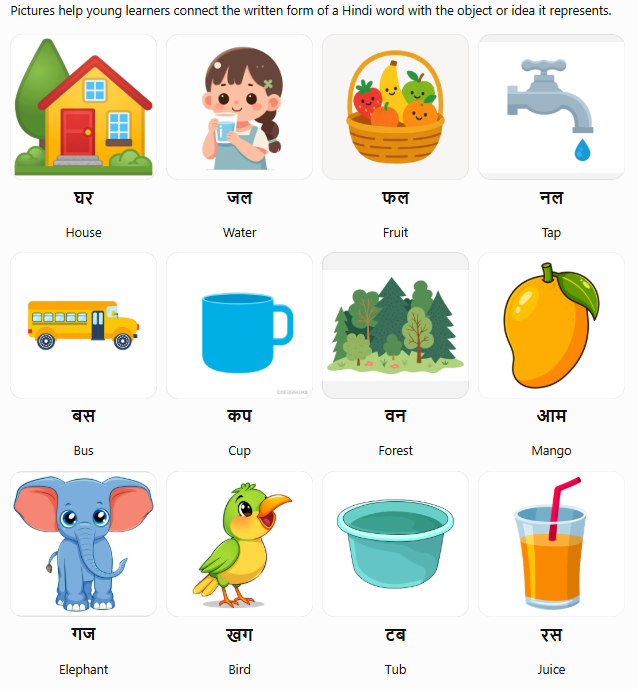
Picture-based learning works particularly well with nouns (संज्ञा). Children can recognise an object before learning its written name, which reduces the difficulty of remembering unfamiliar spellings.
Start by showing the picture of a mango without displaying its name. Ask the child what the object is called in Hindi. Once the child says आम, show its written form and explain that it contains आ and म.
After practising several words, cover the pictures and ask the child to read the Hindi words independently. This helps determine whether the learner remembers the spelling or simply recognises the illustration.
How to Form Two Letter Words in Hindi
Word formation activities teach students how separate Hindi letters can be joined to create meaningful vocabulary.
Basic Letter Combination
Begin with familiar consonants and ask students to pronounce the complete word after joining them.
The process of forming a word from individual letters is called word formation (शब्द निर्माण).
| Letter Combination | Formed Word | English Meaning |
|---|---|---|
| ज + ल | जल | Water |
| न + ल | नल | Tap |
| फ + ल | फल | Fruit |
| घ + र | घर | House |
| म + न | मन | Mind |
| ध + न | धन | Wealth |
| व + न | वन | Forest |
| र + स | रस | Juice |
| ब + स | बस | Bus |
| क + प | कप | Cup |
| छ + त | छत | Roof |
| ह + ल | हल | Plough |
| र + थ | रथ | Chariot |
| द + स | दस | Ten |
| स + ब | सब | All |
| ह + म | हम | We |
| ड + र | डर | Fear |
| स + च | सच | Truth |
| ग + ज | गज | Elephant |
| ख + ग | खग | Bird |
When teaching जल, pronounce ज first and then ल. Gradually combine the sounds until the child can read the complete word naturally.
Avoid inserting an extra vowel sound at the end of every consonant. Although Hindi consonants generally have an inherent vowel, it is not always pronounced in the final position of a word.
For example, जल is normally pronounced Jal, rather than Jala in everyday Hindi.
Words Beginning with Independent Vowels
Two-letter words can also begin with independent Hindi vowels instead of consonants.
| Letter Combination | Hindi Word | English Meaning |
|---|---|---|
| अ + ब | अब | Now |
| अ + ट | अट | Become stuck |
| ए + क | एक | One |
| आ + म | आम | Mango |
| आ + ज | आज | Today |
| ई + ख | ईख | Sugarcane |
| ओ + स | ओस | Dew |
| उ + ठ | उठ | Get up |
| उ + स | उस | That |
| इ + स | इस | This |
| आ + ग | आग | Fire |
| आ + ठ | आठ | Eight |
| ई + ट | ईट | Nonstandard spelling of brick |
The standard spelling of brick is ईंट, which contains a nasalization mark. Beginners should practise the standard form rather than memorising an incomplete spelling.
Independent vowels (स्वर) can form part of a word without being attached to a consonant. Dependent vowel signs function differently because they must be attached to another letter.
For instance, आम contains the independent vowel आ, while नाम contains the vowel sign ा attached to न.
Difference Between Hindi Two Letter Words With and Without Matra
Recognising vowel signs helps students distinguish basic matra-free words from more advanced two-letter words.
Hindi words may contain two written अक्षर while also using one or more vowel signs. The presence of a matra changes pronunciation but does not necessarily increase the number of अक्षर.
| Without Matra | Meaning | With Matra | Meaning |
|---|---|---|---|
| जल | Water | जाल | Net |
| फल | Fruit | फूल | Flower |
| बल | Strength | बाल | Hair |
| कल | Yesterday / Tomorrow | काल | Time / Era |
| मन | Mind | मान | Respect |
| तन | Body | तान | Stretch |
| दल | Group | दाल | Lentils |
| मल | Dirt | माल | Goods |
| पल | Moment | पाल | Nurture / Sail |
| घर | House | घेर | Surround |
| हल | Plough | हाल | Condition |
| रथ | Chariot | रात | Night |
Children sometimes recognise the consonants but overlook the vowel sign. As a result, they may read जाल as जल or दाल as दल.
Practising these pairs together teaches children to pay attention to small spelling differences.
Common Two Letter Words with Matras
Once students become comfortable with matra-free words, they can begin reading words containing different vowel signs.
| Hindi Word | Matra | Pronunciation | English Meaning |
|---|---|---|---|
| नाम | ा | Naam | Name |
| काम | ा | Kaam | Work |
| दाम | ा | Daam | Price |
| राम | ा | Ram | A personal name |
| कान | ा | Kaan | Ear |
| नाक | ा | Naak | Nose |
| हाथ | ा | Haath | Hand |
| दिन | ि | Din | Day |
| दिल | ि | Dil | Heart |
| सिर | ि | Sir | Head |
| बिल | ि | Bil | Burrow / Bill |
| लिख | ि | Likh | Write |
| तीर | ी | Teer | Arrow |
| तीन | ी | Teen | Three |
| झील | ी | Jheel | Lake |
| दूध | ू | Doodh | Milk |
| फूल | ू | Phool | Flower |
| धूप | ू | Dhoop | Sunshine |
| भूल | ू | Bhool | Mistake |
| रुक | ु | Ruk | Stop |
| पुल | ु | Pul | Bridge |
| सुख | ु | Sukh | Happiness |
| मुख | ु | Mukh | Face / Mouth |
| सेब | े | Seb | Apple |
| तेल | े | Tel | Oil |
| रेल | े | Rel | Train |
| मेल | े | Mel | Union / Mail |
| बैल | ै | Bail | Ox |
| पैर | ै | Pair | Foot |
| मोर | ो | Mor | Peacock |
| गोल | ो | Gol | Round |
| चोर | ो | Chor | Thief |
| शोर | ो | Shor | Noise |
| मौन | ौ | Maun | Silence |
| कौन | ौ | Kaun | Who |
| कौम | ौ | Kaum | Community |
The Hindi word दिन contains दि and न. Although the vowel sign ि appears before द visually, its sound is pronounced after the consonant.
This is a frequent source of confusion for children learning to write Hindi for the first time.
Hindi Two Letter Words Starting with Different Letters
Arranging vocabulary according to the first letter allows students to practise alphabet recognition alongside word formation.
| Starting Letter | Two Letter Words |
|---|---|
| अ | अब, अट |
| आ | आम, आज, आग, आठ |
| इ | इस |
| ई | ईख |
| उ | उठ, उस |
| ए | एक |
| ओ | ओस |
| क | कल, कप, कर, कम, कब, कट |
| ख | खत, खग, खट |
| ग | गज, गम, गढ़ |
| घ | घर, घट |
| च | चल, चख, चढ़, चट |
| छ | छत, छल |
| ज | जल, जग, जन, जम, जड़, जय |
| झ | झट |
| ट | टब |
| ड | डर |
| त | तन, तब, तक, तट, तप |
| थ | थल, थम |
| द | दस, दम, दल |
| ध | धन |
| न | नल, नभ, नर, नस, नथ |
| प | पल, पर, पथ, पट, पक, पद, पढ़ |
| फ | फल, फन |
| ब | बस, बल, बन, बच, बह, बढ़ |
| भ | भर, भय |
| म | मन, मत, मल, मर |
| य | यह, यश |
| र | रस, रथ, रख, रह, रज |
| ल | लट, लड़, लय |
| व | वन, वट, वह |
| स | सच, सब, सह |
| ह | हल, हम, हट, हक |
Not every Hindi letter begins an equally large number of familiar two-letter words. Students should first learn useful words rather than memorising rare or unnatural combinations merely to complete the alphabet.
Simple Hindi Sentences Using Two Letter Words
Short sentences teach children how familiar vocabulary works in actual communication.
The highlighted Hindi word in each sentence is the target vocabulary item. Other words may contain matras or additional letters to complete the sentence naturally.
| Hindi Sentence | English Meaning |
|---|---|
| यह मेरा घर है। | This is my house. |
| मुझे जल दो। | Give me water. |
| यह एक फल है। | This is a fruit. |
| नल बंद करो। | Turn off the tap. |
| बस आ गई है। | The bus has arrived. |
| यह मेरा कप है। | This is my cup. |
| छत साफ है। | The roof is clean. |
| टब में पानी है। | There is water in the tub. |
| जग में पानी भरो। | Fill the jug with water. |
| मैंने एक खत लिखा। | I wrote a letter. |
| किसान हल चलाता है। | The farmer uses a plough. |
| वन में पेड़ हैं। | There are trees in the forest. |
| मुझे आम का रस पसंद है। | I like mango juice. |
| नभ नीला है। | The sky is blue. |
| मेरे पास एक किताब है। | I have one book. |
| उसके पास दस पेंसिलें हैं। | He has ten pencils. |
| हम स्कूल जाते हैं। | We go to school. |
| सब यहाँ हैं। | Everyone is here. |
| अब घर चलो। | Go home now. |
| तुम कब आओगे? | When will you come? |
| हमेशा सच बोलो। | Always tell the truth. |
| मुझे डर नहीं लगता। | I am not afraid. |
| मेरा मन खुश है। | I feel happy. |
| पेड़ की जड़ मजबूत है। | The root of the tree is strong. |
| घास पर ओस है। | There is dew on the grass. |
| यह आम मीठा है। | This mango is sweet. |
| खेत में ईख उगती है। | Sugarcane grows in the field. |
| यहाँ मत बैठो। | Do not sit here. |
| थोड़ा पानी भर लो। | Fill up some water. |
| किताब यहाँ रख दो। | Put the book here. |
These sentences also introduce differences between English and Hindi sentence structures.
English generally follows the Subject + Verb + Object pattern, whereas Hindi commonly follows the Subject + Object + Verb pattern.
Consider the following example:
English: I eat fruit.
Hindi: मैं फल खाता हूँ।
In English, the verb “eat” comes before the object “fruit.” In Hindi, the object फल generally comes before the verb खाता हूँ.
Even a small vocabulary of two-letter words can therefore help learners practise basic sentence formation in both languages.
Common Mistakes When Learning Two Letter Hindi Words
Correcting spelling and pronunciation mistakes early helps children develop better reading habits.
Confusing Similar-Looking Letters
Some Hindi letters have similar shapes, making them difficult for beginners to distinguish.
For example, children may confuse ब with व or द with ध.
| Incorrect for the Intended Meaning | Correct Word | Intended Meaning |
|---|---|---|
| वन instead of बस | बस | Bus |
| दन | धन | Wealth |
| जर | जल | Water |
| पर instead of पल | पल | Moment |
| डर instead of दर | दर | Rate |
Some incorrect choices may themselves be valid Hindi words. The mistake occurs because they do not express the intended meaning.
Encourage students to compare the shape of each letter rather than relying entirely on the general appearance of the word.
Adding Unnecessary Vowel Signs
Beginners may accidentally add a matra to a word that does not require one.
For example, जल means water, whereas जाल means net. Similarly, दल means group, while दाल means lentils.
A small vowel sign can completely change the meaning of a Hindi word.
Ask students to read both versions aloud, compare their spelling, and explain their meanings.
Confusing English Pronunciation with English Meaning
Roman pronunciation helps students pronounce Hindi words, but it does not give their English meanings.
| Hindi Word | Pronunciation | Correct English Meaning |
|---|---|---|
| मन | Man | Mind |
| धन | Dhan | Wealth |
| कल | Kal | Yesterday / Tomorrow |
| नल | Nal | Tap |
| जल | Jal | Water |
The Hindi word मन is pronounced Man, but it does not mean an adult male person in English.
Students should treat pronunciation and translation as separate pieces of information.
Counting English Letters Instead of Hindi Letters
The number of English letters used to represent the pronunciation of a Hindi word is not the same as the number of Hindi अक्षर.
For example:
- घर contains घ and र.
- फल contains फ and ल.
- छत contains छ and त.
- खग contains ख and ग.
Although Chhat contains five Roman letters, छत is a two-letter Hindi word.
Incorrectly Classifying Words with Matras
Students should examine the actual written word before placing it in a matra-free vocabulary list.
For example, पढ़ has no dependent vowel matra, whereas लिख contains ि. Similarly, रुक contains ु and should not be classified as a matra-free word.
A useful spelling correction activity is to replace any incorrectly written or repeated entries in a vocabulary list with standard words such as these:
| Hindi Word | Pronunciation | English Meaning |
|---|---|---|
| दर | Dar | Rate |
| छल | Chhal | Deception |
| नक | Nak | A less common literary form |
| दह | Dah | Burning |
| नख | Nakh | Nail / Claw |
| चर | Char | Graze |
| झर | Jhar | Drip / Fall |
| ठग | Thag | Swindler |
| ढक | Dhak | Cover |
| लत | Lat | Habit |
Hindi 2 Letter Words Worksheets with Pictures
These picture-based worksheets help students practise vocabulary recognition, spelling, and English meanings.
Parents and teachers can print the exercises or copy them into a notebook for classroom and home practice.
Worksheet 1: Identify the Pictures
Look at each picture and write its Hindi name in the blank space.
चित्र देखकर दो अक्षरों वाला सही हिंदी शब्द लिखिए।


Worksheet 2: Join the Hindi Letters
Combine the given letters to form meaningful Hindi words.
दिए गए अक्षरों को जोड़कर सही शब्द बनाइए।
| No. | Letters | Your Answer |
|---|---|---|
| 9 | ज + ल | |
| 10 | फ + ल | |
| 11 | घ + र | |
| 12 | म + न | |
| 13 | ध + न | |
| 14 | छ + त | |
| 15 | ह + ल | |
| 16 | र + थ | |
| 17 | द + स | |
| 18 | स + च |
Worksheet 3: Fill in the Missing Letters
Complete each Hindi word using its English meaning as a clue.
अंग्रेजी अर्थ की सहायता से खाली स्थान में सही अक्षर लिखिए।
| No. | Incomplete Word | English Meaning |
|---|---|---|
| 19 | न ___ | Tap |
| 20 | ___ स | Bus |
| 21 | क ___ | Cup |
| 22 | ___ न | Forest |
| 23 | ड ___ | Fear |
| 24 | ___ त | Letter |
| 25 | र ___ | Juice |
| 26 | ___ भ | Sky |
| 27 | आ ___ | Mango |
| 28 | ई ___ | Sugarcane |
Worksheet 4: Match Hindi Words with English Meanings
Match each Hindi word in the first column with its correct English meaning in the second column.
| Hindi Words | English Meanings |
|---|---|
| 29. मन | |
| 30. धन | |
| 31. थल | |
| 32. खग | |
| 33. अब | |
| 34. हम | |
| 35. सब | |
| 36. हल |
Worksheet 5: Choose the Correct Answer
Select the Hindi word that matches the English meaning given in each question.
37. Which Hindi word means water?
38. Which word means truth?
39. Which word means roof?
40. Which word means ten?
41. Which word means forest?
42. Which word means chariot?
43. Which word means elephant?
44. Which word contains no dependent matra?
Worksheet 6: Translate Hindi into English
Translate the following simple Hindi sentences into English.
Answer Key
Check all 50 worksheet answers below after completing the exercises independently.
Answers 1–28
| No. | Answer | No. | Answer |
|---|---|---|---|
| 1 | घर | 15 | हल |
| 2 | फल | 16 | रथ |
| 3 | बस | 17 | दस |
| 4 | नल | 18 | सच |
| 5 | आम | 19 | ल |
| 6 | कप | 20 | ब |
| 7 | वन | 21 | प |
| 8 | गज | 22 | व |
| 9 | जल | 23 | र |
| 10 | फल | 24 | ख |
| 11 | घर | 25 | स |
| 12 | मन | 26 | न |
| 13 | धन | 27 | म |
| 14 | छत | 28 | ख |
Answers 29–44
| No. | Answer | No. | Answer |
|---|---|---|---|
| 29 | D. Mind | 37 | जल |
| 30 | G. Wealth | 38 | सच |
| 31 | A. Land | 39 | छत |
| 32 | B. Bird | 40 | दस |
| 33 | C. Now | 41 | वन |
| 34 | H. We | 42 | रथ |
| 35 | E. All | 43 | गज |
| 36 | F. Plough | 44 | फल |
Answers 45–50
| No. | Correct English Translation |
|---|---|
| 45 | This is my house. |
| 46 | Give me water. |
| 47 | This is a fruit. |
| 48 | We go to school. |
| 49 | Always tell the truth. |
| 50 | I have ten books. |
Hindi Two Letter Words with English Meaning PDF With Worksheet
A printable PDF can make vocabulary revision and handwriting practice easier, especially for younger students.
You can save the vocabulary tables and worksheets from this lesson as a PDF using your browser’s print feature. On a computer, press Ctrl + P and select Save as PDF.
A useful printed learning sheet should contain Hindi spellings, clear English meanings, letter combinations, pictures of familiar objects, and sufficient space for handwriting practice.
Keep the answer key on a separate page so children can complete their work without seeing the solutions.
Download Worksheet From here For Offline Practice
How to Teach Two Letter Hindi Words to Children
Short, regular practice sessions can help children recognise Hindi letters, remember vocabulary, and gradually read independently.
Start with Familiar Objects
Introduce words that children can associate with their everyday surroundings.
Begin with घर, नल, कप, बस, and फल. These words are easier to remember because children already know the objects they represent.
Once a child recognises five familiar words, introduce less concrete vocabulary such as मन, सच, and डर.
Practise Words with Similar Endings
Grouping words by their final letter allows children to recognise recurring spelling patterns.
| Ending Letter | Practice Words |
|---|---|
| ल | जल, नल, फल, हल, बल, पल, कल, दल |
| न | मन, धन, वन, तन, जन, बन |
| र | घर, डर, कर, पर, भर |
| स | बस, रस, दस, नस |
| त | छत, खत, मत, तट |
| म | हम, कम, दम, जम |
| ब | अब, कब, तब, जब, सब |
| क | तक, थक, पक, झक |
Ask the child to read जल and then replace ज with फ. The resulting word is फल.
This activity demonstrates how changing a single letter creates a new word with a different meaning.
Follow a Seven-Day Practice Routine
A weekly routine can introduce new vocabulary without overwhelming young learners.
| Day | Learning Activity |
|---|---|
| Day 1 | Learn five familiar object names. |
| Day 2 | Practise five nature-related words. |
| Day 3 | Join individual Hindi letters. |
| Day 4 | Match pictures with Hindi words. |
| Day 5 | Learn English meanings and pronunciation. |
| Day 6 | Read simple Hindi sentences. |
| Day 7 | Complete worksheets and revise mistakes. |
Ten to fifteen minutes of focused daily practice is a reasonable starting point for young children. Adjust the number of words according to the child’s reading ability rather than expecting every learner to progress at the same speed.
Frequently Asked Questions
These questions address common difficulties students and parents encounter while learning short Hindi words.
What is the difference between Jal and Jaal?
The presence of the vowel sign ा changes both pronunciation and meaning.
जल means water, whereas जाल means net. The first word has no matra, while the second contains the long आ vowel sign.
Are two-letter Hindi words suitable for nursery and UKG students?
Yes, familiar two-letter words are appropriate introductory vocabulary for children who have started recognising Hindi letters.
Picture cards, tracing exercises, letter combinations, and short reading activities are suitable ways to teach these words at the nursery, LKG, and UKG levels.
How can I practise Hindi two-letter words at home?
Use familiar household objects and simple written word cards to create short daily learning activities.
Place cards containing कप, नल, and घर near relevant objects or pictures. Ask children to read each card, identify its meaning, and write the word independently.
How many two-letter Hindi words are there?
There is no single fixed total used across every textbook or dictionary.
The number depends on whether the list includes words with matras, literary vocabulary, independent vowels, verb stems, borrowed words, and less common expressions.
Beginners can start with 20 to 50 familiar words before expanding their vocabulary.
Lets End
Everyday surroundings offer plenty of opportunities to practice short Hindi words without opening a textbook.
During a walk, a child might encounter a बस, notice a घर, or see the green trees of a वन. At home, a कप, नल, and फल can become part of a quick vocabulary activity. Connecting written words with these experiences helps children remember their meanings and use them naturally.
Try completing these four words using their English meanings:
- ___ ल (Water)
- म ___ (Mind)
- ___ र (House)
- आ ___ (Mango)
Write your answers in the comments and see how many words you can recognise without checking the vocabulary tables.
Leave a Reply