Take the English word “light.” In “Turn on the light,” it names an object. In “This bag is light,” it describes a quality. In “Light the candle,” it expresses an action. The same word performs three different grammatical functions. Hindi also has similar patterns involving संज्ञा (noun), विशेषण (adjective), and क्रिया (verb).
Parts of speech (शब्द भेद) help us classify words according to their grammatical functions. English traditionally has eight major parts of speech. Recognizing these categories helps Hindi-speaking learners understand sentence formation, select appropriate words, and avoid grammatical mistakes.
This lesson explains all eight parts of speech in Hindi with definition and examples, including their individual types, grammatical functions, Hindi terminology, and bilingual sentence examples. Comparison tables, practical explanations, interactive exercises, and downloadable PDF notes make the lesson suitable for both beginners and advanced learners.
Parts of Speech in Hindi with Examples
The eight traditional parts of speech are the foundation of English word classification. The table below shows their Hindi names, grammatical functions, and familiar examples.
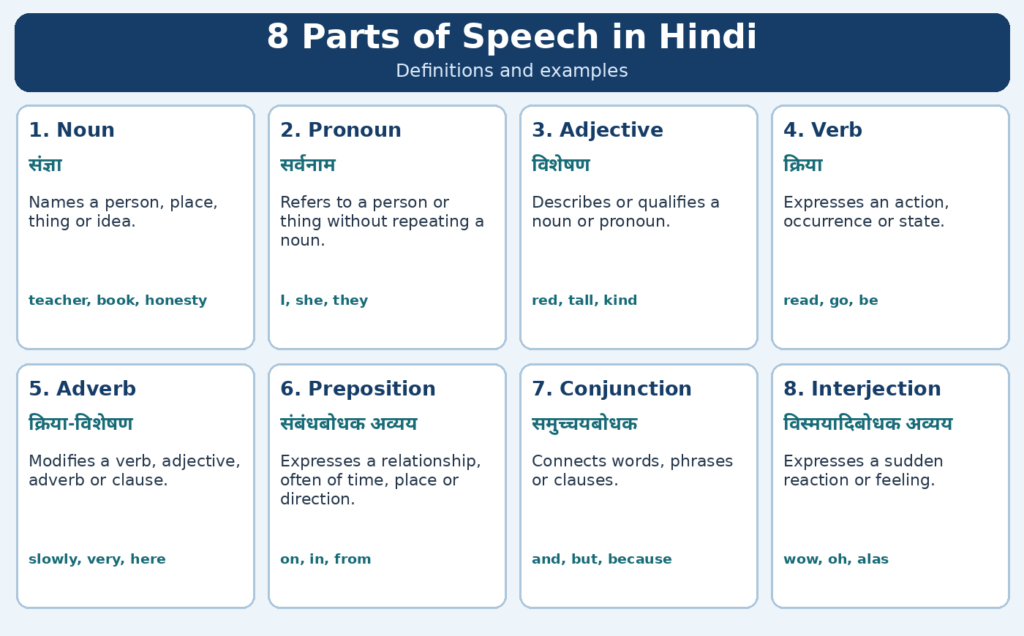
Consider this example:
English: Wow! She carefully placed the beautiful flowers on the table and smiled.
Hindi: वाह! उसने सुंदर फूल सावधानी से मेज़ पर रखे और मुस्कुराई।
| English Word | Part of Speech |
|---|---|
| Wow | Interjection |
| She | Pronoun |
| Carefully | Adverb |
| Placed | Verb |
| Beautiful | Adjective |
| Flowers | Noun |
| On | Preposition |
| And | Conjunction |
The word “the” is an article, classified as a determiner in modern English grammar.
8 Parts of Speech Definitions and Examples in Hindi
Each part of speech has a distinct grammatical role. The following sections explain the definitions, Hindi meanings, main types, and practical examples of all eight traditional categories.
1. Noun (संज्ञा)
A noun is a word used to name a person, place, animal, object, substance, quality, feeling, or idea.
English Definition: A noun is a word that names a person, place, thing, or concept.
Hindi Definition: किसी व्यक्ति, स्थान, वस्तु, प्राणी, गुण, भाव या विचार के नाम को संज्ञा कहते हैं।
Examples include student (विद्यार्थी), river (नदी), school (विद्यालय), honesty (ईमानदारी), and friendship (मित्रता).
Types of Nouns
Nouns can be classified by meaning, countability, number, form, and grammatical function. The following table lists the important classifications with examples. These categories can overlap.
| Noun Type | Hindi Name | Examples |
|---|---|---|
| Proper Noun | व्यक्तिवाचक संज्ञा | India, Rahul, Delhi |
| Common Noun | जातिवाचक संज्ञा | City, boy, teacher |
| Collective Noun | समूहवाचक संज्ञा | Team, family, crowd |
| Material Noun | द्रव्यवाचक संज्ञा | Gold, water, cotton |
| Abstract Noun | भाववाचक संज्ञा | Honesty, courage, love |
| Countable Noun | गणनीय संज्ञा | Chair, apple, pencil |
| Uncountable Noun | अगणनीय संज्ञा | Rice, information, milk |
| Concrete Noun | मूर्त संज्ञा | Stone, flower, bell |
| Possessive Noun | स्वामित्व या संबंधसूचक संज्ञा रूप | Boy’s, teacher’s |
| Compound Noun | संयुक्त संज्ञा | Toothbrush, bus stop |
| Plural Noun | बहुवचन संज्ञा | Children, books, cities |
| Appositive Noun | समानाधिकरण में प्रयुक्त संज्ञा | My friend, a doctor |
| Noun as Subject | कर्ता के रूप में संज्ञा | Birds fly, children play |
| Gender Noun | लिंग के आधार पर संज्ञा | King, queen, teacher |
| Verbal Noun | क्रिया से बनी संज्ञा | Arrival, development |
| Singular Noun | एकवचन संज्ञा | Student, house, tree |
Note: Possessive nouns, plural nouns, and nouns used as subjects describe forms or functions, not necessarily separate lexical noun classes. A noun can belong to several rows simultaneously.
Examples of Nouns in Sentences
The highlighted words function as nouns in these examples.
| English Sentence | Hindi Meaning |
|---|---|
| Ram goes to school. | राम स्कूल जाता है। |
| The teacher explained the lesson. | शिक्षक ने पाठ समझाया। |
| Honesty builds trust. | ईमानदारी से विश्वास बढ़ता है। |
| The children are playing outside. | बच्चे बाहर खेल रहे हैं। |
| This ring is made of gold. | यह अंगूठी सोने की बनी है। |
| Our team won the match. | हमारी टीम ने मैच जीता। |
| The farmer grows vegetables. | किसान सब्ज़ियाँ उगाता है। |
| I bought a new notebook. | मैंने एक नई कॉपी खरीदी। |
A noun can function as a subject, object, or complement.
The girl reads a book.
लड़की एक किताब पढ़ती है।
Here, “girl” is the subject noun, while “book” is the object noun.
2. Pronoun (सर्वनाम)
A pronoun refers to someone or something without necessarily repeating a noun or noun phrase.
English Definition: A pronoun is a word used to refer to a person, thing, or idea, often replacing a noun.
Hindi Definition: संज्ञा के स्थान पर प्रयोग होने वाले शब्दों को सर्वनाम कहते हैं।
For example:
Rahul is a student. Rahul studies every day. Rahul likes English.
A more natural version is:
Rahul is a student. He studies every day. He likes English.
The word “he” is a pronoun referring to Rahul.
Types of Pronouns
English pronouns are grouped according to how they refer to people, things, possession, identity, and relationships.
| Pronoun Type | Hindi Name | Examples |
|---|---|---|
| Personal Pronoun | पुरुषवाचक सर्वनाम | I, me, you, he, she, they |
| Possessive Pronoun | अधिकारवाचक सर्वनाम | Mine, yours, hers, ours |
| Demonstrative Pronoun | संकेतवाचक सर्वनाम | This, that, these, those |
| Interrogative Pronoun | प्रश्नवाचक सर्वनाम | Who, whom, what, which |
| Relative Pronoun | संबंधवाचक सर्वनाम | Who, whose, which, that |
| Indefinite Pronoun | अनिश्चयवाचक सर्वनाम | Someone, anybody, nobody |
| Reflexive Pronoun | निजवाचक सर्वनाम | Myself, himself, themselves |
| Intensive Pronoun | बलसूचक सर्वनाम | Myself, yourself, herself |
| Reciprocal Pronoun | परस्परवाचक सर्वनाम | Each other, one another |
| Distributive Pronoun | वितरणवाचक सर्वनाम | Each, either, neither |
Intensive and reflexive pronouns use similar forms, but their grammatical functions differ.
Examples of Pronouns in Sentences
The highlighted pronouns perform different referring functions.
| English Sentence | Hindi Meaning |
|---|---|
| He is a good student. | वह एक अच्छा विद्यार्थी है। |
| They are learning English. | वे अंग्रेज़ी सीख रहे हैं। |
| This belongs to me. | यह मेरा है। |
| Who opened the window? | खिड़की किसने खोली? |
| The bag is mine. | बैग मेरा है। |
| Someone is waiting outside. | बाहर कोई इंतज़ार कर रहा है। |
| She introduced herself. | उसने अपना परिचय दिया। |
| They helped each other. | उन्होंने एक-दूसरे की मदद की। |
English uses different subject and object pronouns.
| Subject Pronoun | Object Pronoun | Hindi Equivalent |
|---|---|---|
| I | Me | मैं / मुझे |
| We | Us | हम / हमें |
| He | Him | वह / उसे |
| She | Her | वह / उसे |
| They | Them | वे / उन्हें |
Hindi commonly uses वह for both “he” and “she,” whereas English distinguishes between them.
3. Adjective (विशेषण)
An adjective gives additional information about a noun or pronoun. It may describe appearance, size, quality, condition, or another characteristic.
English Definition: An adjective is a word that describes or qualifies a noun or pronoun.
Hindi Definition: संज्ञा या सर्वनाम की विशेषता बताने वाले शब्दों को विशेषण कहते हैं।
Examples include beautiful (सुंदर), red (लाल), tall (लंबा), honest (ईमानदार), and intelligent (बुद्धिमान).
Types of Adjectives
Traditional school grammar recognizes several adjective categories based on their meanings and grammatical functions.
| Adjective Type | Hindi Name | Examples |
|---|---|---|
| Descriptive Adjective | गुणवाचक विशेषण | Beautiful, tall, delicious |
| Quantitative Adjective | परिमाणवाचक विशेषण | Much, little, enough |
| Numeral Adjective | संख्यावाचक विशेषण | One, second, double |
| Demonstrative Adjective | संकेतवाचक विशेषण | This, that, these |
| Possessive Adjective | अधिकारवाचक विशेषण | My, your, their |
| Interrogative Adjective | प्रश्नवाचक विशेषण | Which, whose, what |
| Distributive Adjective | वितरणवाचक विशेषण | Each, every, either |
| Proper Adjective | व्यक्तिवाचक नाम से बना विशेषण | Indian, American, Italian |
| Participial Adjective | कृदंत विशेषण | Tired, exciting, broken |
| Compound Adjective | संयुक्त विशेषण | Well-known, part-time |
| Articles | उपपद / आर्टिकल | A, an, the |
In modern English grammar, articles, demonstratives, and possessive forms such as “my” are generally classified as determiners. They are often included under adjectives in traditional school grammar.
Examples of Adjectives in Sentences
The highlighted adjectives describe nouns or pronouns.
| English Sentence | Hindi Meaning |
|---|---|
| She has a red pen. | उसके पास एक लाल कलम है। |
| This is a beautiful garden. | यह एक सुंदर बगीचा है। |
| The tree is tall. | पेड़ लंबा है। |
| He is an honest person. | वह एक ईमानदार व्यक्ति है। |
| The question is difficult. | प्रश्न कठिन है। |
| This road is narrow. | यह सड़क सँकरी है। |
| The classroom looks clean. | कक्षा साफ़ दिख रही है। |
| The book is useful. | किताब उपयोगी है। |
Degrees of Adjectives
Gradable adjectives can express comparison through positive, comparative, and superlative forms.
| Positive | Comparative | Superlative | Hindi Meaning |
|---|---|---|---|
| Tall | Taller | Tallest | लंबा |
| Small | Smaller | Smallest | छोटा |
| Good | Better | Best | अच्छा |
| Bad | Worse | Worst | बुरा |
| Beautiful | More beautiful | Most beautiful | सुंदर |
| Important | More important | Most important | महत्वपूर्ण |
For example:
Ravi is taller than Amit.
रवि अमित से लंबा है।
English adjectives generally do not change according to the gender of a noun. Some Hindi adjectives do:
अच्छा लड़का (Good boy)
अच्छी लड़की (Good girl)
4. Verb (क्रिया)
A verb expresses an action, event, process, or state. It forms an essential part of a clause and often conveys information about tense, aspect, or modality.
English Definition: A verb is a word that expresses an action, occurrence, process, or state of being.
Hindi Definition: जिस शब्द से किसी काम के करने, होने या किसी अवस्था का बोध होता है, उसे क्रिया कहते हैं।
Common verbs include eat (खाना), read (पढ़ना), write (लिखना), sleep (सोना), speak (बोलना), and understand (समझना).
Types of Verbs
English verbs can be classified according to their meaning, grammatical function, formation, and sentence structure.
| Verb Type | Hindi Explanation | Examples |
|---|---|---|
| Action Verb | कार्यसूचक क्रिया | Run, jump, write |
| Linking Verb | योजक क्रिया | Be, seem, become |
| Helping Verb | सहायक क्रिया | Be, have, do |
| Modal Verb | भावसूचक सहायक क्रिया | Can, should, must |
| Transitive Verb | सकर्मक क्रिया | Read a book, open a door |
| Intransitive Verb | अकर्मक क्रिया | Sleep, arrive, laugh |
| Regular Verb | नियमित क्रिया | Walk, play, clean |
| Irregular Verb | अनियमित क्रिया | Go, eat, take |
| Finite Verb | समापिका क्रिया | Goes, went, is |
| Non-finite Verb | असमापिका क्रिया | To go, going, written |
| Dynamic Verb | गतिशील क्रिया | Build, grow, change |
| Stative Verb | अवस्थासूचक क्रिया | Know, believe, own |
| Reflexive Verb Construction | निजवाचक क्रिया संरचना | Introduce oneself |
| Phrasal Verb | वाक्यांश क्रिया | Give up, turn off |
| Causative Verb | प्रेरणार्थक क्रिया | Make, let, have |
| Copular Verb | योजक क्रिया | Be, seem, remain |
| Imperative Verb | आज्ञार्थक प्रयोग | Sit, listen, stop |
| Gerund | क्रिया का संज्ञात्मक रूप | Reading, swimming |
| Participle | कृदंत | Writing, written |
| Defective Verb | अपूर्ण रूपों वाली क्रिया | Must, may |
| Compound Verb | संयुक्त क्रिया | पढ़ लेना, खा लेना |
| Weak Verb | दंत्य प्रत्यय से भूतकाल बनाने वाली क्रिया | Work, help, keep |
| Strong Verb | स्वर परिवर्तन वाली क्रिया | Sing, drink, begin |
| Impersonal Verb Construction | निर्वैयक्तिक क्रिया संरचना | It rains, it snows |
| Ambitransitive Verb | सकर्मक और अकर्मक दोनों प्रयोग | Eat, read, start |
| Ergative Alternation | सकर्मक-अकर्मक रूपांतरण | Break, melt, open |
These terms describe overlapping classifications. For example, a modal verb is a type of auxiliary verb, while a copular verb is also a linking verb. Gerunds and participles are verb forms rather than entirely separate lexical verb classes.
Examples of Verbs in Sentences
The highlighted verbs express actions, states, or grammatical meanings.
| English Sentence | Hindi Meaning |
|---|---|
| Children play in the park. | बच्चे पार्क में खेलते हैं। |
| She writes neatly. | वह साफ़-साफ़ लिखती है। |
| He is a teacher. | वह शिक्षक है। |
| They have completed the work. | उन्होंने काम पूरा कर लिया है। |
| We can solve this question. | हम यह प्रश्न हल कर सकते हैं। |
| She knows the answer. | उसे उत्तर पता है। |
| The baby slept peacefully. | बच्चा शांति से सोया। |
| Please open the window. | कृपया खिड़की खोलिए। |
| The flowers bloomed yesterday. | फूल कल खिले थे। |
| He became a doctor. | वह डॉक्टर बन गया। |
Five Forms of English Verbs
The five-form model is frequently used in school grammar to teach tense and verb formation.
| V1 | V2 | V3 | V4 | V5 | Hindi Meaning |
|---|---|---|---|---|---|
| Go | Went | Gone | Going | Goes | जाना |
| Eat | Ate | Eaten | Eating | Eats | खाना |
| Write | Wrote | Written | Writing | Writes | लिखना |
| Read | Read | Read | Reading | Reads | पढ़ना |
| Speak | Spoke | Spoken | Speaking | Speaks | बोलना |
| Take | Took | Taken | Taking | Takes | लेना |
| Give | Gave | Given | Giving | Gives | देना |
| Make | Made | Made | Making | Makes | बनाना |
English verbs may change according to tense and subject agreement, while Hindi verb forms may additionally reflect grammatical gender.
5. Adverb (क्रिया-विशेषण)
An adverb provides information about an action, quality, another adverb, or an entire statement.
English Definition: An adverb is a word that modifies a verb, adjective, another adverb, or clause.
Hindi Definition: जो शब्द क्रिया, विशेषण, अन्य क्रिया-विशेषण या वाक्य के अर्थ में अतिरिक्त जानकारी देता है, उसे क्रिया-विशेषण कहते हैं।
Common examples are slowly (धीरे), quickly (जल्दी), here (यहाँ), always (हमेशा), and very (बहुत).
Types of Adverbs
Adverbs are grouped according to their meanings and grammatical functions.
| Adverb Type | Hindi Name | Examples |
|---|---|---|
| Adverb of Manner | रीतिवाचक क्रिया-विशेषण | Slowly, carefully, politely |
| Adverb of Time | कालवाचक क्रिया-विशेषण | Today, yesterday, soon |
| Adverb of Place | स्थानवाचक क्रिया-विशेषण | Here, there, upstairs |
| Adverb of Frequency | आवृत्तिवाचक क्रिया-विशेषण | Always, often, never |
| Adverb of Degree | परिमाणवाचक क्रिया-विशेषण | Very, extremely, almost |
| Conjunctive Adverb | संयोजक क्रिया-विशेषण | However, therefore, meanwhile |
| Focusing Adverb | बलसूचक / सीमासूचक क्रिया-विशेषण | Only, even, especially |
| Interrogative Adverb | प्रश्नवाचक क्रिया-विशेषण | When, where, why, how |
| Relative Adverb | संबंधवाचक क्रिया-विशेषण | Where, when, why |
| Evaluative Adverb | मूल्यांकनसूचक क्रिया-विशेषण | Fortunately, surprisingly |
| Viewpoint Adverb | दृष्टिकोणसूचक क्रिया-विशेषण | Personally, technically |
Examples of Adverbs in Sentences
The highlighted adverbs modify actions, qualities, or complete statements.
| English Sentence | Hindi Meaning |
|---|---|
| He walks slowly. | वह धीरे चलता है। |
| We will meet tomorrow. | हम कल मिलेंगे। |
| The children are playing outside. | बच्चे बाहर खेल रहे हैं। |
| She always arrives early. | वह हमेशा जल्दी पहुँचती है। |
| The question is very difficult. | प्रश्न बहुत कठिन है। |
| He answered politely. | उसने विनम्रता से उत्तर दिया। |
| Fortunately, everyone was safe. | सौभाग्य से, सभी सुरक्षित थे। |
| She is almost ready. | वह लगभग तैयार है। |
| Only Rahul knew the answer. | केवल राहुल को उत्तर पता था। |
| He ran fast. | वह तेज़ दौड़ा। |
Not every adverb ends in “-ly.” For example, “fast,” “hard,” “often,” and “soon” are common adverbs.
Adverbs can modify adjectives as well as verbs.
In “The question is very difficult,” the adverb “very” modifies the adjective “difficult.”
6. Preposition (संबंधबोधक अव्यय)
Prepositions express relationships involving location, time, movement, direction, cause, possession, or other grammatical connections.
English Definition: A preposition is a word that introduces a complement and establishes its relationship to another element of a sentence.
Hindi Definition: जो शब्द संज्ञा या सर्वनाम का संबंध वाक्य के अन्य शब्दों से बताते हैं, उन्हें संबंधबोधक अव्यय कहते हैं।
Common prepositions include in (में), on (पर), under (के नीचे), with (के साथ), and from (से).
Types of Prepositions
Prepositions can be grouped by their meanings or by their form and structure.
| Type by Function | Hindi Explanation | Examples |
|---|---|---|
| Time | समय संबंधी पूर्वसर्ग | At, on, in, before |
| Place or Position | स्थान संबंधी पूर्वसर्ग | Under, behind, between |
| Direction | दिशा संबंधी पूर्वसर्ग | To, towards, into |
| Movement | गति संबंधी पूर्वसर्ग | Across, through, along |
| Manner | रीति संबंधी पूर्वसर्ग | With, by, like |
| Cause | कारण संबंधी पूर्वसर्ग | Because of, due to |
| Purpose | उद्देश्य संबंधी पूर्वसर्ग | For |
| Agent | कर्ता संबंधी पूर्वसर्ग | By |
| Instrument | साधन संबंधी पूर्वसर्ग | With, via |
| Source | स्रोत संबंधी पूर्वसर्ग | From, out of |
| Possession | स्वामित्व संबंधी पूर्वसर्ग | Of, with |
| Measure | माप संबंधी पूर्वसर्ग | By, at, per |
| Type by Structure | Examples |
|---|---|
| Simple Preposition | In, on, at, to |
| Compound Preposition | Because of, next to |
| Double Preposition (traditional label) | Into, onto, within |
| Participial Preposition | Including, concerning |
| Phrasal Preposition | In spite of, according to |
Traditional grammar books sometimes overlap in their use of compound, double, and phrasal preposition labels.
Examples of Prepositions in Sentences
The highlighted prepositions show relationships among objects, people, places, and events.
| English Sentence | Hindi Meaning |
|---|---|
| The book is on the table. | किताब मेज़ पर है। |
| The cat is under the chair. | बिल्ली कुर्सी के नीचे है। |
| She arrived at eight. | वह आठ बजे पहुँची। |
| We walked through the tunnel. | हम सुरंग से होकर चले। |
| I bought a gift for my mother. | मैंने अपनी माँ के लिए उपहार खरीदा। |
| He came from Delhi. | वह दिल्ली से आया। |
| She wrote with a pencil. | उसने पेंसिल से लिखा। |
| The school is near the hospital. | विद्यालय अस्पताल के पास है। |
| The match was canceled because of rain. | बारिश के कारण मैच रद्द हुआ। |
| They walked across the bridge. | वे पुल पार करके गए। |
English Prepositions and Hindi Postpositions
English generally uses prepositions before their complements, while Hindi commonly uses postpositions (परसर्ग) after the associated nouns or pronouns.
| English Expression | Hindi Expression |
|---|---|
| On the table | मेज़ पर |
| In the room | कमरे में |
| Behind the house | घर के पीछे |
| With friends | दोस्तों के साथ |
| Near the school | विद्यालय के पास |
| From the market | बाज़ार से |
This difference in word order is important when translating Hindi sentences into English.
7. Conjunction (समुच्चयबोधक अव्यय)
Conjunctions connect grammatical elements, such as words, phrases, or clauses, and help express relationships between ideas.
English Definition: A conjunction is a word or connecting expression that joins words, phrases, or clauses.
Hindi Definition: दो या दो से अधिक शब्दों, वाक्यांशों या उपवाक्यों को जोड़ने वाले शब्दों को समुच्चयबोधक अव्यय कहते हैं।
Examples include and (और), but (लेकिन), or (या), because (क्योंकि), and although (हालाँकि).
Types of Conjunctions
The three traditional conjunction types are coordinating, subordinating, and correlative. Conjunctive adverbs are often discussed alongside them.
| Category | Hindi Name | Examples |
|---|---|---|
| Coordinating Conjunction | समानाधिकरण समुच्चयबोधक | And, but, or, so |
| Subordinating Conjunction | व्यधिकरण समुच्चयबोधक | Because, although, if |
| Correlative Conjunction | सहसंबंधी समुच्चयबोधक | Either…or, neither…nor |
| Conjunctive Adverb | संयोजक क्रिया-विशेषण | However, therefore, meanwhile |
Conjunctive adverbs are grammatically adverbs, not a separate fourth category of true conjunctions.
The seven traditional coordinating conjunctions can be remembered using FANBOYS: For, And, Nor, But, Or, Yet, So.
Examples of Conjunctions in Sentences
The highlighted conjunctions connect related ideas.
| English Sentence | Hindi Meaning |
|---|---|
| Ram and Shyam are friends. | राम और श्याम दोस्त हैं। |
| She is tired but happy. | वह थकी हुई है लेकिन खुश है। |
| Would you like tea or coffee? | क्या आप चाय या कॉफ़ी लेना चाहेंगे? |
| We stayed home because it was raining. | हम घर पर रहे क्योंकि बारिश हो रही थी। |
| Although he was tired, he continued working. | हालाँकि वह थका हुआ था, फिर भी उसने काम जारी रखा। |
| If you study, you will improve. | यदि तुम पढ़ोगे, तो बेहतर हो जाओगे। |
| Wait here until I return. | जब तक मैं वापस न आऊँ, यहाँ इंतज़ार करो। |
| Both students and teachers attended. | विद्यार्थी और शिक्षक दोनों उपस्थित हुए। |
| Neither Ram nor Amit was absent. | न राम अनुपस्थित था और न ही अमित। |
| The road was blocked; therefore, we returned. | सड़क बंद थी; इसलिए हम लौट आए। |
Correlative conjunctions generally require parallel grammatical structures.
For example:
Incorrect: She likes both reading and to write.
Correct: She likes both reading and writing.
8. Interjection (विस्मयादिबोधक अव्यय)
Interjections express sudden feelings, reactions, greetings, hesitation, or attempts to attract attention.
English Definition: An interjection is a word or short expression that communicates a spontaneous emotional or conversational reaction.
Hindi Definition: अचानक उत्पन्न होने वाले हर्ष, शोक, आश्चर्य, भय या अन्य भावों को व्यक्त करने वाले शब्दों को विस्मयादिबोधक अव्यय कहते हैं।
Examples include wow (वाह!), oh (अरे!), alas (हाय!), bravo (शाबाश!), and ouch (आह!).
Types of Interjections
Interjections can be grouped by grammatical form, communicative function, or emotional intensity.
| Classification | Type | Examples |
|---|---|---|
| By Form | Primary Interjection | Wow!, Ouch!, Oops! |
| By Form | Secondary Interjection | Great!, Goodness!, Well! |
| By Function | Emotive | Hurrah!, Alas!, Wow! |
| By Function | Volitive | Hey!, Shh!, Psst! |
| By Function | Cognitive | Hmm!, Aha!, Eureka! |
| By Function | Phatic or Greeting | Hello!, Hi!, Uh-huh! |
| By Intensity | Strong Interjection | Ouch!, Hurrah! |
| By Intensity | Mild Interjection | Well, Oh, Hmm |
Emotive interjections may also express particular feelings such as joy, sorrow, surprise, pain, approval, fear, or disgust.
Examples of Interjections in Sentences
The highlighted expressions communicate immediate reactions.
| English Sentence | Hindi Meaning |
|---|---|
| Wow! What a beautiful view! | वाह! कितना सुंदर दृश्य है! |
| Alas! We lost the match. | हाय! हम मैच हार गए। |
| Bravo! You answered correctly. | शाबाश! तुमने सही उत्तर दिया। |
| Ouch! My finger hurts. | आह! मेरी उँगली में दर्द है। |
| Oops! I dropped the cup. | अरे! मुझसे कप गिर गया। |
| Aha! I found the answer. | अहा! मुझे उत्तर मिल गया। |
| Hmm, let me think. | हम्म, मुझे सोचने दो। |
| Hey! Look over here. | अरे! यहाँ देखो। |
| Phew! The work is finished. | उफ़! काम पूरा हो गया। |
| Hello! How are you? | नमस्ते! आप कैसे हैं? |
Strong interjections often use an exclamation mark, while milder interjections may be followed by a comma.
For example:
Oh, I remember now.
अरे, अब मुझे याद आया।
Interjections may stand alone or appear alongside complete sentences.
Difference Between English and Hindi Parts of Speech
English and Hindi have comparable grammatical categories, but they do not follow identical rules of word order, agreement, and sentence formation.
Traditional Hindi grammar also distinguishes between विकारी शब्द and अविकारी शब्द.
Vikari Shabd (विकारी शब्द)
Words that may change their grammatical forms according to gender, number, person, case, or tense are called विकारी शब्द.
Hindi Definition: जिन शब्दों के रूप में लिंग, वचन, कारक, पुरुष या काल के कारण परिवर्तन हो सकता है, उन्हें विकारी शब्द कहते हैं।
| Category | Hindi Name | Examples |
|---|---|---|
| Noun | संज्ञा | लड़का, लड़के, लड़कों |
| Pronoun | सर्वनाम | मैं, मुझे, मेरा |
| Adjective | विशेषण | बड़ा, बड़ी, बड़े |
| Verb | क्रिया | पढ़ता, पढ़ती, पढ़ते |
For example:
लड़का खेलता है। (The boy plays.)
लड़की खेलती है। (The girl plays.)
The Hindi verb changes with grammatical gender, while the English verb “plays” remains the same for both subjects.
Avikari Shabd (अविकारी शब्द)
Words that generally remain unchanged regardless of gender, number, or grammatical person are called अविकारी शब्द or अव्यय.
Hindi Definition: जिन शब्दों के रूप में लिंग, वचन, कारक या पुरुष के कारण परिवर्तन नहीं होता, उन्हें अविकारी शब्द कहते हैं।
| Category | Hindi Name | Examples |
|---|---|---|
| Adverb | क्रिया-विशेषण | धीरे, यहाँ, आज |
| Relational Word | संबंधबोधक अव्यय | में, पर, से |
| Conjunction | समुच्चयबोधक अव्यय | और, लेकिन, क्योंकि |
| Interjection | विस्मयादिबोधक अव्यय | वाह!, अरे!, हाय! |
| Particle | निपात | ही, भी, तो |
Consider these examples:
लड़का धीरे चलता है।
The boy walks slowly.
लड़की धीरे चलती है।
The girl walks slowly.
The adverb धीरे remains unchanged even though the Hindi verb changes.
Comparison of English and Hindi Grammar
The following table highlights important differences between the two languages.
| Grammatical Feature | English | Hindi |
|---|---|---|
| Basic word order | Subject + Verb + Object | Subject + Object + Verb |
| Grammatical gender | Limited in ordinary nouns | Masculine and feminine |
| Adjective agreement | Generally unchanged | Some adjectives change with gender and number |
| Relational words | Mainly prepositions | Mainly postpositions |
| Articles | A, an, the | No equivalent obligatory article system |
| Pronouns | He and she are distinct | वह can refer to either |
| Verb agreement | Primarily person and number | May involve gender, number, and person |
| Politeness | Often expressed through wording | Often expressed through pronouns and verb forms |
Understanding these differences helps learners avoid translating Hindi grammar structures directly into English.
How to Identify Parts of Speech in Sentences
Identifying parts of speech requires examining the grammatical function of each word within a complete sentence.
Step-by-Step Identification
Use the following questions to identify the word classes.
| Question | Part of Speech |
|---|---|
| Does it name a person, place, thing, or idea? | Noun |
| Does it refer to a person or thing? | Pronoun |
| Does it describe a noun or pronoun? | Adjective |
| Does it express an action or state? | Verb |
| Does it modify an action, quality, or statement? | Adverb |
| Does it express a relationship between elements? | Preposition |
| Does it connect words, phrases, or clauses? | Conjunction |
| Does it express an immediate reaction? | Interjection |
Sentence Analysis Examples
Study the following examples to recognize different word classes within complete sentences.
Example 1: The clever student answered quickly.
Hindi: चतुर विद्यार्थी ने जल्दी उत्तर दिया।
| Word | Part of Speech |
|---|---|
| The | Article / Determiner |
| Clever | Adjective |
| Student | Noun |
| Answered | Verb |
| Quickly | Adverb |
Example 2: She carefully placed the book on the table.
Hindi: उसने किताब सावधानी से मेज़ पर रखी।
| Word | Part of Speech |
|---|---|
| She | Pronoun |
| Carefully | Adverb |
| Placed | Verb |
| The | Article / Determiner |
| Book | Noun |
| On | Preposition |
| Table | Noun |
Example 3: Wow! He bought a beautiful bicycle and rode it home.
Hindi: वाह! उसने एक सुंदर साइकिल खरीदी और उसे चलाकर घर ले गया।
| Word | Part of Speech |
|---|---|
| Wow | Interjection |
| He | Pronoun |
| Bought | Verb |
| Beautiful | Adjective |
| Bicycle | Noun |
| And | Conjunction |
| Rode | Verb |
| It | Pronoun |
| Home | Adverb |
The same word may belong to different parts of speech depending on its use.
For example:
- Turn on the light. (Noun)
- This bag is light. (Adjective)
- Light the candle. (Verb)
The word “light” has three different grammatical functions in these examples.
Common Mistakes When Learning Parts of Speech
Students often understand the meaning of English words but use the wrong grammatical forms. The following examples highlight frequent problems.
Confusing Nouns and Adjectives
A noun names a quality or concept, while an adjective describes a noun or pronoun.
| Noun | Adjective | Hindi Meaning |
|---|---|---|
| Beauty | Beautiful | सुंदरता / सुंदर |
| Honesty | Honest | ईमानदारी / ईमानदार |
| Happiness | Happy | खुशी / खुश |
| Strength | Strong | शक्ति / मजबूत |
| Success | Successful | सफलता / सफल |
Incorrect: She is a beauty girl.
Correct: She is a beautiful girl.
Hindi: वह एक सुंदर लड़की है।
Confusing Adjectives and Adverbs
Adjectives describe nouns or pronouns, while adverbs can modify verbs, adjectives, and other expressions.
| Incorrect Sentence | Correct Sentence | Hindi Meaning |
|---|---|---|
| He drives careful. | He drives carefully. | वह सावधानी से गाड़ी चलाता है। |
| She speaks polite. | She speaks politely. | वह विनम्रता से बोलती है। |
| He runs quick. | He runs quickly. | वह जल्दी दौड़ता है। |
| The child looks happily. | The child looks happy. | बच्चा खुश दिखता है। |
Notice that “happy” is appropriate after the linking verb “looks” because it describes the child.
Using the Wrong Pronoun Form
English uses different pronouns according to their grammatical position.
| Incorrect Sentence | Correct Sentence | Hindi Meaning |
|---|---|---|
| Him is my friend. | He is my friend. | वह मेरा दोस्त है। |
| Me am ready. | I am ready. | मैं तैयार हूँ। |
| They helped we. | They helped us. | उन्होंने हमारी मदद की। |
| Please call she. | Please call her. | कृपया उसे बुलाइए। |
Using the Wrong Verb Form After Modals
Central modal verbs generally require the base form of the following verb.
| Incorrect Sentence | Correct Sentence | Hindi Meaning |
|---|---|---|
| He can speaks English. | He can speak English. | वह अंग्रेज़ी बोल सकता है। |
| You should to study. | You should study. | तुम्हें पढ़ना चाहिए। |
| She must goes home. | She must go home. | उसे घर जाना होगा। |
| They may comes tomorrow. | They may come tomorrow. | वे शायद कल आएँ। |
Structure: Subject + Modal Verb + Base Verb
Confusing Conjunctions with Conjunctive Adverbs
Conjunctions and conjunctive adverbs can express similar meanings but follow different punctuation patterns.
Incorrect: It was raining, however, we continued walking.
Correct: It was raining; however, we continued walking.
Hindi: बारिश हो रही थी; फिर भी हम चलते रहे।
Using Prepositions in Hindi Word Order
Hindi commonly places relational words after nouns, while English generally places prepositions before their complements.
Incorrect: The book is the table on.
Correct: The book is on the table.
Hindi: किताब मेज़ पर है।
Always examine the structure of the English sentence rather than translating individual Hindi words in their original order.
Hindi Parts of Speech Worksheet
Practice identifying nouns, pronouns, adjectives, verbs, adverbs, prepositions, conjunctions, and interjections through an interactive grammar worksheet.
The worksheet contains 32 practice questions covering the eight traditional parts of speech.
Identify the highlighted words, select their correct grammatical categories, check your answers, and review mistakes.
Parts of Speech Interactive Worksheet
Choose the part of speech of the bold word in each sentence. Then click Check Answers to see your score.
1. The farmer grows rice.
2. They are studying.
3. She has a blue bag.
4. The birds fly overhead.
5. He answered politely.
6. The bag is under the desk.
7. I waited because it was raining.
8. Wow! That is wonderful.
9. Kindness matters.
10. This pencil is mine.
11. The road is wide.
12. She knows the answer.
13. We arrived yesterday.
14. He walked toward the gate.
15. Tea or water?
16. Alas! We missed the bus.
17. The library opens early.
18. Someone knocked.
19. It is a simple question.
20. The soup smells fresh.
21. The room is very warm.
22. Meet me after lunch.
23. She tried but failed.
24. Ouch! That hurt.
25. The team won.
26. Who called you?
27. The sky became dark.
28. They finished the task.
29. Please come inside.
30. We stayed at home.
31. He reads and writes.
32. Oh! I forgot my keys.
Download Printable Parts of Speech Worksheet
This printable worksheet helps students practice identifying parts of speech without using a computer or mobile device.
Frequently Asked Questions
The following questions address a few additional distinctions that learners may encounter when studying English grammar.
Are articles considered a ninth part of speech?
Traditional English grammar commonly lists eight parts of speech, with articles often discussed alongside adjectives. Modern English grammar generally treats articles as members of the determiner category.
The articles are “a,” “an,” and “the.”
What is the difference between parts of speech and parts of a sentence?
Parts of speech classify words, while parts of a sentence describe their grammatical functions.
For example, “teacher” is a noun, but in “The teacher is reading,” the complete noun phrase “the teacher” functions as the subject.
Noun and verb are word classes; subject, object, and complement are grammatical functions.
Can one word belong to more than one part of speech?
Yes. Some words perform different grammatical functions depending on the sentence.
For example:
- I bought a watch. (Noun)
- Please watch the children. (Verb)
Their grammatical roles differ even though the spelling remains unchanged.
Parts of Speech in Hindi – PDF
At last, you can download the bilingual grammar notes to revise all eight parts of speech, their Hindi terminology, definitions, examples, and grammatical functions.
The existing expanded PDF also contains detailed subtype explanations for students who wish to study the categories further. The main article above keeps these subtype discussions brief.
Leave a Reply