One book, three apples, five chairs. These quantities are possible because book (किताब), apple (सेब), and chair (कुर्सी) refer to things that can be counted separately. Each has a singular and plural form in English. Hindi uses एक किताब, तीन सेब, and पाँच कुर्सियाँ to express the same quantities.
A countable noun in Hindi is called गणनीय संज्ञा (Ganneeya Sangya). It names a person, place, thing, or individual concept that can be counted. Countable nouns can usually be used with numbers and have singular (एकवचन) and plural (बहुवचन) forms.
This lesson covers countable noun examples with Hindi meanings, singular and plural rules, noun categories, and sentence usage. It also explains how numbers work with nouns in English and Hindi, common grammatical mistakes, and practice exercises for classroom and home learning.
Types of Countable Nouns
Countable noun is a grammatical classification based on countability. It does not have a completely separate set of semantic subtypes.
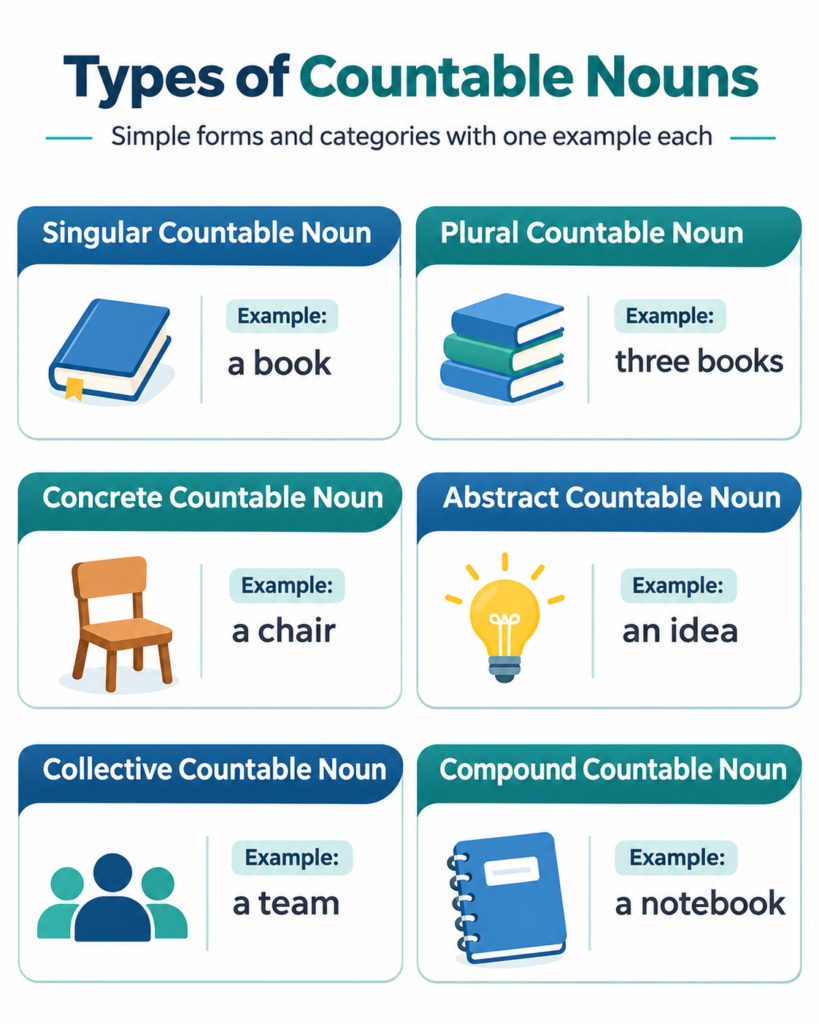
However, countable nouns are commonly studied through their singular and plural forms, as well as their overlap with other noun categories.
Singular Countable Nouns (एकवचन गणनीय संज्ञा)
A singular countable noun refers to one individual person, place, object, or countable concept.
Examples include a pen (एक कलम), an apple (एक सेब), one horse (एक घोड़ा), and a question (एक प्रश्न).
| Singular Countable Noun | Hindi Meaning |
|---|---|
| A student | एक विद्यार्थी |
| An umbrella | एक छाता |
| A computer | एक कंप्यूटर |
| One ticket | एक टिकट |
| A flower | एक फूल |
| An idea | एक विचार |
Example: A student is waiting outside.
Hindi: एक विद्यार्थी बाहर इंतज़ार कर रहा है।
The noun “student” refers to one person and uses a singular verb.
Plural Countable Nouns (बहुवचन गणनीय संज्ञा)
A plural countable noun refers to two or more individual units.
Plural nouns may follow regular or irregular formation patterns.
| Singular | Plural | Hindi Meaning |
|---|---|---|
| Pen | Pens | कलम / कलमें |
| Chair | Chairs | कुर्सी / कुर्सियाँ |
| City | Cities | शहर |
| Child | Children | बच्चा / बच्चे |
| Mouse | Mice | चूहा / चूहे |
| Foot | Feet | पैर |
Example: Several children are playing in the park.
Hindi: कई बच्चे पार्क में खेल रहे हैं।
The noun “children” is plural even though it does not end in “-s.”
Regular Plural Countable Nouns
Most countable nouns form their plural with -s, -es, or -ies, depending on their spelling.
| Rule | Singular | Plural |
|---|---|---|
| Add -s | Book | Books |
| Add -s | Tree | Trees |
| Add -es | Box | Boxes |
| Add -es | Bus | Buses |
| Consonant + y becomes -ies | City | Cities |
| Consonant + y becomes -ies | Baby | Babies |
| Vowel + y usually takes -s | Boy | Boys |
| Vowel + y usually takes -s | Key | Keys |
Words ending in “-f” or “-fe” may form plurals differently. For instance, “leaf” becomes “leaves,” but “roof” becomes “roofs.”
Irregular Plural Countable Nouns
Some nouns do not follow standard plural formation rules.
| Singular | Plural | Hindi Meaning |
|---|---|---|
| Man | Men | आदमी |
| Woman | Women | महिला / महिलाएँ |
| Child | Children | बच्चा / बच्चे |
| Tooth | Teeth | दाँत |
| Foot | Feet | पैर |
| Mouse | Mice | चूहा / चूहे |
| Goose | Geese | हंस |
| Person | People | व्यक्ति / लोग |
| Sheep | Sheep | भेड़ / भेड़ें |
| Deer | Deer | हिरण |
Example: Three women entered the room.
Hindi: तीन महिलाएँ कमरे में आईं।
The plural “women” must be learned separately rather than formed by adding “-s.”
Countable Nouns Across Other Noun Categories
A noun can be countable while also belonging to another noun category.
| Overlapping Category | Examples | Explanation |
|---|---|---|
| Concrete Countable Noun | Table, apple, suitcase | Physical objects counted individually |
| Abstract Countable Noun | Idea, suggestion, problem | Concepts or occurrences counted as units |
| Collective Countable Noun | Team, family, committee | Groups counted as separate units |
| Compound Countable Noun | Notebook, toothbrush, sister-in-law | Multiword or compound nouns with countable forms |
For example:
One team — एक टीम
Three teams — तीन टीमें
The word “team” is both a collective noun and a countable noun.
Similarly, “idea” is an abstract noun that can be counted: one idea, three ideas, and several ideas.
Countable Noun Grammar Rules
Countable nouns follow several important rules involving articles, quantifiers, numbers, and subject-verb agreement.
Rule 1. Use A or An with Singular Countable Nouns
An ordinary singular countable noun generally needs a determiner in English.
| Correct Expression | Hindi Meaning |
|---|---|
| A boy | एक लड़का |
| A teacher | एक शिक्षक |
| An apple | एक सेब |
| An umbrella | एक छाता |
| A useful idea | एक उपयोगी विचार |
The choice between a and an depends on the following sound, not simply the first written letter.
For example, a useful idea is correct because “useful” begins with a consonant sound.
Rule 2. Use Plural Forms After Numbers Greater Than One
English countable nouns normally appear in the plural after numbers such as two, five, and ten.
Incorrect: Three book.
Correct: Three books.
Hindi: तीन किताबें।
Some nouns have irregular or unchanged plural forms.
Two children and five deer are correct.
Rule 3. Use Many and Few with Plural Countable Nouns
Many, few, and a few are frequently used with plural countable nouns.
| Expression | Example | Hindi Meaning |
|---|---|---|
| Many | Many students | बहुत से विद्यार्थी |
| A few | A few questions | कुछ प्रश्न |
| Few | Few opportunities | बहुत कम अवसर |
| Several | Several books | कई किताबें |
| Fewer | Fewer mistakes | कम गलतियाँ |
A few generally indicates a small but positive number. Few often emphasizes that the number is insufficient or smaller than expected.
Rule 4. Use Fewer for Countable Units and Less for Uncountable Quantities
In standard formal usage, fewer is used for countable plural units, while less is generally used for uncountable quantities.
Fewer chairs — कम कुर्सियाँ
Less water — कम पानी
Fewer mistakes — कम गलतियाँ
Less information — कम जानकारी
Expressions involving time, money, measurements, and certain established phrases may use “less” even with numerical values.
Rule 5. Match Singular and Plural Subjects with Appropriate Verbs
Countable noun number affects subject-verb agreement.
| Singular Sentence | Plural Sentence |
|---|---|
| The boy is playing. | The boys are playing. |
| One girl has a book. | Three girls have books. |
| The child was sleeping. | The children were sleeping. |
| A car moves quickly. | The cars move quickly. |
Hindi Example:
लड़का पढ़ रहा है। — The boy is studying.
लड़के पढ़ रहे हैं। — The boys are studying.
Countable Noun Examples in Hindi with English Meaning
Countable nouns appear in everyday conversations involving people, animals, places, objects, and individual ideas.
The following examples show singular and plural forms with their Hindi equivalents.
Countable Nouns for People
Words referring to individual people can generally be counted using numbers such as one, two, and three.
| Singular Noun | Plural Noun | Hindi Singular | Hindi Plural |
|---|---|---|---|
| Boy | Boys | लड़का | लड़के |
| Girl | Girls | लड़की | लड़कियाँ |
| Student | Students | विद्यार्थी | विद्यार्थी |
| Teacher | Teachers | शिक्षक | शिक्षक |
| Child | Children | बच्चा | बच्चे |
| Doctor | Doctors | डॉक्टर | डॉक्टर |
| Farmer | Farmers | किसान | किसान |
| Woman | Women | महिला | महिलाएँ |
| Man | Men | आदमी | आदमी |
| Friend | Friends | दोस्त | दोस्त |
| Worker | Workers | मज़दूर | मज़दूर |
| Player | Players | खिलाड़ी | खिलाड़ी |
Example: Three students are reading.
Hindi: तीन विद्यार्थी पढ़ रहे हैं।
The word students is countable because individual students can be counted. The Hindi noun विद्यार्थी has the same direct form in singular and plural, but the number and verb indicate the plural meaning.
Countable Nouns for Animals and Birds
Individual animals and birds can be counted, although some English nouns have identical singular and plural forms.
| Singular Noun | Plural Noun | Hindi Meaning |
|---|---|---|
| Dog | Dogs | कुत्ता / कुत्ते |
| Cat | Cats | बिल्ली / बिल्लियाँ |
| Cow | Cows | गाय / गायें |
| Horse | Horses | घोड़ा / घोड़े |
| Elephant | Elephants | हाथी |
| Lion | Lions | शेर |
| Tiger | Tigers | बाघ |
| Bird | Birds | पक्षी |
| Rabbit | Rabbits | खरगोश |
| Monkey | Monkeys | बंदर |
| Sheep | Sheep | भेड़ / भेड़ें |
| Goose | Geese | हंस |
Example: Two horses are standing near the gate.
Hindi: दो घोड़े फाटक के पास खड़े हैं।
The English noun changes from “horse” to “horses.” Hindi also changes घोड़ा to घोड़े in this construction.
Countable Nouns for Objects and Things
Classroom supplies, household items, vehicles, and other individual objects provide common examples.
| Singular Noun | Plural Noun | Hindi Meaning |
|---|---|---|
| Book | Books | किताब / किताबें |
| Pen | Pens | कलम / कलमें |
| Pencil | Pencils | पेंसिल / पेंसिलें |
| Chair | Chairs | कुर्सी / कुर्सियाँ |
| Table | Tables | मेज़ / मेज़ें |
| Apple | Apples | सेब |
| Orange | Oranges | संतरा / संतरे |
| Box | Boxes | डिब्बा / डिब्बे |
| Bottle | Bottles | बोतल / बोतलें |
| Bag | Bags | बैग |
| Key | Keys | चाबी / चाबियाँ |
| Phone | Phones | फ़ोन |
| Watch | Watches | घड़ी / घड़ियाँ |
| Toy | Toys | खिलौना / खिलौने |
| Leaf | Leaves | पत्ता / पत्ते |
Example: There are four chairs in the classroom.
Hindi: कक्षा में चार कुर्सियाँ हैं।
The noun chairs (कुर्सियाँ) names individual objects that can be counted.
Countable Nouns for Places
Nouns referring to individual buildings, locations, or geographical units can have countable forms.
| Singular Noun | Plural Noun | Hindi Meaning |
|---|---|---|
| House | Houses | घर |
| School | Schools | विद्यालय |
| Village | Villages | गाँव |
| City | Cities | शहर |
| Country | Countries | देश |
| Hospital | Hospitals | अस्पताल |
| Garden | Gardens | बगीचा / बगीचे |
| Street | Streets | गली / गलियाँ |
| Room | Rooms | कमरा / कमरे |
| Library | Libraries | पुस्तकालय |
Example: The district has twenty villages.
Hindi: ज़िले में बीस गाँव हैं।
The noun “village” refers to an individual settlement, so it can be counted.
Countable Nouns for Ideas and Events
Countable nouns are not limited to things that can be seen or touched. An idea, decision, question, or event can also represent an individual unit.
| Singular Noun | Plural Noun | Hindi Meaning |
|---|---|---|
| Idea | Ideas | विचार |
| Question | Questions | प्रश्न |
| Answer | Answers | उत्तर |
| Decision | Decisions | निर्णय |
| Suggestion | Suggestions | सुझाव |
| Problem | Problems | समस्या / समस्याएँ |
| Dream | Dreams | सपना / सपने |
| Plan | Plans | योजना / योजनाएँ |
| Opportunity | Opportunities | अवसर |
| Mistake | Mistakes | गलती / गलतियाँ |
Example: She asked two questions.
Hindi: उसने दो प्रश्न पूछे।
A countable noun does not have to represent a physical object. The important feature is whether its referent can be counted as an individual unit.
Learn Hindi Numbers in Words for Countable Nouns
Hindi numbers such as एक (one), दो (two), and तीन (three) are used to express the quantity of countable nouns.
These numbers appear before nouns to indicate how many people, animals, places, or objects are being counted such as three books, seven children, and twelve chairs.
Hindi Numbers from 1 to 100
The following table shows Hindi numbers in words from 1 to 100, along with their use in everyday countable noun expressions.
| Number | Hindi Number Word | Example with Countable Noun |
|---|---|---|
| 1 | एक | एक किताब (One book) |
| 2 | दो | दो लड़के (Two boys) |
| 3 | तीन | तीन सेब (Three apples) |
| 4 | चार | चार कुर्सियाँ (Four chairs) |
| 5 | पाँच | पाँच फूल (Five flowers) |
| 6 | छह | छह पेंसिलें (Six pencils) |
| 7 | सात | सात बच्चे (Seven children) |
| 8 | आठ | आठ गाड़ियाँ (Eight vehicles) |
| 9 | नौ | नौ संतरे (Nine oranges) |
| 10 | दस | दस प्रश्न (Ten questions) |
| 11 | ग्यारह | ग्यारह विद्यार्थी (Eleven students) |
| 12 | बारह | बारह महीने (Twelve months) |
| 13 | तेरह | तेरह टिकट (Thirteen tickets) |
| 14 | चौदह | चौदह पक्षी (Fourteen birds) |
| 15 | पंद्रह | पंद्रह खिलौने (Fifteen toys) |
| 16 | सोलह | सोलह घर (Sixteen houses) |
| 17 | सत्रह | सत्रह डिब्बे (Seventeen boxes) |
| 18 | अठारह | अठारह पौधे (Eighteen plants) |
| 19 | उन्नीस | उन्नीस खिलाड़ी (Nineteen players) |
| 20 | बीस | बीस किताबें (Twenty books) |
| 21 | इक्कीस | इक्कीस सवाल (Twenty-one questions) |
| 22 | बाईस | बाईस दुकानें (Twenty-two shops) |
| 23 | तेईस | तेईस शिक्षक (Twenty-three teachers) |
| 24 | चौबीस | चौबीस कमरे (Twenty-four rooms) |
| 25 | पच्चीस | पच्चीस सिक्के (Twenty-five coins) |
| 26 | छब्बीस | छब्बीस पेड़ (Twenty-six trees) |
| 27 | सत्ताईस | सत्ताईस बैग (Twenty-seven bags) |
| 28 | अट्ठाईस | अट्ठाईस मेज़ें (Twenty-eight tables) |
| 29 | उनतीस | उनतीस चाबियाँ (Twenty-nine keys) |
| 30 | तीस | तीस छात्र (Thirty students) |
| 31 | इकतीस | इकतीस किताबें (Thirty-one books) |
| 32 | बत्तीस | बत्तीस कुर्सियाँ (Thirty-two chairs) |
| 33 | तैंतीस | तैंतीस पेंसिलें (Thirty-three pencils) |
| 34 | चौंतीस | चौंतीस बच्चे (Thirty-four children) |
| 35 | पैंतीस | पैंतीस फूल (Thirty-five flowers) |
| 36 | छत्तीस | छत्तीस खिलौने (Thirty-six toys) |
| 37 | सैंतीस | सैंतीस पक्षी (Thirty-seven birds) |
| 38 | अड़तीस | अड़तीस संतरे (Thirty-eight oranges) |
| 39 | उनतालीस | उनतालीस खिलाड़ी (Thirty-nine players) |
| 40 | चालीस | चालीस विद्यार्थी (Forty students) |
| 41 | इकतालीस | इकतालीस सवाल (Forty-one questions) |
| 42 | बयालीस | बयालीस दुकानें (Forty-two shops) |
| 43 | तैंतालीस | तैंतालीस शिक्षक (Forty-three teachers) |
| 44 | चवालीस | चवालीस कमरे (Forty-four rooms) |
| 45 | पैंतालीस | पैंतालीस सिक्के (Forty-five coins) |
| 46 | छियालीस | छियालीस पेड़ (Forty-six trees) |
| 47 | सैंतालीस | सैंतालीस बैग (Forty-seven bags) |
| 48 | अड़तालीस | अड़तालीस मेज़ें (Forty-eight tables) |
| 49 | उनचास | उनचास चाबियाँ (Forty-nine keys) |
| 50 | पचास | पचास छात्र (Fifty students) |
| 51 | इक्यावन | इक्यावन किताबें (Fifty-one books) |
| 52 | बावन | बावन लड़के (Fifty-two boys) |
| 53 | तिरपन | तिरपन सेब (Fifty-three apples) |
| 54 | चौवन | चौवन कुर्सियाँ (Fifty-four chairs) |
| 55 | पचपन | पचपन फूल (Fifty-five flowers) |
| 56 | छप्पन | छप्पन पेंसिलें (Fifty-six pencils) |
| 57 | सत्तावन | सत्तावन बच्चे (Fifty-seven children) |
| 58 | अट्ठावन | अट्ठावन गाड़ियाँ (Fifty-eight vehicles) |
| 59 | उनसठ | उनसठ संतरे (Fifty-nine oranges) |
| 60 | साठ | साठ प्रश्न (Sixty questions) |
| 61 | इकसठ | इकसठ विद्यार्थी (Sixty-one students) |
| 62 | बासठ | बासठ महीने (Sixty-two months) |
| 63 | तिरसठ | तिरसठ टिकट (Sixty-three tickets) |
| 64 | चौंसठ | चौंसठ पक्षी (Sixty-four birds) |
| 65 | पैंसठ | पैंसठ खिलौने (Sixty-five toys) |
| 66 | छियासठ | छियासठ घर (Sixty-six houses) |
| 67 | सड़सठ | सड़सठ डिब्बे (Sixty-seven boxes) |
| 68 | अड़सठ | अड़सठ पौधे (Sixty-eight plants) |
| 69 | उनहत्तर | उनहत्तर खिलाड़ी (Sixty-nine players) |
| 70 | सत्तर | सत्तर किताबें (Seventy books) |
| 71 | इकहत्तर | इकहत्तर सवाल (Seventy-one questions) |
| 72 | बहत्तर | बहत्तर दुकानें (Seventy-two shops) |
| 73 | तिहत्तर | तिहत्तर शिक्षक (Seventy-three teachers) |
| 74 | चौहत्तर | चौहत्तर कमरे (Seventy-four rooms) |
| 75 | पचहत्तर | पचहत्तर सिक्के (Seventy-five coins) |
| 76 | छिहत्तर | छिहत्तर पेड़ (Seventy-six trees) |
| 77 | सतहत्तर | सतहत्तर बैग (Seventy-seven bags) |
| 78 | अठहत्तर | अठहत्तर मेज़ें (Seventy-eight tables) |
| 79 | उनासी | उनासी चाबियाँ (Seventy-nine keys) |
| 80 | अस्सी | अस्सी छात्र (Eighty students) |
| 81 | इक्यासी | इक्यासी किताबें (Eighty-one books) |
| 82 | बयासी | बयासी लड़के (Eighty-two boys) |
| 83 | तिरासी | तिरासी सेब (Eighty-three apples) |
| 84 | चौरासी | चौरासी कुर्सियाँ (Eighty-four chairs) |
| 85 | पचासी | पचासी फूल (Eighty-five flowers) |
| 86 | छियासी | छियासी पेंसिलें (Eighty-six pencils) |
| 87 | सतासी | सतासी बच्चे (Eighty-seven children) |
| 88 | अट्ठासी | अट्ठासी गाड़ियाँ (Eighty-eight vehicles) |
| 89 | नवासी | नवासी संतरे (Eighty-nine oranges) |
| 90 | नब्बे | नब्बे प्रश्न (Ninety questions) |
| 91 | इक्यानवे | इक्यानवे विद्यार्थी (Ninety-one students) |
| 92 | बानवे | बानवे महीने (Ninety-two months) |
| 93 | तिरानवे | तिरानवे टिकट (Ninety-three tickets) |
| 94 | चौरानवे | चौरानवे पक्षी (Ninety-four birds) |
| 95 | पचानवे | पचानवे खिलौने (Ninety-five toys) |
| 96 | छियानवे | छियानवे घर (Ninety-six houses) |
| 97 | सतानवे | सतानवे डिब्बे (Ninety-seven boxes) |
| 98 | अट्ठानवे | अट्ठानवे पौधे (Ninety-eight plants) |
| 99 | निन्यानवे | निन्यानवे खिलाड़ी (Ninety-nine players) |
| 100 | एक सौ | एक सौ किताबें (One hundred books) |
Using Hindi Numbers with Nouns
In both English and Hindi, a number normally appears before the noun being counted.
English: Five girls are reading.
Hindi: पाँच लड़कियाँ पढ़ रही हैं।
English: I bought eight pencils.
Hindi: मैंने आठ पेंसिलें खरीदीं।
An important difference is that English plural countable nouns normally take plural forms after numbers greater than one, whereas some Hindi nouns have identical singular and plural direct forms.
Compare:
एक विद्यार्थी (One student)
दस विद्यार्थी (Ten students)
The noun विद्यार्थी remains unchanged, but the quantity changes.
Countable Noun and Uncountable Noun Difference in Hindi
Countable and uncountable nouns behave differently when used with numbers, articles, quantifiers, and plural forms.
| Feature | Countable Noun | Uncountable Noun |
|---|---|---|
| Hindi Name | गणनीय संज्ञा | अगणनीय संज्ञा |
| Individual counting | Usually possible | Not normally possible in the relevant sense |
| Singular/plural distinction | Usually present | Usually absent |
| Examples | Book, chair, apple | Water, advice, information |
| Singular article | A book, an apple | Not normally a water |
| Common quantifiers | Many, few, fewer | Much, little, less |
| Quantity example | Three apples | Three liters of water |
Common Countable and Uncountable Noun Pairs
| Countable Noun | Hindi Meaning | Uncountable Noun | Hindi Meaning |
|---|---|---|---|
| Apple | सेब | Rice | चावल |
| Chair | कुर्सी | Furniture | फर्नीचर |
| Suggestion | सुझाव | Advice | सलाह |
| Question | प्रश्न | Information | जानकारी |
| Suitcase | सूटकेस | Luggage | सामान |
| Coin | सिक्का | Money | धन / पैसा |
| Tool | औज़ार | Equipment | उपकरण-सामग्री |
| Loaf | पाव रोटी | Bread | रोटी / ब्रेड |
A noun’s countability depends on its meaning in a particular context. Words such as “glass,” “paper,” and “coffee” can be countable or uncountable.
For example:
Glass is fragile. — काँच नाज़ुक होता है।
I bought two glasses. — मैंने दो गिलास खरीदे।
In the first sentence, “glass” names a substance. In the second, it names individual drinking containers.
Countable Noun Sentence Examples in Hindi
These sentences show countable nouns used as subjects, objects, and complements in everyday English.
| No. | English Sentence | Hindi Meaning |
|---|---|---|
| 1 | I bought two books. | मैंने दो किताबें खरीदीं। |
| 2 | The boy opened the door. | लड़के ने दरवाज़ा खोला। |
| 3 | Five birds are sitting in the tree. | पाँच पक्षी पेड़ पर बैठे हैं। |
| 4 | We need three chairs. | हमें तीन कुर्सियाँ चाहिए। |
| 5 | The teacher asked a question. | शिक्षक ने एक प्रश्न पूछा। |
| 6 | Seven children entered the room. | सात बच्चे कमरे में आए। |
| 7 | She has an umbrella. | उसके पास एक छाता है। |
| 8 | The farmer owns four cows. | किसान के पास चार गायें हैं। |
| 9 | There are two windows in the room. | कमरे में दो खिड़कियाँ हैं। |
| 10 | The students completed their homework. | विद्यार्थियों ने अपना गृहकार्य पूरा किया। |
| 11 | I have an interesting idea. | मेरे पास एक दिलचस्प विचार है। |
| 12 | She made three suggestions. | उसने तीन सुझाव दिए। |
| 13 | The team won the competition. | टीम ने प्रतियोगिता जीत ली। |
| 14 | We visited two museums. | हमने दो संग्रहालय देखे। |
| 15 | The doctor examined five patients. | डॉक्टर ने पाँच मरीज़ों की जाँच की। |
| 16 | He bought a new bicycle. | उसने एक नई साइकिल खरीदी। |
| 17 | Six boxes arrived today. | आज छह डिब्बे पहुँचे। |
| 18 | The woman carried a bag. | महिला ने एक बैग उठाया। |
| 19 | They planted ten trees. | उन्होंने दस पेड़ लगाए। |
| 20 | This question has two answers. | इस प्रश्न के दो उत्तर हैं। |
Notice that idea, suggestion, and question are abstract or conceptual countable nouns. Their countability does not depend on whether the referent is physical.
Common Mistakes with Countable Nouns
Errors with countable nouns commonly involve articles, number agreement, irregular plurals, and countability differences.
Mistake 1. Omitting Articles Before Singular Countable Nouns
Incorrect: I bought pencil.
Correct: I bought a pencil.
Hindi: मैंने एक पेंसिल खरीदी।
An ordinary singular countable noun generally requires a determiner such as “a,” “an,” “the,” or “my.”
Mistake 2. Using Singular Nouns After Plural Numbers
Incorrect: She has five book.
Correct: She has five books.
Hindi: उसके पास पाँच किताबें हैं।
Mistake 3. Adding S to Every Irregular Plural
| Incorrect | Correct |
|---|---|
| Childs | Children |
| Womans | Women |
| Mouses (for animals) | Mice |
| Tooths | Teeth |
| Deers | Deer |
English irregular plural forms need to be learned separately.
Mistake 4. Using Much Instead of Many
Incorrect: Much students attended the class.
Correct: Many students attended the class.
Hindi: बहुत से विद्यार्थी कक्षा में उपस्थित हुए।
Use many with plural countable nouns and much with uncountable nouns in their usual meanings.
Mistake 5. Treating Every Abstract Noun as Uncountable
An abstract noun may be countable when it names separate ideas, occurrences, or results.
For example:
Three decisions — तीन निर्णय
Five opportunities — पाँच अवसर
Two suggestions — दो सुझाव
Abstract describes the type of meaning, while countable describes grammatical behavior.
Countable Noun in Hindi Worksheet
Practice गणनीय संज्ञा with 25 questions covering singular and plural forms, countable noun identification, Hindi number words, articles, and grammar rules.
Select the correct answers, check your score, and use the exercises to identify areas that need more practice.
Countable Noun in Hindi Worksheet
गणनीय संज्ञा · 25 multiple-choice questions · English–Hindi grammar practice
Select one answer per question. Check your answers to view the score and correct explanations.
Download Printable Countable Noun Worksheet
The printable worksheet contains 25 multiple-choice questions with a separate answer key. It can be used for classroom assignments, homework, or offline grammar revision.
Frequently Asked Questions
These questions address additional points about countable nouns that are useful in sentence construction.
Can a countable noun have the same si ngular and plural form?
Yes. Some English countable nouns retain the same spelling in singular and plural uses.
For example, one deer and five deer are both correct. The same pattern occurs with sheep, and often with fish when referring to multiple individual fish.
The number or surrounding sentence determines whether the noun has a singular or plural meaning.
Is a dozen a countable noun?
Yes. Dozen can function as a countable unit noun representing twelve items.
For example, a dozen eggs means twelve eggs, while two dozen eggs means twenty-four eggs.
The expression dozens of eggs refers to many eggs without specifying an exact number.
Can a noun change between countable and uncountable meanings?
Yes. Some nouns have different countability patterns depending on their meaning.
For example:
I have three chickens. — मेरे पास तीन मुर्गियाँ हैं।
Here, “chickens” refers to individual birds and is countable.
We ate chicken for dinner. — हमने रात के खाने में चिकन खाया।
Here, “chicken” refers to meat and is normally uncountable.
Download Countable Noun in Hindi PDF
The noun lists, singular and plural forms, Hindi number words, and grammar rules from this lesson are also available for you as a PDF reference.
Save it for offline reading or print a copy to revise countable nouns (गणनीय संज्ञा) and practice their English-Hindi usage without reopening the article.
Conclusion
A shopping list offers a simple way to check noun countability. Write three apples, two bottles, and five notebooks, then compare them with some rice or a liter of milk. The first group contains nouns counted as individual units. The second contains substances measured through quantities.
Now correct these expressions: four childs, three box, and many information. Also try writing the Hindi equivalents of seven books and twelve students.
Post your corrected answers in the comments and add another countable noun with its Hindi singular and plural forms.
Leave a Reply