The morning market is already crowded. A fruit seller arranges fresh apples (सेब), a bicycle (साइकिल) passes through the street, and the smell of hot tea (चाय) drifts from a nearby shop. You can see the apples, hear the bicycle bell, and smell the tea. Each experience connects to something physically real.
In English grammar, words that name things we can experience through our five senses are called concrete nouns, known as मूर्त संज्ञा in Hindi. A mountain (पहाड़), bird (पक्षी), and perfume (इत्र) are concrete nouns, although we experience them in different ways.
Here’s where grammar becomes interesting: water is concrete, but we cannot count it like bottles. A team represents several people but acts as one collective noun.
These differences make the types and grammar rules of concrete nouns worth understanding.
Types of Concrete Noun in Hindi
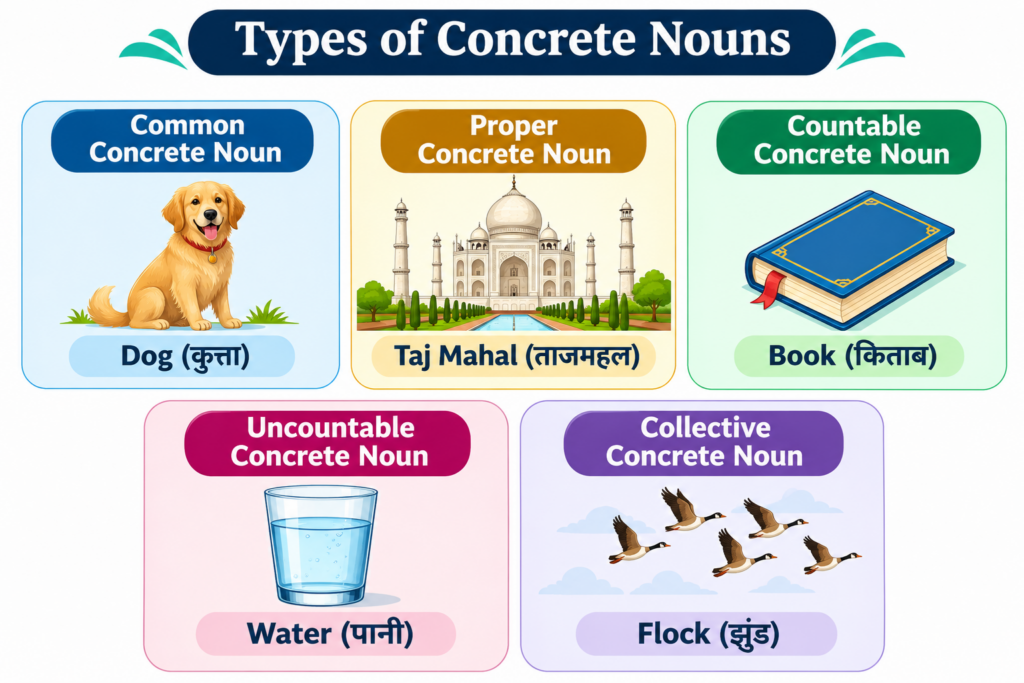
Concrete nouns overlap with several other noun categories. The five groups below show how physical people, places, objects, and substances can be classified.
1. Common Concrete Nouns
Common concrete nouns name ordinary people, places, animals, or physical things without identifying a specific one.
Examples: teacher (शिक्षक), city (शहर), horse (घोड़ा), table (मेज़).
2. Proper Concrete Nouns
Proper concrete nouns identify particular people, places, landmarks, or other named physical entities. They begin with capital letters in English.
Examples: Delhi (दिल्ली), Mount Everest (माउंट एवरेस्ट), Ravi (रवि), Taj Mahal (ताजमहल).
3. Countable Concrete Nouns
Countable concrete nouns refer to separate physical items that can be numbered and usually have singular and plural forms.
Examples: one pen (एक कलम), two chairs (दो कुर्सियाँ), three apples (तीन सेब).
4. Uncountable Concrete Nouns
Uncountable concrete nouns name physical substances or materials that are usually measured as quantities rather than counted individually.
Examples: water (पानी), milk (दूध), sand (रेत), gold (सोना).
5. Collective Concrete Nouns
Collective concrete nouns name groups of physical people, animals, or objects considered together.
Examples: a flock of birds (पक्षियों का झुंड), a herd of cattle (मवेशियों का झुंड), a fleet of ships (जहाज़ों का बेड़ा).
Concrete Noun Grammar Rules
Concrete nouns follow the usual rules of English nouns, including number, articles, possession, capitalization, and subject-verb agreement.
Their correct forms depend on whether they are countable, uncountable, common, or proper.
Rule 1: Countable Concrete Nouns Have Singular and Plural Forms
Most countable concrete nouns form their plurals by adding -s or -es, although some have irregular plurals.
| Singular | Plural | Hindi Meaning |
|---|---|---|
| Book | Books | किताब / किताबें |
| Box | Boxes | डिब्बा / डिब्बे |
| Bus | Buses | बस / बसें |
| Child | Children | बच्चा / बच्चे |
| Tooth | Teeth | दाँत |
| Foot | Feet | पैर |
| Mouse | Mice | चूहा / चूहे |
| Leaf | Leaves | पत्ता / पत्ते |
Rule 2: Singular Countable Concrete Nouns Usually Need a Determiner
Singular countable common nouns normally appear with a, an, the, or another determiner.
| Incorrect | Correct |
|---|---|
| I bought book. | I bought a book. |
| She has umbrella. | She has an umbrella. |
| Boy is running. | The boy is running. |
| This is my bicycle. | This is my bicycle. |
Rule 3: Use Singular or Plural Verbs According to the Subject
Concrete nouns can take either singular or plural verbs depending on their number and grammatical use.
| Singular Sentence | Plural Sentence |
|---|---|
| The dog is barking. | The dogs are barking. |
| The flower smells sweet. | The flowers smell sweet. |
| The child plays outside. | The children play outside. |
| The chair was broken. | The chairs were broken. |
Rule 4: Physical Substances Often Use Uncountable Forms
A material is generally uncountable when referred to as a substance, although individual portions or objects made from it may be counted.
- The glass is clean. (A drinking vessel)
- The window is made of glass. (A material)
- I bought three cups. (Countable objects)
- There is some milk in the cups. (An uncountable substance)
Rule 5: Proper Concrete Nouns Begin with Capital Letters
In English, the names of specific people, locations, and buildings are capitalized.
| Common Noun | Proper Noun |
|---|---|
| City | Mumbai |
| River | The Ganga |
| Monument | India Gate |
| Mountain | Mount Everest |
| Person | Anjali |
Rule 6: Concrete Nouns Can Show Possession
The possessive form shows ownership or a relationship between a concrete noun and another noun.
Examples:
- The boy’s bicycle — लड़के की साइकिल
- The teacher’s chair — शिक्षक की कुर्सी
- The dog’s collar — कुत्ते का पट्टा
- The children’s toys — बच्चों के खिलौने
Rule 7: Concrete Nouns Can Be Identified Through Different Senses
A concrete noun requires a physical or sensory referent, but not every noun must be perceived through all five senses.
| Sense | Concrete Noun | Hindi Meaning |
|---|---|---|
| Sight | Rainbow | इंद्रधनुष |
| Hearing | Thunder | गरज |
| Smell | Perfume | इत्र |
| Taste | Lemon | नींबू |
| Touch | Stone | पत्थर |
Concrete Noun Examples in Hindi
Concrete nouns include physical people, places, animals, objects, food, and natural things. The following six categories contain 30 English-Hindi examples each.
1. Concrete Nouns for People — 30 Examples
These nouns name people who can be physically seen, heard, or touched.
| No. | English Noun | Hindi Meaning |
|---|---|---|
| 1 | Boy | लड़का |
| 2 | Girl | लड़की |
| 3 | Man | आदमी |
| 4 | Woman | महिला |
| 5 | Baby | शिशु |
| 6 | Father | पिता |
| 7 | Mother | माँ |
| 8 | Brother | भाई |
| 9 | Sister | बहन |
| 10 | Grandfather | दादा / नाना |
| 11 | Grandmother | दादी / नानी |
| 12 | Doctor | डॉक्टर |
| 13 | Nurse | नर्स |
| 14 | Farmer | किसान |
| 15 | Driver | चालक |
| 16 | Soldier | सैनिक |
| 17 | Police officer | पुलिस अधिकारी |
| 18 | Shopkeeper | दुकानदार |
| 19 | Carpenter | बढ़ई |
| 20 | Tailor | दर्ज़ी |
| 21 | Baker | रोटी बनाने वाला |
| 22 | Pilot | विमान चालक |
| 23 | Engineer | अभियंता |
| 24 | Scientist | वैज्ञानिक |
| 25 | Artist | कलाकार |
| 26 | Dancer | नर्तक / नर्तकी |
| 27 | Actor | अभिनेता |
| 28 | Chef | रसोइया |
| 29 | Mechanic | मिस्त्री |
| 30 | Gardener | माली |
2. Concrete Nouns for Places — 30 Examples
These nouns refer to physical locations, buildings, and spaces that people can visit or observe.
| No. | English Noun | Hindi Meaning |
|---|---|---|
| 1 | School | विद्यालय |
| 2 | College | महाविद्यालय |
| 3 | University | विश्वविद्यालय |
| 4 | Hospital | अस्पताल |
| 5 | Library | पुस्तकालय |
| 6 | Market | बाज़ार |
| 7 | Shop | दुकान |
| 8 | Restaurant | रेस्तराँ |
| 9 | Hotel | होटल |
| 10 | Airport | हवाई अड्डा |
| 11 | Railway station | रेलवे स्टेशन |
| 12 | Bus stop | बस स्टॉप |
| 13 | Park | उद्यान |
| 14 | Playground | खेल का मैदान |
| 15 | Stadium | स्टेडियम |
| 16 | Museum | संग्रहालय |
| 17 | Cinema | सिनेमाघर |
| 18 | Zoo | चिड़ियाघर |
| 19 | Farm | खेत |
| 20 | Factory | कारखाना |
| 21 | Warehouse | गोदाम |
| 22 | Office | कार्यालय |
| 23 | Bank | बैंक |
| 24 | Post office | डाकघर |
| 25 | Police station | पुलिस थाना |
| 26 | Temple | मंदिर |
| 27 | Mosque | मस्जिद |
| 28 | Church | गिरजाघर |
| 29 | Bridge | पुल |
| 30 | Harbor | बंदरगाह |
3. Concrete Nouns for Animals and Birds — 30 Examples
Animals and birds are concrete nouns because they have physical bodies and can be perceived through the senses.
| No. | English Noun | Hindi Meaning |
|---|---|---|
| 1 | Dog | कुत्ता |
| 2 | Cat | बिल्ली |
| 3 | Cow | गाय |
| 4 | Buffalo | भैंस |
| 5 | Goat | बकरी |
| 6 | Sheep | भेड़ |
| 7 | Horse | घोड़ा |
| 8 | Donkey | गधा |
| 9 | Camel | ऊँट |
| 10 | Elephant | हाथी |
| 11 | Lion | शेर |
| 12 | Tiger | बाघ |
| 13 | Leopard | तेंदुआ |
| 14 | Bear | भालू |
| 15 | Monkey | बंदर |
| 16 | Deer | हिरण |
| 17 | Rabbit | खरगोश |
| 18 | Fox | लोमड़ी |
| 19 | Wolf | भेड़िया |
| 20 | Squirrel | गिलहरी |
| 21 | Sparrow | गौरैया |
| 22 | Pigeon | कबूतर |
| 23 | Crow | कौआ |
| 24 | Parrot | तोता |
| 25 | Peacock | मोर |
| 26 | Eagle | गरुड़ / चील |
| 27 | Owl | उल्लू |
| 28 | Duck | बत्तख |
| 29 | Swan | हंस |
| 30 | Woodpecker | कठफोड़वा |
4. Concrete Nouns for Objects and Things — 30 Examples
These nouns identify everyday physical objects that can be picked up, moved, seen, or touched.
| No. | English Noun | Hindi Meaning |
|---|---|---|
| 1 | Book | किताब |
| 2 | Notebook | कॉपी |
| 3 | Pen | कलम |
| 4 | Pencil | पेंसिल |
| 5 | Eraser | रबर |
| 6 | Ruler | फुटपट्टी |
| 7 | Backpack | बस्ता |
| 8 | Chair | कुर्सी |
| 9 | Table | मेज़ |
| 10 | Desk | लिखने की मेज़ |
| 11 | Cupboard | अलमारी |
| 12 | Bed | बिस्तर |
| 13 | Pillow | तकिया |
| 14 | Blanket | कंबल |
| 15 | Mirror | आईना |
| 16 | Clock | घड़ी |
| 17 | Watch | कलाई घड़ी |
| 18 | Mobile phone | मोबाइल फ़ोन |
| 19 | Laptop | लैपटॉप |
| 20 | Television | टेलीविज़न |
| 21 | Fan | पंखा |
| 22 | Refrigerator | फ्रिज |
| 23 | Bottle | बोतल |
| 24 | Plate | थाली |
| 25 | Spoon | चम्मच |
| 26 | Fork | काँटा |
| 27 | Knife | चाकू |
| 28 | Bucket | बाल्टी |
| 29 | Umbrella | छाता |
| 30 | Bicycle | साइकिल |
5. Concrete Nouns for Food and Drinks — 30 Examples
Food and drinks are concrete because they have sensory qualities such as taste, smell, texture, or physical appearance.
| No. | English Noun | Hindi Meaning |
|---|---|---|
| 1 | Apple | सेब |
| 2 | Banana | केला |
| 3 | Mango | आम |
| 4 | Orange | संतरा |
| 5 | Grapes | अंगूर |
| 6 | Guava | अमरूद |
| 7 | Papaya | पपीता |
| 8 | Pineapple | अनानास |
| 9 | Watermelon | तरबूज़ |
| 10 | Pomegranate | अनार |
| 11 | Carrot | गाजर |
| 12 | Potato | आलू |
| 13 | Onion | प्याज़ |
| 14 | Tomato | टमाटर |
| 15 | Cucumber | खीरा |
| 16 | Cabbage | पत्तागोभी |
| 17 | Spinach | पालक |
| 18 | Bread | ब्रेड / रोटी |
| 19 | Rice | चावल |
| 20 | Butter | मक्खन |
| 21 | Cheese | पनीर / चीज़ |
| 22 | Yogurt | दही |
| 23 | Milk | दूध |
| 24 | Water | पानी |
| 25 | Tea | चाय |
| 26 | Coffee | कॉफ़ी |
| 27 | Honey | शहद |
| 28 | Sugar | चीनी |
| 29 | Salt | नमक |
| 30 | Soup | सूप |
6. Concrete Nouns for Nature and the Environment — 30 Examples
These nouns name natural objects, physical landforms, weather-related substances, and other elements of the physical environment.
| No. | English Noun | Hindi Meaning |
|---|---|---|
| 1 | Tree | पेड़ |
| 2 | Leaf | पत्ता |
| 3 | Flower | फूल |
| 4 | Grass | घास |
| 5 | Root | जड़ |
| 6 | Seed | बीज |
| 7 | Branch | डाली |
| 8 | Bark | पेड़ की छाल |
| 9 | River | नदी |
| 10 | Lake | झील |
| 11 | Pond | तालाब |
| 12 | Ocean | महासागर |
| 13 | Waterfall | झरना |
| 14 | Mountain | पर्वत |
| 15 | Hill | पहाड़ी |
| 16 | Valley | घाटी |
| 17 | Rock | चट्टान |
| 18 | Pebble | कंकड़ |
| 19 | Sand | रेत |
| 20 | Soil | मिट्टी |
| 21 | Mud | कीचड़ |
| 22 | Snow | बर्फ़ |
| 23 | Ice | बर्फ़ |
| 24 | Rain | बारिश |
| 25 | Cloud | बादल |
| 26 | Fog | कोहरा |
| 27 | Smoke | धुआँ |
| 28 | Dew | ओस |
| 29 | Sunlight | सूरज की रोशनी |
| 30 | Rainbow | इंद्रधनुष |
Some of the listed words, including bread, rice, water, sand, and sunlight, are uncountable nouns. They are still concrete because they refer to physical substances or phenomena rather than purely abstract ideas.
Concrete Noun Examples with Pictures in Hindi
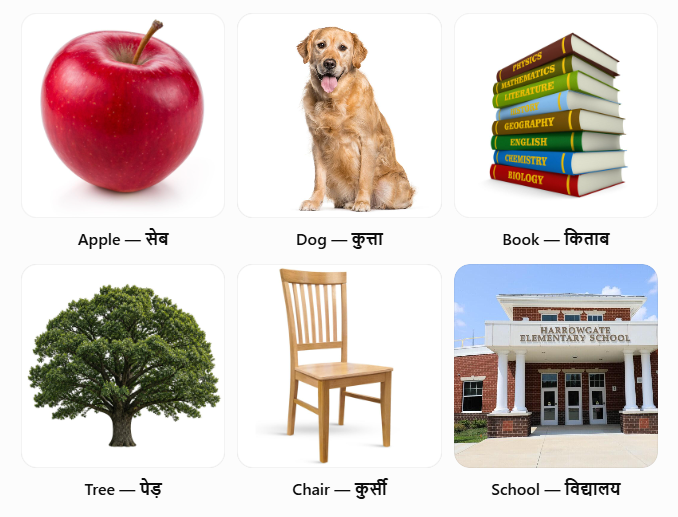
Pictures help learners associate English nouns with visible objects, people, animals, and places. The examples below show familiar concrete nouns with their Hindi names.
Concrete vs Abstract in Hindi
The difference between concrete and abstract nouns is based on whether the noun refers to something physically perceptible or to a quality, feeling, concept, or mental state.
| Feature | Concrete Noun (मूर्त संज्ञा) | Abstract Noun (अमूर्त संज्ञा) |
|---|---|---|
| Meaning | Physical or sensory entity | Idea, feeling, quality, or state |
| Five senses | Perceived through at least one sense | Not directly perceived as a physical thing |
| Examples | Tree, bell, perfume | Honesty, freedom, courage |
| Hindi examples | पेड़, घंटी, इत्र | ईमानदारी, स्वतंत्रता, साहस |
| Countability | Can be countable or uncountable | Can be countable or uncountable |
Concrete and Abstract Noun Examples
| Concrete Noun | Hindi Meaning | Abstract Noun | Hindi Meaning |
|---|---|---|---|
| Child | बच्चा | Childhood | बचपन |
| Friend | मित्र | Friendship | मित्रता |
| Artist | कलाकार | Creativity | रचनात्मकता |
| Soldier | सैनिक | Bravery | बहादुरी |
| Judge | न्यायाधीश | Justice | न्याय |
| Student | विद्यार्थी | Knowledge | ज्ञान |
| Doctor | चिकित्सक | Health | स्वास्थ्य |
| Athlete | खिलाड़ी | Strength | शक्ति |
| Singer | गायक | Talent | प्रतिभा |
| Family | परिवार | Love | प्रेम |
A useful distinction is that music can be concrete when referring to audible sound, whereas happiness is abstract even when happiness is expressed through visible behavior.
Concrete And Abstract Nouns Worksheet With Answers Pdf
Practice the difference between concrete and abstract nouns with this English-Hindi worksheet.
Identify noun types, complete exercises, and check your answers using the answer key provided in the PDF.
Concrete Noun Sentences in English and Hindi
These sentences show concrete nouns functioning as subjects, objects, and complements. Each example identifies a physical entity and provides a natural Hindi translation.
| No. | English Sentence | Hindi Translation |
|---|---|---|
| 1 | The boy is reading a book. | लड़का किताब पढ़ रहा है। |
| 2 | The girl opened the window. | लड़की ने खिड़की खोली। |
| 3 | My father drives a car. | मेरे पिता कार चलाते हैं। |
| 4 | The doctor examined the patient. | डॉक्टर ने मरीज़ की जाँच की। |
| 5 | The farmer works in the field. | किसान खेत में काम करता है। |
| 6 | The school is near the park. | विद्यालय उद्यान के पास है। |
| 7 | We visited the museum yesterday. | हम कल संग्रहालय गए थे। |
| 8 | The train arrived at the station. | रेलगाड़ी स्टेशन पर पहुँची। |
| 9 | There is a bridge over the river. | नदी पर एक पुल है। |
| 10 | The hospital has a new building. | अस्पताल में एक नई इमारत है। |
| 11 | The dog is sleeping outside. | कुत्ता बाहर सो रहा है। |
| 12 | A cat jumped onto the wall. | एक बिल्ली दीवार पर कूद गई। |
| 13 | The elephant walked slowly. | हाथी धीरे-धीरे चला। |
| 14 | The birds are flying above the trees. | पक्षी पेड़ों के ऊपर उड़ रहे हैं। |
| 15 | A horse is running across the field. | घोड़ा मैदान में दौड़ रहा है। |
| 16 | I bought a new notebook. | मैंने एक नई कॉपी खरीदी। |
| 17 | The phone is on the table. | फ़ोन मेज़ पर है। |
| 18 | She filled the bottle with water. | उसने बोतल में पानी भरा। |
| 19 | The chair is made of wood. | कुर्सी लकड़ी की बनी है। |
| 20 | He repaired the bicycle. | उसने साइकिल की मरम्मत की। |
| 21 | The apple tastes sweet. | सेब का स्वाद मीठा है। |
| 22 | The milk is warm. | दूध गर्म है। |
| 23 | She cooked rice for lunch. | उसने दोपहर के खाने के लिए चावल पकाए। |
| 24 | The honey smells pleasant. | शहद की खुशबू अच्छी है। |
| 25 | I cut the mango into pieces. | मैंने आम के टुकड़े किए। |
| 26 | The tree provides shade. | पेड़ छाया देता है। |
| 27 | The mountain is covered with snow. | पर्वत बर्फ़ से ढका हुआ है। |
| 28 | Heavy rain flooded the road. | तेज़ बारिश से सड़क पर पानी भर गया। |
| 29 | The flowers smell wonderful. | फूलों से बहुत अच्छी खुशबू आती है। |
| 30 | The stone feels smooth. | पत्थर छूने पर चिकना लगता है। |
Common Mistakes with Concrete Nouns
Concrete nouns are often confused with abstract nouns, and learners sometimes assume every concrete noun must be visible or countable. The following corrections address these problems.
Mistake 1: Thinking Only Visible Objects Are Concrete
Incorrect assumption: If something cannot be seen, it must be abstract.
Correct explanation: Air (हवा) and music (संगीत) can be concrete because they are felt or heard through the senses.
Mistake 2: Treating Every Concrete Noun as Countable
Incorrect assumption: Every concrete noun has singular and plural forms.
Correct explanation: Water (पानी), gold (सोना), and sand (रेत) are concrete but usually uncountable.
Mistake 3: Assuming All Abstract Nouns Are Uncountable
Incorrect assumption: Abstract nouns cannot be counted.
Correct explanation: An idea, two decisions, and three suggestions are countable abstract nouns.
Mistake 4: Confusing Proper Nouns with Abstract Nouns
Incorrect assumption: A specific name cannot be a concrete noun.
Correct explanation: Delhi, the Taj Mahal, and the name of a physical person can function as proper concrete nouns.
Mistake 5: Using Incorrect Plural Forms
Incorrect: Three childs are playing.
Correct: Three children are playing.
Mistake 6: Using A or An with Uncountable Materials
Incorrect: She bought a gold.
Correct: She bought some gold.
Mistake 7: Classifying Every Feeling as Concrete
Incorrect assumption: Because anger has physical effects, anger is a concrete noun.
Correct explanation: Anger (गुस्सा) is abstract because it names an emotional state, not the physical actions or expressions associated with it.
Concrete Noun Worksheet in Hindi
Use the following exercises to practice identifying concrete nouns and distinguishing them from abstract nouns.
Concrete Noun in Hindi Worksheet
25 questions on concrete nouns, noun types, and concrete vs abstract nouns.
Answered: 0 / 25
Frequently Asked Questions
1. Can a concrete noun also be a collective noun?
Yes. A flock of birds and a herd of elephants are collective expressions referring to groups of physical animals.
2. Can the same word be both concrete and abstract?
Some words change classification according to meaning. For instance, work may describe an abstract activity, while a work of art refers to a particular creation that can be physically displayed.
Conclusion
When identifying a concrete noun, think about what the word names rather than whether it is singular, plural, common, or proper. A physical substance such as water and a countable object such as a bottle can both be concrete, although their grammar differs.
Look around your room and identify five concrete nouns. Then name two abstract nouns connected to what you are doing, such as interest or concentration.
Write your answers in the comments and compare the difference.
Leave a Reply