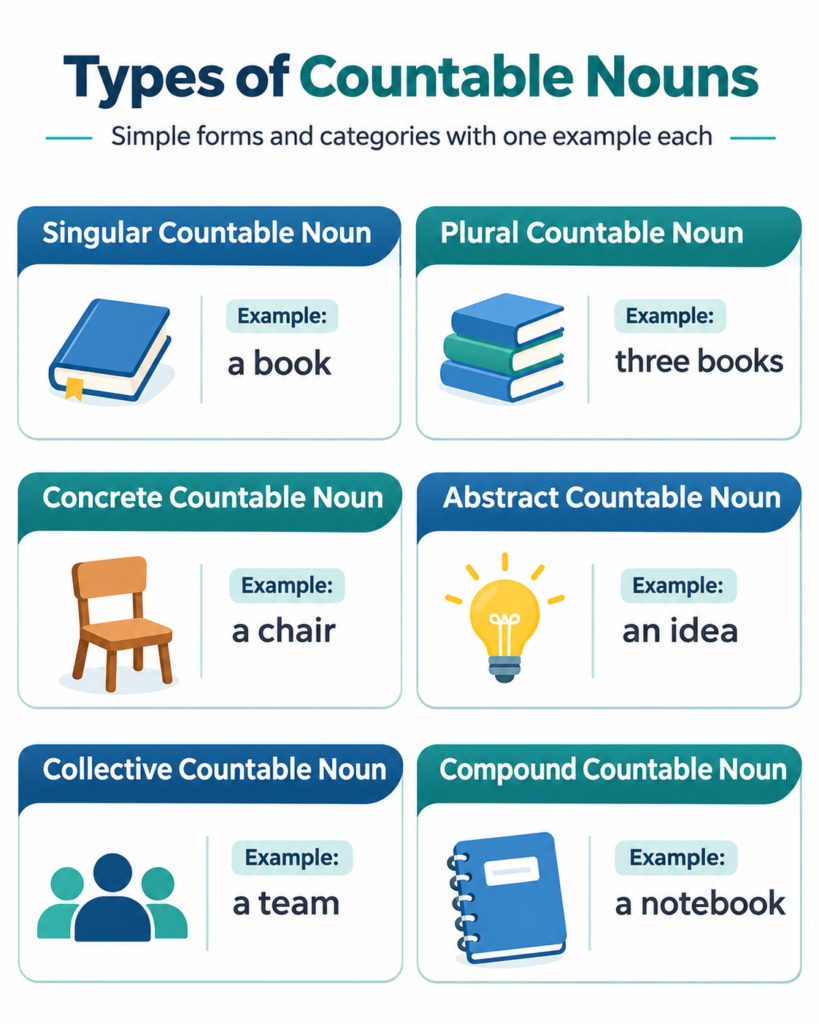
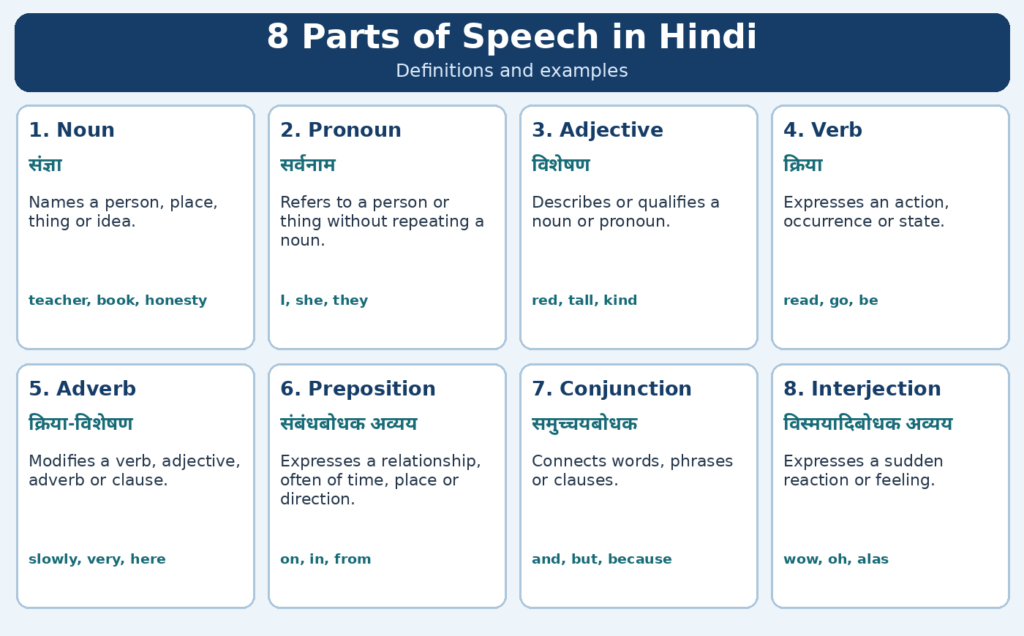
An uncountable noun in Hindi is called अगणनीय संज्ञा. It refers to a substance, quality, condition, or idea that is not normally counted as separate individual units. Words such as water (पानी), rice (चावल), information (जानकारी), and happiness (खुशी) are common examples.
In English grammar, uncountable nouns generally do not take plural endings or the articles a and an. They usually take singular verbs, even when they refer to large amounts. For example, The furniture is expensive is correct, while The furnitures are expensive is not standard English.
Some uncountable nouns can become countable when their meaning changes or when we refer to portions, varieties, or individual items. This guide covers their types, grammar rules, English-Hindi meanings, quantifiers, sentence construction, and common mistakes.
Types of Uncountable Noun in Hindi
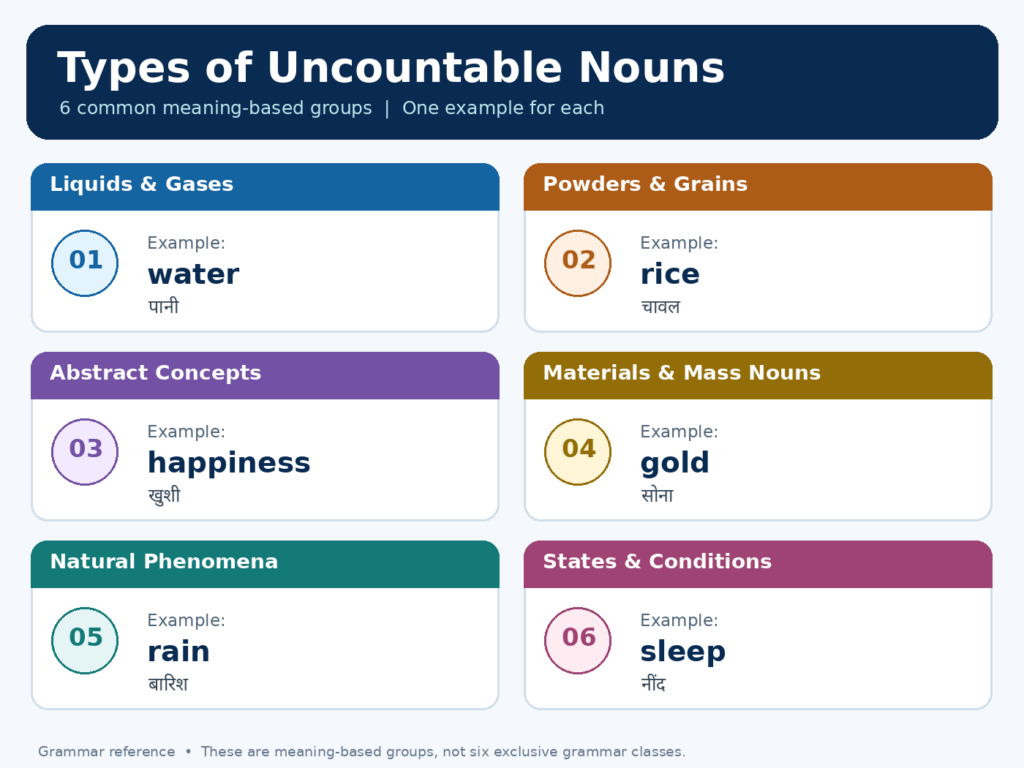
Uncountable nouns can be grouped according to what they describe, including substances, materials, feelings, natural phenomena, and conditions.
These are useful meaning-based groups rather than six completely separate grammatical classes.
1. Liquids and Gases
Liquids and gases are generally measured by volume or quantity rather than counted individually. Examples include milk (दूध) and oxygen (ऑक्सीजन).
2. Powders and Grains
Powders, grains, and similar loose substances are usually treated as masses. For example, flour (आटा) is measured by weight, while individual grains or bags can be counted.
3. Abstract Concepts
Abstract uncountable nouns express qualities, feelings, knowledge, and ideas. Words such as honesty (ईमानदारी) and wisdom (बुद्धिमत्ता) are not normally counted as individual objects.
4. Materials and Mass Nouns
Materials are usually named without counting individual pieces. For example, wood (लकड़ी) is uncountable when referring to the material, but a wooden chair is countable.
5. Natural Phenomena
Many natural phenomena are treated as uncountable, particularly when describing continuous conditions. Examples include sunshine (धूप) and snow (बर्फ़).
6. States and Conditions
Words describing physical, mental, or social conditions often have uncountable uses. Examples include stress (तनाव), sleep (नींद), and poverty (गरीबी).
Uncountable Noun Grammar Rules
Uncountable nouns have specific rules for articles, plural forms, verb agreement, and quantity expressions. These rules help distinguish them from countable nouns.
Rule 1: Uncountable Nouns Usually Have No Plural Form
Most uncountable nouns cannot take -s or -es when used in their mass-noun meanings.
| Incorrect | Correct |
|---|---|
| Informations | Information |
| Advices | Advice |
| Furnitures | Furniture |
| Equipments | Equipment |
| Homeworks | Homework |
| Knowledges | Knowledge |
Example: The information is useful.
Hindi: जानकारी उपयोगी है।
Rule 2: Do Not Use A or An Directly Before Uncountable Nouns
The articles a and an normally refer to one countable item. Use an appropriate quantity expression when referring to a portion of an uncountable substance.
| Incorrect | Correct |
|---|---|
| An advice | A piece of advice |
| A furniture | A piece of furniture |
| An equipment | A piece of equipment |
| A water | A glass of water |
| A bread | A loaf of bread |
Example: She gave me a piece of advice.
Hindi: उसने मुझे एक सलाह दी।
Rule 3: Uncountable Nouns Normally Take Singular Verbs
A singular verb is used when the uncountable noun is the subject and refers to one mass, concept, or amount.
| Subject | Correct Verb | Example |
|---|---|---|
| Milk | is | Milk is fresh. |
| Information | was | The information was correct. |
| Furniture | is | The furniture is expensive. |
| News | is | The news is surprising. |
| Equipment | has | The equipment has arrived. |
Example: The rice is ready.
Hindi: चावल तैयार है।
Rule 4: Use Much and Little Instead of Many and Few
Much, little, and a little are commonly used with uncountable nouns. Many, few, and a few are used with plural countable nouns.
| Incorrect | Correct |
|---|---|
| Many water | Much water |
| A few sugar | A little sugar |
| Many information | A lot of information |
| Few money | Little money |
Example: We have a little time.
Hindi: हमारे पास थोड़ा समय है।
Rule 5: Count Portions, Containers, or Units
Uncountable substances can be expressed in measurable or countable units.
| Quantity Expression | Example | Hindi Meaning |
|---|---|---|
| A glass of | A glass of milk | एक गिलास दूध |
| Two bottles of | Two bottles of water | पानी की दो बोतलें |
| A cup of | A cup of tea | एक कप चाय |
| A piece of | A piece of information | जानकारी का एक अंश |
| A loaf of | A loaf of bread | एक पाव ब्रेड |
| A kilo of | A kilo of sugar | एक किलो चीनी |
| Three bags of | Three bags of rice | चावल की तीन बोरियाँ |
| Two pieces of | Two pieces of furniture | फर्नीचर की दो वस्तुएँ |
Rule 6: Some Nouns Can Be Countable and Uncountable
Countability sometimes changes according to meaning. A word used for a substance may become countable when referring to a portion, type, or separate item.
| Uncountable Use | Countable Use |
|---|---|
| Coffee is hot. | We ordered two coffees. |
| Chicken is delicious. | There are three chickens on the farm. |
| I need paper. | She published two papers. |
| There is glass on the floor. | He bought four glasses. |
| Experience is important. | It was an unforgettable experience. |
In the first column, the nouns refer to a substance or general concept. In the second, they refer to individual servings, animals, documents, objects, or events.
Uncountable Noun Examples in Hindi with English Meaning
The following vocabulary lists contain 180 uncountable noun examples, arranged into six categories with 30 examples each.
These words are commonly uncountable in the meanings shown, although some can have countable uses in other contexts.
1. Uncountable Nouns for Liquids and Gases — 30 Examples
These nouns describe liquids, gases, and flowing substances that are normally measured rather than counted.
| No. | English Noun | Hindi Meaning |
|---|---|---|
| 1 | Water | पानी |
| 2 | Milk | दूध |
| 3 | Tea | चाय |
| 4 | Coffee | कॉफ़ी |
| 5 | Juice | रस |
| 6 | Oil | तेल |
| 7 | Petrol | पेट्रोल |
| 8 | Diesel | डीज़ल |
| 9 | Kerosene | मिट्टी का तेल |
| 10 | Vinegar | सिरका |
| 11 | Honey | शहद |
| 12 | Syrup | चाशनी |
| 13 | Ink | स्याही |
| 14 | Paint | रंग |
| 15 | Blood | खून |
| 16 | Sweat | पसीना |
| 17 | Saliva | लार |
| 18 | Steam | भाप |
| 19 | Smoke | धुआँ |
| 20 | Air | हवा |
| 21 | Oxygen | ऑक्सीजन |
| 22 | Nitrogen | नाइट्रोजन |
| 23 | Hydrogen | हाइड्रोजन |
| 24 | Helium | हीलियम |
| 25 | Carbon dioxide | कार्बन डाइऑक्साइड |
| 26 | Sewage | मलजल |
| 27 | Lemonade | नींबू पानी |
| 28 | Soup | सूप |
| 29 | Coconut water | नारियल पानी |
| 30 | Buttermilk | छाछ |
2. Uncountable Nouns for Powders and Grains — 30 Examples
These words name powdered substances, grains, spices, and loose materials used in cooking or everyday activities.
| No. | English Noun | Hindi Meaning |
|---|---|---|
| 1 | Rice | चावल |
| 2 | Flour | आटा |
| 3 | Wheat | गेहूँ |
| 4 | Barley | जौ |
| 5 | Corn | मक्का |
| 6 | Millet | बाजरा |
| 7 | Semolina | सूजी |
| 8 | Gram flour | बेसन |
| 9 | Sugar | चीनी |
| 10 | Salt | नमक |
| 11 | Ground pepper | पिसी काली मिर्च |
| 12 | Turmeric | हल्दी |
| 13 | Ground cinnamon | पिसी दालचीनी |
| 14 | Ground cumin | पिसा जीरा |
| 15 | Ground coriander | पिसा धनिया |
| 16 | Ginger powder | सोंठ |
| 17 | Garlic powder | लहसुन पाउडर |
| 18 | Baking soda | खाने का सोडा |
| 19 | Baking powder | बेकिंग पाउडर |
| 20 | Cocoa powder | कोको पाउडर |
| 21 | Coffee powder | कॉफ़ी पाउडर |
| 22 | Milk powder | दूध पाउडर |
| 23 | Starch | स्टार्च |
| 24 | Sand | रेत |
| 25 | Dust | धूल |
| 26 | Chalk dust | चॉक की धूल |
| 27 | Gravel | बजरी |
| 28 | Sawdust | बुरादा |
| 29 | Talcum powder | टैल्कम पाउडर |
| 30 | Washing powder | कपड़े धोने का पाउडर |
3. Uncountable Nouns for Abstract Concepts — 30 Examples
Abstract uncountable nouns express feelings, values, knowledge, abilities, and other ideas that do not have a physical form.
| No. | English Noun | Hindi Meaning |
|---|---|---|
| 1 | Knowledge | ज्ञान |
| 2 | Wisdom | बुद्धिमत्ता |
| 3 | Honesty | ईमानदारी |
| 4 | Courage | साहस |
| 5 | Patience | धैर्य |
| 6 | Kindness | दयालुता |
| 7 | Happiness | खुशी |
| 8 | Sadness | उदासी |
| 9 | Love | प्रेम |
| 10 | Hatred | घृणा |
| 11 | Respect | सम्मान |
| 12 | Trust | भरोसा |
| 13 | Confidence | आत्मविश्वास |
| 14 | Creativity | रचनात्मकता |
| 15 | Intelligence | बौद्धिक क्षमता |
| 16 | Beauty | सुंदरता |
| 17 | Freedom | स्वतंत्रता |
| 18 | Justice | न्याय |
| 19 | Peace | शांति |
| 20 | Progress | प्रगति |
| 21 | Education | शिक्षा |
| 22 | Research | अनुसंधान |
| 23 | Information | जानकारी |
| 24 | Advice | सलाह |
| 25 | Feedback | प्रतिक्रिया |
| 26 | Evidence | साक्ष्य |
| 27 | Permission | अनुमति |
| 28 | Luck | भाग्य |
| 29 | Fun | मज़ा |
| 30 | Entertainment | मनोरंजन |
4. Uncountable Nouns for Materials and Mass Nouns — 30 Examples
These nouns refer to metals, fabrics, construction materials, and collections of items treated as a whole.
| No. | English Noun | Hindi Meaning |
|---|---|---|
| 1 | Gold | सोना |
| 2 | Silver | चाँदी |
| 3 | Iron | लोहा |
| 4 | Steel | इस्पात |
| 5 | Copper | ताँबा |
| 6 | Brass | पीतल |
| 7 | Bronze | काँसा |
| 8 | Aluminium | एल्यूमिनियम |
| 9 | Wood | लकड़ी |
| 10 | Timber | इमारती लकड़ी |
| 11 | Plastic | प्लास्टिक |
| 12 | Glass | काँच |
| 13 | Rubber | रबर |
| 14 | Leather | चमड़ा |
| 15 | Cotton | कपास |
| 16 | Wool | ऊन |
| 17 | Silk | रेशम |
| 18 | Linen | लिनन |
| 19 | Denim | डेनिम |
| 20 | Concrete | कंक्रीट |
| 21 | Cement | सीमेंट |
| 22 | Clay | चिकनी मिट्टी |
| 23 | Marble | संगमरमर |
| 24 | Granite | ग्रेनाइट |
| 25 | Coal | कोयला |
| 26 | Charcoal | लकड़ी का कोयला |
| 27 | Furniture | फर्नीचर |
| 28 | Luggage | यात्रा का सामान |
| 29 | Equipment | उपकरण-सामग्री |
| 30 | Machinery | मशीनरी |
5. Uncountable Nouns for Natural Phenomena — 30 Examples
Many words used for weather, light, environmental conditions, and physical forces are uncountable when describing them generally.
| No. | English Noun | Hindi Meaning |
|---|---|---|
| 1 | Rain | बारिश |
| 2 | Snowfall | बर्फ़बारी |
| 3 | Snow | बर्फ़ |
| 4 | Hail | ओले |
| 5 | Thunder | गरज |
| 6 | Lightning | आकाशीय बिजली |
| 7 | Sunshine | धूप |
| 8 | Sunlight | सूर्य का प्रकाश |
| 9 | Moonlight | चाँदनी |
| 10 | Daylight | दिन का उजाला |
| 11 | Darkness | अँधेरा |
| 12 | Heat | गर्मी |
| 13 | Cold | ठंड |
| 14 | Humidity | नमी |
| 15 | Frost | पाला |
| 16 | Dew | ओस |
| 17 | Wind | पवन |
| 18 | Turbulence | वायु की अशांति |
| 19 | Erosion | कटाव |
| 20 | Pollution | प्रदूषण |
| 21 | Radiation | विकिरण |
| 22 | Gravity | गुरुत्वाकर्षण |
| 23 | Magnetism | चुंबकत्व |
| 24 | Electricity | विद्युत |
| 25 | Static electricity | स्थिर विद्युत |
| 26 | Weather | मौसम |
| 27 | Cloud cover | बादलों का आवरण |
| 28 | Rainfall | वर्षा |
| 29 | Drizzle | बूँदाबाँदी |
| 30 | Smog | धूम-कोहरा |
6. Uncountable Nouns for States and Conditions — 30 Examples
These nouns describe health, life stages, emotions, and physical or mental conditions. Some can also be countable when referring to specific experiences or cases.
| No. | English Noun | Hindi Meaning |
|---|---|---|
| 1 | Sleep | नींद |
| 2 | Stress | तनाव |
| 3 | Fatigue | थकान |
| 4 | Exhaustion | अत्यधिक थकावट |
| 5 | Hunger | भूख |
| 6 | Thirst | प्यास |
| 7 | Health | स्वास्थ्य |
| 8 | Fitness | तंदुरुस्ती |
| 9 | Illness | अस्वस्थता |
| 10 | Sickness | बीमारी की अवस्था |
| 11 | Childhood | बचपन |
| 12 | Youth | युवावस्था |
| 13 | Old age | बुढ़ापा |
| 14 | Adulthood | वयस्कता |
| 15 | Poverty | गरीबी |
| 16 | Wealth | धन-संपत्ति |
| 17 | Unemployment | बेरोज़गारी |
| 18 | Loneliness | अकेलापन |
| 19 | Anxiety | चिंता |
| 20 | Excitement | उत्साह |
| 21 | Boredom | ऊब |
| 22 | Confusion | उलझन |
| 23 | Fear | डर |
| 24 | Anger | गुस्सा |
| 25 | Grief | शोक |
| 26 | Depression | अवसाद |
| 27 | Discomfort | असुविधा |
| 28 | Relaxation | विश्राम |
| 29 | Rest | आराम |
| 30 | Tension | खींचाव |
These lists show typical uncountable uses. Context matters: for instance, a fear, an illness, and a glass are possible countable expressions with meanings different from their mass-noun uses.
100 Examples of Uncountable Nouns Sentences in English and Hindi
These 100 sentences demonstrate how uncountable nouns are used in everyday English. Each sentence includes a Hindi translation to clarify its meaning and grammatical use.
Sentences 1–20: Food and Drinks
| No. | English Sentence | Hindi Translation |
|---|---|---|
| 1 | Water is essential for life. | पानी जीवन के लिए आवश्यक है। |
| 2 | Milk is good for growing children. | दूध बढ़ते बच्चों के लिए अच्छा है। |
| 3 | I drink tea every morning. | मैं हर सुबह चाय पीता हूँ। |
| 4 | She likes coffee without sugar. | उसे बिना चीनी की कॉफ़ी पसंद है। |
| 5 | This juice tastes fresh. | इस रस का स्वाद ताज़ा है। |
| 6 | We need more rice for dinner. | हमें रात के खाने के लिए और चावल चाहिए। |
| 7 | There is some flour in the kitchen. | रसोई में थोड़ा आटा है। |
| 8 | Too much salt can spoil the soup. | बहुत अधिक नमक सूप का स्वाद बिगाड़ सकता है। |
| 9 | Honey tastes sweet. | शहद का स्वाद मीठा होता है। |
| 10 | Add a little oil to the pan. | कड़ाही में थोड़ा तेल डालो। |
| 11 | Butter melts quickly in the heat. | गर्मी में मक्खन जल्दी पिघलता है। |
| 12 | We bought some cheese yesterday. | हमने कल थोड़ा पनीर खरीदा। |
| 13 | Bread is available at the bakery. | बेकरी में ब्रेड मिलती है। |
| 14 | There is enough sugar for the cake. | केक के लिए पर्याप्त चीनी है। |
| 15 | Soup is easy to prepare. | सूप बनाना आसान है। |
| 16 | She added some turmeric to the curry. | उसने सब्ज़ी में थोड़ी हल्दी डाली। |
| 17 | Vinegar gives the sauce a sour taste. | सिरका सॉस को खट्टा स्वाद देता है। |
| 18 | We need a little ginger for this recipe. | इस व्यंजन के लिए हमें थोड़ा अदरक चाहिए। |
| 19 | There is no jam left in the jar. | जार में जैम नहीं बचा है। |
| 20 | Fresh lemonade is refreshing. | ताज़ा नींबू पानी पीने से ताज़गी मिलती है। |
Sentences 21–40: Materials and Household Items
| No. | English Sentence | Hindi Translation |
|---|---|---|
| 21 | Gold is a valuable metal. | सोना एक मूल्यवान धातु है। |
| 22 | Silver shines when polished. | पॉलिश करने पर चाँदी चमकती है। |
| 23 | Iron is used in construction. | निर्माण कार्य में लोहे का उपयोग होता है। |
| 24 | Steel is stronger than many common materials. | इस्पात कई सामान्य सामग्रियों से अधिक मज़बूत होता है। |
| 25 | This table is made of wood. | यह मेज़ लकड़ी की बनी है। |
| 26 | Plastic can cause environmental problems. | प्लास्टिक पर्यावरण संबंधी समस्याएँ पैदा कर सकता है। |
| 27 | Glass breaks easily. | काँच आसानी से टूट जाता है। |
| 28 | Cotton feels soft against the skin. | कपास त्वचा पर मुलायम लगता है। |
| 29 | Wool keeps us warm in winter. | ऊन सर्दियों में हमें गर्म रखती है। |
| 30 | This scarf is made of silk. | यह दुपट्टा रेशम से बना है। |
| 31 | We bought new furniture for the office. | हमने कार्यालय के लिए नया फर्नीचर खरीदा। |
| 32 | The equipment is ready for use. | उपकरण-सामग्री उपयोग के लिए तैयार है। |
| 33 | His luggage is very heavy. | उसका यात्रा का सामान बहुत भारी है। |
| 34 | The factory uses modern machinery. | कारखाने में आधुनिक मशीनरी का उपयोग होता है। |
| 35 | Cement is needed to repair the wall. | दीवार की मरम्मत के लिए सीमेंट चाहिए। |
| 36 | The workers mixed sand with cement. | मज़दूरों ने सीमेंट में रेत मिलाई। |
| 37 | Leather requires careful cleaning. | चमड़े की सफ़ाई सावधानी से करनी चाहिए। |
| 38 | Rubber is used to make tyres. | टायर बनाने में रबर का उपयोग होता है। |
| 39 | There is dust on the shelf. | शेल्फ़ पर धूल है। |
| 40 | Copper conducts electricity well. | ताँबा बिजली का अच्छा सुचालक है। |
Sentences 41–60: Knowledge, Feelings, and Ideas
| No. | English Sentence | Hindi Translation |
|---|---|---|
| 41 | Knowledge helps us make better decisions. | ज्ञान हमें बेहतर निर्णय लेने में मदद करता है। |
| 42 | Honesty builds trust. | ईमानदारी भरोसा बढ़ाती है। |
| 43 | Patience is important when learning a language. | भाषा सीखते समय धैर्य महत्वपूर्ण होता है। |
| 44 | Kindness makes relationships stronger. | दयालुता रिश्तों को मज़बूत बनाती है। |
| 45 | Happiness comes from different experiences. | खुशी अलग-अलग अनुभवों से मिलती है। |
| 46 | Love makes life meaningful. | प्रेम जीवन को अर्थपूर्ण बनाता है। |
| 47 | Courage helps people face difficulties. | साहस लोगों को कठिनाइयों का सामना करने में मदद करता है। |
| 48 | Wisdom develops through learning and experience. | सीखने और अनुभव से बुद्धिमत्ता विकसित होती है। |
| 49 | Respect is important in every relationship. | हर रिश्ते में सम्मान महत्वपूर्ण होता है। |
| 50 | Confidence improves with regular practice. | नियमित अभ्यास से आत्मविश्वास बढ़ता है। |
| 51 | We need more information about the course. | हमें पाठ्यक्रम के बारे में और जानकारी चाहिए। |
| 52 | Her advice helped me solve the problem. | उसकी सलाह से मुझे समस्या हल करने में मदद मिली। |
| 53 | The teacher gave useful feedback. | शिक्षक ने उपयोगी प्रतिक्रिया दी। |
| 54 | Research takes time and effort. | अनुसंधान में समय और मेहनत लगती है। |
| 55 | Education creates opportunities. | शिक्षा अवसर पैदा करती है। |
| 56 | Creativity helps us develop new ideas. | रचनात्मकता हमें नए विचार विकसित करने में मदद करती है। |
| 57 | Justice should be available to everyone. | न्याय सभी के लिए उपलब्ध होना चाहिए। |
| 58 | Freedom comes with responsibility. | स्वतंत्रता के साथ ज़िम्मेदारी भी आती है। |
| 59 | Peace is important for a healthy society. | स्वस्थ समाज के लिए शांति महत्वपूर्ण है। |
| 60 | Progress requires consistent effort. | प्रगति के लिए निरंतर प्रयास आवश्यक है। |
Sentences 61–80: Weather and Natural Conditions
| No. | English Sentence | Hindi Translation |
|---|---|---|
| 61 | Heavy rain continued throughout the night. | पूरी रात तेज़ बारिश होती रही। |
| 62 | Snow covered the mountains. | बर्फ़ ने पहाड़ों को ढक लिया। |
| 63 | Sunshine makes the garden bright. | धूप बगीचे को रोशन करती है। |
| 64 | Moonlight reflected on the lake. | चाँदनी झील पर प्रतिबिंबित हो रही थी। |
| 65 | Thunder woke the children. | गरज से बच्चे जाग गए। |
| 66 | Lightning lit up the sky. | बिजली की चमक से आसमान रोशन हो गया। |
| 67 | Fog reduced visibility on the road. | कोहरे से सड़क पर दृश्यता कम हो गई। |
| 68 | Humidity makes the air feel uncomfortable. | नमी के कारण हवा असहज लगती है। |
| 69 | Heat can cause dehydration. | गर्मी से शरीर में पानी की कमी हो सकती है। |
| 70 | Cold affects people differently. | ठंड का असर लोगों पर अलग-अलग तरह से पड़ता है। |
| 71 | Wind is blowing from the east. | पूर्व दिशा से हवा चल रही है। |
| 72 | Dew formed on the grass overnight. | रात में घास पर ओस जम गई। |
| 73 | Frost covered the windows. | खिड़कियों पर पाला जम गया। |
| 74 | Pollution affects air quality. | प्रदूषण हवा की गुणवत्ता को प्रभावित करता है। |
| 75 | Gravity pulls objects towards the Earth. | गुरुत्वाकर्षण वस्तुओं को पृथ्वी की ओर खींचता है। |
| 76 | Electricity powers our homes. | बिजली हमारे घरों को ऊर्जा देती है। |
| 77 | Sunlight helps plants grow. | सूर्य का प्रकाश पौधों को बढ़ने में मदद करता है। |
| 78 | Erosion changes the shape of riverbanks. | कटाव नदी के किनारों का आकार बदल देता है। |
| 79 | Snowfall continued for several hours. | कई घंटों तक बर्फ़बारी होती रही। |
| 80 | Weather changes throughout the year. | साल भर मौसम बदलता रहता है। |
Sentences 81–100: Daily Life, Conditions, and Quantities
| No. | English Sentence | Hindi Translation |
|---|---|---|
| 81 | Sleep is important for good health. | अच्छे स्वास्थ्य के लिए नींद ज़रूरी है। |
| 82 | Stress can affect concentration. | तनाव एकाग्रता को प्रभावित कर सकता है। |
| 83 | Hunger made the children restless. | भूख के कारण बच्चे बेचैन हो गए। |
| 84 | Thirst increases during hot weather. | गर्म मौसम में प्यास बढ़ जाती है। |
| 85 | Health requires regular attention. | स्वास्थ्य पर नियमित ध्यान देना आवश्यक है। |
| 86 | Poverty affects many families. | गरीबी कई परिवारों को प्रभावित करती है। |
| 87 | Unemployment remains a serious concern. | बेरोज़गारी एक गंभीर चिंता का विषय बनी हुई है। |
| 88 | Loneliness can affect emotional well-being. | अकेलापन भावनात्मक स्वास्थ्य को प्रभावित कर सकता है। |
| 89 | Boredom sometimes reduces motivation. | ऊब कभी-कभी प्रेरणा कम कर देती है। |
| 90 | Relaxation helps the body recover. | विश्राम शरीर को स्वस्थ होने में मदद करता है। |
| 91 | There is some water in the bottle. | बोतल में थोड़ा पानी है। |
| 92 | We do not have much time. | हमारे पास ज़्यादा समय नहीं है। |
| 93 | She has a little money in her bag. | उसके बैग में थोड़े पैसे हैं। |
| 94 | There is too much traffic today. | आज सड़कों पर बहुत ज़्यादा यातायात है। |
| 95 | I need a piece of paper. | मुझे कागज़ का एक टुकड़ा चाहिए। |
| 96 | He bought two bottles of juice. | उसने रस की दो बोतलें खरीदीं। |
| 97 | We received a lot of help. | हमें बहुत मदद मिली। |
| 98 | The news is encouraging. | समाचार उत्साहजनक है। |
| 99 | There is enough space in the room. | कमरे में पर्याप्त जगह है। |
| 100 | She has less homework today. | आज उसके पास कम गृहकार्य है। |
Uncountable Nouns Quantifiers
Quantifiers indicate how much of an uncountable substance, concept, or quality is present. Common quantifiers include some, much, little, a little, and enough.
| Quantifier | Hindi Meaning | Example |
|---|---|---|
| Some | कुछ | Some water |
| Any | कुछ / कोई | Any information |
| Much | बहुत / अधिक | Much time |
| A little | थोड़ा | A little milk |
| Little | बहुत कम | Little hope |
| A lot of | बहुत सारा | A lot of traffic |
| Lots of | बहुत सारा | Lots of work |
| Plenty of | भरपूर | Plenty of food |
| Enough | पर्याप्त | Enough money |
| Too much | बहुत ज़्यादा | Too much sugar |
| Less | कम | Less pollution |
| More | अधिक | More information |
| A bit of | थोड़ा-सा | A bit of luck |
| A great deal of | बहुत अधिक | A great deal of patience |
| No | बिल्कुल नहीं / कोई नहीं | No evidence |
Much vs Many
Much is used with uncountable nouns, while many is used with plural countable nouns.
- Much water — बहुत पानी
- Many bottles — बहुत सारी बोतलें
Little vs A Little
Little emphasizes that an amount is insufficient or very small. A little suggests that a small amount is available.
- There is little hope. — बहुत कम उम्मीद है।
- There is a little hope. — थोड़ी उम्मीद है।
Less vs Fewer
Less normally describes a smaller amount of an uncountable noun. Fewer describes a smaller number of countable items.
- Less traffic — कम यातायात
- Fewer cars — कम गाड़ियाँ
Countable and Uncountable Nouns Difference in Hindi
Countable nouns name separate items that can be counted, while uncountable nouns usually refer to substances, abstract concepts, and quantities treated as a whole.
| Feature | Countable Nouns | Uncountable Nouns |
|---|---|---|
| Hindi name | गणनीय संज्ञा | अगणनीय संज्ञा |
| Individual counting | Possible | Usually not possible |
| Singular and plural | Usually both | Usually no plural |
| A/An | Can be used with singular nouns | Normally not used directly |
| Many | Used | Not normally used |
| Much | Not normally used | Used |
| Few | Used | Not normally used |
| Little | Not normally used | Used |
| Verb | Singular or plural according to number | Usually singular |
| Example | Book (किताब) | Knowledge (ज्ञान) |
Common Countable and Uncountable Noun Pairs
These pairs show the difference between a countable unit and the uncountable material or concept it measures.
| Countable Noun | Uncountable Noun |
|---|---|
| A bottle | Water |
| A cup | Tea |
| A chair | Furniture |
| A suitcase | Luggage |
| A question | Information |
| A suggestion | Advice |
| A machine | Equipment |
| A coin | Money |
| A grain | Rice |
| A loaf | Bread |
Common Mistakes with Uncountable Nouns
Several errors occur when learners use plural endings, incorrect articles, or countable-noun quantifiers with uncountable nouns.
Mistake 1: Adding S or ES to Uncountable Nouns
Incorrect: She gave me three advices.
Correct: She gave me three pieces of advice.
Mistake 2: Using Many Instead of Much
Incorrect: We do not have many time.
Correct: We do not have much time.
Mistake 3: Using A or An Before Mass Nouns
Incorrect: I need an information.
Correct: I need some information.
Mistake 4: Using a Plural Verb
Incorrect: The furniture are new.
Correct: The furniture is new.
Mistake 5: Treating News as a Plural Noun
Incorrect: The news are shocking.
Correct: The news is shocking.
Although news ends with -s, it is grammatically singular.
Mistake 6: Using Few Instead of Little
Incorrect: There is a few milk left.
Correct: There is a little milk left.
Mistake 7: Confusing Materials with Individual Objects
Incorrect: I bought two furnitures.
Correct: I bought two pieces of furniture.
Mistake 8: Treating Every Abstract Noun as Uncountable
Incorrect assumption: Every abstract noun is uncountable.
Correct explanation: An idea, a decision, a dream, and a suggestion are countable abstract nouns. Being abstract does not automatically make a noun uncountable.
Uncountable Noun in Hindi Worksheet
Practice identifying uncountable nouns, choosing correct quantifiers, using singular verbs, and forming accurate sentences with this interactive worksheet.
Uncountable Noun in Hindi Worksheet
Practice uncountable nouns (अगणनीय संज्ञा) with 25 multiple-choice questions. Choose the correct answer for each question.
Frequently Asked Questions
1. Is money a countable or uncountable noun?
Money (पैसा) is normally uncountable in English. However, individual coins (सिक्के), notes (नोट), and amounts such as rupees (रुपये) can be counted.
2. Can uncountable nouns have plural meanings?
Yes. An uncountable noun may refer to a large quantity or several items collectively while remaining grammatically singular. For example, The furniture is new may describe multiple chairs, tables, and cupboards.
3. Why is hair sometimes countable?
Hair is usually uncountable when describing someone's hair collectively, but individual hairs are countable. Compare She has long hair with I found two hairs on my jacket.
4. Can all uncountable nouns be measured?
Not always in the same way. Physical substances can often be measured by weight or volume, while abstract concepts may be expressed through degrees, amounts, or specific instances. For example, a litre of water and a great deal of patience use different expressions.
Download Uncountable Noun in Hindi PDF Notes
The study notes provide an offline reference for the six main groups, important grammar rules, quantifiers, and English-Hindi sentence examples.
Final Notes
When describing a substance, material, or general concept in English, first check whether it is normally counted as individual units. This helps determine the correct article, verb, and quantifier.
Consider these three expressions: much information, many questions, and two pieces of advice. Each expresses quantity differently because the nouns do not behave in the same grammatical way.
Try correcting these sentences: I have many homework, She gave me an advice, and The equipment are expensive. Share your corrected answers in the comments.