A student opens his schoolbag and finds two notebooks. One belongs to him, while the other belongs to his friend. When the teacher asks whose notebooks they are, the student replies, “This is Ravi’s notebook, and that one is mine.” The two expressions communicate ownership, but they use different grammatical forms.
In English grammar, Ravi’s is a possessive noun, while mine is a possessive pronoun. A possessive noun, called अधिकार या संबंध बताने वाली संज्ञा in Hindi, shows ownership or a relationship. In Hindi, such relationships are commonly expressed using का, की, and के.
A small apostrophe can change the meaning of a sentence. Compare the student’s book with the students’ books. The difference is easy to miss, but it tells us whether one student or several students are involved. Understanding these forms also makes my, mine, your, yours, her, and hers much easier to use correctly.
Types of Possessive Nouns in Hindi
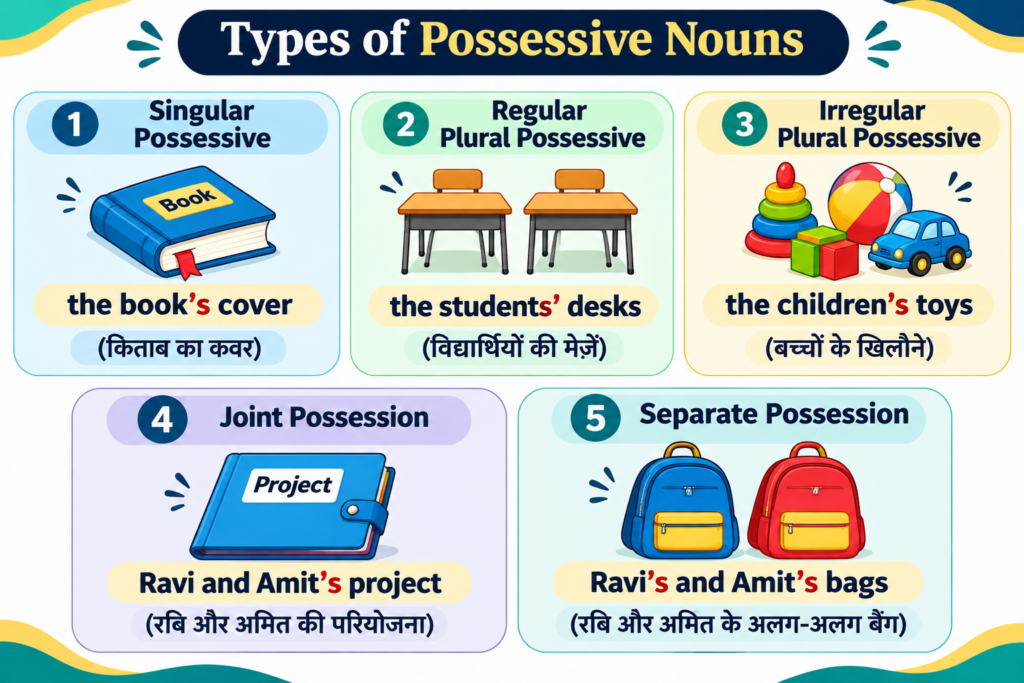
Possessive nouns can be classified by their singular and plural forms and by whether ownership is shared or separate.
1. Singular Possessive Noun
Add ‘s to most singular nouns to express possession or a relationship.
Example: The boy’s pencil — लड़के की पेंसिल
2. Regular Plural Possessive Noun
Add only an apostrophe ‘ after a regular plural noun ending in -s.
Example: The teachers’ room — शिक्षकों का कमरा
3. Irregular Plural Possessive Noun
Add ‘s to irregular plural nouns that do not end in -s.
Example: The men’s shoes — पुरुषों के जूते
4. Joint Possession
When two people share the same object or responsibility, place ‘s after the last name.
Example: Ravi and Amit’s shop — रवि और अमित की साझा दुकान
5. Separate Possession
When two people own different things, place ‘s after each person’s name.
Example: Ravi’s and Amit’s bicycles — रवि और अमित की अलग-अलग साइकिलें
Possessive Noun Grammar Rules
English possessive nouns use apostrophes to show ownership, relationships, and associations.
The correct placement depends on the number and structure of the noun.
Rule 1: Add ‘s to Singular Nouns
For most singular nouns, add ‘s, whether the noun refers to a person, animal, organization, or thing.
| Base Noun | Possessive Form |
|---|---|
| Teacher | Teacher’s |
| Student | Student’s |
| Child | Child’s |
| Book | Book’s |
| School | School’s |
Example: The school’s library is large. — विद्यालय का पुस्तकालय बड़ा है।
Rule 2: Add an Apostrophe After Regular Plural Nouns
When a plural noun already ends in -s, add an apostrophe without another s.
| Plural Noun | Possessive Form |
|---|---|
| Teachers | Teachers’ |
| Students | Students’ |
| Parents | Parents’ |
| Workers | Workers’ |
| Players | Players’ |
Example: The workers’ uniforms are clean. — मज़दूरों की वर्दियाँ साफ़ हैं।
Rule 3: Add ‘s to Irregular Plural Nouns
Irregular plurals such as children, men, and women do not end in -s, so they take ‘s.
Examples: Children’s books, men’s clothing, women’s shoes, people’s opinions.
Rule 4: Distinguish Joint and Separate Ownership
Ravi and Amit’s office suggests a shared office. Ravi’s and Amit’s offices suggests separate offices associated with each person.
Rule 5: Use Possessive Nouns for More Than Ownership
The possessive form also expresses relationships, origin, time, and association.
| Relationship | Example |
|---|---|
| Ownership | Ravi’s laptop |
| Family relationship | Meera’s brother |
| Duration | A day’s work |
| Organization | The company’s policy |
| Physical part | The table’s legs |
Rule 6: Do Not Confuse Apostrophes with Regular Plurals
Books is an ordinary plural, while book’s expresses a relationship involving one book.
| Incorrect | Correct |
|---|---|
| The students bag | The student’s bag |
| The teachers room (several teachers) | The teachers’ room |
| The childrens toys | The children’s toys |
| The schools library | The school’s library |
Rule 7: Its and It’s Have Different Meanings
Its is a possessive determiner meaning something belongs to or is associated with it. It’s means it is or it has.
Example: The school changed its timetable. — विद्यालय ने अपनी समय-सारणी बदल दी।
Example: It’s raining outside. — बाहर बारिश हो रही है।
Possessive Noun Examples in Hindi
Possessive nouns are common in conversations about belongings, family relationships, workplaces, buildings, and everyday objects.
These examples demonstrate how English possessive constructions correspond to Hindi expressions using का, की, and के.
Singular Possessive Noun Examples — 30 Examples
| No. | English Example | Hindi Meaning |
|---|---|---|
| 1 | The boy’s bag | लड़के का बैग |
| 2 | The girl’s notebook | लड़की की कॉपी |
| 3 | The teacher’s desk | शिक्षक की मेज़ |
| 4 | The student’s pencil | विद्यार्थी की पेंसिल |
| 5 | The father’s watch | पिता की घड़ी |
| 6 | The mother’s phone | माँ का फ़ोन |
| 7 | The brother’s bicycle | भाई की साइकिल |
| 8 | The sister’s umbrella | बहन का छाता |
| 9 | The doctor’s clinic | डॉक्टर का क्लिनिक |
| 10 | The farmer’s field | किसान का खेत |
| 11 | The driver’s seat | चालक की सीट |
| 12 | The pilot’s uniform | विमान चालक की वर्दी |
| 13 | The chef’s apron | रसोइए का एप्रन |
| 14 | The artist’s painting | कलाकार की पेंटिंग |
| 15 | The carpenter’s tools | बढ़ई के औज़ार |
| 16 | The librarian’s register | पुस्तकालयाध्यक्ष का रजिस्टर |
| 17 | The manager’s office | प्रबंधक का कार्यालय |
| 18 | The engineer’s helmet | इंजीनियर का हेलमेट |
| 19 | The scientist’s laboratory | वैज्ञानिक की प्रयोगशाला |
| 20 | The gardener’s gloves | माली के दस्ताने |
| 21 | The tailor’s scissors | दर्ज़ी की कैंची |
| 22 | The baker’s oven | बेकर का ओवन |
| 23 | The shopkeeper’s counter | दुकानदार का काउंटर |
| 24 | The mechanic’s toolbox | मिस्त्री का औज़ारों का बक्सा |
| 25 | The photographer’s camera | फ़ोटोग्राफ़र का कैमरा |
| 26 | The author’s manuscript | लेखक की पांडुलिपि |
| 27 | The judge’s decision | न्यायाधीश का निर्णय |
| 28 | The coach’s whistle | प्रशिक्षक की सीटी |
| 29 | The musician’s instrument | संगीतकार का वाद्ययंत्र |
| 30 | The passenger’s ticket | यात्री का टिकट |
Plural Possessive Noun Examples — 30 Examples
Regular plural nouns ending in -s usually take an apostrophe after the s. Irregular plural nouns take ‘s.
| No. | English Example | Hindi Meaning |
|---|---|---|
| 1 | The students’ books | विद्यार्थियों की किताबें |
| 2 | The teachers’ meeting | शिक्षकों की बैठक |
| 3 | The parents’ room | अभिभावकों का कमरा |
| 4 | The workers’ helmets | मज़दूरों के हेलमेट |
| 5 | The players’ uniforms | खिलाड़ियों की वर्दियाँ |
| 6 | The farmers’ crops | किसानों की फ़सलें |
| 7 | The doctors’ conference | डॉक्टरों का सम्मेलन |
| 8 | The nurses’ station | नर्सों का स्टेशन |
| 9 | The drivers’ lounge | चालकों का विश्राम कक्ष |
| 10 | The artists’ exhibition | कलाकारों की प्रदर्शनी |
| 11 | The customers’ complaints | ग्राहकों की शिकायतें |
| 12 | The employees’ salaries | कर्मचारियों के वेतन |
| 13 | The managers’ reports | प्रबंधकों की रिपोर्टें |
| 14 | The athletes’ equipment | खिलाड़ियों की उपकरण-सामग्री |
| 15 | The visitors’ entrance | आगंतुकों का प्रवेश द्वार |
| 16 | The passengers’ luggage | यात्रियों का सामान |
| 17 | The chefs’ recipes | रसोइयों की व्यंजन-विधियाँ |
| 18 | The readers’ comments | पाठकों की टिप्पणियाँ |
| 19 | The writers’ association | लेखकों का संघ |
| 20 | The engineers’ workshop | इंजीनियरों की कार्यशाला |
| 21 | The children’s playground | बच्चों का खेल का मैदान |
| 22 | The men’s shoes | पुरुषों के जूते |
| 23 | The women’s bags | महिलाओं के बैग |
| 24 | The people’s choice | लोगों की पसंद |
| 25 | The mice’s tails | चूहों की पूँछें |
| 26 | The geese’s feathers | कलहंसों के पंख |
| 27 | The oxen’s shelter | बैलों का आश्रय-स्थल |
| 28 | The sheep’s wool | भेड़ों की ऊन |
| 29 | The fish’s scales | मछलियों के शल्क |
| 30 | The deer’s tracks | हिरणों के पदचिह्न |
Note: Plural nouns such as sheep, fish, and deer can have the same form in the singular and plural. The meaning of their possessive phrases depends on context.
Possessive Nouns for Places and Organizations — 30 Examples
Names of places and institutions can take possessive forms to express facilities, features, history, services, or institutional relationships.
| No. | English Example | Hindi Meaning |
|---|---|---|
| 1 | The school’s playground | विद्यालय का खेल का मैदान |
| 2 | The college’s library | महाविद्यालय का पुस्तकालय |
| 3 | The university’s website | विश्वविद्यालय की वेबसाइट |
| 4 | The hospital’s entrance | अस्पताल का प्रवेश द्वार |
| 5 | The museum’s collection | संग्रहालय का संग्रह |
| 6 | The bank’s opening hours | बैंक के खुलने का समय |
| 7 | The hotel’s reception | होटल का स्वागत कक्ष |
| 8 | The restaurant’s menu | रेस्तराँ का मेन्यू |
| 9 | The airport’s runway | हवाई अड्डे का रनवे |
| 10 | The station’s platform | स्टेशन का प्लेटफ़ॉर्म |
| 11 | The library’s rules | पुस्तकालय के नियम |
| 12 | The market’s main gate | बाज़ार का मुख्य द्वार |
| 13 | The park’s fountain | उद्यान का फव्वारा |
| 14 | The stadium’s seating area | स्टेडियम का बैठने का क्षेत्र |
| 15 | The factory’s machinery | कारखाने की मशीनरी |
| 16 | The company’s headquarters | कंपनी का मुख्यालय |
| 17 | The office’s address | कार्यालय का पता |
| 18 | The laboratory’s equipment | प्रयोगशाला के उपकरण |
| 19 | The theater’s stage | रंगमंच का मंच |
| 20 | The shop’s window | दुकान की खिड़की |
| 21 | The temple’s courtyard | मंदिर का प्रांगण |
| 22 | The mosque’s courtyard | मस्जिद का आँगन |
| 23 | The church’s roof | गिरजाघर की छत |
| 24 | The city’s roads | शहर की सड़कें |
| 25 | The village’s well | गाँव का कुआँ |
| 26 | The country’s capital | देश की राजधानी |
| 27 | The state’s borders | राज्य की सीमाएँ |
| 28 | The bridge’s pillars | पुल के स्तंभ |
| 29 | The building’s elevator | इमारत की लिफ़्ट |
| 30 | The warehouse’s storage area | गोदाम का भंडारण क्षेत्र |
Frequently Asked Questions
Is a possessive noun the same as a possessive pronoun?
No. Ravi’s is a possessive noun form, while mine, yours, hers, ours, and theirs are independent possessive pronouns.
Can possessive nouns describe things other than ownership?
Yes. A day’s work, the city’s history, and the book’s cover express duration, association, or a part-whole relationship rather than straightforward personal ownership.
Is theirs singular or plural?
Theirs refers to something associated with them. The things being referred to can be singular or plural: The house is theirs and The books are theirs are both correct.
Should we write James’s or James’?
Both forms can occur depending on the style guide. James’s book is widely accepted, while some styles prefer James’ book. Consistency matters.
Conclusion
A misplaced apostrophe may seem minor, but it can change who owns something. The student’s bag refers to one student; the students’ bag refers to several students associated with the bag.
For a quick challenge, complete these sentences without looking back: This notebook is ___ (my/mine), The ___ (children/children’s) toys are new, and That bicycle is ___ (her/hers).
Share your answers in the comments.