A schoolbag rests beside a notebook, while a raincoat hangs near the door. Outside, a school bus stops beside a traffic light. These familiar objects have interesting names: schoolbag (स्कूल बैग), notebook (नोटबुक), raincoat (बरसाती), and traffic light (यातायात संकेत बत्ती).
Each name combines two or more words to express one meaning. In English grammar, these are called compound nouns, known as संयुक्त संज्ञा or यौगिक संज्ञा in Hindi. Some appear as single words, some remain separate, and others use hyphens.
But why is notebook written together, bus stop written separately, and mother-in-law joined with hyphens? Their structures follow different spelling and grammar patterns. Recognizing these patterns helps you identify compound nouns, form their plurals, and use them naturally in sentences.
Types of Compound Nouns in Hindi
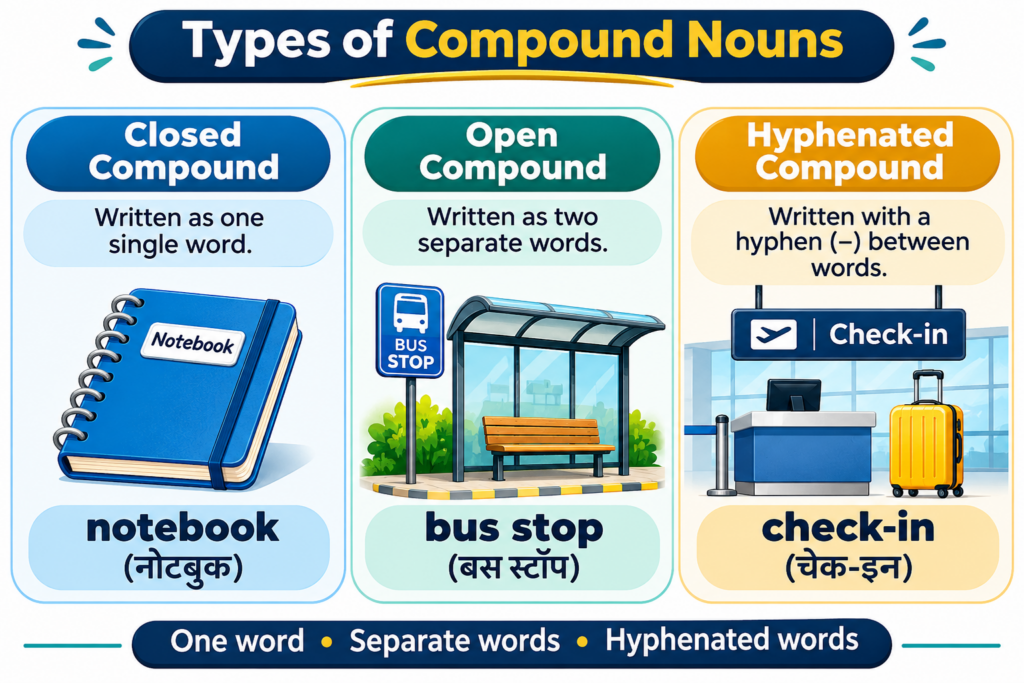
English compound nouns have three main written forms: closed, open, and hyphenated.
All three combine words into one meaningful noun, but their spelling patterns differ.
1. Closed Compound Nouns
Closed compound nouns combine two or more elements into one word, without spaces or hyphens.
Examples:
- Notebook (नोटबुक)
- Toothbrush (टूथब्रश)
- Sunflower (सूरजमुखी)
2. Open Compound Nouns
Open compound nouns contain two or more separate words that function together as a single noun.
Examples:
- Bus stop (बस स्टॉप)
- Post office (डाकघर)
- Dining table (खाने की मेज़)
3. Hyphenated Compound Nouns
Hyphenated compound nouns connect their elements with a hyphen (-).
Examples:
- Mother-in-law (सास)
- Editor-in-chief (प्रधान संपादक)
- Runner-up (उपविजेता)
Types of Compound Nouns at a Glance
| Type | Written Form | Example | Hindi Meaning |
|---|---|---|---|
| Closed | One word | Notebook | नोटबुक |
| Open | Separate words | Bus stop | बस स्टॉप |
| Hyphenated | Words joined by hyphens | Mother-in-law | सास |
Compound Noun Grammar Rules
Compound nouns function as single nouns, even when written as two or more words.
Their plural forms, articles, and verb agreement depend on their grammatical structure.
Rule 1: Two or More Words Form One Noun
The elements of a compound noun work together to name a person, place, object, or concept.
Examples:
- Toothbrush = tooth + brush
- Football = foot + ball
- Swimming pool = swimming + pool
- Mother-in-law = mother + in + law
Rule 2: Use the Correct Written Form
Compound nouns do not follow one universal spelling pattern.
| Closed | Open | Hyphenated |
|---|---|---|
| Bedroom | Living room | Mother-in-law |
| Toothpaste | Bus stop | Editor-in-chief |
| Raincoat | Ice cream | Passer-by |
| Blackboard | Post office | Runner-up |
| Airport | Railway station | Merry-go-round |
Use a reliable dictionary when a compound’s spelling is uncertain. Accepted forms may also change over time.
Rule 3: Make the Main Noun Plural
Most compound nouns form their plurals by adding -s or -es to the main noun.
| Singular | Plural |
|---|---|
| Notebook | Notebooks |
| Toothbrush | Toothbrushes |
| Bus stop | Bus stops |
| School bus | School buses |
| Mother-in-law | Mothers-in-law |
| Editor-in-chief | Editors-in-chief |
| Passer-by | Passers-by |
| Runner-up | Runners-up |
Rule 4: Articles Depend on Countability
Use a or an with singular countable compound nouns. Plural and uncountable compounds follow their usual determiner rules.
Examples:
- A notebook — एक नोटबुक
- An airport — एक हवाई अड्डा
- Two school buses — दो स्कूल बसें
- Some ice cream — थोड़ी आइसक्रीम
Rule 5: Compound Nouns Can Be Subjects or Objects
A compound noun can perform the same grammatical functions as an ordinary noun.
Subject: The school bus arrived early.
Object: She bought a new toothbrush.
Complement: This building is a post office.
Rule 6: The Whole Compound Determines Verb Agreement
Compound nouns take singular or plural verbs according to their number.
| Singular | Plural |
|---|---|
| The notebook is new. | The notebooks are new. |
| The bus stop is crowded. | The bus stops are crowded. |
| The runner-up was happy. | The runners-up were happy. |
Rule 7: Possessive Forms Usually Follow the Entire Compound
Add the possessive ending to the complete compound noun.
Examples:
- My brother-in-law’s car — मेरे साले / जीजा की कार
- The editor-in-chief’s office — प्रधान संपादक का कार्यालय
- The bus driver’s seat — बस चालक की सीट
Compound Nouns Examples in Hindi
Compound nouns appear in everyday vocabulary, including transportation, household objects, workplaces, food, and family relationships.
The following tables contain 90 examples, with 30 for each written form.
30 Closed Compound Nouns with Hindi Meaning
| No. | Compound Noun | Hindi Meaning |
|---|---|---|
| 1 | Notebook | नोटबुक / कॉपी |
| 2 | Toothbrush | दाँत साफ़ करने का ब्रश |
| 3 | Raincoat | बरसाती |
| 4 | Sunflower | सूरजमुखी |
| 5 | Classroom | कक्षा-कक्ष |
| 6 | Football | फ़ुटबॉल |
| 7 | Bedroom | शयनकक्ष |
| 8 | Bookshelf | किताबों की अलमारी |
| 9 | Playground | खेल का मैदान |
| 10 | Airport | हवाई अड्डा |
| 11 | Keyboard | कीबोर्ड |
| 12 | Smartphone | स्मार्टफ़ोन |
| 13 | Lighthouse | प्रकाशस्तंभ |
| 14 | Haircut | बाल कटवाना / बालों की कटाई |
| 15 | Toothpaste | टूथपेस्ट |
| 16 | Backpack | पीठ पर लटकाने वाला बैग |
| 17 | Waterfall | झरना |
| 18 | Snowman | बर्फ़ का पुतला |
| 19 | Birthday | जन्मदिन |
| 20 | Newspaper | अख़बार |
| 21 | Handbag | हैंडबैग |
| 22 | Sidewalk | फुटपाथ |
| 23 | Greenhouse | पौधशाला का काँचघर |
| 24 | Blackboard | श्यामपट्ट |
| 25 | Armchair | हाथ रखने वाली कुर्सी |
| 26 | Doorbell | दरवाज़े की घंटी |
| 27 | Mailbox | डाक-पेटी |
| 28 | Headache | सिरदर्द |
| 29 | Countryside | ग्रामीण इलाक़ा |
| 30 | Lifetime | जीवनकाल |
30 Open Compound Nouns with Hindi Meaning
| No. | Compound Noun | Hindi Meaning |
|---|---|---|
| 1 | Bus stop | बस स्टॉप |
| 2 | Post office | डाकघर |
| 3 | Railway station | रेलवे स्टेशन |
| 4 | Dining table | खाने की मेज़ |
| 5 | Coffee table | छोटी बैठक की मेज़ |
| 6 | Ice cream | आइसक्रीम |
| 7 | Swimming pool | तैराकी का तालाब |
| 8 | Washing machine | कपड़े धोने की मशीन |
| 9 | Traffic light | यातायात संकेत बत्ती |
| 10 | Police station | पुलिस थाना |
| 11 | Fire station | अग्निशमन केंद्र |
| 12 | High school | उच्च विद्यालय |
| 13 | Living room | बैठक का कमरा |
| 14 | Dining room | भोजन कक्ष |
| 15 | Bus driver | बस चालक |
| 16 | Parking lot | वाहन खड़ा करने की जगह |
| 17 | Credit card | क्रेडिट कार्ड |
| 18 | Mobile phone | मोबाइल फ़ोन |
| 19 | Water bottle | पानी की बोतल |
| 20 | Train ticket | रेलगाड़ी का टिकट |
| 21 | Shopping mall | शॉपिंग मॉल |
| 22 | City hall | नगर भवन |
| 23 | Science fiction | विज्ञान-कथा साहित्य |
| 24 | Phone number | फ़ोन नंबर |
| 25 | Book club | पुस्तक क्लब |
| 26 | Coffee shop | कॉफ़ी की दुकान |
| 27 | Train station | रेलगाड़ी का स्टेशन |
| 28 | School bus | स्कूल बस |
| 29 | Computer science | कंप्यूटर विज्ञान |
| 30 | Movie theater | सिनेमाघर |
30 Hyphenated Compound Nouns with Hindi Meaning
| No. | Compound Noun | Hindi Meaning |
|---|---|---|
| 1 | Mother-in-law | सास |
| 2 | Father-in-law | ससुर |
| 3 | Sister-in-law | ननद / भाभी / साली (संबंध के अनुसार) |
| 4 | Brother-in-law | साला / जीजा / देवर (संबंध के अनुसार) |
| 5 | Son-in-law | दामाद |
| 6 | Daughter-in-law | बहू |
| 7 | Editor-in-chief | प्रधान संपादक |
| 8 | Commander-in-chief | सर्वोच्च सेनापति |
| 9 | Passer-by | राहगीर |
| 10 | Runner-up | उपविजेता |
| 11 | Go-between | मध्यस्थ |
| 12 | Stand-in | स्थानापन्न व्यक्ति |
| 13 | Check-in | आगमन-पंजीकरण |
| 14 | Walk-in | बिना पूर्व नियुक्ति का आगंतुक |
| 15 | Drive-in | वाहन से सेवा लेने का स्थान |
| 16 | Follow-up | अनुवर्ती कार्रवाई |
| 17 | Warm-up | अभ्यास से पहले की तैयारी |
| 18 | Sign-up | पंजीकरण |
| 19 | Merry-go-round | घूमने वाला झूला |
| 20 | Jack-in-the-box | डिब्बे से उछलने वाला खिलौना |
| 21 | Hand-me-down | पुराना इस्तेमाल किया हुआ सामान |
| 22 | Know-how | व्यावहारिक जानकारी |
| 23 | Self-esteem | आत्मसम्मान |
| 24 | Self-control | आत्मसंयम |
| 25 | Well-being | कल्याण / स्वस्थ अवस्था |
| 26 | T-shirt | टी-शर्ट |
| 27 | U-turn | यू-टर्न |
| 28 | X-ray | एक्स-रे |
| 29 | Right-of-way | रास्ते के उपयोग का अधिकार |
| 30 | Court-martial | सैन्य न्यायालय / सैनिक अदालत में मुक़दमा |
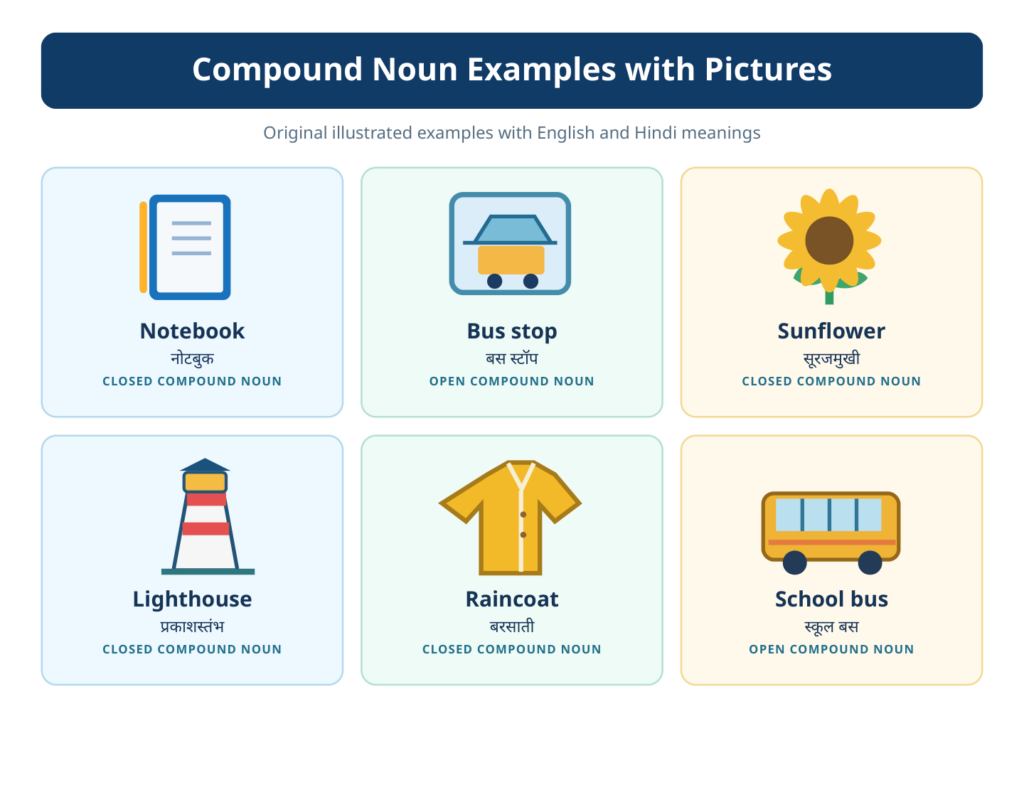
Compound Noun Examples with Pictures in Hindi
Compound nouns become easier to recognize when their meanings are connected to familiar objects.
Hindi Compound Words: Types of Samas (समास)
English compound nouns are classified as Closed, Open, and Hyphenated based on spelling.
Hindi grammar uses Samas (समास) to classify compounds according to the relationship between their parts. The six commonly taught types are listed below.
Six Types of Samas with English Names
| Hindi Type | English Name | Example | Meaning |
|---|---|---|---|
| अव्ययीभाव समास | Adverbial Compound | प्रतिदिन | Every day |
| तत्पुरुष समास | Determinative Compound | राजपुत्र | King’s son |
| कर्मधारय समास | Descriptive Compound | नीलकमल | Blue lotus |
| द्विगु समास | Numeral Compound | नवरत्न | Nine gems |
| द्वंद्व समास | Copulative / Coordinative Compound | माता-पिता | Parents |
| बहुव्रीहि समास | Exocentric Compound | दशानन | Ten-faced; Ravana |
How Hindi Samas Differs from English Compound Nouns
English compound types describe how words are written, while Hindi Samas types describe how their meanings are connected.
For example, notebook is a closed compound in English. माता-पिता is a Dvandva (Copulative) Compound in Hindi because both parts have equal importance.
Compound Noun Examples in Sentences
These 30 sentences demonstrate closed, open, and hyphenated compound nouns in natural English with Hindi translations.
| No. | English Sentence | Hindi Translation |
|---|---|---|
| 1 | I bought a new notebook. | मैंने एक नई नोटबुक खरीदी। |
| 2 | The toothbrush is on the shelf. | टूथब्रश शेल्फ़ पर है। |
| 3 | He wore a raincoat in the rain. | उसने बारिश में बरसाती पहनी। |
| 4 | A sunflower grew in the garden. | बगीचे में एक सूरजमुखी उगा। |
| 5 | Our classroom is bright. | हमारा कक्षा-कक्ष रोशन है। |
| 6 | The children played football. | बच्चों ने फ़ुटबॉल खेला। |
| 7 | My bedroom has two windows. | मेरे शयनकक्ष में दो खिड़कियाँ हैं। |
| 8 | The bookshelf is full of books. | किताबों की अलमारी किताबों से भरी है। |
| 9 | We arrived at the airport early. | हम हवाई अड्डे पर जल्दी पहुँचे। |
| 10 | The doorbell rang twice. | दरवाज़े की घंटी दो बार बजी। |
| 11 | The bus stop is near my house. | बस स्टॉप मेरे घर के पास है। |
| 12 | She went to the post office. | वह डाकघर गई। |
| 13 | The railway station was crowded. | रेलवे स्टेशन पर भीड़ थी। |
| 14 | We placed the plates on the dining table. | हमने खाने की मेज़ पर प्लेटें रखीं। |
| 15 | The ice cream melted quickly. | आइसक्रीम जल्दी पिघल गई। |
| 16 | The swimming pool is closed today. | आज तैराकी का तालाब बंद है। |
| 17 | Our washing machine needs repair. | हमारी कपड़े धोने की मशीन को मरम्मत की ज़रूरत है। |
| 18 | The traffic light turned red. | यातायात संकेत बत्ती लाल हो गई। |
| 19 | The school bus arrived on time. | स्कूल बस समय पर पहुँची। |
| 20 | I lost my train ticket. | मेरा रेलगाड़ी का टिकट खो गया। |
| 21 | My mother-in-law lives nearby. | मेरी सास पास में रहती हैं। |
| 22 | His father-in-law owns a shop. | उसके ससुर की एक दुकान है। |
| 23 | The editor-in-chief reviewed the article. | प्रधान संपादक ने लेख की समीक्षा की। |
| 24 | A passer-by helped the driver. | एक राहगीर ने चालक की मदद की। |
| 25 | The runner-up received a medal. | उपविजेता को पदक मिला। |
| 26 | We completed the check-in early. | हमने आगमन-पंजीकरण जल्दी पूरा कर लिया। |
| 27 | Please send a follow-up tomorrow. | कृपया कल एक अनुवर्ती संदेश भेजें। |
| 28 | The players began their warm-up. | खिलाड़ियों ने अभ्यास से पहले की तैयारी शुरू की। |
| 29 | The merry-go-round stopped suddenly. | घूमने वाला झूला अचानक रुक गया। |
| 30 | The lawyer explained the right-of-way. | वकील ने रास्ते के उपयोग का अधिकार समझाया। |
Common Mistakes with Compound Nouns
Compound noun errors usually involve spelling, hyphens, plurals, and confusion with other grammatical structures.
Mistake 1: Joining Every Compound into One Word
Incorrect: Busstop
Correct: Bus stop
Mistake 2: Separating Closed Compound Nouns
Incorrect: Tooth brush
Correct: Toothbrush
Mistake 3: Omitting Necessary Hyphens
Incorrect: Mother in law
Correct: Mother-in-law
Mistake 4: Making the Wrong Element Plural
Incorrect: Mother-in-laws
Correct: Mothers-in-law
Mistake 5: Assuming Every Compound Noun Contains Two Words
Some compound nouns contain more than two elements.
Examples: Editor-in-chief, mother-in-law, and jack-in-the-box.
Mistake 6: Confusing Compound Nouns with Compound Sentences
Compound noun: The school bus is late.
Compound sentence: The bus is late, so we will walk.
Mistake 7: Using a Compound Adjective as a Noun
Well-known normally functions as an adjective, as in a well-known writer.
It should not be classified as an ordinary compound noun simply because it contains a hyphen.
Compound Nouns Worksheet
Practice identifying compound noun forms, choosing correct spellings, making plurals, and distinguishing compound nouns from compound sentences.
FAQ’s
Can a compound noun be uncountable?
Yes. Ice cream, software, and self-esteem commonly have uncountable uses. Countability depends on meaning, not merely on the compound’s spelling.
Can compound nouns change spelling over time?
Yes. Some compounds evolve from separate words to hyphenated or closed forms. Dictionaries and regional usage may differ.
Can a compound noun contain more than two words?
Yes. Mother-in-law, editor-in-chief, and jack-in-the-box contain multiple elements that function together as one noun.
Are all hyphenated words compound nouns?
No. Hyphens also appear in compound adjectives and other expressions. Part-time in a part-time job is an adjective, not a noun.
Practice Offline With Compound Nouns Pdf
Conclusion
The easiest way to recognize a compound noun is to notice when familiar words combine to create one name. Raincoat, bus stop, and runner-up look different on the page, but each functions as a noun.
For a quick challenge, classify waterfall, coffee table, and sister-in-law by their written forms. Then try making each noun plural. Share your answers in the comments.
Leave a Reply