A teacher places one book (किताब) on a desk. A few minutes later, several more books arrive. The teacher first says एक किताब, then पाँच किताबें. The object is the same, but its Hindi word changes because the number has changed.
This difference is called singular and plural in Hindi, or एकवचन और बहुवचन. A singular noun refers to one person, animal, place, or thing, while a plural noun refers to more than one. For example, लड़का becomes लड़के, and कुर्सी becomes कुर्सियाँ.
However, not every Hindi noun changes in the same way. घर can mean both house and houses, while किताब becomes किताबें. Some forms also change when used with में, से, को, or पर. These patterns make Hindi singular and plural grammar especially interesting.
Types of Singular and Plural Nouns in Hindi
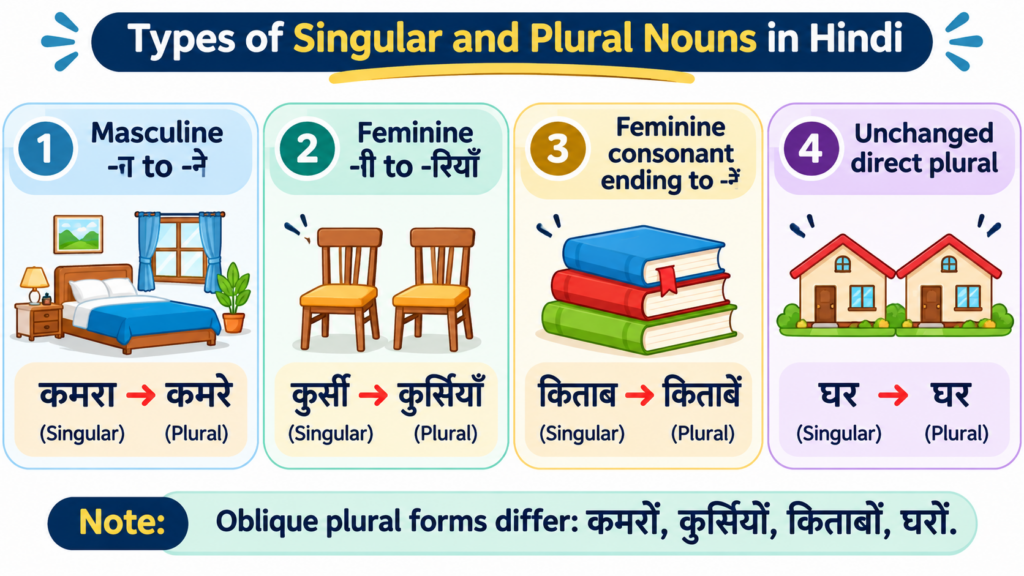
Hindi nouns have two grammatical numbers: Singular (एकवचन) and Plural (बहुवचन).
Their forms also depend on gender, word endings, and how they are used in a sentence.
1. Singular Nouns (एकवचन)
A singular noun refers to one person, animal, place, object, or individual entity.
Examples: एक लड़का (one boy), एक किताब (one book), एक कमरा (one room).
2. Plural Nouns (बहुवचन)
A plural noun refers to more than one person, animal, place, object, or entity.
Examples: दो लड़के (two boys), तीन किताबें (three books), चार कमरे (four rooms).
Main Singular and Plural Patterns
Hindi singular and plural nouns follow several common patterns.
| Pattern | Singular | Plural |
|---|---|---|
| Masculine nouns ending in आ | कमरा | कमरे |
| Feminine nouns ending in ई | कुर्सी | कुर्सियाँ |
| Feminine nouns ending in a consonant | किताब | किताबें |
| Feminine nouns ending in आ | महिला | महिलाएँ |
| Nouns with unchanged direct plurals | घर | घर |
These are common patterns rather than rules for every word. Hindi also has exceptions, irregular forms, and nouns that are normally used only in particular numbers.
Singular and Plural Grammar Rules in Hindi
Hindi nouns change according to gender, number, and sentence structure.
The most important rules concern masculine and feminine endings, unchanged plurals, and direct versus oblique forms.
Rule 1: Masculine Nouns Ending in आ Usually Change to ए
Many masculine nouns ending in आ change their ending to ए in the direct plural form.
Pattern: आ → ए
| Singular | Plural | English Meaning |
|---|---|---|
| लड़का | लड़के | Boy / Boys |
| कमरा | कमरे | Room / Rooms |
| बच्चा | बच्चे | Child / Children |
| घोड़ा | घोड़े | Horse / Horses |
| ताला | ताले | Lock / Locks |
Example: एक कमरा बड़ा है। (One room is big.)
Plural: दो कमरे बड़े हैं। (Two rooms are big.)
Rule 2: Feminine Nouns Ending in ई Usually Change to इयाँ
Many feminine nouns ending in the long ई sound form their direct plurals with इयाँ.
Pattern: ई → इयाँ
| Singular | Plural | English Meaning |
|---|---|---|
| लड़की | लड़कियाँ | Girl / Girls |
| कुर्सी | कुर्सियाँ | Chair / Chairs |
| चाबी | चाबियाँ | Key / Keys |
| नदी | नदियाँ | River / Rivers |
| तितली | तितलियाँ | Butterfly / Butterflies |
Example: एक कुर्सी खाली है। (One chair is empty.)
Plural: तीन कुर्सियाँ खाली हैं। (Three chairs are empty.)
Rule 3: Many Feminine Consonant-Ending Nouns Add एँ
Many feminine nouns ending in consonants form their direct plurals by adding एँ.
Pattern: Add एँ.
| Singular | Plural | English Meaning |
|---|---|---|
| किताब | किताबें | Book / Books |
| सड़क | सड़कें | Road / Roads |
| दुकान | दुकानें | Shop / Shops |
| रात | रातें | Night / Nights |
| आँख | आँखें | Eye / Eyes |
Example: यह किताब नई है। (This book is new.)
Plural: ये किताबें नई हैं। (These books are new.)
Rule 4: Feminine आ-Ending Nouns Often Add एँ
Many feminine nouns ending in आ take एँ in their direct plural forms.
Examples:
- महिला → महिलाएँ (Woman → Women)
- माता → माताएँ (Mother → Mothers)
- भाषा → भाषाएँ (Language → Languages)
- कक्षा → कक्षाएँ (Class → Classes)
- दिशा → दिशाएँ (Direction → Directions)
Rule 5: Some Nouns Keep the Same Direct Singular and Plural Forms
Not every plural noun changes spelling. Several masculine nouns retain the same form in direct singular and plural contexts.
| Singular | Direct Plural | English Meaning |
|---|---|---|
| घर | घर | House / Houses |
| पेड़ | पेड़ | Tree / Trees |
| फल | फल | Fruit / Fruits |
| आदमी | आदमी | Man / Men |
| दोस्त | दोस्त | Friend / Friends |
Example: एक घर बड़ा है। (One house is big.)
Plural: तीन घर बड़े हैं। (Three houses are big.)
Rule 6: Direct and Oblique Plural Forms Are Different
Hindi nouns can change form before postpositions such as में, पर, से, को, and के.
These forms are known as oblique forms (परसर्ग के साथ प्रयुक्त रूप).
| Singular | Direct Plural | Oblique Plural |
|---|---|---|
| कमरा | कमरे | कमरों |
| लड़का | लड़के | लड़कों |
| कुर्सी | कुर्सियाँ | कुर्सियों |
| किताब | किताबें | किताबों |
| घर | घर | घरों |
Direct plural: तीन कमरे खाली हैं। (Three rooms are empty.)
Oblique plural: तीन कमरों में पंखे हैं। (There are fans in three rooms.)
Rule 7: Verbs Often Change with Singular and Plural Subjects
Hindi verbs frequently agree with the number and gender of the subject.
Agreement also depends on tense, aspect, and sentence structure.
| Singular Sentence | Plural Sentence |
|---|---|
| लड़का खेलता है। | लड़के खेलते हैं। |
| लड़की गाती है। | लड़कियाँ गाती हैं। |
| बच्चा सो रहा है। | बच्चे सो रहे हैं। |
| किताब नई है। | किताबें नई हैं। |
| कमरा साफ़ है। | कमरे साफ़ हैं। |
Rule 8: Not Every Hindi Noun Is Normally Counted
Some words refer to substances or abstract ideas rather than separate objects.
Examples: पानी (water), दूध (milk), ईमानदारी (honesty).
When needed, count their units or containers instead.
Example: दो गिलास पानी (Two glasses of water).
Singular And Plural in Hindi – 50 Words
Hindi singular and plural words are useful for learning vocabulary alongside noun formation.
The following 50 examples show common direct singular and plural forms with English meanings.
| No. | Singular | Plural | English Meaning |
|---|---|---|---|
| 1 | लड़का | लड़के | Boy / Boys |
| 2 | बच्चा | बच्चे | Child / Children |
| 3 | कमरा | कमरे | Room / Rooms |
| 4 | घोड़ा | घोड़े | Horse / Horses |
| 5 | कुत्ता | कुत्ते | Dog / Dogs |
| 6 | जूता | जूते | Shoe / Shoes |
| 7 | पौधा | पौधे | Plant / Plants |
| 8 | ताला | ताले | Lock / Locks |
| 9 | रास्ता | रास्ते | Road / Paths |
| 10 | बेटा | बेटे | Son / Sons |
| 11 | लड़की | लड़कियाँ | Girl / Girls |
| 12 | कुर्सी | कुर्सियाँ | Chair / Chairs |
| 13 | चाबी | चाबियाँ | Key / Keys |
| 14 | नदी | नदियाँ | River / Rivers |
| 15 | तितली | तितलियाँ | Butterfly / Butterflies |
| 16 | रोटी | रोटियाँ | Flatbread / Flatbreads |
| 17 | खिड़की | खिड़कियाँ | Window / Windows |
| 18 | टोपी | टोपियाँ | Cap / Caps |
| 19 | थाली | थालियाँ | Plate / Plates |
| 20 | गाड़ी | गाड़ियाँ | Vehicle / Vehicles |
| 21 | किताब | किताबें | Book / Books |
| 22 | सड़क | सड़कें | Road / Roads |
| 23 | रात | रातें | Night / Nights |
| 24 | आँख | आँखें | Eye / Eyes |
| 25 | दुकान | दुकानें | Shop / Shops |
| 26 | बहन | बहनें | Sister / Sisters |
| 27 | मेज़ | मेज़ें | Table / Tables |
| 28 | दीवार | दीवारें | Wall / Walls |
| 29 | बोतल | बोतलें | Bottle / Bottles |
| 30 | बात | बातें | Statement / Statements |
| 31 | महिला | महिलाएँ | Woman / Women |
| 32 | माता | माताएँ | Mother / Mothers |
| 33 | भाषा | भाषाएँ | Language / Languages |
| 34 | कथा | कथाएँ | Story / Stories |
| 35 | सभा | सभाएँ | Assembly / Assemblies |
| 36 | दिशा | दिशाएँ | Direction / Directions |
| 37 | कक्षा | कक्षाएँ | Class / Classes |
| 38 | शाखा | शाखाएँ | Branch / Branches |
| 39 | प्रार्थना | प्रार्थनाएँ | Prayer / Prayers |
| 40 | आशा | आशाएँ | Hope / Hopes |
| 41 | घर | घर | House / Houses |
| 42 | पेड़ | पेड़ | Tree / Trees |
| 43 | फल | फल | Fruit / Fruits |
| 44 | फूल | फूल | Flower / Flowers |
| 45 | आदमी | आदमी | Man / Men |
| 46 | हाथ | हाथ | Hand / Hands |
| 47 | दिन | दिन | Day / Days |
| 48 | शहर | शहर | City / Cities |
| 49 | दोस्त | दोस्त | Friend / Friends |
| 50 | किसान | किसान | Farmer / Farmers |
These are direct plural forms. Some words change when followed by Hindi postpositions.
For example, घर remains घर in the direct plural, but becomes घरों in phrases such as घरों में.
Singular Noun in Hindi: 30 Sentence Examples
A singular noun refers to one person, animal, place, or thing. These sentences use singular nouns in familiar contexts.
| No. | Hindi Sentence | English Translation |
|---|---|---|
| 1 | एक लड़का पढ़ रहा है। | One boy is studying. |
| 2 | एक बच्चा सो रहा है। | One child is sleeping. |
| 3 | यह कमरा बड़ा है। | This room is big. |
| 4 | एक घोड़ा दौड़ रहा है। | A horse is running. |
| 5 | वह जूता नया है। | That shoe is new. |
| 6 | एक पौधा बढ़ रहा है। | A plant is growing. |
| 7 | यह ताला मज़बूत है। | This lock is strong. |
| 8 | वह रास्ता लंबा है। | That path is long. |
| 9 | मेरा बेटा पढ़ता है। | My son studies. |
| 10 | एक कुर्सी खाली है। | One chair is empty. |
| 11 | यह चाबी छोटी है। | This key is small. |
| 12 | नदी गहरी है। | The river is deep. |
| 13 | एक तितली उड़ रही है। | A butterfly is flying. |
| 14 | यह रोटी गर्म है। | This flatbread is hot. |
| 15 | खिड़की खुली है। | The window is open. |
| 16 | यह टोपी लाल है। | This cap is red. |
| 17 | थाली साफ़ है। | The plate is clean. |
| 18 | एक किताब मेज़ पर है। | One book is on the table. |
| 19 | यह सड़क चौड़ी है। | This road is wide. |
| 20 | आज रात ठंडी है। | Tonight is cold. |
| 21 | मेरी बहन घर पर है। | My sister is at home. |
| 22 | दुकान बंद है। | The shop is closed. |
| 23 | यह बोतल खाली है। | This bottle is empty. |
| 24 | एक महिला बोल रही है। | A woman is speaking. |
| 25 | यह भाषा कठिन है। | This language is difficult. |
| 26 | एक सभा चल रही है। | An assembly is taking place. |
| 27 | कक्षा शुरू हो गई है। | The class has started. |
| 28 | एक घर सुंदर है। | One house is beautiful. |
| 29 | यह पेड़ ऊँचा है। | This tree is tall. |
| 30 | एक किसान खेत में है। | One farmer is in the field. |
Plural Noun in Hindi: 30 Sentence Examples
Plural nouns refer to more than one person, animal, place, or thing. Their endings and accompanying verbs may change.
| No. | Hindi Sentence | English Translation |
|---|---|---|
| 1 | दो लड़के पढ़ रहे हैं। | Two boys are studying. |
| 2 | तीन बच्चे सो रहे हैं। | Three children are sleeping. |
| 3 | चार कमरे बड़े हैं। | Four rooms are big. |
| 4 | दो घोड़े दौड़ रहे हैं। | Two horses are running. |
| 5 | ये जूते नए हैं। | These shoes are new. |
| 6 | पाँच पौधे बढ़ रहे हैं। | Five plants are growing. |
| 7 | ये ताले मज़बूत हैं। | These locks are strong. |
| 8 | दो रास्ते लंबे हैं। | Two paths are long. |
| 9 | मेरे बेटे पढ़ते हैं। | My sons study. |
| 10 | तीन कुर्सियाँ खाली हैं। | Three chairs are empty. |
| 11 | ये चाबियाँ छोटी हैं। | These keys are small. |
| 12 | दो नदियाँ गहरी हैं। | Two rivers are deep. |
| 13 | तितलियाँ उड़ रही हैं। | Butterflies are flying. |
| 14 | ये रोटियाँ गर्म हैं। | These flatbreads are hot. |
| 15 | खिड़कियाँ खुली हैं। | The windows are open. |
| 16 | ये टोपियाँ लाल हैं। | These caps are red. |
| 17 | थालियाँ साफ़ हैं। | The plates are clean. |
| 18 | तीन किताबें मेज़ पर हैं। | Three books are on the table. |
| 19 | ये सड़कें चौड़ी हैं। | These roads are wide. |
| 20 | सर्दियों की रातें ठंडी हैं। | Winter nights are cold. |
| 21 | मेरी बहनें घर पर हैं। | My sisters are at home. |
| 22 | दुकानें बंद हैं। | The shops are closed. |
| 23 | ये बोतलें खाली हैं। | These bottles are empty. |
| 24 | तीन महिलाएँ बोल रही हैं। | Three women are speaking. |
| 25 | ये भाषाएँ कठिन हैं। | These languages are difficult. |
| 26 | कई सभाएँ चल रही हैं। | Several assemblies are taking place. |
| 27 | कक्षाएँ शुरू हो गई हैं। | The classes have started. |
| 28 | ये घर सुंदर हैं। | These houses are beautiful. |
| 29 | वे पेड़ ऊँचे हैं। | Those trees are tall. |
| 30 | किसान खेतों में हैं। | Farmers are in the fields. |
Singular and Plural in Hindi vs English
Both Hindi and English distinguish singular and plural nouns. However, their word endings and sentence agreement rules differ.
| Feature | English | Hindi |
|---|---|---|
| Singular | Book | किताब |
| Plural | Books | किताबें |
| Masculine example | Boy / Boys | लड़का / लड़के |
| Feminine example | Girl / Girls | लड़की / लड़कियाँ |
| Unchanged plural | Sheep / Sheep | घर / घर |
| Oblique plural | Usually no separate form | किताबों, लड़कों, घरों |
English often adds -s or -es to form a plural. Hindi uses several patterns influenced by grammatical gender and noun endings.
Hindi also has separate oblique forms, which appear with many postpositions.
Common Mistakes in Hindi Singular and Plural
Learners often confuse direct plural forms with oblique forms or apply the same ending to every noun.
These examples show how to avoid the most frequent errors.
Mistake 1: Using a Masculine Plural Ending with a Feminine Noun
Incorrect: दो कुर्से
Correct: दो कुर्सियाँ
Mistake 2: Adding an Unnecessary Ending to an Unchanged Plural
Incorrect: तीन घरें
Correct: तीन घर
Mistake 3: Using a Direct Plural Before a Postposition
Incorrect: कमरे में when referring to several rooms.
Correct: कमरों में
Mistake 4: Using a Singular Verb with a Plural Subject
Incorrect: दो लड़के खेलता है।
Correct: दो लड़के खेलते हैं।
Mistake 5: Confusing Feminine Direct and Oblique Plurals
Direct plural: लड़कियाँ पढ़ रही हैं।
Oblique plural: लड़कियों के पास किताबें हैं।
Mistake 6: Assuming Every Masculine Noun Ending in आ Changes to ए
Some words, particularly certain kinship terms and borrowed or exceptional nouns, do not follow the basic pattern.
For example, राजा normally remains राजा in the direct plural rather than becoming राजे.
Singular and Plural in Hindi Worksheet
Practice एकवचन और बहुवचन through exercises on noun endings, masculine and feminine plurals, unchanged word forms, and direct versus oblique usage.
The activities also help improve Hindi sentence formation.
Frequently Asked Questions
Can a Hindi noun have the same singular and plural form?
Yes. Nouns such as घर, पेड़, and आदमी can retain the same form in the direct singular and plural. The sentence context helps indicate the number.
Why does किताबें become किताबों?
किताबें is the direct plural, while किताबों is the oblique plural. The oblique form commonly appears before postpositions, as in किताबों में.
Do Hindi adjectives change with plural nouns?
Some adjectives change according to gender and number, while others remain unchanged. For example, बड़ा कमरा becomes बड़े कमरे, but सुंदर कमरा becomes सुंदर कमरे.
Are all Hindi nouns used in both singular and plural?
No. Some mass nouns and abstract nouns are not normally pluralized in their ordinary meanings. Other words may have special plural uses depending on context.
Lets End!
A useful way to learn Hindi plurals is to compare complete phrases instead of memorizing word endings alone. एक किताब, दो किताबें, and किताबों में demonstrate how number and sentence structure work together.
Try forming plurals of चाबी, कमरा, and दुकान. Then use their plural forms with में or के.
Share your answers in the comments to check whether you have understood both direct and oblique forms.
Leave a Reply