During a school assembly, the principal introduces a guest: “Mr. Sharma, a famous scientist, will speak today.” The students already know the guest’s name, but the words a famous scientist tell them something more. That extra description makes the introduction clearer and more interesting.
English grammar uses this structure frequently. An appositive noun in Hindi can be explained through समानाधिकरण, where a noun or noun phrase stands beside another noun to identify, rename, or explain it. For example, “Ravi, my best friend, lives in Delhi” tells us that Ravi is the speaker’s best friend.
Sometimes this additional information needs commas, and sometimes it does not. Compare “My brother Amit is a teacher” with “Amit, my brother, is a teacher.”
The words look similar, but their punctuation serves different purposes. Understanding that difference makes appositives much easier to recognize and use.
Appositive Noun Types in Hindi with Examples
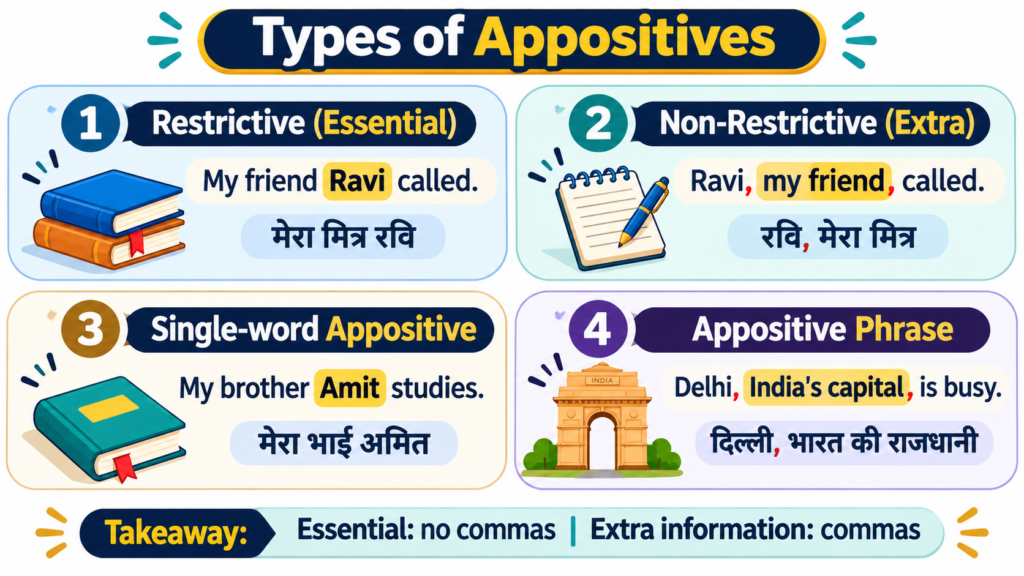
Appositives are mainly classified by whether they provide essential or additional information. They can also be identified by their structure.
1. Restrictive Appositive (Essential Appositive)
A restrictive appositive identifies exactly which person, place, or thing is being discussed.
It is usually written without commas because the identifying information is essential.
Example: My friend Ravi called yesterday.
Hindi: मेरे मित्र रवि ने कल फ़ोन किया।
Here, Ravi identifies which friend the speaker means.
2. Non-Restrictive Appositive (Nonessential Appositive)
A non-restrictive appositive adds information about a noun that is already sufficiently identified.
It is normally separated from the sentence with commas.
Example: Ravi, my best friend, lives in Delhi.
Hindi: रवि, मेरा सबसे अच्छा मित्र, दिल्ली में रहता है।
The phrase my best friend provides extra information about Ravi.
3. Single-Word Appositive
A single-word appositive consists of one noun or name used to identify another noun.
It may be restrictive or non-restrictive depending on the sentence.
Example: My sister Neha studies English.
Hindi: मेरी बहन नेहा अंग्रेज़ी पढ़ती है।
4. Appositive Phrase
An appositive phrase contains a noun together with words that modify or describe it.
It functions as one complete noun phrase beside another noun.
Example: Delhi, the capital of India, is a busy city.
Hindi: दिल्ली, भारत की राजधानी, एक व्यस्त शहर है।
Appositive Types Comparison
| Type | Main Function | Example | Commas |
|---|---|---|---|
| Restrictive Appositive | Essential identification | My friend Ravi | Usually no |
| Non-Restrictive Appositive | Additional information | Ravi, my friend, | Usually yes |
| Single-Word Appositive | Identifies through one noun or name | My brother Amit | Depends on meaning |
| Appositive Phrase | Identifies through a noun phrase | Delhi, India’s capital, | Depends on meaning |
Note: These are two overlapping ways of describing appositives, not four completely separate grammatical classes. A single-word appositive or an appositive phrase can be either restrictive or non-restrictive.
Appositive Noun Grammar Rules
Appositive nouns follow clear rules involving noun identification, punctuation, placement, and sentence meaning.
The most important distinction is whether the appositive is necessary to identify the noun.
Rule 1: An Appositive Renames or Identifies a Noun
The appositive stands beside another noun and refers to the same person, place, or thing.
Example: My cousin Aman plays cricket.
Hindi: मेरा चचेरा भाई अमन क्रिकेट खेलता है।
The name Aman identifies the cousin.
Rule 2: Use Commas Around Nonessential Appositives
When an appositive adds optional information in the middle of a sentence, place commas on both sides.
Example: Jaipur, the Pink City, attracts tourists.
Hindi: जयपुर, गुलाबी नगर, पर्यटकों को आकर्षित करता है।
Rule 3: Do Not Use Commas Around Essential Appositives
An essential appositive identifies which specific person or thing is intended.
Example: The poet Rabindranath Tagore won the Nobel Prize in Literature.
Hindi: कवि रवीन्द्रनाथ टैगोर ने साहित्य का नोबेल पुरस्कार जीता।
The name identifies the particular poet.
Rule 4: An Appositive May Appear at the End of a Sentence
A nonessential appositive at the end usually needs only one preceding comma.
Example: We visited the Taj Mahal, a famous monument.
Hindi: हमने ताजमहल, एक प्रसिद्ध स्मारक, का दौरा किया।
Rule 5: An Appositive Can Be a Word or a Phrase
Both single nouns and longer noun phrases can work as appositives.
| Structure | Example |
|---|---|
| Single noun or name | My brother Rohan |
| Short noun phrase | Rohan, a student, |
| Expanded noun phrase | Rohan, a student at our school, |
| Proper-name appositive | The planet Mars |
Rule 6: Removing a Nonessential Appositive Preserves the Core Identification
A sentence should remain understandable when optional identifying details are removed.
Original: The Ganga, a major river in India, is considered sacred.
Without appositive: The Ganga is considered sacred.
Both sentences identify the same river.
Rule 7: Dashes or Parentheses Can Sometimes Replace Commas
Nonessential appositives may also be set off with dashes or parentheses for different emphasis.
Commas: My city, a popular tourist destination, is growing.
Dashes: My city — a popular tourist destination — is growing.
Parentheses: My city (a popular tourist destination) is growing.
Rule 8: An Appositive Should Clearly Refer to the Correct Noun
Keep an appositive close to the noun it identifies to avoid confusion.
Clear: The principal, Mr. Das, addressed the students.
Unclear: The principal addressed the students, Mr. Das.
The second sentence can incorrectly suggest that Mr. Das identifies the students.
Appositive Noun Examples
Appositives commonly identify relatives, professions, places, buildings, books, and organizations.
The following examples distinguish essential identification from extra information through punctuation.
Restrictive Appositive Noun Examples in Hindi
These examples use identifying appositives without commas. The highlighted names or noun phrases help specify which person or thing is meant.
| No. | English Example | Hindi Meaning |
|---|---|---|
| 1 | My friend Arjun | मेरा मित्र अर्जुन |
| 2 | My brother Rohan | मेरा भाई रोहन |
| 3 | My sister Priya | मेरी बहन प्रिया |
| 4 | My cousin Aman | मेरा चचेरा भाई अमन |
| 5 | My teacher Mr. Gupta | मेरे शिक्षक श्री गुप्ता |
| 6 | The doctor Dr. Mehta | डॉक्टर मेहता |
| 7 | The author Premchand | लेखक प्रेमचंद |
| 8 | The poet Kabir | कवि कबीर |
| 9 | The scientist C. V. Raman | वैज्ञानिक सी. वी. रमन |
| 10 | The artist M. F. Husain | कलाकार एम. एफ. हुसैन |
| 11 | The actor Amitabh Bachchan | अभिनेता अमिताभ बच्चन |
| 12 | The singer Arijit Singh | गायक अरिजीत सिंह |
| 13 | The athlete Neeraj Chopra | खिलाड़ी नीरज चोपड़ा |
| 14 | The cricketer Virat Kohli | क्रिकेट खिलाड़ी विराट कोहली |
| 15 | The emperor Ashoka | सम्राट अशोक |
| 16 | The king Akbar | राजा अकबर |
| 17 | The planet Venus | शुक्र ग्रह |
| 18 | The river Yamuna | यमुना नदी |
| 19 | The mountain Kangchenjunga | कंचनजंगा पर्वत |
| 20 | The city Mumbai | मुंबई शहर |
| 21 | The state Rajasthan | राजस्थान राज्य |
| 22 | The country Nepal | नेपाल देश |
| 23 | The monument India Gate | इंडिया गेट स्मारक |
| 24 | The festival Diwali | दीवाली त्योहार |
| 25 | The month January | जनवरी महीना |
| 26 | The novel Godan | गोदान उपन्यास |
| 27 | The newspaper The Hindu | द हिंदू समाचारपत्र |
| 28 | The language Sanskrit | संस्कृत भाषा |
| 29 | The company Infosys | इन्फोसिस कंपनी |
| 30 | The university Banaras Hindu University | बनारस हिंदू विश्वविद्यालय |
Non-Restrictive Appositive Noun Examples in Hindi
These appositives provide additional information about nouns that are already identified.
Notice how commas separate the descriptive phrases from the rest of the sentence.
| No. | English Example | Hindi Meaning |
|---|---|---|
| 1 | Delhi, India’s capital, | दिल्ली, भारत की राजधानी |
| 2 | The Taj Mahal, a famous monument, | ताजमहल, एक प्रसिद्ध स्मारक |
| 3 | The Ganga, a sacred river, | गंगा, एक पवित्र नदी |
| 4 | Mount Everest, the world’s highest mountain above sea level, | माउंट एवरेस्ट, समुद्र तल से विश्व का सबसे ऊँचा पर्वत |
| 5 | Jaipur, the Pink City, | जयपुर, गुलाबी नगर |
| 6 | Bengaluru, a major technology hub, | बेंगलुरु, एक प्रमुख प्रौद्योगिकी केंद्र |
| 7 | Kolkata, a historic city, | कोलकाता, एक ऐतिहासिक शहर |
| 8 | Mumbai, a major financial center, | मुंबई, एक प्रमुख वित्तीय केंद्र |
| 9 | The Sun, a star, | सूर्य, एक तारा |
| 10 | The Moon, Earth’s natural satellite, | चंद्रमा, पृथ्वी का प्राकृतिक उपग्रह |
| 11 | Earth, our home planet, | पृथ्वी, हमारा गृह ग्रह |
| 12 | Mars, the Red Planet, | मंगल, लाल ग्रह |
| 13 | Hindi, an Indo-Aryan language, | हिंदी, एक हिंद-आर्य भाषा |
| 14 | Sanskrit, an ancient Indian language, | संस्कृत, एक प्राचीन भारतीय भाषा |
| 15 | Chess, a strategy game, | शतरंज, एक रणनीतिक खेल |
| 16 | Football, a popular sport, | फ़ुटबॉल, एक लोकप्रिय खेल |
| 17 | Yoga, a traditional system of practice, | योग, एक पारंपरिक अभ्यास पद्धति |
| 18 | The peacock, India’s national bird, | मोर, भारत का राष्ट्रीय पक्षी |
| 19 | The lotus, India’s national flower, | कमल, भारत का राष्ट्रीय फूल |
| 20 | The banyan, India’s national tree, | बरगद, भारत का राष्ट्रीय वृक्ष |
| 21 | My laptop, a useful study tool, | मेरा लैपटॉप, पढ़ाई का एक उपयोगी साधन |
| 22 | This library, a quiet learning space, | यह पुस्तकालय, सीखने की एक शांत जगह |
| 23 | Our classroom, a bright room, | हमारा कक्षा-कक्ष, एक रोशन कमरा |
| 24 | The school garden, a green open space, | विद्यालय का बगीचा, एक हरा खुला स्थान |
| 25 | My bicycle, a birthday gift, | मेरी साइकिल, जन्मदिन का एक उपहार |
| 26 | The old clock, a family heirloom, | पुरानी घड़ी, परिवार की विरासत में मिली वस्तु |
| 27 | Our village, a peaceful settlement, | हमारा गाँव, एक शांत बस्ती |
| 28 | This bridge, a major transport link, | यह पुल, एक प्रमुख यातायात संपर्क मार्ग |
| 29 | The national museum, an important cultural institution, | राष्ट्रीय संग्रहालय, एक महत्वपूर्ण सांस्कृतिक संस्था |
| 30 | My notebook, a collection of grammar notes, | मेरी नोटबुक, व्याकरण के नोट्स का एक संग्रह |
Appositive Noun Examples in Sentences
Appositive nouns make writing more precise by adding a name or explanation beside another noun.
The following sentences show how appositives function in English, with their Hindi translations.
| No. | English Sentence | Hindi Translation |
|---|---|---|
| 1 | My friend Rahul called yesterday. | मेरे मित्र राहुल ने कल फ़ोन किया। |
| 2 | Rahul, my closest friend, helped me. | राहुल, मेरे सबसे करीबी मित्र, ने मेरी मदद की। |
| 3 | My sister Anjali studies science. | मेरी बहन अंजलि विज्ञान पढ़ती है। |
| 4 | Anjali, a college student, lives nearby. | अंजलि, जो महाविद्यालय की छात्रा है, पास में रहती है। |
| 5 | The writer Ruskin Bond wrote many stories. | लेखक रस्किन बॉन्ड ने अनेक कहानियाँ लिखीं। |
| 6 | Ruskin Bond, a well-known author, writes about life and nature. | रस्किन बॉन्ड, एक प्रसिद्ध लेखक, जीवन और प्रकृति पर लिखते हैं। |
| 7 | The river Narmada flows westward. | नर्मदा नदी पश्चिम की ओर बहती है। |
| 8 | The Narmada, an important Indian river, flows towards the Arabian Sea. | नर्मदा, भारत की एक महत्वपूर्ण नदी, अरब सागर की ओर बहती है। |
| 9 | The planet Jupiter is very large. | बृहस्पति ग्रह बहुत बड़ा है। |
| 10 | Jupiter, the largest planet in our solar system, has many moons. | बृहस्पति, हमारे सौरमंडल का सबसे बड़ा ग्रह, के कई उपग्रह हैं। |
| 11 | My uncle Suresh runs a shop. | मेरे चाचा सुरेश एक दुकान चलाते हैं। |
| 12 | Suresh, my uncle, runs a shop. | सुरेश, मेरे चाचा, एक दुकान चलाते हैं। |
| 13 | The poet Tulsidas wrote the Ramcharitmanas. | कवि तुलसीदास ने रामचरितमानस की रचना की। |
| 14 | Tulsidas, a devotional poet, wrote in Awadhi. | तुलसीदास, एक भक्तिकालीन कवि, ने अवधी में रचनाएँ लिखीं। |
| 15 | The city Chennai lies on India’s southeastern coast. | चेन्नई शहर भारत के दक्षिण-पूर्वी तट पर स्थित है। |
| 16 | Chennai, the capital of Tamil Nadu, is a major city. | चेन्नई, तमिलनाडु की राजधानी, एक प्रमुख शहर है। |
| 17 | My neighbor Vikram owns a bookstore. | मेरे पड़ोसी विक्रम की एक किताबों की दुकान है। |
| 18 | Vikram, my neighbor, owns a bookstore. | विक्रम, मेरे पड़ोसी, की एक किताबों की दुकान है। |
| 19 | The month February has 28 or 29 days. | फरवरी महीने में 28 या 29 दिन होते हैं। |
| 20 | February, the second month of the year, follows January. | फरवरी, वर्ष का दूसरा महीना, जनवरी के बाद आता है। |
| 21 | The scientist Homi Bhabha contributed to India’s nuclear program. | वैज्ञानिक होमी भाभा ने भारत के परमाणु कार्यक्रम में योगदान दिया। |
| 22 | Homi Bhabha, an Indian physicist, worked on nuclear research. | होमी भाभा, एक भारतीय भौतिक विज्ञानी, ने परमाणु अनुसंधान पर काम किया। |
| 23 | My cousin Meera plays badminton. | मेरी चचेरी बहन मीरा बैडमिंटन खेलती है। |
| 24 | Meera, a talented badminton player, practices daily. | मीरा, एक प्रतिभाशाली बैडमिंटन खिलाड़ी, प्रतिदिन अभ्यास करती है। |
| 25 | The monument Qutub Minar is in Delhi. | कुतुब मीनार स्मारक दिल्ली में है। |
| 26 | Qutub Minar, a historic tower, attracts visitors. | कुतुब मीनार, एक ऐतिहासिक मीनार, पर्यटकों को आकर्षित करती है। |
| 27 | The poet Sarojini Naidu was also a freedom fighter. | कवयित्री सरोजिनी नायडू एक स्वतंत्रता सेनानी भी थीं। |
| 28 | Sarojini Naidu, the Nightingale of India, was a poet and political leader. | सरोजिनी नायडू, भारत कोकिला, एक कवयित्री और राजनीतिक नेता थीं। |
| 29 | My teacher Mr. Verma explains grammar clearly. | मेरे शिक्षक श्री वर्मा व्याकरण स्पष्ट रूप से समझाते हैं। |
| 30 | Mr. Verma, our English teacher, gives useful examples. | श्री वर्मा, हमारे अंग्रेज़ी शिक्षक, उपयोगी उदाहरण देते हैं। |
| 31 | The lake Dal Lake is in Srinagar. | डल झील श्रीनगर में है। |
| 32 | Dal Lake, a famous lake in Kashmir, is known for houseboats. | डल झील, कश्मीर की एक प्रसिद्ध झील, हाउसबोट के लिए जानी जाती है। |
| 33 | My colleague Aditi designed the poster. | मेरी सहकर्मी अदिति ने पोस्टर डिज़ाइन किया। |
| 34 | Aditi, our graphic designer, created the poster. | अदिति, हमारी ग्राफ़िक डिज़ाइनर, ने पोस्टर बनाया। |
| 35 | The festival Holi is celebrated in spring. | होली का त्योहार वसंत ऋतु में मनाया जाता है। |
| 36 | Holi, the festival of colors, is celebrated across India. | होली, रंगों का त्योहार, पूरे भारत में मनाई जाती है। |
| 37 | My grandfather Mohan loves gardening. | मेरे दादा मोहन को बागवानी पसंद है। |
| 38 | Mohan, my grandfather, grows vegetables. | मोहन, मेरे दादा, सब्ज़ियाँ उगाते हैं। |
| 39 | The spacecraft Chandrayaan-3 landed on the Moon. | चंद्रयान-3 अंतरिक्षयान चंद्रमा पर उतरा। |
| 40 | Chandrayaan-3, an Indian lunar mission, achieved a successful landing in 2023. | चंद्रयान-3, भारत का एक चंद्र मिशन, 2023 में सफलतापूर्वक चंद्रमा पर उतरा। |
Restrictive vs Non-Restrictive Appositive in Hindi
Both types place identifying information beside a noun, but they differ in importance and punctuation.
A restrictive appositive helps identify the referent, while a non-restrictive appositive supplies optional detail.
| Feature | Restrictive Appositive | Non-Restrictive Appositive |
|---|---|---|
| Information | Essential | Additional |
| Commas | Usually absent | Usually required |
| Main purpose | Specifies identity | Adds explanation |
| Example | My friend Ravi | Ravi, my friend, |
| Removal | May change or weaken identification | Usually preserves the intended identity |
Compare These Two Sentences
Restrictive: My brother Amit lives in Mumbai.
Hindi: मेरा भाई अमित मुंबई में रहता है।
Non-restrictive: Amit, my brother, lives in Mumbai.
Hindi: अमित, मेरा भाई, मुंबई में रहता है।
The first sentence uses the name to identify the brother. The second adds the brother relationship to an already named person.
How to Identify an Appositive in a Sentence
Appositives are easier to recognize when you check the relationship between neighboring noun expressions.
Use these steps when analyzing a sentence.
- Find the main noun or name.
- Look for another noun or noun phrase beside it.
- Check whether both expressions refer to the same person, place, or thing.
- Decide whether the second expression is essential or optional.
- Check that the punctuation reflects its role.
Example: The museum, a popular tourist attraction, opens at nine.
The appositive is a popular tourist attraction because it renames the museum.
Common Mistakes with Appositive Nouns
Most errors involve misplaced commas, unclear identification, or confusing appositives with ordinary descriptive phrases.
Mistake 1: Omitting Commas Around Extra Information
Incorrect: Delhi the capital of India is a busy city.
Correct: Delhi, the capital of India, is a busy city.
Mistake 2: Unnecessarily Separating Essential Identification
Usually incorrect for essential identification: My friend, Ravi, called.
Correct: My friend Ravi called.
The punctuation can change when Ravi is intended as additional information rather than essential identification.
Mistake 3: Using Only One Comma for a Medial Nonessential Appositive
Incorrect: The Ganga, a major river flows through India.
Correct: The Ganga, a major river, flows through India.
Mistake 4: Confusing an Appositive with an Adjective
The beautiful garden contains an adjective modifying a noun.
The garden, a peaceful place, contains an appositive noun phrase.
Mistake 5: Placing an Appositive Too Far from Its Noun
Unclear: The teacher met the students, Mr. Sharma.
Clear: Mr. Sharma, the teacher, met the students.
Mistake 6: Assuming Every Appositive Requires Commas
Not all appositives are nonessential.
The author Premchand contains essential identification and normally does not need commas.
Appositive Noun in Hindi Worksheet
Practice identifying restrictive and non-restrictive appositives, choosing correct punctuation, and finding single-word appositives and appositive phrases in sentences.
The exercises also help distinguish essential information from optional descriptions.
⋮⋮⋮⋮Frequently Asked Questions
Can an appositive appear before the noun it identifies?
Yes. Appositive constructions can sometimes be placed before a noun for emphasis.
Example: A talented musician, Ravi performed at the event.
Here, a talented musician describes Ravi through an introductory appositive expression.
Can an appositive refer to an object rather than a person?
Yes. Appositives can identify objects, places, institutions, and concepts.
Example: My new laptop, a lightweight model, is easy to carry.
Are appositives the same as relative clauses?
No. Appositives are nouns or noun phrases, while relative clauses contain a clause structure.
Compare Ravi, a teacher, with Ravi, who is a teacher,.
Can an appositive come after a pronoun?
Yes, appositives can occur with pronouns in certain constructions.
Example: We, the students, requested extra practice.
Conclusion
A good appositive can make a sentence more informative without adding an entirely new sentence. The key is recognizing whether the information identifies someone or simply tells us more about someone already identified.
Try punctuating these two examples: My cousin Rohan plays football and Rohan my cousin plays football.
Notice why the comma placement differs, then share your answers in the comments.
Leave a Reply