A student finishes a difficult homework assignment without asking anyone for help. When the teacher asks who completed it, the student replies, “मैंने यह काम खुद किया।” His friend says, “मैंने भी अपना काम अपने आप पूरा किया।” Both sentences emphasize doing something personally, but they use slightly different expressions.
In Hindi grammar, words such as खुद (self), स्वयं (oneself), and अपने आप (by oneself) are associated with reflexive pronouns in hindi, known as निजवाचक सर्वनाम. They refer back to a person already identified in the sentence or emphasize that the person performs an action personally.
Here is what makes Hindi interesting. English uses myself, yourself, himself, herself, and themselves, but Hindi can use खुद or स्वयं with different persons and genders.
Meanwhile, अपना, अपनी, and अपने change according to grammatical agreement. These distinctions explain why reflexive expressions cannot always be translated word for word.
Main Forms and Types of Reflexive Pronouns in Hindi
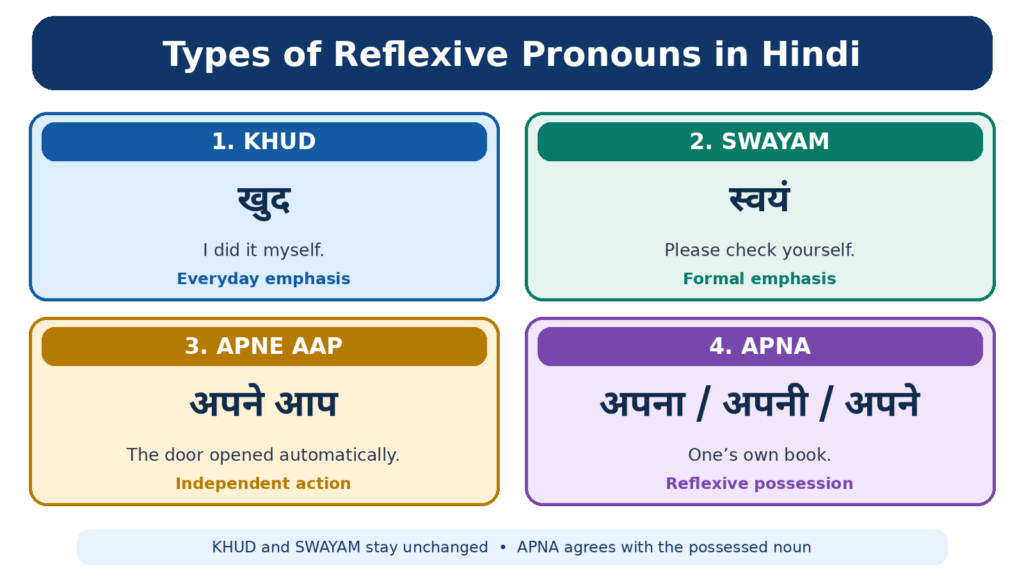
Hindi reflexive expressions are usually studied through खुद, स्वयं, अपने आप, and the reflexive possessive अपना.
These are forms with different uses, not four separate person-based grammatical types.
| Reflexive Form | English Meaning | Main Use | Example |
|---|---|---|---|
| खुद | Self / Personally | Everyday emphasis or self-reference | मैं खुद जाऊँगा। |
| स्वयं | Oneself / Personally | Formal emphasis | आप स्वयं देखिए। |
| अपने आप | By oneself / On one’s own | Independent or spontaneous action | दरवाज़ा अपने आप खुल गया। |
| अपना / अपनी / अपने | One’s own | Reflexive possession | उसने अपनी किताब उठाई। |
1. Khud (खुद) — Everyday Reflexive Form
खुद is a common expression meaning self, personally, or oneself.
It can be used with मैं, तुम, आप, वह, and हम without changing its spelling.
Example: मैं यह काम खुद करूँगा।
English: I will do this work myself.
2. Swayam (स्वयं) — Formal Reflexive Form
स्वयं expresses self-reference or personal involvement in a more formal or literary style.
It is frequently found in instructions, speeches, formal writing, and educational texts.
Example: आप स्वयं उत्तर जाँच सकते हैं।
English: You can check the answer yourself.
3. Apne Aap (अपने आप) — Independent Action
अपने आप often means by oneself, on one’s own, or automatically, depending on context.
With the object marker को, अपने आप को can also refer directly back to the subject.
Example: बच्चा अपने आप चलने लगा।
English: The child started walking on their own.
4. Apna, Apni, Apne (अपना / अपनी / अपने) — Reflexive Possessive
These forms express something associated with the subject, usually meaning one’s own.
Unlike खुद and स्वयं, their endings change according to the gender, number, and grammatical case of the possessed noun.
Examples:
- अपना घर — One’s own house
- अपनी किताब — One’s own book
- अपने दोस्त — One’s own friends
Reflexive Pronoun Grammar Rules in Hindi
Reflexive expressions may emphasize the subject, function as an object referring back to it, or indicate ownership.
The correct form depends on the role of the expression and the structure of the sentence.
Rule 1: Reflexive Expressions Refer Back to the Subject
A reflexive expression can indicate that the subject acts on itself.
Example: मैंने अपने आप को शीशे में देखा।
English: I saw myself in the mirror.
Here, अपने आप को refers back to मैं.
Rule 2: Khud and Swayam Do Not Change with Person or Gender
The forms खुद and स्वयं normally remain unchanged regardless of who performs the action.
| Subject | Example | English |
|---|---|---|
| मैं | मैं खुद करूँगा। | I will do it myself. |
| तुम | तुम खुद करो। | Do it yourself. |
| आप | आप स्वयं देखिए। | See it yourself. |
| वह | वह खुद करेगी। | She will do it herself. |
| हम | हम स्वयं करेंगे। | We will do it ourselves. |
| वे | वे खुद करेंगे। | They will do it themselves. |
The verb may change with person, gender, and number, but the reflexive expression remains the same.
Rule 3: Apna Changes According to the Possessed Noun
अपना, अपनी, and अपने generally agree with the noun describing the possession.
| Reflexive Possessive | Example | English |
|---|---|---|
| अपना | अपना कमरा | One’s own room |
| अपनी | अपनी कुर्सी | One’s own chair |
| अपने | अपने कपड़े | One’s own clothes |
| अपनी | अपनी किताबें | One’s own books |
| अपने | अपने कमरे में | In one’s own room |
अपनी किताब remains feminine whether its owner is male or female.
Rule 4: Use Apne Aap Ko for Direct Self-Reference
When a person performs an action on themselves, अपने आप को or खुद को can express the reflexive object.
Example: उसने खुद को संभाला।
English: He or she composed themselves.
Example: मैंने अपने आप को समझाया।
English: I explained it to myself.
Rule 5: Apne Aap Can Indicate an Action Without Help
अपने आप often emphasizes that an action occurs independently.
Example: वह अपने आप घर पहुँच गया।
English: He reached home on his own.
It can also describe an event happening automatically.
Example: दरवाज़ा अपने आप बंद हो गया।
English: The door closed automatically.
Rule 6: Reflexive and Emphatic Uses Are Not Identical
An actual reflexive object receives the action of its own subject.
An emphatic expression simply stresses that the subject personally performed an action.
| Function | Hindi Example | English |
|---|---|---|
| Reflexive object | उसने खुद को देखा। | He saw himself. |
| Emphasis | उसने खुद देखा। | He saw it himself. |
| Independent action | उसने अपने आप सीखा। | He learned on his own. |
| Reflexive possession | उसने अपनी किताब उठाई। | He picked up his own book. |
Rule 7: Reflexive Possession Depends on the Antecedent
अपना often refers back to the subject, while उसका generally refers to another person or entity in the relevant context.
Example: रवि ने अपनी किताब उठाई।
English: Ravi picked up his own book.
Example: रवि ने उसकी किताब उठाई।
English: Ravi picked up his or her book, referring to someone else in the normal reading.
Rule 8: Reflexive Expressions Work with Different Tenses
Reflexive expressions can appear with past, present, or future actions.
| Tense | Hindi Sentence | English |
|---|---|---|
| Present | मैं खुद करता हूँ। | I do it myself. |
| Past | मैंने खुद किया। | I did it myself. |
| Future | मैं खुद करूँगा। | I will do it myself. |
| Present continuous | वह स्वयं पढ़ रही है। | She is studying herself. |
| Imperative | आप स्वयं जाँचिए। | Please check it yourself. |
Reflexive Pronoun in Hindi Examples
Reflexive expressions can be used with different subjects, objects, postpositions, and possessive constructions.
The following groups illustrate their common forms and everyday meanings.
Khud and Swayam Reflexive Pronoun Examples
खुद is widely used in conversation, while स्वयं is common in formal or emphatic expression.
Both can refer to personal involvement without changing according to grammatical person.
| No. | Hindi Expression | English Meaning |
|---|---|---|
| 1 | मैं खुद | I myself |
| 2 | तुम खुद | You yourself |
| 3 | आप खुद | You yourself, polite |
| 4 | वह खुद | He or she personally |
| 5 | हम खुद | We ourselves |
| 6 | वे खुद | They themselves |
| 7 | खुद को | Oneself, object |
| 8 | खुद से | By oneself / With oneself |
| 9 | खुद के लिए | For oneself |
| 10 | खुद पर | On oneself |
| 11 | खुद ही | Personally / Without help |
| 12 | खुद का | One’s own, masculine |
| 13 | खुद की | One’s own, feminine |
| 14 | खुद के | One’s own, plural or oblique |
| 15 | खुद करना | To do personally |
| 16 | मैं स्वयं | I myself |
| 17 | हम स्वयं | We ourselves |
| 18 | आप स्वयं | You yourself |
| 19 | वह स्वयं | He or she personally |
| 20 | वे स्वयं | They themselves |
| 21 | स्वयं को | Oneself, object |
| 22 | स्वयं से | With oneself |
| 23 | स्वयं के लिए | For oneself |
| 24 | स्वयं पर | On oneself |
| 25 | स्वयं ही | Personally, emphatic |
| 26 | स्वयं का | One’s own, masculine |
| 27 | स्वयं की | One’s own, feminine |
| 28 | स्वयं के | One’s own, plural or oblique |
| 29 | स्वयं करना | To do oneself |
| 30 | स्वयं निर्णय लेना | To decide personally |
Apne Aap Reflexive Pronoun Examples
अपने आप often expresses independence, spontaneous action, or self-directed activity.
Its interpretation depends on the verb and surrounding sentence.
| No. | Hindi Expression | English Meaning |
|---|---|---|
| 1 | अपने आप | By oneself |
| 2 | अपने आप को | Oneself, object |
| 3 | अपने आप से | With oneself / By oneself |
| 4 | अपने आप पर | On oneself |
| 5 | अपने आप ही | Automatically / On its own |
| 6 | अपने आप में | In itself |
| 7 | अपने आप के लिए | For oneself |
| 8 | अपने आप करना | To do independently |
| 9 | अपने आप सीखना | To learn independently |
| 10 | अपने आप चलना | To walk on one’s own |
| 11 | अपने आप उठना | To get up independently |
| 12 | अपने आप बैठना | To sit independently |
| 13 | अपने आप पढ़ना | To study independently |
| 14 | अपने आप लिखना | To write independently |
| 15 | अपने आप समझना | To understand independently |
| 16 | अपने आप बनना | To form on its own |
| 17 | अपने आप खुलना | To open automatically |
| 18 | अपने आप बंद होना | To close automatically |
| 19 | अपने आप ठीक होना | To get better on its own |
| 20 | अपने आप काम करना | To work automatically |
| 21 | अपने आप बोलना | To speak on one’s own |
| 22 | अपने आप सोचना | To think independently |
| 23 | अपने आप निर्णय लेना | To decide independently |
| 24 | अपने आप तैयार होना | To get ready independently |
| 25 | अपने आप संभलना | To regain control by oneself |
| 26 | अपने आप लौटना | To return independently |
| 27 | अपने आप जाना | To go alone |
| 28 | अपने आप आना | To come independently |
| 29 | अपने आप पूरा होना | To be completed automatically |
| 30 | अपने आप बदलना | To change on its own |
Apna, Apni and Apne Reflexive Possessive Examples
The reflexive possessives अपना, अपनी, and अपने express relationships involving the subject.
Their endings follow the grammatical gender, number, and case of the noun being modified.
| No. | Hindi Expression | English Meaning |
|---|---|---|
| 1 | अपना घर | One’s own house |
| 2 | अपना कमरा | One’s own room |
| 3 | अपना बैग | One’s own bag |
| 4 | अपना काम | One’s own work |
| 5 | अपना नाम | One’s own name |
| 6 | अपना निर्णय | One’s own decision |
| 7 | अपना रास्ता | One’s own path |
| 8 | अपना समय | One’s own time |
| 9 | अपना लक्ष्य | One’s own goal |
| 10 | अपना परिवार | One’s own family |
| 11 | अपनी किताब | One’s own book |
| 12 | अपनी कॉपी | One’s own notebook |
| 13 | अपनी कुर्सी | One’s own chair |
| 14 | अपनी चाबी | One’s own key |
| 15 | अपनी गलती | One’s own mistake |
| 16 | अपनी भाषा | One’s own language |
| 17 | अपनी ज़िम्मेदारी | One’s own responsibility |
| 18 | अपनी राय | One’s own opinion |
| 19 | अपनी योजना | One’s own plan |
| 20 | अपनी पहचान | One’s own identity |
| 21 | अपने दोस्त | One’s own friends |
| 22 | अपने कपड़े | One’s own clothes |
| 23 | अपने माता-पिता | One’s own parents |
| 24 | अपने विचार | One’s own thoughts |
| 25 | अपने अधिकार | One’s own rights |
| 26 | अपने शिक्षक | One’s own teachers |
| 27 | अपने सवाल | One’s own questions |
| 28 | अपने कमरे में | In one’s own room |
| 29 | अपने घर से | From one’s own home |
| 30 | अपने काम पर | At one’s own work |
Reflexive Pronoun in Hindi Examples in Sentences
These examples show how reflexive expressions work in different situations, including independent actions, personal emphasis, and possession.
The relevant Hindi reflexive expressions and English equivalents are bolded for easier identification.
| No. | Hindi Sentence | English Translation |
|---|---|---|
| 1 | मैंने यह काम खुद किया। | I did this work myself. |
| 2 | तुम खुद उत्तर लिखो। | Write the answer yourself. |
| 3 | आप स्वयं निर्णय लीजिए। | Make the decision yourself. |
| 4 | वह खुद बाज़ार गया। | He went to the market himself. |
| 5 | हमने खाना खुद बनाया। | We cooked the food ourselves. |
| 6 | वे स्वयं यहाँ आए। | They came here themselves. |
| 7 | मैं खुद को जानता हूँ। | I know myself. |
| 8 | उसने खुद को संभाला। | She composed herself. |
| 9 | बच्चा अपने आप चलने लगा। | The child started walking on their own. |
| 10 | दरवाज़ा अपने आप खुल गया। | The door opened automatically. |
| 11 | मैंने अपने आप को शीशे में देखा। | I saw myself in the mirror. |
| 12 | आप स्वयं उत्तर जाँच सकते हैं। | You can check the answer yourself. |
| 13 | उसने अपना कमरा साफ़ किया। | He cleaned his own room. |
| 14 | सीमा ने अपनी किताब उठाई। | Seema picked up her own book. |
| 15 | बच्चों ने अपने खिलौने रख दिए। | The children put away their own toys. |
| 16 | मैं अपने घर जा रहा हूँ। | I am going to my own home. |
| 17 | वह अपनी गलती मान गई। | She admitted her own mistake. |
| 18 | हमें अपने विचार बताने चाहिए। | We should express our own ideas. |
| 19 | उसने खुद ही समस्या हल की। | He solved the problem himself. |
| 20 | मशीन अपने आप बंद हो गई। | The machine switched off automatically. |
| 21 | मैंने स्वयं यह पत्र लिखा। | I wrote this letter myself. |
| 22 | वह अपने आप पढ़ना सीख गया। | He learned to read on his own. |
| 23 | तुम अपने आप से यह प्रश्न पूछो। | Ask yourself this question. |
| 24 | उन्होंने खुद नियम समझाए। | They explained the rules themselves. |
| 25 | वह अपने काम पर ध्यान देता है। | He focuses on his own work. |
| 26 | आप अपनी राय दीजिए। | Please give your own opinion. |
| 27 | हमने अपनी योजना बदली। | We changed our own plan. |
| 28 | वह खुद को दोष दे रहा था। | He was blaming himself. |
| 29 | मैं अपने आप वहाँ पहुँचा। | I reached there on my own. |
| 30 | शिक्षक ने स्वयं उदाहरण दिया। | The teacher gave the example personally. |
| 31 | बच्चों ने खुद चित्र बनाए। | The children drew the pictures themselves. |
| 32 | राधा ने अपने लिए समय निकाला। | Radha made time for herself. |
| 33 | यह घड़ी अपने आप चलती है। | This clock runs automatically. |
| 34 | उसने अपना वादा निभाया। | She kept her own promise. |
| 35 | मैं खुद वहाँ मौजूद था। | I was there myself. |
| 36 | वे अपनी तैयारी खुद करते हैं। | They prepare by themselves. |
| 37 | उसने अपने आप को समझाया। | She reassured herself. |
| 38 | आप स्वयं परिणाम देख सकते हैं। | You can see the result yourself. |
| 39 | हमें अपनी ज़िम्मेदारी समझनी चाहिए। | We should understand our own responsibility. |
| 40 | समस्या अपने आप ठीक नहीं होगी। | The problem will not resolve on its own. |
Reflexive vs Emphatic Pronouns in Hindi
Hindi uses similar forms for genuine reflexive reference and for emphasis.
The distinction depends on whether the expression receives the action or simply stresses who performed it.
| Feature | Reflexive Use | Emphatic Use |
|---|---|---|
| Function | Refers back to the subject as an object | Emphasizes the person performing the action |
| Typical form | खुद को / अपने आप को | खुद / स्वयं |
| Example | मैंने खुद को देखा। | मैंने खुद देखा। |
| English | I saw myself. | I saw it myself. |
Reflexive Possessive vs Ordinary Possessive
Compare अपना and उसका in the same grammatical context.
| Sentence | Meaning |
|---|---|
| रवि ने अपनी किताब उठाई। | Ravi picked up his own book. |
| रवि ने उसकी किताब उठाई। | Ravi picked up someone else’s book, in the usual reading. |
Common Mistakes with Reflexive Pronouns
Most errors involve choosing an ordinary object pronoun instead of a reflexive expression or using the wrong possessive form.
This table shows common mistakes and their corrections.
| Common Mistake | Incorrect | Correct / Explanation |
|---|---|---|
| Using an ordinary object form for self-reference | मैंने मुझे देखा। | मैंने खुद को देखा। |
| Incorrect agreement with a feminine noun | सीमा ने अपना किताब उठाई। | सीमा ने अपनी किताब उठाई। |
| Confusing self-reference with independent action | वह खुद को स्कूल गया। | वह अपने आप स्कूल गया। |
| Using खुद as a possessive without the proper form | यह खुद किताब है। | यह उसकी अपनी किताब है। |
| Using a masculine possessive with a feminine noun | उसने अपना चाबी ली। | उसने अपनी चाबी ली। |
| Incorrect plural agreement | वे अपना कपड़े लाए। | वे अपने कपड़े लाए। |
| Treating स्वयं as only first person | Assuming स्वयं means only myself | स्वयं can refer to different persons, depending on context. |
| Confusing emphasis with a reflexive object | Assuming मैं खुद गया means I went to myself | It means I went myself. |
Reflexive Pronouns in Hindi Worksheet
Practice choosing खुद, स्वयं, अपने आप, and अपना/अपनी/अपने in different sentence patterns.
The exercises cover self-reference, independent actions, correct possessive agreement, and the difference between reflexive and emphatic uses.
Download Reflexive Pronouns Worksheet with Answers PDF
Use the printable worksheet to practice identifying reflexive expressions, completing Hindi sentences, and selecting the correct possessive forms.
The PDF includes an answer key for independent checking and revision.
Download Reflexive Pronouns in Hindi Study Notes PDF
Review the main reflexive expressions, their English meanings, important grammar rules, and examples in a single document.
These notes are designed for offline reading, classroom revision, and quick reference.
Frequently Asked Questions
Is खुद a reflexive pronoun or an emphatic word?
खुद can serve a reflexive function in expressions such as खुद को, or emphasize the subject in sentences such as मैं खुद गया. Its function depends on the construction.
Is स्वयं more formal than खुद?
Yes. स्वयं is generally associated with more formal or literary Hindi, while खुद is common in everyday conversation.
Does अपने आप always mean by oneself?
No. It can mean independently, on one’s own, or automatically, depending on the verb and context.
Why do अपना, अपनी, and अपने change?
They agree with the gender, number, and grammatical case of the noun they modify rather than simply matching the gender of the owner.
Lets Practice!
Think of a familiar task such as preparing a meal, writing an answer, or organizing your room. You can say मैंने खुद किया to emphasize your involvement, or मैंने अपने आप किया to show that you worked independently.
Try writing three new sentences: one using स्वयं, one using अपने आप, and one using अपनी.
Check whether each expression matches its intended meaning, then share your sentences in the comments.
Leave a Reply