A teacher places one notebook on the desk and several others on a shelf across the classroom. Pointing to the notebook nearby, the teacher says, “यह मेरा है” (This is mine). Then, pointing to the distant notebooks, the teacher adds, “वे तुम्हारे हैं” (Those are yours). Two short sentences tell us which objects are being discussed without repeating their names.
Words such as यह, ये, वह, and वे are called demonstrative pronouns, known as संकेतवाचक सर्वनाम or निश्चयवाचक सर्वनाम in Hindi. They point to particular people, objects, or places and help distinguish nearby things from those farther away.
But what happens when we say “यह किताब मेरी है” instead of “यह मेरी है”? The same word can act differently depending on whether it stands alone or appears before a noun. Understanding that difference, along with number and oblique forms, makes Hindi demonstrative pronouns easier to use correctly.
Demonstrative Pronoun Types in Hindi
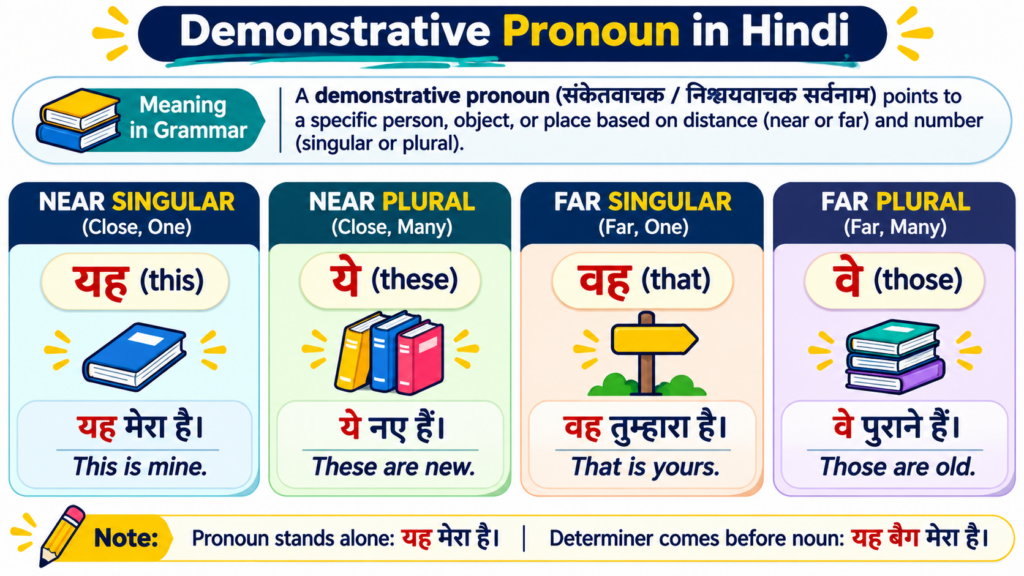
Hindi demonstrative pronouns are commonly organized by distance and number. These two distinctions produce four main direct forms.
The forms point to nearby or more distant referents and can also function as third-person pronouns.
| Type | Hindi Pronoun | English Meaning | Example |
|---|---|---|---|
| Near Singular | यह | This | यह मेरा है। |
| Near Plural | ये | These | ये मेरे हैं। |
| Far Singular | वह | That | वह तुम्हारा है। |
| Far Plural | वे | Those | वे तुम्हारे हैं। |
1. Near Singular Demonstrative Pronoun
यह points to one nearby person, object, or thing already understood from context.
Example: यह बहुत अच्छा है। (This is very good.)
2. Near Plural Demonstrative Pronoun
ये points to more than one nearby person or thing. It can also be used for a single person respectfully.
Example: ये मेरे हैं। (These are mine.)
3. Far Singular Demonstrative Pronoun
वह identifies one person or object farther away, or someone or something already mentioned.
Example: वह बहुत पुराना है। (That is very old.)
4. Far Plural Demonstrative Pronoun
वे identifies multiple more distant people or objects. It may also refer respectfully to one person.
Example: वे अभी वहाँ हैं। (Those are still there.)
Demonstrative Pronoun Grammar Rules in Hindi
Demonstrative pronouns have different forms depending on their grammatical role and whether the referent is near, distant, singular, or plural.
They also interact with Hindi postpositions, possessive forms, and verb agreement.
Rule 1: Use यह and ये for Nearby Reference
यह is the common direct singular form, while ये is the corresponding plural form.
| Singular | Plural |
|---|---|
| यह मेरा है। | ये मेरे हैं। |
| This is mine. | These are mine. |
| यह नया है। | ये नए हैं। |
| This is new. | These are new. |
Rule 2: Use वह and वे for Distant Reference
वह is the common direct singular form, while वे is the corresponding plural form.
| Singular | Plural |
|---|---|
| वह तुम्हारा है। | वे तुम्हारे हैं। |
| That is yours. | Those are yours. |
| वह पुराना है। | वे पुराने हैं। |
| That is old. | Those are old. |
Rule 3: Pronouns May Change Before Postpositions
Hindi demonstratives take oblique forms before many postpositions such as को, से, में, पर, and के लिए.
| Direct Form | Oblique Stem | Example |
|---|---|---|
| यह | इस | इससे (from/with this) |
| ये | इन | इनमें (among/in these) |
| वह | उस | उसको (to that one) |
| वे | उन | उनसे (from/with those) |
For example, यह मेरा है uses the direct form, but इसमें पानी है uses the oblique form.
Rule 4: Demonstrative Pronouns Do Not Change for Gender
The pronouns यह and वह can refer to masculine or feminine people and objects.
Verb forms or adjectives may reveal grammatical gender.
| Hindi Sentence | English Meaning |
|---|---|
| यह अच्छा है। | This is good. (masculine) |
| यह अच्छी है। | This is good. (feminine) |
| वह आया। | He came. |
| वह आई। | She came. |
Rule 5: Verbs and Adjectives May Show Number Agreement
Singular demonstratives usually take singular agreement, while ordinary plural demonstratives take plural agreement.
Examples:
- यह नया है। (This is new.)
- ये नए हैं। (These are new.)
- वह तैयार है। (That is ready.)
- वे तैयार हैं। (Those are ready.)
Rule 6: ये and वे Can Express Respect
In Hindi, plural-style demonstratives may refer to a single person respectfully.
Example: ये हमारे शिक्षक हैं। (This person is our teacher.)
Example: वे बहुत अनुभवी हैं। (He or she is very experienced, respectfully.)
Rule 7: Emphatic Forms Identify a Particular Referent
Adding ही creates emphatic forms such as यही and वही.
| Ordinary Form | Emphatic Form | Meaning |
|---|---|---|
| यह | यही | This very one |
| वह | वही | That very one |
| इसको | इसी को | To this very one |
| उसको | उसी को | To that very one |
Example: यही सही है। (This very one is correct.)
Rule 8: Demonstratives Can Refer to Previously Mentioned Ideas
Distance is not always physical. A demonstrative may refer to something discussed earlier in a conversation.
Example: यह सही नहीं है। (This is not right.)
Here, यह may refer to an action, decision, or idea rather than a visible object.
Demonstrative Pronoun Examples in Hindi with Pictures
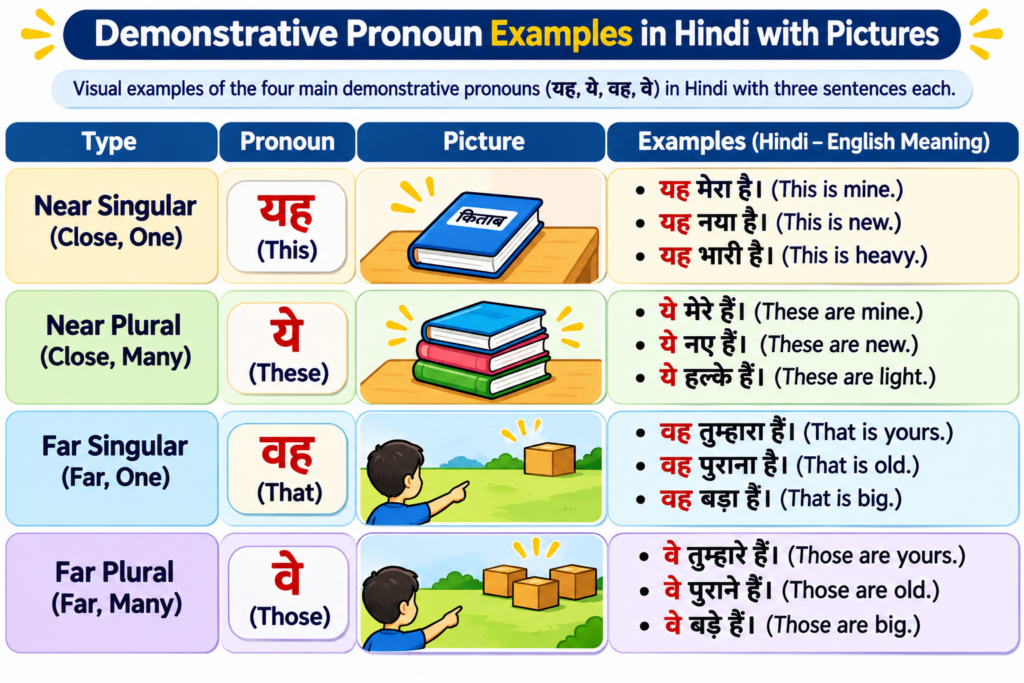
Pictures help learners connect demonstrative pronouns with nearby and distant objects.
The table includes three examples for each of the four main forms. The Hindi examples use the pronouns independently, with the referenced object understood.
| Type | Pronoun | Three Examples | Suggested Picture |
|---|---|---|---|
| Near Singular | यह | यह मेरा है। (This is mine.) यह नया है। (This is new.) यह भारी है। (This is heavy.) | One nearby notebook |
| Near Plural | ये | ये मेरे हैं। (These are mine.) ये नए हैं। (These are new.) ये हल्के हैं। (These are light.) | Several nearby notebooks |
| Far Singular | वह | वह तुम्हारा है। (That is yours.) वह पुराना है। (That is old.) वह बड़ा है। (That is big.) | One distant box |
| Far Plural | वे | वे तुम्हारे हैं। (Those are yours.) वे पुराने हैं। (Those are old.) वे बड़े हैं। (Those are big.) | Several distant boxes |
The picture chart can be placed directly beneath this table to reinforce distance and number visually.
Demonstrative Pronoun Examples in Hindi
Demonstrative pronouns appear in everyday statements, questions, comparisons, and instructions.
The examples below demonstrate direct forms, oblique forms, and possessive constructions.
Near Demonstrative Pronoun Examples
These examples use यह, ये, इस, and इन to refer to nearby people, objects, or previously mentioned things.
| No. | Hindi Example | English Meaning |
|---|---|---|
| 1 | यह मेरा है। | This is mine. |
| 2 | यह नया है। | This is new. |
| 3 | यह सुंदर है। | This is beautiful. |
| 4 | यह भारी है। | This is heavy. |
| 5 | यह हल्का है। | This is light. |
| 6 | यह बहुत उपयोगी है। | This is very useful. |
| 7 | यह किसका है? | Whose is this? |
| 8 | यह क्या है? | What is this? |
| 9 | यह कहाँ रखा था? | Where was this kept? |
| 10 | यह यहाँ है। | This is here. |
| 11 | ये मेरे हैं। | These are mine. |
| 12 | ये नए हैं। | These are new. |
| 13 | ये पुराने हैं। | These are old. |
| 14 | ये साफ़ हैं। | These are clean. |
| 15 | ये भारी हैं। | These are heavy. |
| 16 | ये किसके हैं? | Whose are these? |
| 17 | ये कहाँ मिले? | Where were these found? |
| 18 | ये यहाँ रखे हैं। | These are kept here. |
| 19 | इसको उठाओ। | Pick this up. |
| 20 | इसे देखो। | Look at this. |
| 21 | इससे काम होगा। | This will be useful for the task. |
| 22 | इसमें पानी है। | There is water in this. |
| 23 | इस पर लिखो। | Write on this. |
| 24 | इसका रंग नीला है। | Its color is blue. |
| 25 | इसी को चुनो। | Choose this very one. |
| 26 | इनको अंदर रखो। | Put these inside. |
| 27 | इन्हें संभालकर रखो। | Keep these safely. |
| 28 | इनसे सीखो। | Learn from these. |
| 29 | इनमें क्या है? | What is inside these? |
| 30 | इनका आकार छोटा है। | Their size is small. |
Far Demonstrative Pronoun Examples
These examples use वह, वे, उस, and उन to refer to more distant or contextually established people and things.
| No. | Hindi Example | English Meaning |
|---|---|---|
| 1 | वह तुम्हारा है। | That is yours. |
| 2 | वह पुराना है। | That is old. |
| 3 | वह बड़ा है। | That is big. |
| 4 | वह बहुत ऊँचा है। | That is very tall. |
| 5 | वह खाली है। | That is empty. |
| 6 | वह कहाँ है? | Where is that? |
| 7 | वह किसका है? | Whose is that? |
| 8 | वह बहुत दूर है। | That is very far away. |
| 9 | वह तैयार है। | That is ready. |
| 10 | वह ठीक नहीं है। | That is not right. |
| 11 | वे तुम्हारे हैं। | Those are yours. |
| 12 | वे पुराने हैं। | Those are old. |
| 13 | वे बड़े हैं। | Those are big. |
| 14 | वे नए नहीं हैं। | Those are not new. |
| 15 | वे बाहर हैं। | Those are outside. |
| 16 | वे किसके हैं? | Whose are those? |
| 17 | वे कहाँ रखे हैं? | Where are those kept? |
| 18 | वे बहुत दूर हैं। | Those are very far away. |
| 19 | उसको बुलाओ। | Call that person. |
| 20 | उसे रख दो। | Put that away. |
| 21 | उससे सावधान रहो। | Be careful of that. |
| 22 | उसमें क्या रखा है? | What is kept inside that? |
| 23 | उस पर मत बैठो। | Do not sit on that. |
| 24 | उसका रंग लाल है। | Its color is red. |
| 25 | उसी को ले आओ। | Bring that very one. |
| 26 | उनको वापस रखो। | Put those back. |
| 27 | उन्हें साफ़ करो। | Clean those. |
| 28 | उनसे दूरी रखो। | Keep a distance from those. |
| 29 | उनमें कुछ रखा है। | Something is kept in those. |
| 30 | उनका आकार बड़ा है। | Their size is large. |
Demonstrative Pronoun in Hindi Sentences with English Meaning
Demonstratives make communication precise by showing which object, person, or idea is intended.
The important demonstrative pronouns and corresponding English forms are highlighted below.
| No. | Hindi Sentence | English Translation |
|---|---|---|
| 1 | यह मेरा है। | This is mine. |
| 2 | ये मेरे हैं। | These are mine. |
| 3 | वह तुम्हारा है। | That is yours. |
| 4 | वे तुम्हारे हैं। | Those are yours. |
| 5 | यह बहुत अच्छा है। | This is very good. |
| 6 | ये बहुत अच्छे हैं। | These are very good. |
| 7 | वह काफी पुराना है। | That is quite old. |
| 8 | वे अभी नए हैं। | Those are still new. |
| 9 | यह किसका है? | Whose is this? |
| 10 | ये किसके हैं? | Whose are these? |
| 11 | वह कहाँ गया? | Where did that one go? |
| 12 | वे कहाँ गए? | Where did those go? |
| 13 | इसे यहाँ रख दो। | Put this here. |
| 14 | उसे वहाँ रख दो। | Put that there. |
| 15 | इन्हें साफ़ करो। | Clean these. |
| 16 | उन्हें वापस रखो। | Put those back. |
| 17 | इसमें पानी है। | There is water in this. |
| 18 | उसमें दूध है। | There is milk in that. |
| 19 | इनमें किताबें हैं। | There are books in these. |
| 20 | उनमें कपड़े हैं। | There are clothes in those. |
| 21 | यह मेरे काम आएगा। | This will be useful to me. |
| 22 | वह हमारे काम आएगा। | That will be useful to us. |
| 23 | ये सही लगते हैं। | These seem correct. |
| 24 | वे गलत लगते हैं। | Those seem incorrect. |
| 25 | इससे मुझे मदद मिली। | This helped me. |
| 26 | उससे मुझे नुकसान हुआ। | That caused me harm. |
| 27 | इनसे बहुत कुछ सीखा जा सकता है। | A lot can be learned from these. |
| 28 | उनसे सावधान रहना चाहिए। | One should be careful of those. |
| 29 | यही सही उत्तर है। | This very one is the correct answer. |
| 30 | वही मेरा पसंदीदा है। | That very one is my favorite. |
| 31 | इसी को चुनना चाहिए। | This very one should be chosen. |
| 32 | उसी को वापस लाओ। | Bring that very one back. |
| 33 | ये मेरी पसंद के हैं। | These are the ones I like. |
| 34 | वे मुझे पसंद नहीं हैं। | I do not like those. |
| 35 | यह अभी उपलब्ध है। | This is available now. |
| 36 | वह अब उपलब्ध नहीं है। | That is no longer available. |
| 37 | इन्हें बाहर मत ले जाओ। | Do not take these outside. |
| 38 | उन्हें अलग रखो। | Keep those separately. |
| 39 | यह पहले से बेहतर है। | This is better than before. |
| 40 | वे अभी भी वहीं हैं। | Those are still there. |
Difference Between Demonstrative Pronoun and Demonstrative Adjective in Hindi
A demonstrative pronoun stands independently in place of a noun. A demonstrative adjective, more precisely called a demonstrative determiner, appears before a noun and identifies it.
The Hindi words may look identical, but their grammatical functions differ.
| Demonstrative Pronoun | Demonstrative Adjective / Determiner |
|---|---|
| यह मेरा है। (This is mine.) | यह बैग मेरा है। (This bag is mine.) |
| ये नए हैं। (These are new.) | ये जूते नए हैं। (These shoes are new.) |
| वह पुराना है। (That is old.) | वह घर पुराना है। (That house is old.) |
| वे खाली हैं। (Those are empty.) | वे डिब्बे खाली हैं। (Those boxes are empty.) |
How to Identify the Difference
Pronoun: यह मेरा है।
Here, यह stands independently. The referenced object is understood.
Determiner: यह बैग मेरा है।
Here, यह appears before बैग and identifies a particular bag.
Important: Hindi grammars may describe these uses through the terms सार्वनामिक विशेषण, संकेतवाचक विशेषण, or related labels.
Common Mistakes with Demonstrative Pronouns
Most mistakes involve confusing distance, number, oblique forms, or the grammatical role of demonstratives.
| Common Mistake | Incorrect | Correct / Explanation |
|---|---|---|
| Using singular demonstratives for plural objects | यह मेरे हैं। | ये मेरे हैं। |
| Using plural demonstratives with ordinary singular agreement | ये नया है। | ये नए हैं। when referring to several masculine objects. |
| Confusing near and far reference | Using यह for a distant object without context | Prefer वह when clearly pointing to something farther away. |
| Incorrect oblique form | यह से काम करो। | इससे काम करो। |
| Incorrect far oblique form | वह में पानी है। | उसमें पानी है। |
| Incorrect plural object construction | ये को रखो। | इन्हें रखो। |
| Treating every यह as a pronoun | यह किताब मेरी है। | Here यह acts as a demonstrative determiner. |
| Assuming demonstratives change for gender | Using different demonstrative forms for he and she | वह can refer to either; agreement and context clarify gender. |
| Ignoring honorific singular usage | Assuming वे always means several people | वे can refer respectfully to one person. |
| Confusing यह and यही | Treating both as equally emphatic | यही specifically emphasizes this very one. |
Demonstrative Pronoun in Hindi Worksheet
Practice choosing यह, ये, वह, and वे, identifying near and distant references, and using correct oblique forms.
The activities also help distinguish demonstrative pronouns from demonstrative adjectives in sentences.
⋮⋮⋮⋮Download Demonstrative Pronoun Worksheet with Answers PDF
Use the printable exercises to review distance, number, sentence agreement, and demonstrative pronoun forms.
The worksheet includes an answer key so learners can check their responses and review mistakes independently.
Download Demonstrative Pronoun in Hindi PDF Study Notes
Keep the four main demonstrative forms, their English meanings, grammar rules, and sentence examples together for revision.
These study notes also explain oblique forms and the difference between demonstrative pronouns and demonstrative adjectives.
Frequently Asked Questions
Can यह and वह refer to people?
Yes. यह and वह can refer to people as well as objects. The context and verb agreement help determine their meaning.
Why is इसमें used instead of यह में?
Hindi uses the oblique stem इस before the postposition में, producing इसमें.
Can ये and वे refer to one person?
Yes. Both may refer respectfully to one person in honorific contexts, with plural-style agreement.
Is यही a separate basic demonstrative pronoun?
यही is an emphatic form related to यह. It highlights a specific referent rather than introducing an entirely new near/far category.
Final Lines
A demonstrative pronoun helps the listener know exactly what you mean. यह and ये commonly point nearby, while वह and वे can identify more distant people or objects.
Try describing four objects around your room using one sentence for each demonstrative.
Then rewrite one sentence using a demonstrative determiner, such as यह किताब, and compare the structure.
Leave a Reply