A student opens his schoolbag and finds two notebooks. One belongs to him, while the other belongs to his friend. When the teacher asks whose notebooks they are, the student replies, “This is Ravi’s notebook, and that one is mine.” The two expressions communicate ownership, but they use different grammatical forms.
In English grammar, Ravi’s is a possessive noun, while mine is a possessive pronoun. A possessive noun, called अधिकार या संबंध बताने वाली संज्ञा in Hindi, shows ownership or a relationship. In Hindi, such relationships are commonly expressed using का, की, and के.
A small apostrophe can change the meaning of a sentence. Compare the student’s book with the students’ books. The difference is easy to miss, but it tells us whether one student or several students are involved. Understanding these forms also makes my, mine, your, yours, her, and hers much easier to use correctly.
Types of Possessive Nouns in Hindi
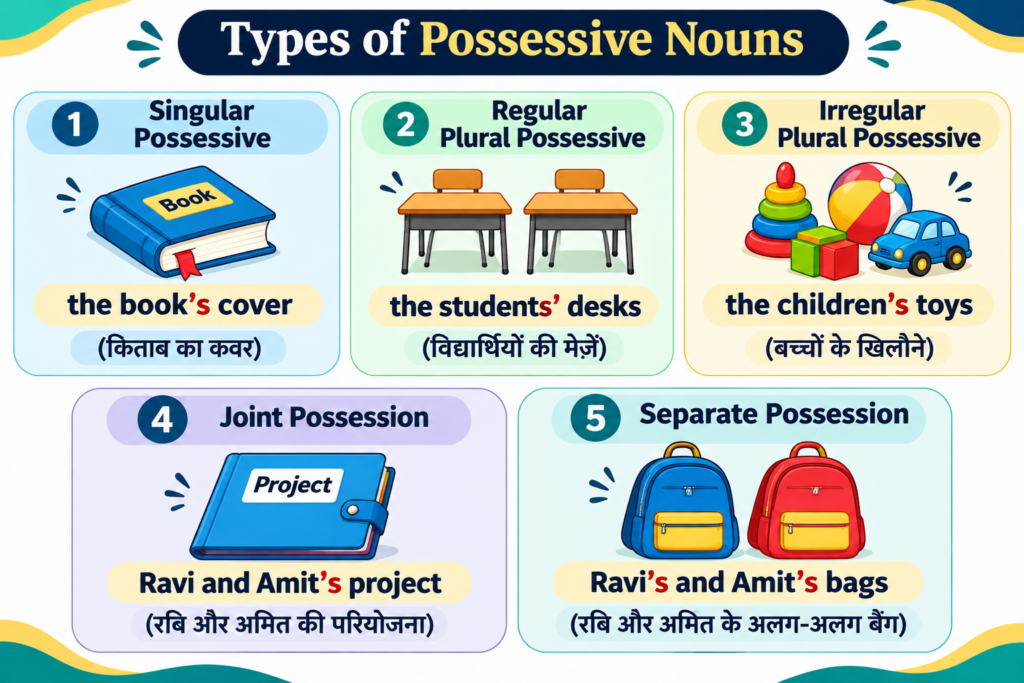
Possessive nouns can be classified by their singular and plural forms and by whether ownership is shared or separate.
1. Singular Possessive Noun
Add ‘s to most singular nouns to express possession or a relationship.
Example:The boy’s pencil — लड़के की पेंसिल
2. Regular Plural Possessive Noun
Add only an apostrophe ‘ after a regular plural noun ending in -s.
Example:The teachers’ room — शिक्षकों का कमरा
3. Irregular Plural Possessive Noun
Add ‘s to irregular plural nouns that do not end in -s.
Example:The men’s shoes — पुरुषों के जूते
4. Joint Possession
When two people share the same object or responsibility, place ‘s after the last name.
Example:Ravi and Amit’s shop — रवि और अमित की साझा दुकान
5. Separate Possession
When two people own different things, place ‘s after each person’s name.
Example:Ravi’s and Amit’s bicycles — रवि और अमित की अलग-अलग साइकिलें
Possessive Noun Grammar Rules
English possessive nouns use apostrophes to show ownership, relationships, and associations.
The correct placement depends on the number and structure of the noun.
Rule 1: Add ‘s to Singular Nouns
For most singular nouns, add ‘s, whether the noun refers to a person, animal, organization, or thing.
Base Noun
Possessive Form
Teacher
Teacher’s
Student
Student’s
Child
Child’s
Book
Book’s
School
School’s
Example:The school’s library is large. — विद्यालय का पुस्तकालय बड़ा है।
Rule 2: Add an Apostrophe After Regular Plural Nouns
When a plural noun already ends in -s, add an apostrophe without another s.
Plural Noun
Possessive Form
Teachers
Teachers’
Students
Students’
Parents
Parents’
Workers
Workers’
Players
Players’
Example:The workers’ uniforms are clean. — मज़दूरों की वर्दियाँ साफ़ हैं।
Rule 3: Add ‘s to Irregular Plural Nouns
Irregular plurals such as children, men, and women do not end in -s, so they take ‘s.
Ravi and Amit’s office suggests a shared office. Ravi’s and Amit’s offices suggests separate offices associated with each person.
Rule 5: Use Possessive Nouns for More Than Ownership
The possessive form also expresses relationships, origin, time, and association.
Relationship
Example
Ownership
Ravi’s laptop
Family relationship
Meera’s brother
Duration
A day’s work
Organization
The company’s policy
Physical part
The table’s legs
Rule 6: Do Not Confuse Apostrophes with Regular Plurals
Books is an ordinary plural, while book’s expresses a relationship involving one book.
Incorrect
Correct
The students bag
The student’s bag
The teachers room (several teachers)
The teachers’ room
The childrens toys
The children’s toys
The schools library
The school’s library
Rule 7: Its and It’s Have Different Meanings
Its is a possessive determiner meaning something belongs to or is associated with it. It’s means it is or it has.
Example:The school changed its timetable. — विद्यालय ने अपनी समय-सारणी बदल दी।
Example:It’s raining outside. — बाहर बारिश हो रही है।
Possessive Noun Examples in Hindi
Possessive nouns are common in conversations about belongings, family relationships, workplaces, buildings, and everyday objects.
These examples demonstrate how English possessive constructions correspond to Hindi expressions using का, की, and के.
Singular Possessive Noun Examples — 30 Examples
No.
English Example
Hindi Meaning
1
The boy’s bag
लड़के का बैग
2
The girl’s notebook
लड़की की कॉपी
3
The teacher’s desk
शिक्षक की मेज़
4
The student’s pencil
विद्यार्थी की पेंसिल
5
The father’s watch
पिता की घड़ी
6
The mother’s phone
माँ का फ़ोन
7
The brother’s bicycle
भाई की साइकिल
8
The sister’s umbrella
बहन का छाता
9
The doctor’s clinic
डॉक्टर का क्लिनिक
10
The farmer’s field
किसान का खेत
11
The driver’s seat
चालक की सीट
12
The pilot’s uniform
विमान चालक की वर्दी
13
The chef’s apron
रसोइए का एप्रन
14
The artist’s painting
कलाकार की पेंटिंग
15
The carpenter’s tools
बढ़ई के औज़ार
16
The librarian’s register
पुस्तकालयाध्यक्ष का रजिस्टर
17
The manager’s office
प्रबंधक का कार्यालय
18
The engineer’s helmet
इंजीनियर का हेलमेट
19
The scientist’s laboratory
वैज्ञानिक की प्रयोगशाला
20
The gardener’s gloves
माली के दस्ताने
21
The tailor’s scissors
दर्ज़ी की कैंची
22
The baker’s oven
बेकर का ओवन
23
The shopkeeper’s counter
दुकानदार का काउंटर
24
The mechanic’s toolbox
मिस्त्री का औज़ारों का बक्सा
25
The photographer’s camera
फ़ोटोग्राफ़र का कैमरा
26
The author’s manuscript
लेखक की पांडुलिपि
27
The judge’s decision
न्यायाधीश का निर्णय
28
The coach’s whistle
प्रशिक्षक की सीटी
29
The musician’s instrument
संगीतकार का वाद्ययंत्र
30
The passenger’s ticket
यात्री का टिकट
Plural Possessive Noun Examples — 30 Examples
Regular plural nouns ending in -s usually take an apostrophe after the s. Irregular plural nouns take ‘s.
No.
English Example
Hindi Meaning
1
The students’ books
विद्यार्थियों की किताबें
2
The teachers’ meeting
शिक्षकों की बैठक
3
The parents’ room
अभिभावकों का कमरा
4
The workers’ helmets
मज़दूरों के हेलमेट
5
The players’ uniforms
खिलाड़ियों की वर्दियाँ
6
The farmers’ crops
किसानों की फ़सलें
7
The doctors’ conference
डॉक्टरों का सम्मेलन
8
The nurses’ station
नर्सों का स्टेशन
9
The drivers’ lounge
चालकों का विश्राम कक्ष
10
The artists’ exhibition
कलाकारों की प्रदर्शनी
11
The customers’ complaints
ग्राहकों की शिकायतें
12
The employees’ salaries
कर्मचारियों के वेतन
13
The managers’ reports
प्रबंधकों की रिपोर्टें
14
The athletes’ equipment
खिलाड़ियों की उपकरण-सामग्री
15
The visitors’ entrance
आगंतुकों का प्रवेश द्वार
16
The passengers’ luggage
यात्रियों का सामान
17
The chefs’ recipes
रसोइयों की व्यंजन-विधियाँ
18
The readers’ comments
पाठकों की टिप्पणियाँ
19
The writers’ association
लेखकों का संघ
20
The engineers’ workshop
इंजीनियरों की कार्यशाला
21
The children’s playground
बच्चों का खेल का मैदान
22
The men’s shoes
पुरुषों के जूते
23
The women’s bags
महिलाओं के बैग
24
The people’s choice
लोगों की पसंद
25
The mice’s tails
चूहों की पूँछें
26
The geese’s feathers
कलहंसों के पंख
27
The oxen’s shelter
बैलों का आश्रय-स्थल
28
The sheep’s wool
भेड़ों की ऊन
29
The fish’s scales
मछलियों के शल्क
30
The deer’s tracks
हिरणों के पदचिह्न
Note: Plural nouns such as sheep, fish, and deer can have the same form in the singular and plural. The meaning of their possessive phrases depends on context.
Possessive Nouns for Places and Organizations — 30 Examples
Names of places and institutions can take possessive forms to express facilities, features, history, services, or institutional relationships.
No.
English Example
Hindi Meaning
1
The school’s playground
विद्यालय का खेल का मैदान
2
The college’s library
महाविद्यालय का पुस्तकालय
3
The university’s website
विश्वविद्यालय की वेबसाइट
4
The hospital’s entrance
अस्पताल का प्रवेश द्वार
5
The museum’s collection
संग्रहालय का संग्रह
6
The bank’s opening hours
बैंक के खुलने का समय
7
The hotel’s reception
होटल का स्वागत कक्ष
8
The restaurant’s menu
रेस्तराँ का मेन्यू
9
The airport’s runway
हवाई अड्डे का रनवे
10
The station’s platform
स्टेशन का प्लेटफ़ॉर्म
11
The library’s rules
पुस्तकालय के नियम
12
The market’s main gate
बाज़ार का मुख्य द्वार
13
The park’s fountain
उद्यान का फव्वारा
14
The stadium’s seating area
स्टेडियम का बैठने का क्षेत्र
15
The factory’s machinery
कारखाने की मशीनरी
16
The company’s headquarters
कंपनी का मुख्यालय
17
The office’s address
कार्यालय का पता
18
The laboratory’s equipment
प्रयोगशाला के उपकरण
19
The theater’s stage
रंगमंच का मंच
20
The shop’s window
दुकान की खिड़की
21
The temple’s courtyard
मंदिर का प्रांगण
22
The mosque’s courtyard
मस्जिद का आँगन
23
The church’s roof
गिरजाघर की छत
24
The city’s roads
शहर की सड़कें
25
The village’s well
गाँव का कुआँ
26
The country’s capital
देश की राजधानी
27
The state’s borders
राज्य की सीमाएँ
28
The bridge’s pillars
पुल के स्तंभ
29
The building’s elevator
इमारत की लिफ़्ट
30
The warehouse’s storage area
गोदाम का भंडारण क्षेत्र
Frequently Asked Questions
Is a possessive noun the same as a possessive pronoun?
No. Ravi’s is a possessive noun form, while mine, yours, hers, ours, and theirs are independent possessive pronouns.
Can possessive nouns describe things other than ownership?
Yes. A day’s work, the city’s history, and the book’s cover express duration, association, or a part-whole relationship rather than straightforward personal ownership.
Is theirs singular or plural?
Theirs refers to something associated with them. The things being referred to can be singular or plural: The house is theirs and The books are theirs are both correct.
Should we write James’s or James’?
Both forms can occur depending on the style guide. James’s book is widely accepted, while some styles prefer James’ book. Consistency matters.
Conclusion
A misplaced apostrophe may seem minor, but it can change who owns something. The student’s bag refers to one student; the students’ bag refers to several students associated with the bag.
For a quick challenge, complete these sentences without looking back: This notebook is___(my/mine), The___(children/children’s) toys are new, and That bicycle is___(her/hers).
The morning market is already crowded. A fruit seller arranges fresh apples (सेब), a bicycle (साइकिल) passes through the street, and the smell of hot tea (चाय) drifts from a nearby shop. You can see the apples, hear the bicycle bell, and smell the tea. Each experience connects to something physically real.
In English grammar, words that name things we can experience through our five senses are called concrete nouns, known as मूर्त संज्ञा in Hindi. A mountain (पहाड़), bird (पक्षी), and perfume (इत्र) are concrete nouns, although we experience them in different ways.
Here’s where grammar becomes interesting: water is concrete, but we cannot count it like bottles. A team represents several people but acts as one collective noun.
These differences make the types and grammar rules of concrete nouns worth understanding.
Types of Concrete Noun in Hindi
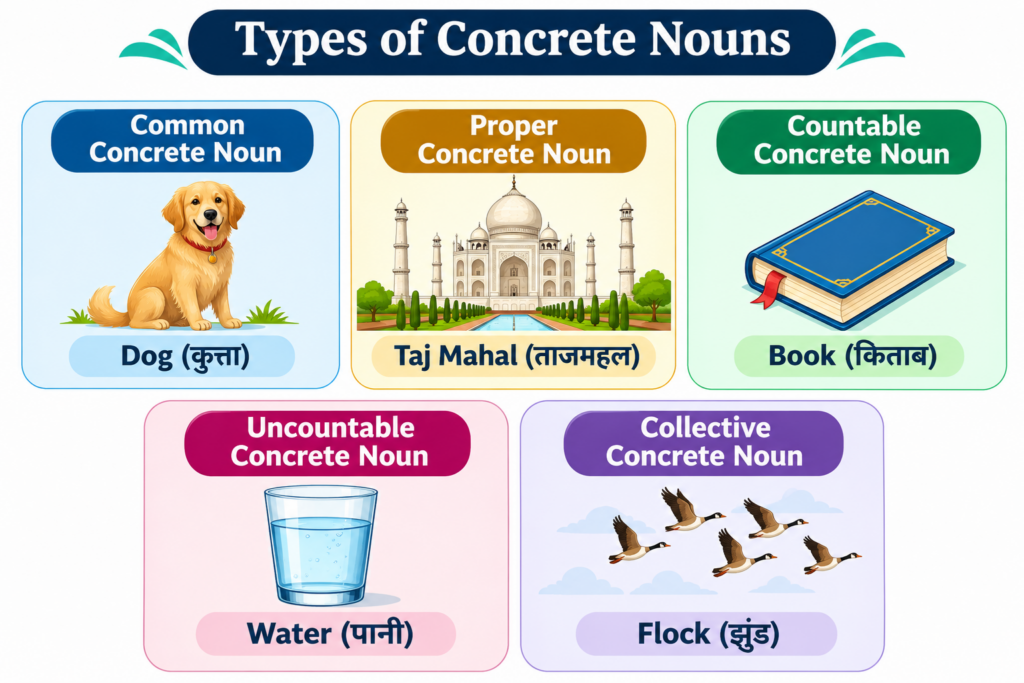
Concrete nouns overlap with several other noun categories. The five groups below show how physical people, places, objects, and substances can be classified.
1. Common Concrete Nouns
Common concrete nouns name ordinary people, places, animals, or physical things without identifying a specific one.
Examples:teacher (शिक्षक), city (शहर), horse (घोड़ा), table (मेज़).
2. Proper Concrete Nouns
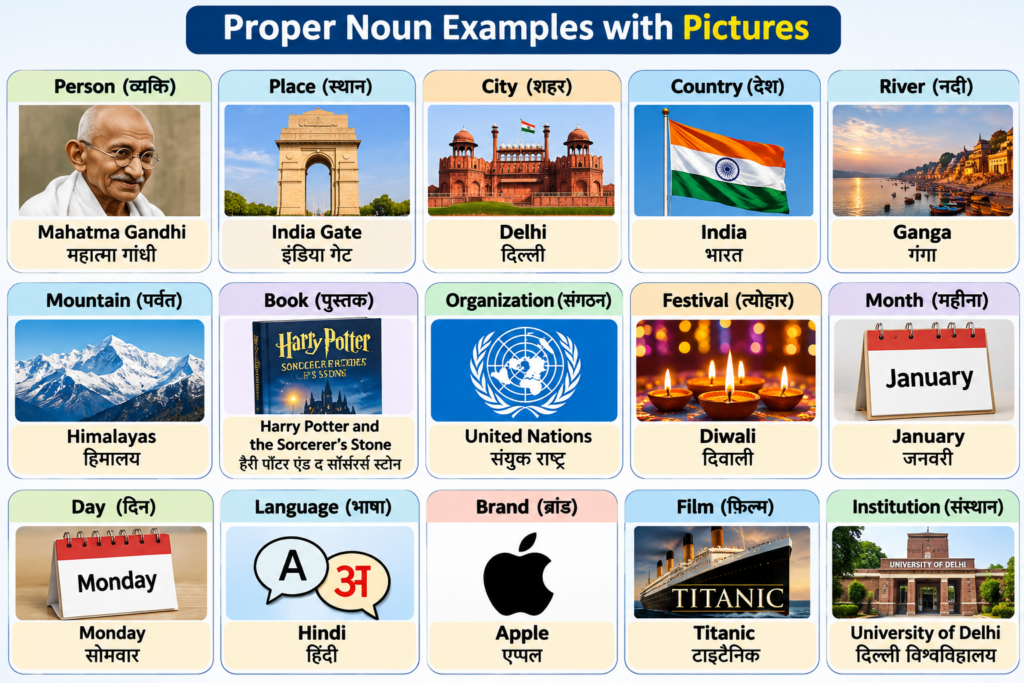
Proper concrete nouns identify particular people, places, landmarks, or other named physical entities. They begin with capital letters in English.
Examples:Delhi (दिल्ली), Mount Everest (माउंट एवरेस्ट), Ravi (रवि), Taj Mahal (ताजमहल).
3. Countable Concrete Nouns
Countable concrete nouns refer to separate physical items that can be numbered and usually have singular and plural forms.
Examples:one pen (एक कलम), two chairs (दो कुर्सियाँ), three apples (तीन सेब).
4. Uncountable Concrete Nouns
Uncountable concrete nouns name physical substances or materials that are usually measured as quantities rather than counted individually.
Collective concrete nouns name groups of physical people, animals, or objects considered together.
Examples:a flock of birds (पक्षियों का झुंड), a herd of cattle (मवेशियों का झुंड), a fleet of ships (जहाज़ों का बेड़ा).
Concrete Noun Grammar Rules
Concrete nouns follow the usual rules of English nouns, including number, articles, possession, capitalization, and subject-verb agreement.
Their correct forms depend on whether they are countable, uncountable, common, or proper.
Rule 1: Countable Concrete Nouns Have Singular and Plural Forms
Most countable concrete nouns form their plurals by adding -s or -es, although some have irregular plurals.
Singular
Plural
Hindi Meaning
Book
Books
किताब / किताबें
Box
Boxes
डिब्बा / डिब्बे
Bus
Buses
बस / बसें
Child
Children
बच्चा / बच्चे
Tooth
Teeth
दाँत
Foot
Feet
पैर
Mouse
Mice
चूहा / चूहे
Leaf
Leaves
पत्ता / पत्ते
Rule 2: Singular Countable Concrete Nouns Usually Need a Determiner
Singular countable common nouns normally appear with a, an, the, or another determiner.
Incorrect
Correct
I bought book.
I bought a book.
She has umbrella.
She has an umbrella.
Boy is running.
The boy is running.
This is my bicycle.
This is my bicycle.
Rule 3: Use Singular or Plural Verbs According to the Subject
Concrete nouns can take either singular or plural verbs depending on their number and grammatical use.
Singular Sentence
Plural Sentence
The dog is barking.
The dogs are barking.
The flower smells sweet.
The flowers smell sweet.
The child plays outside.
The children play outside.
The chair was broken.
The chairs were broken.
Rule 4: Physical Substances Often Use Uncountable Forms
A material is generally uncountable when referred to as a substance, although individual portions or objects made from it may be counted.
The glass is clean. (A drinking vessel)
The window is made of glass. (A material)
I bought three cups. (Countable objects)
There is some milk in the cups. (An uncountable substance)
Rule 5: Proper Concrete Nouns Begin with Capital Letters
In English, the names of specific people, locations, and buildings are capitalized.
Common Noun
Proper Noun
City
Mumbai
River
The Ganga
Monument
India Gate
Mountain
Mount Everest
Person
Anjali
Rule 6: Concrete Nouns Can Show Possession
The possessive form shows ownership or a relationship between a concrete noun and another noun.
Examples:
The boy’s bicycle — लड़के की साइकिल
The teacher’s chair — शिक्षक की कुर्सी
The dog’s collar — कुत्ते का पट्टा
The children’s toys — बच्चों के खिलौने
Rule 7: Concrete Nouns Can Be Identified Through Different Senses
A concrete noun requires a physical or sensory referent, but not every noun must be perceived through all five senses.
Sense
Concrete Noun
Hindi Meaning
Sight
Rainbow
इंद्रधनुष
Hearing
Thunder
गरज
Smell
Perfume
इत्र
Taste
Lemon
नींबू
Touch
Stone
पत्थर
Concrete Noun Examples in Hindi
Concrete nouns include physical people, places, animals, objects, food, and natural things. The following six categories contain 30 English-Hindi examples each.
1. Concrete Nouns for People — 30 Examples
These nouns name people who can be physically seen, heard, or touched.
No.
English Noun
Hindi Meaning
1
Boy
लड़का
2
Girl
लड़की
3
Man
आदमी
4
Woman
महिला
5
Baby
शिशु
6
Father
पिता
7
Mother
माँ
8
Brother
भाई
9
Sister
बहन
10
Grandfather
दादा / नाना
11
Grandmother
दादी / नानी
12
Doctor
डॉक्टर
13
Nurse
नर्स
14
Farmer
किसान
15
Driver
चालक
16
Soldier
सैनिक
17
Police officer
पुलिस अधिकारी
18
Shopkeeper
दुकानदार
19
Carpenter
बढ़ई
20
Tailor
दर्ज़ी
21
Baker
रोटी बनाने वाला
22
Pilot
विमान चालक
23
Engineer
अभियंता
24
Scientist
वैज्ञानिक
25
Artist
कलाकार
26
Dancer
नर्तक / नर्तकी
27
Actor
अभिनेता
28
Chef
रसोइया
29
Mechanic
मिस्त्री
30
Gardener
माली
2. Concrete Nouns for Places — 30 Examples
These nouns refer to physical locations, buildings, and spaces that people can visit or observe.
No.
English Noun
Hindi Meaning
1
School
विद्यालय
2
College
महाविद्यालय
3
University
विश्वविद्यालय
4
Hospital
अस्पताल
5
Library
पुस्तकालय
6
Market
बाज़ार
7
Shop
दुकान
8
Restaurant
रेस्तराँ
9
Hotel
होटल
10
Airport
हवाई अड्डा
11
Railway station
रेलवे स्टेशन
12
Bus stop
बस स्टॉप
13
Park
उद्यान
14
Playground
खेल का मैदान
15
Stadium
स्टेडियम
16
Museum
संग्रहालय
17
Cinema
सिनेमाघर
18
Zoo
चिड़ियाघर
19
Farm
खेत
20
Factory
कारखाना
21
Warehouse
गोदाम
22
Office
कार्यालय
23
Bank
बैंक
24
Post office
डाकघर
25
Police station
पुलिस थाना
26
Temple
मंदिर
27
Mosque
मस्जिद
28
Church
गिरजाघर
29
Bridge
पुल
30
Harbor
बंदरगाह
3. Concrete Nouns for Animals and Birds — 30 Examples
Animals and birds are concrete nouns because they have physical bodies and can be perceived through the senses.
No.
English Noun
Hindi Meaning
1
Dog
कुत्ता
2
Cat
बिल्ली
3
Cow
गाय
4
Buffalo
भैंस
5
Goat
बकरी
6
Sheep
भेड़
7
Horse
घोड़ा
8
Donkey
गधा
9
Camel
ऊँट
10
Elephant
हाथी
11
Lion
शेर
12
Tiger
बाघ
13
Leopard
तेंदुआ
14
Bear
भालू
15
Monkey
बंदर
16
Deer
हिरण
17
Rabbit
खरगोश
18
Fox
लोमड़ी
19
Wolf
भेड़िया
20
Squirrel
गिलहरी
21
Sparrow
गौरैया
22
Pigeon
कबूतर
23
Crow
कौआ
24
Parrot
तोता
25
Peacock
मोर
26
Eagle
गरुड़ / चील
27
Owl
उल्लू
28
Duck
बत्तख
29
Swan
हंस
30
Woodpecker
कठफोड़वा
4. Concrete Nouns for Objects and Things — 30 Examples
These nouns identify everyday physical objects that can be picked up, moved, seen, or touched.
No.
English Noun
Hindi Meaning
1
Book
किताब
2
Notebook
कॉपी
3
Pen
कलम
4
Pencil
पेंसिल
5
Eraser
रबर
6
Ruler
फुटपट्टी
7
Backpack
बस्ता
8
Chair
कुर्सी
9
Table
मेज़
10
Desk
लिखने की मेज़
11
Cupboard
अलमारी
12
Bed
बिस्तर
13
Pillow
तकिया
14
Blanket
कंबल
15
Mirror
आईना
16
Clock
घड़ी
17
Watch
कलाई घड़ी
18
Mobile phone
मोबाइल फ़ोन
19
Laptop
लैपटॉप
20
Television
टेलीविज़न
21
Fan
पंखा
22
Refrigerator
फ्रिज
23
Bottle
बोतल
24
Plate
थाली
25
Spoon
चम्मच
26
Fork
काँटा
27
Knife
चाकू
28
Bucket
बाल्टी
29
Umbrella
छाता
30
Bicycle
साइकिल
5. Concrete Nouns for Food and Drinks — 30 Examples
Food and drinks are concrete because they have sensory qualities such as taste, smell, texture, or physical appearance.
No.
English Noun
Hindi Meaning
1
Apple
सेब
2
Banana
केला
3
Mango
आम
4
Orange
संतरा
5
Grapes
अंगूर
6
Guava
अमरूद
7
Papaya
पपीता
8
Pineapple
अनानास
9
Watermelon
तरबूज़
10
Pomegranate
अनार
11
Carrot
गाजर
12
Potato
आलू
13
Onion
प्याज़
14
Tomato
टमाटर
15
Cucumber
खीरा
16
Cabbage
पत्तागोभी
17
Spinach
पालक
18
Bread
ब्रेड / रोटी
19
Rice
चावल
20
Butter
मक्खन
21
Cheese
पनीर / चीज़
22
Yogurt
दही
23
Milk
दूध
24
Water
पानी
25
Tea
चाय
26
Coffee
कॉफ़ी
27
Honey
शहद
28
Sugar
चीनी
29
Salt
नमक
30
Soup
सूप
6. Concrete Nouns for Nature and the Environment — 30 Examples
These nouns name natural objects, physical landforms, weather-related substances, and other elements of the physical environment.
No.
English Noun
Hindi Meaning
1
Tree
पेड़
2
Leaf
पत्ता
3
Flower
फूल
4
Grass
घास
5
Root
जड़
6
Seed
बीज
7
Branch
डाली
8
Bark
पेड़ की छाल
9
River
नदी
10
Lake
झील
11
Pond
तालाब
12
Ocean
महासागर
13
Waterfall
झरना
14
Mountain
पर्वत
15
Hill
पहाड़ी
16
Valley
घाटी
17
Rock
चट्टान
18
Pebble
कंकड़
19
Sand
रेत
20
Soil
मिट्टी
21
Mud
कीचड़
22
Snow
बर्फ़
23
Ice
बर्फ़
24
Rain
बारिश
25
Cloud
बादल
26
Fog
कोहरा
27
Smoke
धुआँ
28
Dew
ओस
29
Sunlight
सूरज की रोशनी
30
Rainbow
इंद्रधनुष
Some of the listed words, including bread, rice, water, sand, and sunlight, are uncountable nouns. They are still concrete because they refer to physical substances or phenomena rather than purely abstract ideas.
Concrete Noun Examples with Pictures in Hindi
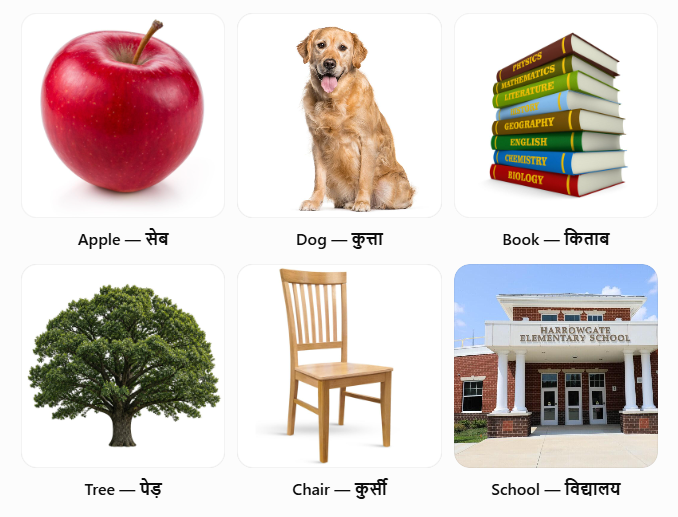
Pictures help learners associate English nouns with visible objects, people, animals, and places. The examples below show familiar concrete nouns with their Hindi names.
Concrete vs Abstract in Hindi
The difference between concrete and abstract nouns is based on whether the noun refers to something physically perceptible or to a quality, feeling, concept, or mental state.
Feature
Concrete Noun (मूर्त संज्ञा)
Abstract Noun (अमूर्त संज्ञा)
Meaning
Physical or sensory entity
Idea, feeling, quality, or state
Five senses
Perceived through at least one sense
Not directly perceived as a physical thing
Examples
Tree, bell, perfume
Honesty, freedom, courage
Hindi examples
पेड़, घंटी, इत्र
ईमानदारी, स्वतंत्रता, साहस
Countability
Can be countable or uncountable
Can be countable or uncountable
Concrete and Abstract Noun Examples
Concrete Noun
Hindi Meaning
Abstract Noun
Hindi Meaning
Child
बच्चा
Childhood
बचपन
Friend
मित्र
Friendship
मित्रता
Artist
कलाकार
Creativity
रचनात्मकता
Soldier
सैनिक
Bravery
बहादुरी
Judge
न्यायाधीश
Justice
न्याय
Student
विद्यार्थी
Knowledge
ज्ञान
Doctor
चिकित्सक
Health
स्वास्थ्य
Athlete
खिलाड़ी
Strength
शक्ति
Singer
गायक
Talent
प्रतिभा
Family
परिवार
Love
प्रेम
A useful distinction is that music can be concrete when referring to audible sound, whereas happiness is abstract even when happiness is expressed through visible behavior.
Concrete And Abstract Nouns Worksheet With Answers Pdf
Practice the difference between concrete and abstract nouns with this English-Hindi worksheet.
Identify noun types, complete exercises, and check your answers using the answer key provided in the PDF.
These sentences show concrete nouns functioning as subjects, objects, and complements. Each example identifies a physical entity and provides a natural Hindi translation.
No.
English Sentence
Hindi Translation
1
The boy is reading a book.
लड़का किताब पढ़ रहा है।
2
The girl opened the window.
लड़की ने खिड़की खोली।
3
My father drives a car.
मेरे पिता कार चलाते हैं।
4
The doctor examined the patient.
डॉक्टर ने मरीज़ की जाँच की।
5
The farmer works in the field.
किसान खेत में काम करता है।
6
The school is near the park.
विद्यालय उद्यान के पास है।
7
We visited the museum yesterday.
हम कल संग्रहालय गए थे।
8
The train arrived at the station.
रेलगाड़ी स्टेशन पर पहुँची।
9
There is a bridge over the river.
नदी पर एक पुल है।
10
The hospital has a new building.
अस्पताल में एक नई इमारत है।
11
The dog is sleeping outside.
कुत्ता बाहर सो रहा है।
12
A cat jumped onto the wall.
एक बिल्ली दीवार पर कूद गई।
13
The elephant walked slowly.
हाथी धीरे-धीरे चला।
14
The birds are flying above the trees.
पक्षी पेड़ों के ऊपर उड़ रहे हैं।
15
A horse is running across the field.
घोड़ा मैदान में दौड़ रहा है।
16
I bought a new notebook.
मैंने एक नई कॉपी खरीदी।
17
The phone is on the table.
फ़ोन मेज़ पर है।
18
She filled the bottle with water.
उसने बोतल में पानी भरा।
19
The chair is made of wood.
कुर्सी लकड़ी की बनी है।
20
He repaired the bicycle.
उसने साइकिल की मरम्मत की।
21
The apple tastes sweet.
सेब का स्वाद मीठा है।
22
The milk is warm.
दूध गर्म है।
23
She cooked rice for lunch.
उसने दोपहर के खाने के लिए चावल पकाए।
24
The honey smells pleasant.
शहद की खुशबू अच्छी है।
25
I cut the mango into pieces.
मैंने आम के टुकड़े किए।
26
The tree provides shade.
पेड़ छाया देता है।
27
The mountain is covered with snow.
पर्वत बर्फ़ से ढका हुआ है।
28
Heavy rain flooded the road.
तेज़ बारिश से सड़क पर पानी भर गया।
29
The flowers smell wonderful.
फूलों से बहुत अच्छी खुशबू आती है।
30
The stone feels smooth.
पत्थर छूने पर चिकना लगता है।
Common Mistakes with Concrete Nouns
Concrete nouns are often confused with abstract nouns, and learners sometimes assume every concrete noun must be visible or countable. The following corrections address these problems.
Mistake 1: Thinking Only Visible Objects Are Concrete
Incorrect assumption: If something cannot be seen, it must be abstract.
Correct explanation: Air (हवा) and music (संगीत) can be concrete because they are felt or heard through the senses.
Mistake 2: Treating Every Concrete Noun as Countable
Incorrect assumption: Every concrete noun has singular and plural forms.
Correct explanation: Water (पानी), gold (सोना), and sand (रेत) are concrete but usually uncountable.
Mistake 3: Assuming All Abstract Nouns Are Uncountable
Incorrect assumption: Abstract nouns cannot be counted.
Correct explanation: An idea, two decisions, and three suggestions are countable abstract nouns.
Mistake 4: Confusing Proper Nouns with Abstract Nouns
Incorrect assumption: A specific name cannot be a concrete noun.
Correct explanation: Delhi, the Taj Mahal, and the name of a physical person can function as proper concrete nouns.
Mistake 5: Using Incorrect Plural Forms
Incorrect: Three childs are playing.
Correct: Three children are playing.
Mistake 6: Using A or An with Uncountable Materials
Incorrect: She bought a gold.
Correct: She bought some gold.
Mistake 7: Classifying Every Feeling as Concrete
Incorrect assumption: Because anger has physical effects, anger is a concrete noun.
Correct explanation: Anger (गुस्सा) is abstract because it names an emotional state, not the physical actions or expressions associated with it.
Concrete Noun Worksheet in Hindi
Use the following exercises to practice identifying concrete nouns and distinguishing them from abstract nouns.
Concrete Noun in Hindi Worksheet
Concrete Noun in Hindi Worksheet
25 questions on concrete nouns, noun types, and concrete vs abstract nouns.
Answered: 0 / 25
Frequently Asked Questions
1. Can a concrete noun also be a collective noun?
Yes. A flock of birds and a herd of elephants are collective expressions referring to groups of physical animals.
2. Can the same word be both concrete and abstract?
Some words change classification according to meaning. For instance, work may describe an abstract activity, while a work of art refers to a particular creation that can be physically displayed.
Conclusion
When identifying a concrete noun, think about what the word names rather than whether it is singular, plural, common, or proper. A physical substance such as water and a countable object such as a bottle can both be concrete, although their grammar differs.
Look around your room and identify five concrete nouns. Then name two abstract nouns connected to what you are doing, such as interest or concentration.
Write your answers in the comments and compare the difference.
An uncountable noun in Hindi is called अगणनीय संज्ञा. It refers to a substance, quality, condition, or idea that is not normally counted as separate individual units. Words such as water (पानी), rice (चावल), information (जानकारी), and happiness (खुशी) are common examples.
In English grammar, uncountable nouns generally do not take plural endings or the articles a and an. They usually take singular verbs, even when they refer to large amounts. For example, The furniture is expensive is correct, while The furnitures are expensive is not standard English.
Some uncountable nouns can become countable when their meaning changes or when we refer to portions, varieties, or individual items. This guide covers their types, grammar rules, English-Hindi meanings, quantifiers, sentence construction, and common mistakes.
Types of Uncountable Noun in Hindi
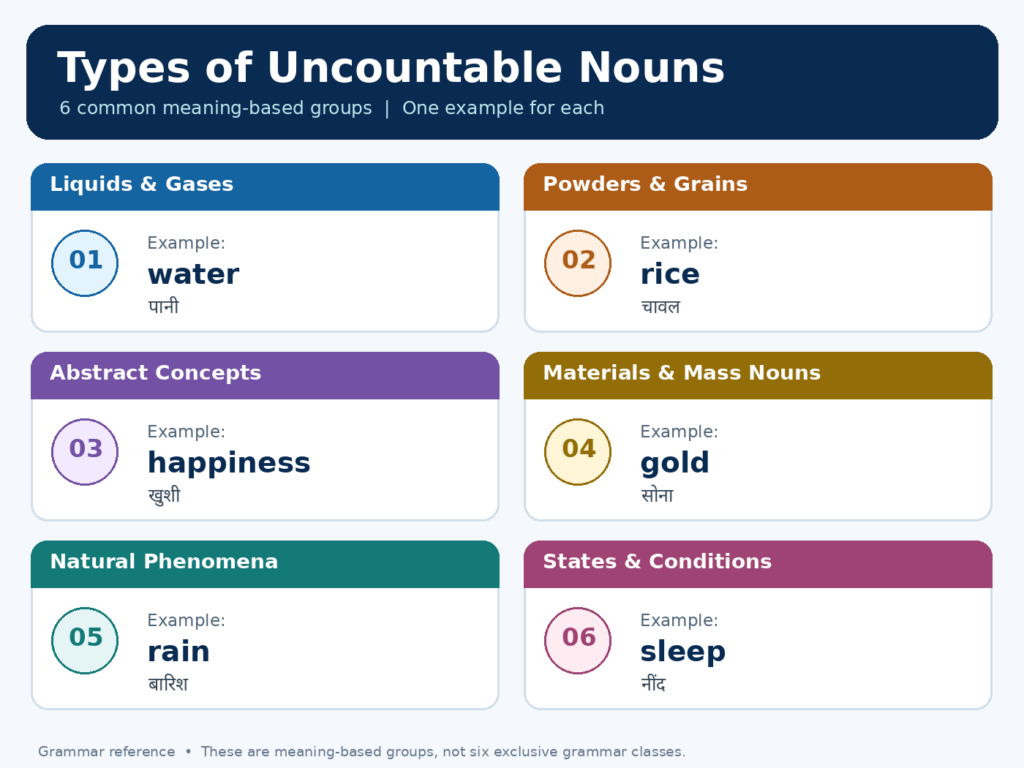
Uncountable nouns can be grouped according to what they describe, including substances, materials, feelings, natural phenomena, and conditions.
These are useful meaning-based groups rather than six completely separate grammatical classes.
1. Liquids and Gases
Liquids and gases are generally measured by volume or quantity rather than counted individually. Examples include milk (दूध) and oxygen (ऑक्सीजन).
2. Powders and Grains
Powders, grains, and similar loose substances are usually treated as masses. For example, flour (आटा) is measured by weight, while individual grains or bags can be counted.
3. Abstract Concepts
Abstract uncountable nouns express qualities, feelings, knowledge, and ideas. Words such as honesty (ईमानदारी) and wisdom (बुद्धिमत्ता) are not normally counted as individual objects.
4. Materials and Mass Nouns
Materials are usually named without counting individual pieces. For example, wood (लकड़ी) is uncountable when referring to the material, but a wooden chair is countable.
5. Natural Phenomena
Many natural phenomena are treated as uncountable, particularly when describing continuous conditions. Examples include sunshine (धूप) and snow (बर्फ़).
6. States and Conditions
Words describing physical, mental, or social conditions often have uncountable uses. Examples include stress (तनाव), sleep (नींद), and poverty (गरीबी).
Uncountable Noun Grammar Rules
Uncountable nouns have specific rules for articles, plural forms, verb agreement, and quantity expressions. These rules help distinguish them from countable nouns.
Rule 1: Uncountable Nouns Usually Have No Plural Form
Most uncountable nouns cannot take -s or -es when used in their mass-noun meanings.
Incorrect
Correct
Informations
Information
Advices
Advice
Furnitures
Furniture
Equipments
Equipment
Homeworks
Homework
Knowledges
Knowledge
Example: The information is useful.
Hindi:जानकारी उपयोगी है।
Rule 2: Do Not Use A or An Directly Before Uncountable Nouns
The articles a and an normally refer to one countable item. Use an appropriate quantity expression when referring to a portion of an uncountable substance.
Incorrect
Correct
An advice
A piece of advice
A furniture
A piece of furniture
An equipment
A piece of equipment
A water
A glass of water
A bread
A loaf of bread
Example: She gave me a piece of advice.
Hindi:उसने मुझे एक सलाह दी।
Rule 3: Uncountable Nouns Normally Take Singular Verbs
A singular verb is used when the uncountable noun is the subject and refers to one mass, concept, or amount.
Subject
Correct Verb
Example
Milk
is
Milk is fresh.
Information
was
The information was correct.
Furniture
is
The furniture is expensive.
News
is
The news is surprising.
Equipment
has
The equipment has arrived.
Example: The rice is ready.
Hindi:चावल तैयार है।
Rule 4: Use Much and Little Instead of Many and Few
Much, little, and a little are commonly used with uncountable nouns. Many, few, and a few are used with plural countable nouns.
Incorrect
Correct
Many water
Much water
A few sugar
A little sugar
Many information
A lot of information
Few money
Little money
Example: We have a little time.
Hindi:हमारे पास थोड़ा समय है।
Rule 5: Count Portions, Containers, or Units
Uncountable substances can be expressed in measurable or countable units.
Quantity Expression
Example
Hindi Meaning
A glass of
A glass of milk
एक गिलास दूध
Two bottles of
Two bottles of water
पानी की दो बोतलें
A cup of
A cup of tea
एक कप चाय
A piece of
A piece of information
जानकारी का एक अंश
A loaf of
A loaf of bread
एक पाव ब्रेड
A kilo of
A kilo of sugar
एक किलो चीनी
Three bags of
Three bags of rice
चावल की तीन बोरियाँ
Two pieces of
Two pieces of furniture
फर्नीचर की दो वस्तुएँ
Rule 6: Some Nouns Can Be Countable and Uncountable
Countability sometimes changes according to meaning. A word used for a substance may become countable when referring to a portion, type, or separate item.
Uncountable Use
Countable Use
Coffee is hot.
We ordered two coffees.
Chicken is delicious.
There are three chickens on the farm.
I need paper.
She published two papers.
There is glass on the floor.
He bought four glasses.
Experience is important.
It was an unforgettable experience.
In the first column, the nouns refer to a substance or general concept. In the second, they refer to individual servings, animals, documents, objects, or events.
Uncountable Noun Examples in Hindi with English Meaning
The following vocabulary lists contain 180 uncountable noun examples, arranged into six categories with 30 examples each.
These words are commonly uncountable in the meanings shown, although some can have countable uses in other contexts.
1. Uncountable Nouns for Liquids and Gases — 30 Examples
These nouns describe liquids, gases, and flowing substances that are normally measured rather than counted.
No.
English Noun
Hindi Meaning
1
Water
पानी
2
Milk
दूध
3
Tea
चाय
4
Coffee
कॉफ़ी
5
Juice
रस
6
Oil
तेल
7
Petrol
पेट्रोल
8
Diesel
डीज़ल
9
Kerosene
मिट्टी का तेल
10
Vinegar
सिरका
11
Honey
शहद
12
Syrup
चाशनी
13
Ink
स्याही
14
Paint
रंग
15
Blood
खून
16
Sweat
पसीना
17
Saliva
लार
18
Steam
भाप
19
Smoke
धुआँ
20
Air
हवा
21
Oxygen
ऑक्सीजन
22
Nitrogen
नाइट्रोजन
23
Hydrogen
हाइड्रोजन
24
Helium
हीलियम
25
Carbon dioxide
कार्बन डाइऑक्साइड
26
Sewage
मलजल
27
Lemonade
नींबू पानी
28
Soup
सूप
29
Coconut water
नारियल पानी
30
Buttermilk
छाछ
2. Uncountable Nouns for Powders and Grains — 30 Examples
These words name powdered substances, grains, spices, and loose materials used in cooking or everyday activities.
No.
English Noun
Hindi Meaning
1
Rice
चावल
2
Flour
आटा
3
Wheat
गेहूँ
4
Barley
जौ
5
Corn
मक्का
6
Millet
बाजरा
7
Semolina
सूजी
8
Gram flour
बेसन
9
Sugar
चीनी
10
Salt
नमक
11
Ground pepper
पिसी काली मिर्च
12
Turmeric
हल्दी
13
Ground cinnamon
पिसी दालचीनी
14
Ground cumin
पिसा जीरा
15
Ground coriander
पिसा धनिया
16
Ginger powder
सोंठ
17
Garlic powder
लहसुन पाउडर
18
Baking soda
खाने का सोडा
19
Baking powder
बेकिंग पाउडर
20
Cocoa powder
कोको पाउडर
21
Coffee powder
कॉफ़ी पाउडर
22
Milk powder
दूध पाउडर
23
Starch
स्टार्च
24
Sand
रेत
25
Dust
धूल
26
Chalk dust
चॉक की धूल
27
Gravel
बजरी
28
Sawdust
बुरादा
29
Talcum powder
टैल्कम पाउडर
30
Washing powder
कपड़े धोने का पाउडर
3. Uncountable Nouns for Abstract Concepts — 30 Examples
Abstract uncountable nouns express feelings, values, knowledge, abilities, and other ideas that do not have a physical form.
No.
English Noun
Hindi Meaning
1
Knowledge
ज्ञान
2
Wisdom
बुद्धिमत्ता
3
Honesty
ईमानदारी
4
Courage
साहस
5
Patience
धैर्य
6
Kindness
दयालुता
7
Happiness
खुशी
8
Sadness
उदासी
9
Love
प्रेम
10
Hatred
घृणा
11
Respect
सम्मान
12
Trust
भरोसा
13
Confidence
आत्मविश्वास
14
Creativity
रचनात्मकता
15
Intelligence
बौद्धिक क्षमता
16
Beauty
सुंदरता
17
Freedom
स्वतंत्रता
18
Justice
न्याय
19
Peace
शांति
20
Progress
प्रगति
21
Education
शिक्षा
22
Research
अनुसंधान
23
Information
जानकारी
24
Advice
सलाह
25
Feedback
प्रतिक्रिया
26
Evidence
साक्ष्य
27
Permission
अनुमति
28
Luck
भाग्य
29
Fun
मज़ा
30
Entertainment
मनोरंजन
4. Uncountable Nouns for Materials and Mass Nouns — 30 Examples
These nouns refer to metals, fabrics, construction materials, and collections of items treated as a whole.
No.
English Noun
Hindi Meaning
1
Gold
सोना
2
Silver
चाँदी
3
Iron
लोहा
4
Steel
इस्पात
5
Copper
ताँबा
6
Brass
पीतल
7
Bronze
काँसा
8
Aluminium
एल्यूमिनियम
9
Wood
लकड़ी
10
Timber
इमारती लकड़ी
11
Plastic
प्लास्टिक
12
Glass
काँच
13
Rubber
रबर
14
Leather
चमड़ा
15
Cotton
कपास
16
Wool
ऊन
17
Silk
रेशम
18
Linen
लिनन
19
Denim
डेनिम
20
Concrete
कंक्रीट
21
Cement
सीमेंट
22
Clay
चिकनी मिट्टी
23
Marble
संगमरमर
24
Granite
ग्रेनाइट
25
Coal
कोयला
26
Charcoal
लकड़ी का कोयला
27
Furniture
फर्नीचर
28
Luggage
यात्रा का सामान
29
Equipment
उपकरण-सामग्री
30
Machinery
मशीनरी
5. Uncountable Nouns for Natural Phenomena — 30 Examples
Many words used for weather, light, environmental conditions, and physical forces are uncountable when describing them generally.
No.
English Noun
Hindi Meaning
1
Rain
बारिश
2
Snowfall
बर्फ़बारी
3
Snow
बर्फ़
4
Hail
ओले
5
Thunder
गरज
6
Lightning
आकाशीय बिजली
7
Sunshine
धूप
8
Sunlight
सूर्य का प्रकाश
9
Moonlight
चाँदनी
10
Daylight
दिन का उजाला
11
Darkness
अँधेरा
12
Heat
गर्मी
13
Cold
ठंड
14
Humidity
नमी
15
Frost
पाला
16
Dew
ओस
17
Wind
पवन
18
Turbulence
वायु की अशांति
19
Erosion
कटाव
20
Pollution
प्रदूषण
21
Radiation
विकिरण
22
Gravity
गुरुत्वाकर्षण
23
Magnetism
चुंबकत्व
24
Electricity
विद्युत
25
Static electricity
स्थिर विद्युत
26
Weather
मौसम
27
Cloud cover
बादलों का आवरण
28
Rainfall
वर्षा
29
Drizzle
बूँदाबाँदी
30
Smog
धूम-कोहरा
6. Uncountable Nouns for States and Conditions — 30 Examples
These nouns describe health, life stages, emotions, and physical or mental conditions. Some can also be countable when referring to specific experiences or cases.
No.
English Noun
Hindi Meaning
1
Sleep
नींद
2
Stress
तनाव
3
Fatigue
थकान
4
Exhaustion
अत्यधिक थकावट
5
Hunger
भूख
6
Thirst
प्यास
7
Health
स्वास्थ्य
8
Fitness
तंदुरुस्ती
9
Illness
अस्वस्थता
10
Sickness
बीमारी की अवस्था
11
Childhood
बचपन
12
Youth
युवावस्था
13
Old age
बुढ़ापा
14
Adulthood
वयस्कता
15
Poverty
गरीबी
16
Wealth
धन-संपत्ति
17
Unemployment
बेरोज़गारी
18
Loneliness
अकेलापन
19
Anxiety
चिंता
20
Excitement
उत्साह
21
Boredom
ऊब
22
Confusion
उलझन
23
Fear
डर
24
Anger
गुस्सा
25
Grief
शोक
26
Depression
अवसाद
27
Discomfort
असुविधा
28
Relaxation
विश्राम
29
Rest
आराम
30
Tension
खींचाव
These lists show typical uncountable uses. Context matters: for instance, a fear, an illness, and a glass are possible countable expressions with meanings different from their mass-noun uses.
100 Examples of Uncountable Nouns Sentences in English and Hindi
These 100 sentences demonstrate how uncountable nouns are used in everyday English. Each sentence includes a Hindi translation to clarify its meaning and grammatical use.
Sentences 1–20: Food and Drinks
No.
English Sentence
Hindi Translation
1
Water is essential for life.
पानी जीवन के लिए आवश्यक है।
2
Milk is good for growing children.
दूध बढ़ते बच्चों के लिए अच्छा है।
3
I drink tea every morning.
मैं हर सुबह चाय पीता हूँ।
4
She likes coffee without sugar.
उसे बिना चीनी की कॉफ़ी पसंद है।
5
This juice tastes fresh.
इस रस का स्वाद ताज़ा है।
6
We need more rice for dinner.
हमें रात के खाने के लिए और चावल चाहिए।
7
There is some flour in the kitchen.
रसोई में थोड़ा आटा है।
8
Too much salt can spoil the soup.
बहुत अधिक नमक सूप का स्वाद बिगाड़ सकता है।
9
Honey tastes sweet.
शहद का स्वाद मीठा होता है।
10
Add a little oil to the pan.
कड़ाही में थोड़ा तेल डालो।
11
Butter melts quickly in the heat.
गर्मी में मक्खन जल्दी पिघलता है।
12
We bought some cheese yesterday.
हमने कल थोड़ा पनीर खरीदा।
13
Bread is available at the bakery.
बेकरी में ब्रेड मिलती है।
14
There is enough sugar for the cake.
केक के लिए पर्याप्त चीनी है।
15
Soup is easy to prepare.
सूप बनाना आसान है।
16
She added some turmeric to the curry.
उसने सब्ज़ी में थोड़ी हल्दी डाली।
17
Vinegar gives the sauce a sour taste.
सिरका सॉस को खट्टा स्वाद देता है।
18
We need a little ginger for this recipe.
इस व्यंजन के लिए हमें थोड़ा अदरक चाहिए।
19
There is no jam left in the jar.
जार में जैम नहीं बचा है।
20
Fresh lemonade is refreshing.
ताज़ा नींबू पानी पीने से ताज़गी मिलती है।
Sentences 21–40: Materials and Household Items
No.
English Sentence
Hindi Translation
21
Gold is a valuable metal.
सोना एक मूल्यवान धातु है।
22
Silver shines when polished.
पॉलिश करने पर चाँदी चमकती है।
23
Iron is used in construction.
निर्माण कार्य में लोहे का उपयोग होता है।
24
Steel is stronger than many common materials.
इस्पात कई सामान्य सामग्रियों से अधिक मज़बूत होता है।
25
This table is made of wood.
यह मेज़ लकड़ी की बनी है।
26
Plastic can cause environmental problems.
प्लास्टिक पर्यावरण संबंधी समस्याएँ पैदा कर सकता है।
27
Glass breaks easily.
काँच आसानी से टूट जाता है।
28
Cotton feels soft against the skin.
कपास त्वचा पर मुलायम लगता है।
29
Wool keeps us warm in winter.
ऊन सर्दियों में हमें गर्म रखती है।
30
This scarf is made of silk.
यह दुपट्टा रेशम से बना है।
31
We bought new furniture for the office.
हमने कार्यालय के लिए नया फर्नीचर खरीदा।
32
The equipment is ready for use.
उपकरण-सामग्री उपयोग के लिए तैयार है।
33
His luggage is very heavy.
उसका यात्रा का सामान बहुत भारी है।
34
The factory uses modern machinery.
कारखाने में आधुनिक मशीनरी का उपयोग होता है।
35
Cement is needed to repair the wall.
दीवार की मरम्मत के लिए सीमेंट चाहिए।
36
The workers mixed sand with cement.
मज़दूरों ने सीमेंट में रेत मिलाई।
37
Leather requires careful cleaning.
चमड़े की सफ़ाई सावधानी से करनी चाहिए।
38
Rubber is used to make tyres.
टायर बनाने में रबर का उपयोग होता है।
39
There is dust on the shelf.
शेल्फ़ पर धूल है।
40
Copper conducts electricity well.
ताँबा बिजली का अच्छा सुचालक है।
Sentences 41–60: Knowledge, Feelings, and Ideas
No.
English Sentence
Hindi Translation
41
Knowledge helps us make better decisions.
ज्ञान हमें बेहतर निर्णय लेने में मदद करता है।
42
Honesty builds trust.
ईमानदारी भरोसा बढ़ाती है।
43
Patience is important when learning a language.
भाषा सीखते समय धैर्य महत्वपूर्ण होता है।
44
Kindness makes relationships stronger.
दयालुता रिश्तों को मज़बूत बनाती है।
45
Happiness comes from different experiences.
खुशी अलग-अलग अनुभवों से मिलती है।
46
Love makes life meaningful.
प्रेम जीवन को अर्थपूर्ण बनाता है।
47
Courage helps people face difficulties.
साहस लोगों को कठिनाइयों का सामना करने में मदद करता है।
48
Wisdom develops through learning and experience.
सीखने और अनुभव से बुद्धिमत्ता विकसित होती है।
49
Respect is important in every relationship.
हर रिश्ते में सम्मान महत्वपूर्ण होता है।
50
Confidence improves with regular practice.
नियमित अभ्यास से आत्मविश्वास बढ़ता है।
51
We need more information about the course.
हमें पाठ्यक्रम के बारे में और जानकारी चाहिए।
52
Her advice helped me solve the problem.
उसकी सलाह से मुझे समस्या हल करने में मदद मिली।
53
The teacher gave useful feedback.
शिक्षक ने उपयोगी प्रतिक्रिया दी।
54
Research takes time and effort.
अनुसंधान में समय और मेहनत लगती है।
55
Education creates opportunities.
शिक्षा अवसर पैदा करती है।
56
Creativity helps us develop new ideas.
रचनात्मकता हमें नए विचार विकसित करने में मदद करती है।
57
Justice should be available to everyone.
न्याय सभी के लिए उपलब्ध होना चाहिए।
58
Freedom comes with responsibility.
स्वतंत्रता के साथ ज़िम्मेदारी भी आती है।
59
Peace is important for a healthy society.
स्वस्थ समाज के लिए शांति महत्वपूर्ण है।
60
Progress requires consistent effort.
प्रगति के लिए निरंतर प्रयास आवश्यक है।
Sentences 61–80: Weather and Natural Conditions
No.
English Sentence
Hindi Translation
61
Heavy rain continued throughout the night.
पूरी रात तेज़ बारिश होती रही।
62
Snow covered the mountains.
बर्फ़ ने पहाड़ों को ढक लिया।
63
Sunshine makes the garden bright.
धूप बगीचे को रोशन करती है।
64
Moonlight reflected on the lake.
चाँदनी झील पर प्रतिबिंबित हो रही थी।
65
Thunder woke the children.
गरज से बच्चे जाग गए।
66
Lightning lit up the sky.
बिजली की चमक से आसमान रोशन हो गया।
67
Fog reduced visibility on the road.
कोहरे से सड़क पर दृश्यता कम हो गई।
68
Humidity makes the air feel uncomfortable.
नमी के कारण हवा असहज लगती है।
69
Heat can cause dehydration.
गर्मी से शरीर में पानी की कमी हो सकती है।
70
Cold affects people differently.
ठंड का असर लोगों पर अलग-अलग तरह से पड़ता है।
71
Wind is blowing from the east.
पूर्व दिशा से हवा चल रही है।
72
Dew formed on the grass overnight.
रात में घास पर ओस जम गई।
73
Frost covered the windows.
खिड़कियों पर पाला जम गया।
74
Pollution affects air quality.
प्रदूषण हवा की गुणवत्ता को प्रभावित करता है।
75
Gravity pulls objects towards the Earth.
गुरुत्वाकर्षण वस्तुओं को पृथ्वी की ओर खींचता है।
76
Electricity powers our homes.
बिजली हमारे घरों को ऊर्जा देती है।
77
Sunlight helps plants grow.
सूर्य का प्रकाश पौधों को बढ़ने में मदद करता है।
78
Erosion changes the shape of riverbanks.
कटाव नदी के किनारों का आकार बदल देता है।
79
Snowfall continued for several hours.
कई घंटों तक बर्फ़बारी होती रही।
80
Weather changes throughout the year.
साल भर मौसम बदलता रहता है।
Sentences 81–100: Daily Life, Conditions, and Quantities
No.
English Sentence
Hindi Translation
81
Sleep is important for good health.
अच्छे स्वास्थ्य के लिए नींद ज़रूरी है।
82
Stress can affect concentration.
तनाव एकाग्रता को प्रभावित कर सकता है।
83
Hunger made the children restless.
भूख के कारण बच्चे बेचैन हो गए।
84
Thirst increases during hot weather.
गर्म मौसम में प्यास बढ़ जाती है।
85
Health requires regular attention.
स्वास्थ्य पर नियमित ध्यान देना आवश्यक है।
86
Poverty affects many families.
गरीबी कई परिवारों को प्रभावित करती है।
87
Unemployment remains a serious concern.
बेरोज़गारी एक गंभीर चिंता का विषय बनी हुई है।
88
Loneliness can affect emotional well-being.
अकेलापन भावनात्मक स्वास्थ्य को प्रभावित कर सकता है।
89
Boredom sometimes reduces motivation.
ऊब कभी-कभी प्रेरणा कम कर देती है।
90
Relaxation helps the body recover.
विश्राम शरीर को स्वस्थ होने में मदद करता है।
91
There is some water in the bottle.
बोतल में थोड़ा पानी है।
92
We do not have much time.
हमारे पास ज़्यादा समय नहीं है।
93
She has a little money in her bag.
उसके बैग में थोड़े पैसे हैं।
94
There is too much traffic today.
आज सड़कों पर बहुत ज़्यादा यातायात है।
95
I need a piece of paper.
मुझे कागज़ का एक टुकड़ा चाहिए।
96
He bought two bottles of juice.
उसने रस की दो बोतलें खरीदीं।
97
We received a lot of help.
हमें बहुत मदद मिली।
98
The news is encouraging.
समाचार उत्साहजनक है।
99
There is enough space in the room.
कमरे में पर्याप्त जगह है।
100
She has less homework today.
आज उसके पास कम गृहकार्य है।
Uncountable Nouns Quantifiers
Quantifiers indicate how much of an uncountable substance, concept, or quality is present. Common quantifiers include some, much, little, a little, and enough.
Quantifier
Hindi Meaning
Example
Some
कुछ
Some water
Any
कुछ / कोई
Any information
Much
बहुत / अधिक
Much time
A little
थोड़ा
A little milk
Little
बहुत कम
Little hope
A lot of
बहुत सारा
A lot of traffic
Lots of
बहुत सारा
Lots of work
Plenty of
भरपूर
Plenty of food
Enough
पर्याप्त
Enough money
Too much
बहुत ज़्यादा
Too much sugar
Less
कम
Less pollution
More
अधिक
More information
A bit of
थोड़ा-सा
A bit of luck
A great deal of
बहुत अधिक
A great deal of patience
No
बिल्कुल नहीं / कोई नहीं
No evidence
Much vs Many
Much is used with uncountable nouns, while many is used with plural countable nouns.
Much water — बहुत पानी
Many bottles — बहुत सारी बोतलें
Little vs A Little
Little emphasizes that an amount is insufficient or very small. A little suggests that a small amount is available.
There is little hope. — बहुत कम उम्मीद है।
There is a little hope. — थोड़ी उम्मीद है।
Less vs Fewer
Less normally describes a smaller amount of an uncountable noun. Fewer describes a smaller number of countable items.
Less traffic — कम यातायात
Fewer cars — कम गाड़ियाँ
Countable and Uncountable Nouns Difference in Hindi
Countable nouns name separate items that can be counted, while uncountable nouns usually refer to substances, abstract concepts, and quantities treated as a whole.
Feature
Countable Nouns
Uncountable Nouns
Hindi name
गणनीय संज्ञा
अगणनीय संज्ञा
Individual counting
Possible
Usually not possible
Singular and plural
Usually both
Usually no plural
A/An
Can be used with singular nouns
Normally not used directly
Many
Used
Not normally used
Much
Not normally used
Used
Few
Used
Not normally used
Little
Not normally used
Used
Verb
Singular or plural according to number
Usually singular
Example
Book (किताब)
Knowledge (ज्ञान)
Common Countable and Uncountable Noun Pairs
These pairs show the difference between a countable unit and the uncountable material or concept it measures.
Countable Noun
Uncountable Noun
A bottle
Water
A cup
Tea
A chair
Furniture
A suitcase
Luggage
A question
Information
A suggestion
Advice
A machine
Equipment
A coin
Money
A grain
Rice
A loaf
Bread
Common Mistakes with Uncountable Nouns
Several errors occur when learners use plural endings, incorrect articles, or countable-noun quantifiers with uncountable nouns.
Mistake 1: Adding S or ES to Uncountable Nouns
Incorrect: She gave me three advices.
Correct: She gave me three pieces of advice.
Mistake 2: Using Many Instead of Much
Incorrect: We do not have many time.
Correct: We do not have much time.
Mistake 3: Using A or An Before Mass Nouns
Incorrect: I need an information.
Correct: I need some information.
Mistake 4: Using a Plural Verb
Incorrect: The furniture are new.
Correct: The furniture is new.
Mistake 5: Treating News as a Plural Noun
Incorrect: The news are shocking.
Correct: The news is shocking.
Although news ends with -s, it is grammatically singular.
Mistake 6: Using Few Instead of Little
Incorrect: There is a few milk left.
Correct: There is a little milk left.
Mistake 7: Confusing Materials with Individual Objects
Incorrect: I bought two furnitures.
Correct: I bought two pieces of furniture.
Mistake 8: Treating Every Abstract Noun as Uncountable
Incorrect assumption: Every abstract noun is uncountable.
Correct explanation: An idea, a decision, a dream, and a suggestion are countable abstract nouns. Being abstract does not automatically make a noun uncountable.
Uncountable Noun in Hindi Worksheet
Practice identifying uncountable nouns, choosing correct quantifiers, using singular verbs, and forming accurate sentences with this interactive worksheet.
Uncountable Noun in Hindi Worksheet
Practice uncountable nouns (अगणनीय संज्ञा)
with 25 multiple-choice questions.
Choose the correct answer for each question.
Answered: 0 / 25
Frequently Asked Questions
1. Is money a countable or uncountable noun?
Money (पैसा) is normally uncountable in English. However, individual coins (सिक्के), notes (नोट), and amounts such as rupees (रुपये) can be counted.
2. Can uncountable nouns have plural meanings?
Yes. An uncountable noun may refer to a large quantity or several items collectively while remaining grammatically singular. For example, The furniture is new may describe multiple chairs, tables, and cupboards.
3. Why is hair sometimes countable?
Hair is usually uncountable when describing someone's hair collectively, but individual hairs are countable. Compare She has long hair with I found two hairs on my jacket.
4. Can all uncountable nouns be measured?
Not always in the same way. Physical substances can often be measured by weight or volume, while abstract concepts may be expressed through degrees, amounts, or specific instances. For example, a litre of water and a great deal of patience use different expressions.
Download Uncountable Noun in Hindi PDF Notes
The study notes provide an offline reference for the six main groups, important grammar rules, quantifiers, and English-Hindi sentence examples.
When describing a substance, material, or general concept in English, first check whether it is normally counted as individual units. This helps determine the correct article, verb, and quantifier.
Consider these three expressions: much information, many questions, and two pieces of advice. Each expresses quantity differently because the nouns do not behave in the same grammatical way.
Try correcting these sentences: I have many homework, She gave me an advice, and The equipment are expensive. Share your corrected answers in the comments.
One book, three apples, five chairs. These quantities are possible because book (किताब), apple (सेब), and chair (कुर्सी) refer to things that can be counted separately. Each has a singular and plural form in English. Hindi uses एक किताब, तीन सेब, and पाँच कुर्सियाँ to express the same quantities.
A countable noun in Hindi is called गणनीय संज्ञा (Ganneeya Sangya). It names a person, place, thing, or individual concept that can be counted. Countable nouns can usually be used with numbers and have singular (एकवचन) and plural (बहुवचन) forms.
This lesson covers countable noun examples with Hindi meanings, singular and plural rules, noun categories, and sentence usage. It also explains how numbers work with nouns in English and Hindi, common grammatical mistakes, and practice exercises for classroom and home learning.
Types of Countable Nouns
Countable noun is a grammatical classification based on countability. It does not have a completely separate set of semantic subtypes.
However, countable nouns are commonly studied through their singular and plural forms, as well as their overlap with other noun categories.
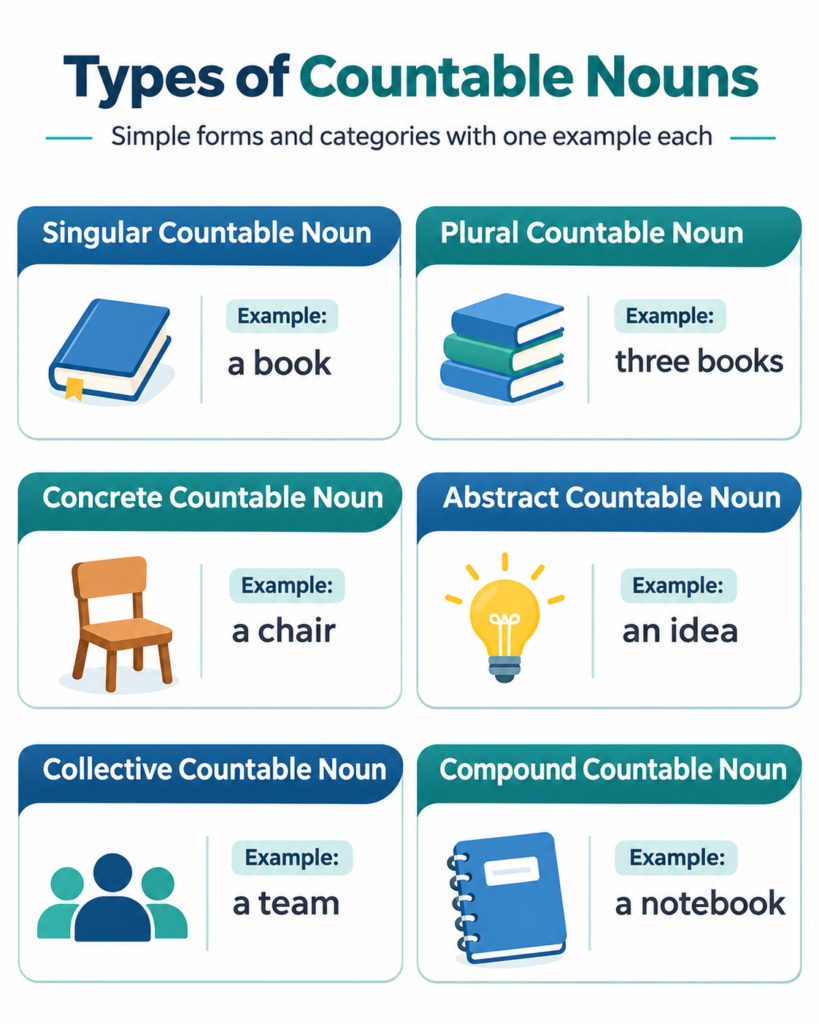
Singular Countable Nouns (एकवचन गणनीय संज्ञा)
A singular countable noun refers to one individual person, place, object, or countable concept.
Examples include a pen (एक कलम), an apple (एक सेब), one horse (एक घोड़ा), and a question (एक प्रश्न).
Singular Countable Noun
Hindi Meaning
A student
एक विद्यार्थी
An umbrella
एक छाता
A computer
एक कंप्यूटर
One ticket
एक टिकट
A flower
एक फूल
An idea
एक विचार
Example: A student is waiting outside.
Hindi:एक विद्यार्थी बाहर इंतज़ार कर रहा है।
The noun “student” refers to one person and uses a singular verb.
Plural Countable Nouns (बहुवचन गणनीय संज्ञा)
A plural countable noun refers to two or more individual units.
Plural nouns may follow regular or irregular formation patterns.
Singular
Plural
Hindi Meaning
Pen
Pens
कलम / कलमें
Chair
Chairs
कुर्सी / कुर्सियाँ
City
Cities
शहर
Child
Children
बच्चा / बच्चे
Mouse
Mice
चूहा / चूहे
Foot
Feet
पैर
Example: Several children are playing in the park.
Hindi:कई बच्चे पार्क में खेल रहे हैं।
The noun “children” is plural even though it does not end in “-s.”
Regular Plural Countable Nouns
Most countable nouns form their plural with -s, -es, or -ies, depending on their spelling.
Rule
Singular
Plural
Add -s
Book
Books
Add -s
Tree
Trees
Add -es
Box
Boxes
Add -es
Bus
Buses
Consonant + y becomes -ies
City
Cities
Consonant + y becomes -ies
Baby
Babies
Vowel + y usually takes -s
Boy
Boys
Vowel + y usually takes -s
Key
Keys
Words ending in “-f” or “-fe” may form plurals differently. For instance, “leaf” becomes “leaves,” but “roof” becomes “roofs.”
Irregular Plural Countable Nouns
Some nouns do not follow standard plural formation rules.
Singular
Plural
Hindi Meaning
Man
Men
आदमी
Woman
Women
महिला / महिलाएँ
Child
Children
बच्चा / बच्चे
Tooth
Teeth
दाँत
Foot
Feet
पैर
Mouse
Mice
चूहा / चूहे
Goose
Geese
हंस
Person
People
व्यक्ति / लोग
Sheep
Sheep
भेड़ / भेड़ें
Deer
Deer
हिरण
Example: Three women entered the room.
Hindi:तीन महिलाएँ कमरे में आईं।
The plural “women” must be learned separately rather than formed by adding “-s.”
Countable Nouns Across Other Noun Categories
A noun can be countable while also belonging to another noun category.
Overlapping Category
Examples
Explanation
Concrete Countable Noun
Table, apple, suitcase
Physical objects counted individually
Abstract Countable Noun
Idea, suggestion, problem
Concepts or occurrences counted as units
Collective Countable Noun
Team, family, committee
Groups counted as separate units
Compound Countable Noun
Notebook, toothbrush, sister-in-law
Multiword or compound nouns with countable forms
For example:
One team — एक टीम
Three teams — तीन टीमें
The word “team” is both a collective noun and a countable noun.
Similarly, “idea” is an abstract noun that can be counted: one idea, three ideas, and several ideas.
Countable Noun Grammar Rules
Countable nouns follow several important rules involving articles, quantifiers, numbers, and subject-verb agreement.
Rule 1. Use A or An with Singular Countable Nouns
An ordinary singular countable noun generally needs a determiner in English.
Correct Expression
Hindi Meaning
A boy
एक लड़का
A teacher
एक शिक्षक
An apple
एक सेब
An umbrella
एक छाता
A useful idea
एक उपयोगी विचार
The choice between a and an depends on the following sound, not simply the first written letter.
For example, a useful idea is correct because “useful” begins with a consonant sound.
Rule 2. Use Plural Forms After Numbers Greater Than One
English countable nouns normally appear in the plural after numbers such as two, five, and ten.
Incorrect: Three book.
Correct: Three books.
Hindi: तीन किताबें।
Some nouns have irregular or unchanged plural forms.
Two children and five deer are correct.
Rule 3. Use Many and Few with Plural Countable Nouns
Many, few, and a few are frequently used with plural countable nouns.
Expression
Example
Hindi Meaning
Many
Many students
बहुत से विद्यार्थी
A few
A few questions
कुछ प्रश्न
Few
Few opportunities
बहुत कम अवसर
Several
Several books
कई किताबें
Fewer
Fewer mistakes
कम गलतियाँ
A few generally indicates a small but positive number. Few often emphasizes that the number is insufficient or smaller than expected.
Rule 4. Use Fewer for Countable Units and Less for Uncountable Quantities
In standard formal usage, fewer is used for countable plural units, while less is generally used for uncountable quantities.
Fewer chairs — कम कुर्सियाँ
Less water — कम पानी
Fewer mistakes — कम गलतियाँ
Less information — कम जानकारी
Expressions involving time, money, measurements, and certain established phrases may use “less” even with numerical values.
Rule 5. Match Singular and Plural Subjects with Appropriate Verbs
Countable noun number affects subject-verb agreement.
Singular Sentence
Plural Sentence
The boy is playing.
The boys are playing.
One girl has a book.
Three girls have books.
The child was sleeping.
The children were sleeping.
A car moves quickly.
The cars move quickly.
Hindi Example:
लड़का पढ़ रहा है। — The boy is studying.
लड़के पढ़ रहे हैं। — The boys are studying.
Countable Noun Examples in Hindi with English Meaning
Countable nouns appear in everyday conversations involving people, animals, places, objects, and individual ideas.
The following examples show singular and plural forms with their Hindi equivalents.
Countable Nouns for People
Words referring to individual people can generally be counted using numbers such as one, two, and three.
Singular Noun
Plural Noun
Hindi Singular
Hindi Plural
Boy
Boys
लड़का
लड़के
Girl
Girls
लड़की
लड़कियाँ
Student
Students
विद्यार्थी
विद्यार्थी
Teacher
Teachers
शिक्षक
शिक्षक
Child
Children
बच्चा
बच्चे
Doctor
Doctors
डॉक्टर
डॉक्टर
Farmer
Farmers
किसान
किसान
Woman
Women
महिला
महिलाएँ
Man
Men
आदमी
आदमी
Friend
Friends
दोस्त
दोस्त
Worker
Workers
मज़दूर
मज़दूर
Player
Players
खिलाड़ी
खिलाड़ी
Example: Three students are reading.
Hindi:तीन विद्यार्थी पढ़ रहे हैं।
The word students is countable because individual students can be counted. The Hindi noun विद्यार्थी has the same direct form in singular and plural, but the number and verb indicate the plural meaning.
Countable Nouns for Animals and Birds
Individual animals and birds can be counted, although some English nouns have identical singular and plural forms.
Singular Noun
Plural Noun
Hindi Meaning
Dog
Dogs
कुत्ता / कुत्ते
Cat
Cats
बिल्ली / बिल्लियाँ
Cow
Cows
गाय / गायें
Horse
Horses
घोड़ा / घोड़े
Elephant
Elephants
हाथी
Lion
Lions
शेर
Tiger
Tigers
बाघ
Bird
Birds
पक्षी
Rabbit
Rabbits
खरगोश
Monkey
Monkeys
बंदर
Sheep
Sheep
भेड़ / भेड़ें
Goose
Geese
हंस
Example: Two horses are standing near the gate.
Hindi:दो घोड़े फाटक के पास खड़े हैं।
The English noun changes from “horse” to “horses.” Hindi also changes घोड़ा to घोड़े in this construction.
Countable Nouns for Objects and Things
Classroom supplies, household items, vehicles, and other individual objects provide common examples.
Singular Noun
Plural Noun
Hindi Meaning
Book
Books
किताब / किताबें
Pen
Pens
कलम / कलमें
Pencil
Pencils
पेंसिल / पेंसिलें
Chair
Chairs
कुर्सी / कुर्सियाँ
Table
Tables
मेज़ / मेज़ें
Apple
Apples
सेब
Orange
Oranges
संतरा / संतरे
Box
Boxes
डिब्बा / डिब्बे
Bottle
Bottles
बोतल / बोतलें
Bag
Bags
बैग
Key
Keys
चाबी / चाबियाँ
Phone
Phones
फ़ोन
Watch
Watches
घड़ी / घड़ियाँ
Toy
Toys
खिलौना / खिलौने
Leaf
Leaves
पत्ता / पत्ते
Example: There are four chairs in the classroom.
Hindi:कक्षा में चार कुर्सियाँ हैं।
The noun chairs (कुर्सियाँ) names individual objects that can be counted.
Countable Nouns for Places
Nouns referring to individual buildings, locations, or geographical units can have countable forms.
Singular Noun
Plural Noun
Hindi Meaning
House
Houses
घर
School
Schools
विद्यालय
Village
Villages
गाँव
City
Cities
शहर
Country
Countries
देश
Hospital
Hospitals
अस्पताल
Garden
Gardens
बगीचा / बगीचे
Street
Streets
गली / गलियाँ
Room
Rooms
कमरा / कमरे
Library
Libraries
पुस्तकालय
Example: The district has twenty villages.
Hindi:ज़िले में बीस गाँव हैं।
The noun “village” refers to an individual settlement, so it can be counted.
Countable Nouns for Ideas and Events
Countable nouns are not limited to things that can be seen or touched. An idea, decision, question, or event can also represent an individual unit.
Singular Noun
Plural Noun
Hindi Meaning
Idea
Ideas
विचार
Question
Questions
प्रश्न
Answer
Answers
उत्तर
Decision
Decisions
निर्णय
Suggestion
Suggestions
सुझाव
Problem
Problems
समस्या / समस्याएँ
Dream
Dreams
सपना / सपने
Plan
Plans
योजना / योजनाएँ
Opportunity
Opportunities
अवसर
Mistake
Mistakes
गलती / गलतियाँ
Example: She asked two questions.
Hindi:उसने दो प्रश्न पूछे।
A countable noun does not have to represent a physical object. The important feature is whether its referent can be counted as an individual unit.
Learn Hindi Numbers in Words for Countable Nouns
Hindi numbers such as एक (one), दो (two), and तीन (three) are used to express the quantity of countable nouns.
These numbers appear before nouns to indicate how many people, animals, places, or objects are being counted such as three books, seven children, and twelve chairs.
Hindi Numbers from 1 to 100
The following table shows Hindi numbers in words from 1 to 100, along with their use in everyday countable noun expressions.
Number
Hindi Number Word
Example with Countable Noun
1
एक
एक किताब (One book)
2
दो
दो लड़के (Two boys)
3
तीन
तीन सेब (Three apples)
4
चार
चार कुर्सियाँ (Four chairs)
5
पाँच
पाँच फूल (Five flowers)
6
छह
छह पेंसिलें (Six pencils)
7
सात
सात बच्चे (Seven children)
8
आठ
आठ गाड़ियाँ (Eight vehicles)
9
नौ
नौ संतरे (Nine oranges)
10
दस
दस प्रश्न (Ten questions)
11
ग्यारह
ग्यारह विद्यार्थी (Eleven students)
12
बारह
बारह महीने (Twelve months)
13
तेरह
तेरह टिकट (Thirteen tickets)
14
चौदह
चौदह पक्षी (Fourteen birds)
15
पंद्रह
पंद्रह खिलौने (Fifteen toys)
16
सोलह
सोलह घर (Sixteen houses)
17
सत्रह
सत्रह डिब्बे (Seventeen boxes)
18
अठारह
अठारह पौधे (Eighteen plants)
19
उन्नीस
उन्नीस खिलाड़ी (Nineteen players)
20
बीस
बीस किताबें (Twenty books)
21
इक्कीस
इक्कीस सवाल (Twenty-one questions)
22
बाईस
बाईस दुकानें (Twenty-two shops)
23
तेईस
तेईस शिक्षक (Twenty-three teachers)
24
चौबीस
चौबीस कमरे (Twenty-four rooms)
25
पच्चीस
पच्चीस सिक्के (Twenty-five coins)
26
छब्बीस
छब्बीस पेड़ (Twenty-six trees)
27
सत्ताईस
सत्ताईस बैग (Twenty-seven bags)
28
अट्ठाईस
अट्ठाईस मेज़ें (Twenty-eight tables)
29
उनतीस
उनतीस चाबियाँ (Twenty-nine keys)
30
तीस
तीस छात्र (Thirty students)
31
इकतीस
इकतीस किताबें (Thirty-one books)
32
बत्तीस
बत्तीस कुर्सियाँ (Thirty-two chairs)
33
तैंतीस
तैंतीस पेंसिलें (Thirty-three pencils)
34
चौंतीस
चौंतीस बच्चे (Thirty-four children)
35
पैंतीस
पैंतीस फूल (Thirty-five flowers)
36
छत्तीस
छत्तीस खिलौने (Thirty-six toys)
37
सैंतीस
सैंतीस पक्षी (Thirty-seven birds)
38
अड़तीस
अड़तीस संतरे (Thirty-eight oranges)
39
उनतालीस
उनतालीस खिलाड़ी (Thirty-nine players)
40
चालीस
चालीस विद्यार्थी (Forty students)
41
इकतालीस
इकतालीस सवाल (Forty-one questions)
42
बयालीस
बयालीस दुकानें (Forty-two shops)
43
तैंतालीस
तैंतालीस शिक्षक (Forty-three teachers)
44
चवालीस
चवालीस कमरे (Forty-four rooms)
45
पैंतालीस
पैंतालीस सिक्के (Forty-five coins)
46
छियालीस
छियालीस पेड़ (Forty-six trees)
47
सैंतालीस
सैंतालीस बैग (Forty-seven bags)
48
अड़तालीस
अड़तालीस मेज़ें (Forty-eight tables)
49
उनचास
उनचास चाबियाँ (Forty-nine keys)
50
पचास
पचास छात्र (Fifty students)
51
इक्यावन
इक्यावन किताबें (Fifty-one books)
52
बावन
बावन लड़के (Fifty-two boys)
53
तिरपन
तिरपन सेब (Fifty-three apples)
54
चौवन
चौवन कुर्सियाँ (Fifty-four chairs)
55
पचपन
पचपन फूल (Fifty-five flowers)
56
छप्पन
छप्पन पेंसिलें (Fifty-six pencils)
57
सत्तावन
सत्तावन बच्चे (Fifty-seven children)
58
अट्ठावन
अट्ठावन गाड़ियाँ (Fifty-eight vehicles)
59
उनसठ
उनसठ संतरे (Fifty-nine oranges)
60
साठ
साठ प्रश्न (Sixty questions)
61
इकसठ
इकसठ विद्यार्थी (Sixty-one students)
62
बासठ
बासठ महीने (Sixty-two months)
63
तिरसठ
तिरसठ टिकट (Sixty-three tickets)
64
चौंसठ
चौंसठ पक्षी (Sixty-four birds)
65
पैंसठ
पैंसठ खिलौने (Sixty-five toys)
66
छियासठ
छियासठ घर (Sixty-six houses)
67
सड़सठ
सड़सठ डिब्बे (Sixty-seven boxes)
68
अड़सठ
अड़सठ पौधे (Sixty-eight plants)
69
उनहत्तर
उनहत्तर खिलाड़ी (Sixty-nine players)
70
सत्तर
सत्तर किताबें (Seventy books)
71
इकहत्तर
इकहत्तर सवाल (Seventy-one questions)
72
बहत्तर
बहत्तर दुकानें (Seventy-two shops)
73
तिहत्तर
तिहत्तर शिक्षक (Seventy-three teachers)
74
चौहत्तर
चौहत्तर कमरे (Seventy-four rooms)
75
पचहत्तर
पचहत्तर सिक्के (Seventy-five coins)
76
छिहत्तर
छिहत्तर पेड़ (Seventy-six trees)
77
सतहत्तर
सतहत्तर बैग (Seventy-seven bags)
78
अठहत्तर
अठहत्तर मेज़ें (Seventy-eight tables)
79
उनासी
उनासी चाबियाँ (Seventy-nine keys)
80
अस्सी
अस्सी छात्र (Eighty students)
81
इक्यासी
इक्यासी किताबें (Eighty-one books)
82
बयासी
बयासी लड़के (Eighty-two boys)
83
तिरासी
तिरासी सेब (Eighty-three apples)
84
चौरासी
चौरासी कुर्सियाँ (Eighty-four chairs)
85
पचासी
पचासी फूल (Eighty-five flowers)
86
छियासी
छियासी पेंसिलें (Eighty-six pencils)
87
सतासी
सतासी बच्चे (Eighty-seven children)
88
अट्ठासी
अट्ठासी गाड़ियाँ (Eighty-eight vehicles)
89
नवासी
नवासी संतरे (Eighty-nine oranges)
90
नब्बे
नब्बे प्रश्न (Ninety questions)
91
इक्यानवे
इक्यानवे विद्यार्थी (Ninety-one students)
92
बानवे
बानवे महीने (Ninety-two months)
93
तिरानवे
तिरानवे टिकट (Ninety-three tickets)
94
चौरानवे
चौरानवे पक्षी (Ninety-four birds)
95
पचानवे
पचानवे खिलौने (Ninety-five toys)
96
छियानवे
छियानवे घर (Ninety-six houses)
97
सतानवे
सतानवे डिब्बे (Ninety-seven boxes)
98
अट्ठानवे
अट्ठानवे पौधे (Ninety-eight plants)
99
निन्यानवे
निन्यानवे खिलाड़ी (Ninety-nine players)
100
एक सौ
एक सौ किताबें (One hundred books)
Using Hindi Numbers with Nouns
In both English and Hindi, a number normally appears before the noun being counted.
English: Five girls are reading.
Hindi:पाँच लड़कियाँ पढ़ रही हैं।
English: I bought eight pencils.
Hindi:मैंने आठ पेंसिलें खरीदीं।
An important difference is that English plural countable nouns normally take plural forms after numbers greater than one, whereas some Hindi nouns have identical singular and plural direct forms.
Compare:
एक विद्यार्थी (One student)
दस विद्यार्थी (Ten students)
The noun विद्यार्थी remains unchanged, but the quantity changes.
Countable Noun and Uncountable Noun Difference in Hindi
Countable and uncountable nouns behave differently when used with numbers, articles, quantifiers, and plural forms.
Feature
Countable Noun
Uncountable Noun
Hindi Name
गणनीय संज्ञा
अगणनीय संज्ञा
Individual counting
Usually possible
Not normally possible in the relevant sense
Singular/plural distinction
Usually present
Usually absent
Examples
Book, chair, apple
Water, advice, information
Singular article
A book, an apple
Not normally a water
Common quantifiers
Many, few, fewer
Much, little, less
Quantity example
Three apples
Three liters of water
Common Countable and Uncountable Noun Pairs
Countable Noun
Hindi Meaning
Uncountable Noun
Hindi Meaning
Apple
सेब
Rice
चावल
Chair
कुर्सी
Furniture
फर्नीचर
Suggestion
सुझाव
Advice
सलाह
Question
प्रश्न
Information
जानकारी
Suitcase
सूटकेस
Luggage
सामान
Coin
सिक्का
Money
धन / पैसा
Tool
औज़ार
Equipment
उपकरण-सामग्री
Loaf
पाव रोटी
Bread
रोटी / ब्रेड
A noun’s countability depends on its meaning in a particular context. Words such as “glass,” “paper,” and “coffee” can be countable or uncountable.
For example:
Glass is fragile. — काँच नाज़ुक होता है।
I bought two glasses. — मैंने दो गिलास खरीदे।
In the first sentence, “glass” names a substance. In the second, it names individual drinking containers.
Countable Noun Sentence Examples in Hindi
These sentences show countable nouns used as subjects, objects, and complements in everyday English.
No.
English Sentence
Hindi Meaning
1
I bought two books.
मैंने दो किताबें खरीदीं।
2
The boy opened the door.
लड़के ने दरवाज़ा खोला।
3
Five birds are sitting in the tree.
पाँच पक्षी पेड़ पर बैठे हैं।
4
We need three chairs.
हमें तीन कुर्सियाँ चाहिए।
5
The teacher asked a question.
शिक्षक ने एक प्रश्न पूछा।
6
Seven children entered the room.
सात बच्चे कमरे में आए।
7
She has an umbrella.
उसके पास एक छाता है।
8
The farmer owns four cows.
किसान के पास चार गायें हैं।
9
There are two windows in the room.
कमरे में दो खिड़कियाँ हैं।
10
The students completed their homework.
विद्यार्थियों ने अपना गृहकार्य पूरा किया।
11
I have an interesting idea.
मेरे पास एक दिलचस्प विचार है।
12
She made three suggestions.
उसने तीन सुझाव दिए।
13
The team won the competition.
टीम ने प्रतियोगिता जीत ली।
14
We visited two museums.
हमने दो संग्रहालय देखे।
15
The doctor examined five patients.
डॉक्टर ने पाँच मरीज़ों की जाँच की।
16
He bought a new bicycle.
उसने एक नई साइकिल खरीदी।
17
Six boxes arrived today.
आज छह डिब्बे पहुँचे।
18
The woman carried a bag.
महिला ने एक बैग उठाया।
19
They planted ten trees.
उन्होंने दस पेड़ लगाए।
20
This question has two answers.
इस प्रश्न के दो उत्तर हैं।
Notice that idea, suggestion, and question are abstract or conceptual countable nouns. Their countability does not depend on whether the referent is physical.
Common Mistakes with Countable Nouns
Errors with countable nouns commonly involve articles, number agreement, irregular plurals, and countability differences.
Mistake 1. Omitting Articles Before Singular Countable Nouns
Incorrect: I bought pencil.
Correct: I bought a pencil.
Hindi: मैंने एक पेंसिल खरीदी।
An ordinary singular countable noun generally requires a determiner such as “a,” “an,” “the,” or “my.”
Mistake 2. Using Singular Nouns After Plural Numbers
Incorrect: She has five book.
Correct: She has five books.
Hindi: उसके पास पाँच किताबें हैं।
Mistake 3. Adding S to Every Irregular Plural
Incorrect
Correct
Childs
Children
Womans
Women
Mouses (for animals)
Mice
Tooths
Teeth
Deers
Deer
English irregular plural forms need to be learned separately.
Mistake 4. Using Much Instead of Many
Incorrect: Much students attended the class.
Correct: Many students attended the class.
Hindi: बहुत से विद्यार्थी कक्षा में उपस्थित हुए।
Use many with plural countable nouns and much with uncountable nouns in their usual meanings.
Mistake 5. Treating Every Abstract Noun as Uncountable
An abstract noun may be countable when it names separate ideas, occurrences, or results.
For example:
Three decisions — तीन निर्णय
Five opportunities — पाँच अवसर
Two suggestions — दो सुझाव
Abstract describes the type of meaning, while countable describes grammatical behavior.
Countable Noun in Hindi Worksheet
Practice गणनीय संज्ञा with 25 questions covering singular and plural forms, countable noun identification, Hindi number words, articles, and grammar rules.
Select the correct answers, check your score, and use the exercises to identify areas that need more practice.
Countable Noun in Hindi Worksheet
गणनीय संज्ञा · 25 multiple-choice questions · English–Hindi grammar practice
Select one answer per question. Check your answers to view the score and correct explanations.
Answered: 0 / 25One point per correct answer
Download Printable Countable Noun Worksheet
The printable worksheet contains 25 multiple-choice questions with a separate answer key. It can be used for classroom assignments, homework, or offline grammar revision.
These questions address additional points about countable nouns that are useful in sentence construction.
Can a countable noun have the same si ngular and plural form?
Yes. Some English countable nouns retain the same spelling in singular and plural uses.
For example, one deer and five deer are both correct. The same pattern occurs with sheep, and often with fish when referring to multiple individual fish.
The number or surrounding sentence determines whether the noun has a singular or plural meaning.
Is a dozen a countable noun?
Yes. Dozen can function as a countable unit noun representing twelve items.
For example, a dozen eggs means twelve eggs, while two dozen eggs means twenty-four eggs.
The expression dozens of eggs refers to many eggs without specifying an exact number.
Can a noun change between countable and uncountable meanings?
Yes. Some nouns have different countability patterns depending on their meaning.
For example:
I have three chickens. — मेरे पास तीन मुर्गियाँ हैं।
Here, “chickens” refers to individual birds and is countable.
We ate chicken for dinner. — हमने रात के खाने में चिकन खाया।
Here, “chicken” refers to meat and is normally uncountable.
Download Countable Noun in Hindi PDF
The noun lists, singular and plural forms, Hindi number words, and grammar rules from this lesson are also available for you as a PDF reference.
Save it for offline reading or print a copy to revise countable nouns (गणनीय संज्ञा) and practice their English-Hindi usage without reopening the article.
A shopping list offers a simple way to check noun countability. Write three apples, two bottles, and five notebooks, then compare them with some rice or a liter of milk. The first group contains nouns counted as individual units. The second contains substances measured through quantities.
Now correct these expressions: four childs, three box, and many information. Also try writing the Hindi equivalents of seven books and twelve students.
Post your corrected answers in the comments and add another countable noun with its Hindi singular and plural forms.
A person can show kindness (दयालुता), experience happiness (खुशी), or demonstrate courage (साहस). None of these can be held like a book or placed on a table. Yet each has a name and can function as a noun in a sentence. Words such as love (प्रेम), honesty (ईमानदारी), and freedom (स्वतंत्रता) belong to the same category.
An abstract noun in Hindi is called भाववाचक संज्ञा (Bhavvachak Sangya). It names a feeling, quality, condition, state, action, or idea rather than an individual physical object. Abstract nouns are common in English and Hindi conversations, school textbooks, and written examinations.
This lesson covers categorized abstract noun examples, English-Hindi meanings, sentence usage, noun formation rules, and common grammatical mistakes. Practice exercises, a worksheet, and downloadable PDF notes are also included.
Abstract Noun Meaning and English Definition in Hindi
An abstract noun identifies something that exists as a feeling, quality, idea, condition, or process rather than as an individual tangible object.
English Definition: An abstract noun is a noun that names a quality, feeling, state, action, or concept instead of a physical object.
Hindi Definition:जिस संज्ञा शब्द से किसी गुण, भाव, अवस्था, क्रिया या विचार का बोध होता है, उसे भाववाचक संज्ञा कहते हैं।
Abstract Noun Examples in Hindi with English Meaning
The following abstract noun in Hindi examples are arranged by meaning.
Feelings, personal qualities, life stages, conditions, and general concepts all provide useful examples of abstract nouns.
Emotions and Feelings (भावनाएँ)
These abstract nouns name emotional experiences rather than physical objects.
Abstract Noun
Hindi Meaning
Pronunciation
Love
प्रेम / प्यार
Prem / Pyaar
Happiness
खुशी
Khushi
Anger
गुस्सा / क्रोध
Gussa / Krodh
Fear
डर / भय
Dar / Bhay
Sadness
दुःख / उदासी
Dukh / Udaasi
Joy
आनंद
Aanand
Hope
आशा
Aasha
Jealousy
ईर्ष्या
Eershya
Grief
शोक
Shok
Anxiety
चिंता / व्याकुलता
Chinta / Vyaakulata
Pride
गर्व
Garv
Surprise
आश्चर्य
Aashcharya
Affection
स्नेह
Sneh
Disappointment
निराशा
Niraasha
Excitement
उत्साह
Utsaah
Example: Her happiness was visible in her smile.
Hindi: उसकी मुस्कान में खुशी झलक रही थी।
The noun happiness (खुशी) names an emotion. The word “smile” names an observable expression of that emotion.
Qualities and Character Traits (गुण और स्वभाव)
These nouns describe qualities that people or things possess.
Abstract Noun
Hindi Meaning
Pronunciation
Honesty
ईमानदारी
Imaandari
Bravery
बहादुरी
Bahaaduri
Courage
साहस
Saahas
Kindness
दयालुता
Dayaaluta
Beauty
सुंदरता
Sundarta
Truthfulness
सच्चाई
Sachchai
Patience
धैर्य
Dhairya
Wisdom
बुद्धिमत्ता
Buddhimatta
Loyalty
वफ़ादारी
Vafaadaari
Generosity
उदारता
Udaarata
Politeness
विनम्रता
Vinamrata
Confidence
आत्मविश्वास
Aatmavishvaas
Creativity
रचनात्मकता
Rachanaatmakata
Humility
नम्रता
Namrata
Intelligence
बुद्धि / मेधा
Buddhi / Medha
Example:Honesty is essential for building trust.
Hindi: विश्वास बनाने के लिए ईमानदारी आवश्यक है।
Here, honesty (ईमानदारी) and trust (विश्वास) are both abstract nouns.
States, Conditions and Life Stages (अवस्थाएँ)
Abstract nouns can also name conditions, stages of life, and personal or social situations.
Abstract Noun
Hindi Meaning
Pronunciation
Childhood
बचपन
Bachpan
Youth
जवानी / युवावस्था
Jawaani / Yuvaavastha
Old age
बुढ़ापा
Budhaapa
Poverty
गरीबी
Gareebi
Health
स्वास्थ्य
Svaasthya
Illness
बीमारी
Beemaari
Safety
सुरक्षा
Suraksha
Strength
शक्ति
Shakti
Weakness
कमज़ोरी
Kamzori
Loneliness
अकेलापन
Akelaapan
Independence
स्वाधीनता
Svaadheenata
Unemployment
बेरोज़गारी
Berozgaari
Hunger
भूख
Bhookh
Thirst
प्यास
Pyaas
Growth
विकास / वृद्धि
Vikaas / Vriddhi
Example:Childhood is an important stage of life.
Hindi:बचपन जीवन का एक महत्वपूर्ण चरण है।
The noun childhood (बचपन) names a period of life, rather than an individual child.
Ideas, Values and Concepts (विचार और अवधारणाएँ)
These abstract nouns name principles, ideas, values, and intellectual concepts.
Abstract Noun
Hindi Meaning
Pronunciation
Freedom
स्वतंत्रता / आज़ादी
Svatantrata / Aazaadi
Peace
शांति
Shaanti
Justice
न्याय
Nyaay
Knowledge
ज्ञान
Gyaan
Education
शिक्षा
Shiksha
Equality
समानता
Samaanata
Responsibility
ज़िम्मेदारी
Zimmedaari
Friendship
मित्रता
Mitrata
Success
सफलता
Safalata
Failure
असफलता
Asafalata
Truth
सत्य
Satya
Respect
सम्मान
Sammaan
Faith
आस्था / विश्वास
Aastha / Vishvaas
Democracy
लोकतंत्र
Loktantra
Discipline
अनुशासन
Anushaasan
Example:Education creates opportunities.
Hindi:शिक्षा अवसर पैदा करती है।
The word education (शिक्षा) identifies a process and concept, not an individual physical object.
How to Form Abstract Nouns in English and Hindi
Many abstract nouns are formed from adjectives, verbs, and other nouns. However, not all abstract nouns are derived by adding a suffix.
Words such as love, fear, and peace can function as abstract nouns without requiring a visible word-formation change.
Abstract Nouns Formed from Adjectives
Adjectives describe qualities. Abstract nouns name the qualities themselves.
Adjective
Abstract Noun
Hindi Meaning
Kind
Kindness
दयालुता
Happy
Happiness
खुशी
Honest
Honesty
ईमानदारी
Brave
Bravery
बहादुरी
Wise
Wisdom
बुद्धिमत्ता
Strong
Strength
शक्ति
Free
Freedom
स्वतंत्रता
Beautiful
Beauty
सुंदरता
Patient
Patience
धैर्य
Intelligent
Intelligence
बुद्धिमत्ता
Poor
Poverty
गरीबी
Equal
Equality
समानता
Compare:
She is kind. — वह दयालु है।
Her kindness impressed everyone. — उसकी दयालुता ने सभी को प्रभावित किया।
In the first sentence, “kind” is an adjective. In the second, “kindness” is an abstract noun.
Abstract Nouns Formed from Verbs
Some abstract nouns name the action, event, process, or result associated with a verb.
Verb
Abstract Noun
Hindi Meaning
Decide
Decision
निर्णय
Educate
Education
शिक्षा
Develop
Development
विकास
Arrive
Arrival
आगमन
Fail
Failure
असफलता
Grow
Growth
वृद्धि
Move
Movement
गति / हलचल
Discuss
Discussion
चर्चा
Imagine
Imagination
कल्पना
Succeed
Success
सफलता
Example: The committee made a decision.
Hindi: समिति ने एक निर्णय लिया।
The verb “decide” expresses an action, whereas the noun “decision” names its result.
Abstract Nouns Formed from Other Nouns
Certain abstract nouns are derived from nouns referring to people, relationships, or life stages.
Base Noun
Abstract Noun
Hindi Meaning
Friend
Friendship
मित्रता
Child
Childhood
बचपन
Brother
Brotherhood
भाईचारा
Leader
Leadership
नेतृत्व
Neighbor
Neighborhood
पड़ोस / आसपास का क्षेत्र
Citizen
Citizenship
नागरिकता
Member
Membership
सदस्यता
Example:Friendship requires honesty.
Hindi:मित्रता में ईमानदारी आवश्यक है।
Both highlighted Hindi words are abstract nouns.
Forming Bhavvachak Sangya in Hindi
Hindi also creates भाववाचक संज्ञा from adjectives, nouns, and verbs through suffixes and other word-formation patterns.
Base Word
Abstract Noun
English Meaning
सुंदर
सुंदरता
Beauty
मीठा
मिठास
Sweetness
अच्छा
अच्छाई
Goodness
गहरा
गहराई
Depth
कठोर
कठोरता
Hardness
मित्र
मित्रता
Friendship
बच्चा
बचपन
Childhood
अपना
अपनापन
Sense of belonging
पढ़ना
पढ़ाई
Study
लिखना
लेखन
Writing
थकना
थकान
Tiredness
हँसना
हँसी
Laughter
Common Hindi word-forming elements include -ता, -पन, -आई, and -आस, but a suffix cannot be added freely to every word. Established vocabulary and spelling must be followed.
Abstract Noun Sentence Examples in Hindi
Abstract nouns can function as subjects, objects, and complements. They may also appear after prepositions and in expressions describing feelings or qualities.
The following examples include short and longer sentences used in everyday communication.
No.
English Sentence
Hindi Meaning
1
Childhood is a beautiful stage of life.
बचपन जीवन का एक सुंदर चरण है।
2
We should always act with honesty.
हमें हमेशा ईमानदारी से काम करना चाहिए।
3
Her courage inspired the students.
उसके साहस ने विद्यार्थियों को प्रेरित किया।
4
Patience is necessary for learning.
सीखने के लिए धैर्य आवश्यक है।
5
The news brought great joy.
खबर से बहुत आनंद हुआ।
6
Everyone deserves respect.
हर व्यक्ति सम्मान का हकदार है।
7
Knowledge improves judgment.
ज्ञान निर्णय क्षमता बेहतर बनाता है।
8
His confidence increased after practice.
अभ्यास के बाद उसका आत्मविश्वास बढ़ा।
9
The children spoke about freedom.
बच्चों ने स्वतंत्रता के बारे में बात की।
10
Peace is important for society.
समाज के लिए शांति महत्वपूर्ण है।
11
She expressed her gratitude.
उसने अपना आभार व्यक्त किया।
12
Poverty affects access to education.
गरीबी शिक्षा तक पहुँच को प्रभावित करती है।
13
His anger disappeared quickly.
उसका गुस्सा जल्दी शांत हो गया।
14
Creativity helps solve problems.
रचनात्मकता समस्याएँ हल करने में मदद करती है।
15
The teacher praised her discipline.
शिक्षक ने उसके अनुशासन की प्रशंसा की।
16
They celebrated their success.
उन्होंने अपनी सफलता का जश्न मनाया।
17
Education opens new opportunities.
शिक्षा नए अवसर प्रदान करती है।
18
He admitted his failure.
उसने अपनी असफलता स्वीकार की।
19
She values friendship.
वह मित्रता को महत्व देती है।
20
Equality is an important principle.
समानता एक महत्वपूर्ण सिद्धांत है।
21
The child showed curiosity.
बच्चे ने जिज्ञासा दिखाई।
22
Her kindness helped the family.
उसकी दयालुता से परिवार को मदद मिली।
23
Loneliness can affect well-being.
अकेलापन व्यक्ति के स्वास्थ्य और मनोदशा को प्रभावित कर सकता है।
24
The project required cooperation.
परियोजना में सहयोग की आवश्यकता थी।
25
His wisdom guided the team.
उसकी बुद्धिमत्ता ने टीम का मार्गदर्शन किया।
In sentence 2, honesty (ईमानदारी) is the object of the English preposition “with.” In sentence 4, patience (धैर्य) is the subject.
An abstract noun can occupy the same grammatical positions as many other nouns. Its classification depends on its meaning rather than its position alone.
Abstract Noun vs Concrete Noun
An abstract noun names a quality, feeling, state, or concept. A concrete noun names something perceptible through the senses.
Abstract Noun
Hindi Meaning
Concrete Noun
Hindi Meaning
Happiness
खुशी
Smile
मुस्कान
Knowledge
ज्ञान
Book
किताब
Courage
साहस
Soldier
सैनिक
Beauty
सुंदरता
Flower
फूल
Friendship
मित्रता
Friend
मित्र
Wisdom
बुद्धिमत्ता
Teacher
शिक्षक
Childhood
बचपन
Child
बच्चा
Education
शिक्षा
Classroom
कक्षा
Freedom
स्वतंत्रता
Bird
पक्षी
Anger
क्रोध
Face
चेहरा
These are comparisons between related concepts and tangible things, not exact word-by-word opposites.
Example 1: The flower is beautiful.
Hindi:फूल सुंदर है।
“Flower” is a concrete noun, while “beautiful” is an adjective.
Example 2: The beauty of the flower attracted attention.
Hindi: फूल की सुंदरता ने सबका ध्यान खींचा।
“Beauty” is an abstract noun naming the quality.
Countable and Uncountable Abstract Nouns
Abstract nouns are often uncountable, but not all of them are. Their countability depends on the particular meaning used.
Usually Uncountable
Hindi Meaning
Countable in Common Uses
Hindi Meaning
Honesty
ईमानदारी
Idea
विचार
Knowledge
ज्ञान
Decision
निर्णय
Patience
धैर्य
Dream
सपना
Happiness
खुशी
Opportunity
अवसर
Courage
साहस
Suggestion
सुझाव
Information
जानकारी
Belief
विश्वास / मान्यता
Correct: She gave me useful information.
Incorrect in standard English: She gave me many informations.
Correct: He made three important decisions.
Hindi: उसने तीन महत्वपूर्ण निर्णय लिए।
A noun can also have countable and uncountable senses. For example, “experience” may refer to general practical knowledge or to individual events someone has undergone.
How to Identify Abstract Nouns in a Sentence
Use the meaning and grammatical function of the word to distinguish an abstract noun from a physical object, an adjective, or a verb.
Find the naming word. Check whether it names something rather than simply describing it or expressing an action.
Identify its meaning. Determine whether it names an emotion, quality, state, idea, or process.
Look for related word forms. An adjective such as “honest” may correspond to the abstract noun honesty.
Read the complete sentence. A word such as “love” can function as either a noun or a verb.
Check its grammatical position. Abstract nouns can be subjects, objects, and complements.
Sentence
Abstract Noun
Hindi Meaning
His honesty impressed everyone.
Honesty
ईमानदारी
We need patience.
Patience
धैर्य
Her decision was correct.
Decision
निर्णय
They celebrated their victory.
Victory
विजय
Freedom matters to everyone.
Freedom
स्वतंत्रता
Friendship brings happiness.
Friendship, Happiness
मित्रता, खुशी
The instruction “abstract nouns cannot be seen or touched” is a useful beginner shortcut, but it is not a complete grammatical test. Some abstract concepts have visible expressions or measurable effects. The word names the abstract concept rather than its physical manifestation.
Common Mistakes with Abstract Nouns
Mistake 1. Using an Adjective Instead of an Abstract Noun
Incorrect: Her honest impressed everyone.
Correct: Her honesty impressed everyone.
Hindi: उसकी ईमानदारी ने सभी को प्रभावित किया।
“Honest” is an adjective, while “honesty” is the corresponding noun.
Mistake 2. Adding Plural Endings to Uncountable Abstract Nouns
Incorrect: He shared many knowledges.
Correct: He shared a great deal of knowledge.
Hindi: उसने बहुत ज्ञान साझा किया।
In its ordinary meaning, “knowledge” is uncountable.
Mistake 3. Confusing a Feeling with the Person Experiencing It
Compare:
The child was afraid. — बच्चा डरा हुआ था।
The child felt fear. — बच्चे को डर लगा।
“Afraid” is an adjective, while fear is a noun in the second sentence.
Mistake 4. Assuming Every Ing Word Is an Abstract Noun
A word ending in “-ing” can function as a verb form, a modifier, or within a gerund construction.
Swimming is enjoyable.
तैरना आनंददायक है।
The expression “swimming” functions in a subject position, but it retains verbal characteristics in many grammatical analyses.
The word ending alone does not determine its grammatical category.
Mistake 5. Treating Abstract and Common Nouns as Opposite Categories
An abstract noun can also be a common noun. The categories describe different properties.
For example, happiness is abstract because it names a feeling and common because it is not the unique name of an individual entity.
“Abstract noun” and “proper noun” are not parallel opposites either. Proper names may even refer to abstract concepts in certain naming contexts.
Abstract Noun in Hindi Worksheet
This interactive worksheet includes 25 questions on भाववाचक संज्ञा, covering emotions, qualities, word formation, countability, and identifying abstract nouns in sentences.
Select an answer for each question and use Check Answers to see your score and the correct responses. The Reset Worksheet button clears the answers for another attempt.
Abstract Noun in Hindi Worksheet
Abstract Noun in Hindi — Practice Worksheet
25 English-Hindi questions on भाववाचक संज्ञा. Choose one answer per question, then check your score.
Download Printable Abstract Noun Worksheet
This printable worksheet contains 25 multiple-choice questions and a separate answer key for offline grammar practice.
The following questions cover grammatical distinctions that are useful after learning abstract noun definitions and examples.
Can an abstract noun have a plural form?
Yes. Some abstract nouns have regular plural uses, particularly when referring to separate instances, ideas, or results.
For example, decisions, ideas, dreams, and achievements can be plural. However, nouns such as knowledge, patience, and honesty are normally uncountable in their ordinary senses.
Is love always an abstract noun?
No. The word “love” can function as either a noun or a verb.
Love requires trust. — प्रेम में विश्वास आवश्यक है।
Here, love is an abstract noun.
I love reading. — मुझे पढ़ना पसंद है।
Here, love is a verb.
Can a proper noun name an abstract concept?
Yes. A specific named work, institution, event, or other entity may have a proper name that refers to an abstract idea or incorporates an abstract noun.
For example, “freedom” is normally an abstract common noun, but it can appear as part of an official name or title. The grammatical classification depends on how the word is used in context.
Abstract Noun in Hindi PDF
The downloadable notes cover the meaning and definition of भाववाचक संज्ञा, 32 categorized abstract nouns with Hindi meanings, noun formation examples, bilingual sentences, and essential usage rules.
A short sentence can contain more than one abstract noun without containing any physical object names. Consider “Patience builds confidence” and “Honesty strengthens friendship.” In Hindi, these become धैर्य आत्मविश्वास बढ़ाता है। and ईमानदारी मित्रता को मज़बूत बनाती है।
For a final exercise, change बहादुर, सुंदर, मित्र, and मीठा into their abstract noun forms. Then write an English sentence using any two of the resulting nouns.
Share your answers in the comments, including a Hindi abstract noun that you encounter in everyday reading.
A school may have hundreds of students, but Rahul identifies one particular person. Similarly, city is a general word, while Delhi names a specific city. In Hindi, these names become राहुल and दिल्ली. The difference is important because English grammar treats general names and specific names differently.
A proper noun in Hindi is called व्यक्तिवाचक संज्ञा (Vyaktivachak Sangya). It identifies a particular person, place, organization, historical event, book, brand, or other named entity. In English, proper names are normally capitalized, even when they appear in the middle of a sentence.
This lesson presents proper noun examples in Hindi through categories such as people, places, organizations, books, holidays, languages, and brands. It also covers capitalization rules, common noun comparisons, sentence examples, picture-based learning, and worksheet practice.
Proper Noun Examples in Hindi
Proper nouns appear in school textbooks, addresses, calendars, news reports, and everyday conversations. The following examples show how general categories become specific names.
Category
Proper Noun Examples
Hindi Meaning
Person
Rahul, Anita, Mahatma Gandhi
राहुल, अनीता, महात्मा गांधी
Place
Delhi, Mumbai, Jaipur
दिल्ली, मुंबई, जयपुर
Country
India, Nepal, Japan
भारत, नेपाल, जापान
River
Ganga, Yamuna, Nile
गंगा, यमुना, नील
Monument
Taj Mahal, India Gate, Red Fort
ताजमहल, इंडिया गेट, लाल किला
Organization
United Nations, Red Cross, ISRO
संयुक्त राष्ट्र, रेड क्रॉस, इसरो
Book
Ramayana, Panchatantra, The Jungle Book
रामायण, पंचतंत्र, द जंगल बुक
Month
January, April, December
जनवरी, अप्रैल, दिसंबर
Day
Monday, Friday, Sunday
सोमवार, शुक्रवार, रविवार
Festival
Diwali, Holi, Christmas
दिवाली, होली, क्रिसमस
Language
Hindi, English, Bengali
हिंदी, अंग्रेज़ी, बांग्ला
Brand
Apple, Samsung, Toyota
एप्पल, सैमसंग, टोयोटा
Historical Event
World War II, Dandi March
द्वितीय विश्व युद्ध, दांडी मार्च
Institution
University of Delhi, IIT Delhi
दिल्ली विश्वविद्यालय, आईआईटी दिल्ली
A proper noun identifies a specific entity, not just a general category. For example, river is a common noun, but Ganga is a proper noun.
Proper Noun in Hindi Examples by Category
Proper nouns can identify people, cities, famous works, organizations, official names, dates, and products.
The following categories follow the practical examples used in school grammar exercises.
1. Proper Nouns for Persons
A person’s individual name is a proper noun. Words such as “girl,” “student,” and “doctor” are common nouns, while the names of particular people are proper nouns.
Proper Noun
English Sentence
Hindi Meaning
Sarah
Sarah visited her grandmother.
सारा अपनी दादी से मिलने गई।
Alice
Alice enjoys adventure books.
एलिस को रोमांचक किताबें पसंद हैं।
Rohan
Rohan is learning English.
रोहन अंग्रेज़ी सीख रहा है।
Ayesha
Ayesha won the competition.
आयशा ने प्रतियोगिता जीती।
Mahatma Gandhi
Mahatma Gandhi led important independence movements.
महात्मा गांधी ने स्वतंत्रता के महत्वपूर्ण आंदोलनों का नेतृत्व किया।
Rabindranath Tagore
Rabindranath Tagore wrote poetry.
रवींद्रनाथ टैगोर ने कविताएँ लिखीं।
A person’s name remains a proper noun regardless of where it appears in a sentence.
2. Proper Nouns for Places
Names of particular cities, countries, states, mountains, rivers, and geographical landmarks are proper nouns.
Proper Noun
English Sentence
Hindi Meaning
New York City
We visited New York City.
हमने न्यूयॉर्क शहर की यात्रा की।
Paris
Paris is a famous tourist destination.
पेरिस एक प्रसिद्ध पर्यटन स्थल है।
Jaipur
Jaipur is in Rajasthan.
जयपुर राजस्थान में है।
Nepal
Nepal borders India.
नेपाल की सीमा भारत से लगती है।
Mount Everest
Mount Everest is the world’s highest mountain above sea level.
माउंट एवरेस्ट समुद्र तल से दुनिया का सबसे ऊँचा पर्वत है।
Ganga
The Ganga flows through Varanasi.
गंगा वाराणसी से होकर बहती है।
Compare “city” with “Jaipur” or “river” with “Ganga.” The first names a general class, while the second identifies a specific entity.
3. Proper Nouns for Things and Creative Works
Certain named objects, books, films, ships, spacecraft, and other individual works can have proper names.
Proper Noun
English Sentence
Hindi Meaning
The Jungle Book
I read The Jungle Book.
मैंने द जंगल बुक पढ़ी।
Harry Potter and the Sorcerer’s Stone
She borrowed Harry Potter and the Sorcerer’s Stone.
उसने हैरी पॉटर एंड द सॉर्सरर्स स्टोन उधार ली।
Titanic
We watched Titanic last night.
हमने कल रात टाइटैनिक फिल्म देखी।
Chandrayaan-3
Chandrayaan-3 landed on the Moon in 2023.
चंद्रयान-3 वर्ष 2023 में चंद्रमा पर उतरा।
The Starry Night
The Starry Night is a famous painting.
द स्टाररी नाइट एक प्रसिद्ध चित्रकला है।
A general word such as “book” is a common noun, while the particular title The Jungle Book is a proper name.
Names of creative works follow title-capitalization conventions, which may differ slightly between publishing style guides.
4. Proper Nouns for Organizations
The official names of companies, institutions, charities, government organizations, and associations are proper nouns.
Proper Noun
English Sentence
Hindi Meaning
Google
Google develops digital services.
गूगल डिजिटल सेवाएँ विकसित करता है।
Red Cross
The Red Cross provides humanitarian assistance.
रेड क्रॉस मानवीय सहायता प्रदान करता है।
ISRO
ISRO conducts space research.
इसरो अंतरिक्ष अनुसंधान करता है।
United Nations
The United Nations supports international cooperation.
संयुक्त राष्ट्र अंतरराष्ट्रीय सहयोग को बढ़ावा देता है।
University of Delhi
The University of Delhi offers many academic programs.
दिल्ली विश्वविद्यालय कई शैक्षणिक पाठ्यक्रम उपलब्ध कराता है।
The phrase “an organization” is a common noun expression. An official name such as “United Nations” is a proper noun expression.
5. Proper Nouns with Titles
A title may form part of a person’s formal name or customary identifying expression.
Proper Name with Title
English Sentence
Hindi Meaning
Dr. Martin Luther King Jr.
Dr. Martin Luther King Jr. was a civil rights leader.
डॉ. मार्टिन लूथर किंग जूनियर नागरिक अधिकारों के नेता थे।
Dr. A. P. J. Abdul Kalam
Dr. A. P. J. Abdul Kalam inspired students.
डॉ. ए. पी. जे. अब्दुल कलाम ने विद्यार्थियों को प्रेरित किया।
Professor Sen
Professor Sen teaches physics.
प्रोफेसर सेन भौतिकी पढ़ाते हैं।
President Lincoln
President Lincoln led the United States during the Civil War.
राष्ट्रपति लिंकन ने गृहयुद्ध के दौरान संयुक्त राज्य अमेरिका का नेतृत्व किया।
Capitalization depends on how a title is used. “Doctor” is generally a common noun in “She is a doctor,” but “Dr.” is capitalized when used as a title with a name.
6. Proper Nouns for Months and Days
In English, the names of days and months are capitalized because they function as proper names.
Proper Noun
English Sentence
Hindi Meaning
January
January is the first month of the year.
जनवरी साल का पहला महीना है।
April
Our examinations begin in April.
हमारी परीक्षाएँ अप्रैल में शुरू होती हैं।
December
December is my favorite month.
दिसंबर मेरा पसंदीदा महीना है।
Monday
Classes resume on Monday.
सोमवार को कक्षाएँ फिर शुरू होंगी।
Wednesday
We have a test on Wednesday.
बुधवार को हमारी परीक्षा है।
Sunday
The library is closed on Sunday.
रविवार को पुस्तकालय बंद रहता है।
The names of seasons, such as spring and summer, are generally not capitalized unless they form part of an official name or title.
7. Proper Nouns for Holidays and Festivals
Official names of festivals, holidays, and special commemorative days are proper nouns.
Proper Noun
English Sentence
Hindi Meaning
Diwali
Many families decorate their homes during Diwali.
दिवाली पर कई परिवार अपने घर सजाते हैं।
Holi
Holi is celebrated with colors.
होली रंगों के साथ मनाई जाती है।
Christmas
Christmas is celebrated on December 25.
क्रिसमस 25 दिसंबर को मनाया जाता है।
Thanksgiving
Many families gather for Thanksgiving.
थैंक्सगिविंग पर कई परिवार एक साथ मिलते हैं।
Independence Day
India celebrates Independence Day on August 15.
भारत 15 अगस्त को स्वतंत्रता दिवस मनाता है।
Eid al-Fitr
Eid al-Fitr marks the end of Ramadan.
ईद-उल-फ़ित्र रमज़ान के अंत का प्रतीक है।
Words such as “festival” and “holiday” are common nouns unless used as part of an official name.
8. Proper Nouns for Languages
Names of languages are proper nouns in English and normally begin with capital letters.
Proper Noun
English Sentence
Hindi Meaning
Hindi
Hindi is spoken in many regions of India.
भारत के कई क्षेत्रों में हिंदी बोली जाती है।
English
English is widely used internationally.
अंग्रेज़ी का अंतरराष्ट्रीय स्तर पर व्यापक उपयोग होता है।
Spanish
I am learning Spanish this year.
मैं इस साल स्पेनिश सीख रहा हूँ।
Bengali
Bengali has a rich literary tradition.
बांग्ला की साहित्यिक परंपरा समृद्ध है।
Japanese
Japanese uses several writing systems.
जापानी में कई लेखन प्रणालियाँ उपयोग की जाती हैं।
Incorrect: She speaks hindi and english.
Correct: She speaks Hindi and English.
Hindi: वह हिंदी और अंग्रेज़ी बोलती है।
9. Proper Nouns for Brands and Products
Brand names and the official names of particular products can function as proper nouns.
Proper Noun
English Sentence
Hindi Meaning
Apple
Apple sells electronic products.
एप्पल इलेक्ट्रॉनिक उत्पाद बेचती है।
Coca-Cola
Coca-Cola is a beverage brand.
कोका-कोला पेय पदार्थों का एक ब्रांड है।
Samsung
Samsung manufactures smartphones.
सैमसंग स्मार्टफोन बनाती है।
Toyota
My uncle bought a Toyota car.
मेरे चाचा ने टोयोटा की कार खरीदी।
PlayStation
He received a PlayStation as a gift.
उसे उपहार में प्लेस्टेशन मिला।
A brand name should be distinguished from a general product category. “Car” and “phone” are common nouns, while “Toyota” and “Samsung” are proper names.
Proper Noun Examples with Pictures
Picture-based learning helps beginners identify the difference between a general category and the name of a particular entity. Lets see.
Proper Noun Capitalization Rules
One of the most important differences between proper nouns and common nouns in English is capitalization.
Hindi uses Devanagari, which does not distinguish uppercase and lowercase letters, but English proper names generally follow capitalization conventions.
Rule 1. Capitalize Names of People
Every person’s name begins with a capital letter in English.
Incorrect
Correct
rahul
Rahul
anita
Anita
mahatma gandhi
Mahatma Gandhi
rabindranath tagore
Rabindranath Tagore
Correct Sentence:Rahul and Anita are classmates.
Hindi:राहुल और अनीता सहपाठी हैं।
Rule 2. Capitalize Specific Geographical Names
The names of cities, countries, rivers, mountains, states, and other particular geographical locations require capitalization.
Common Noun
Proper Noun
country
India
city
Kolkata
river
Yamuna
mountain
Mount Everest
ocean
Indian Ocean
state
Rajasthan
English: The Yamuna flows through Delhi.
Hindi:यमुना दिल्ली से होकर बहती है।
A general geographical term such as “river” is not automatically capitalized unless it is part of an official name or appears at the beginning of a sentence.
Rule 3. Capitalize Days, Months, and Festivals
Names of weekdays, months, holidays, and festivals use initial capital letters in English.
Correct: Our examinations begin on Monday in December.
Hindi:हमारी परीक्षाएँ दिसंबर में सोमवार को शुरू होंगी।
Words such as “month,” “week,” and “holiday” remain common nouns when used generally.
Rule 4. Capitalize Names of Languages and Nationalities
Language names and nationality words begin with capitals in English.
Incorrect
Correct
hindi
Hindi
english
English
bengali
Bengali
indian
Indian
japanese
Japanese
English: An Indian student is learning Japanese.
Hindi:एक भारतीय विद्यार्थी जापानी सीख रहा है।
Rule 5. Capitalize Official Names of Organizations
Official organization names use capitalization according to their recognized spelling.
For example:
United Nations
World Health Organization
Indian Space Research Organisation
University of Delhi
English: The Indian Space Research Organisation conducts space research.
Hindi:भारतीय अंतरिक्ष अनुसंधान संगठन अंतरिक्ष अनुसंधान करता है।
Not every word referring to a group is a proper noun. “Company,” “university,” and “organization” are ordinary common nouns unless part of an official name.
Rule 6. Follow Title Capitalization for Books and Films
Names of literary works, films, and other creative works follow title conventions. These can vary depending on the publication’s style guide.
Examples include The Jungle Book, Harry Potter and the Sorcerer’s Stone, and The Lion King.
In common English title case, principal words are capitalized, while shorter function words such as “and,” “the,” and “of” may be lowercase unless appearing at the beginning or end of a title.
Common Noun vs Proper Noun in Hindi
A common noun names any member of a category. A proper noun identifies a particular member or named entity.
Common Noun Hindi Meaning:जातिवाचक संज्ञा
Proper Noun Hindi Meaning:व्यक्तिवाचक संज्ञा
Common Noun
Proper Noun
Hindi Explanation
Boy
Rahul
लड़का / राहुल
Girl
Ayesha
लड़की / आयशा
Country
India
देश / भारत
City
Mumbai
शहर / मुंबई
River
Ganga
नदी / गंगा
Monument
Taj Mahal
स्मारक / ताजमहल
Organization
ISRO
संगठन / इसरो
Language
Hindi
भाषा / हिंदी
Festival
Holi
त्योहार / होली
Month
January
महीना / जनवरी
Brand
Toyota
ब्रांड / टोयोटा
Film
Titanic
फिल्म / टाइटैनिक
Compare the Two Categories in Sentences
Example 1
Common Noun: A boy is playing cricket.
Hindi: एक लड़का क्रिकेट खेल रहा है।
Proper Noun: Rahul is playing cricket.
Hindi: राहुल क्रिकेट खेल रहा है।
Example 2
Common Noun: The river is very long.
Hindi: नदी बहुत लंबी है।
Proper Noun: The Ganga is a major river in India.
Hindi: गंगा भारत की एक प्रमुख नदी है।
Example 3
Common Noun: She works at a university.
Hindi: वह एक विश्वविद्यालय में काम करती है।
Proper Noun: She works at the University of Delhi.
Hindi: वह दिल्ली विश्वविद्यालय में काम करती है।
A proper noun identifies a particular name, whereas a common noun identifies a general category.
How to Identify Proper Nouns in Sentences
Proper nouns can be identified by examining whether a word or phrase is functioning as the official or specific name of someone or something.
The following identification method is useful for grammar exercises.
Read the complete sentence before selecting any word.
Find the names of people, locations, institutions, works, festivals, or other specific entities.
Determine whether each expression names a particular entity or merely refers to a general class.
Check the capitalization of English names.
Treat multiword names, such as “New York City,” as complete proper-name expressions.
Proper Noun Identification Examples
Sentence
Proper Noun
Reason
Anita studies in Delhi.
Anita, Delhi
Personal and city names
We visited the Red Fort.
Red Fort
Particular monument
Rohan speaks Hindi.
Rohan, Hindi
Personal and language names
She works at Google.
Google
Organization name
Our holiday begins in December.
December
Month name
The children celebrate Diwali.
Diwali
Festival name
He watched Titanic.
Titanic
Film title
We traveled to Nepal.
Nepal
Country name
For example, in “Rohan speaks Hindi,” both “Rohan” and “Hindi” are proper nouns. The verb “speaks” expresses an action and does not function as a noun.
Common Mistakes with Proper Nouns
Several common errors arise when students confuse general nouns with specific names or apply capitalization inconsistently.
Mistake 1. Writing Proper Names in Lowercase
Incorrect: We visited delhi in january.
Correct: We visited Delhi in January.
Hindi: हम जनवरी में दिल्ली गए थे।
Both “Delhi” and “January” require capitalization.
Mistake 2. Capitalizing Every Common Noun
Incorrect: My Brother bought a new Bicycle.
Correct: My brother bought a new bicycle.
Hindi: मेरे भाई ने एक नई साइकिल खरीदी।
“Brother” and “bicycle” are common nouns in this sentence and do not need capitals.
Mistake 3. Treating a General Title as a Proper Name
Incorrect: My Teacher is very helpful.
Correct: My teacher is very helpful.
Hindi: मेरे शिक्षक बहुत मददगार हैं।
However, a title used directly with a person’s name may be capitalized.
Professor Sharma is very helpful.
प्रोफेसर शर्मा बहुत मददगार हैं।
Mistake 4. Forgetting Capitalization in Language Names
Incorrect: I speak hindi and bengali.
Correct: I speak Hindi and Bengali.
Hindi: मैं हिंदी और बांग्ला बोलता हूँ।
English capitalizes language names even though equivalent Devanagari words do not use uppercase letters.
Mistake 5. Treating Every Capitalized Word as a Proper Noun
Capitalization alone is not enough to identify a proper noun.
For example:
The children are studying.
The word “The” is capitalized because it begins the sentence, not because it is a proper noun.
Similarly, the first word of a book title may be capitalized even when it is an article or another grammatical category.
Identify a proper noun by its naming function, then apply the appropriate capitalization rule.
Proper Noun Worksheet in Hindi
Practice identifying specific names, distinguishing proper nouns from common nouns, and applying capitalization rules with this interactive worksheet.
The worksheet contains 30 multiple-choice questions covering personal names, places, organizations, books, festivals, languages, brands, and other proper nouns.
The worksheet includes Check Answers, Score, and Reset controls. These were tested in a browser. For WordPress, use a Custom HTML block on a site that permits JavaScript, or host the standalone HTML file separately.
Proper Noun in Hindi: Interactive Worksheet
30 questions about proper names, common nouns, and English capitalization. Choose an answer and select Check Answers.
Download Printable Proper Noun Worksheet
The printable worksheet provides 30 questions about proper noun identification, capitalization, and common noun comparisons.
It includes a separate answer key for teachers and independent learners.
This PDF provides a reference for proper noun definition and examples in Hindi.
It includes examples from people, places, organizations, creative works, festivals, languages, and brands, together with English capitalization rules and comparisons.
The following questions address some additional grammatical points about proper nouns.
Can a proper noun be plural?
Yes. Proper nouns can sometimes appear in plural forms.
For example, There are two Rahuls in my class means that two students share the name Rahul.
Some geographical names, such as the Himalayas, also have plural forms.
Do all proper nouns require the article “the”?
No. Many personal names and city names do not normally require an article.
Correct: Rahul lives in Delhi.
However, some geographical names and official titles conventionally include “the,” as in the United States, the Himalayas, and the Indian Ocean.
Can a brand name become a common noun?
Yes. Through a process called genericization, some brand names become widely used as general terms for a product or activity. Whether the resulting word is treated as a common noun depends on established usage and the context.
In formal writing, it is best to distinguish the official brand name from the general product category.
Lets Close The Topic Today
A name on a classroom attendance sheet, a city printed on a train ticket, and a festival marked on a calendar all provide opportunities to recognize proper nouns.
Try rewriting this sentence with correct capitalization:
“anita traveled from jaipur to delhi on monday.”
Then find five more proper names in a book, newspaper, or school timetable.
Share your corrected sentence in the comments and identify which names refer to people, places, or days of the week.
Look around a classroom. You might see a teacher, a desk, several books, and a group of students. In Hindi, these are शिक्षक, मेज़, किताबें, and विद्यार्थी. Each word names someone or something, making it a noun. Even words that describe things we cannot touch, such as खुशी (happiness) and ईमानदारी (honesty), belong to this category.
A noun in Hindi grammar is called संज्ञा (Sangya). Nouns name people, places, animals, objects, substances, qualities, and ideas. Hindi nouns also have grammatical gender (लिंग) and number (वचन), which can affect other words in a sentence.
This lesson covers noun definition and examples in Hindi, the five main Hindi noun categories, and 16 commonly taught noun classifications and uses.
Each type includes examples and practical sentences. Grammar tables, worksheets, and downloadable PDF notes provide additional practice..
Noun in Hindi PDF
Before going to details, you can download the whole topic from here for quick learning.
This downloadable grammar reference includes noun definition and examples in Hindi, all 16 noun classifications and grammatical uses, English-Hindi sentences, and important features such as gender and number.
It is suitable for school grammar revision, classroom notes, and independent English learning.
Nouns are among the most frequently used words in English and Hindi. They help us identify people, describe places, refer to objects, and discuss feelings or ideas.
English Definition: A noun is a word that names a person, place, animal, thing, substance, quality, state, or idea.
Hindi Definition:किसी व्यक्ति, स्थान, वस्तु, प्राणी, पदार्थ, गुण, भाव या विचार के नाम को संज्ञा कहते हैं।
Consider these examples:
Category
English Nouns
Hindi Meaning
Person
Teacher, doctor, farmer
शिक्षक, डॉक्टर, किसान
Place
School, village, market
विद्यालय, गाँव, बाज़ार
Animal
Elephant, horse, tiger
हाथी, घोड़ा, बाघ
Object
Book, chair, bicycle
किताब, कुर्सी, साइकिल
Substance
Water, gold, cotton
पानी, सोना, कपास
Quality
Honesty, kindness, courage
ईमानदारी, दयालुता, साहस
Feeling
Happiness, fear, sadness
खुशी, डर, उदासी
Idea
Freedom, knowledge, justice
स्वतंत्रता, ज्ञान, न्याय
Noun Examples in English and Hindi Sentences
The highlighted English nouns help identify the people, places, things, and ideas discussed in each sentence.
English Sentence
Hindi Meaning
The teacher is explaining the lesson.
शिक्षक पाठ समझा रहे हैं।
Delhi is a large city.
दिल्ली एक बड़ा शहर है।
The elephant is drinking water.
हाथी पानी पी रहा है।
I bought a new notebook.
मैंने एक नई कॉपी खरीदी।
Honesty earns respect.
ईमानदारी से सम्मान मिलता है।
The children are playing outside.
बच्चे बाहर खेल रहे हैं।
Our family lives in a village.
हमारा परिवार एक गाँव में रहता है।
The ring is made of silver.
अंगूठी चाँदी की बनी है।
Friendship requires trust.
मित्रता में विश्वास आवश्यक है।
The farmer grows vegetables.
किसान सब्ज़ियाँ उगाता है।
A noun does not have to represent something that can be seen or touched. Words such as “freedom,” “happiness,” and “wisdom” are nouns because they name concepts, feelings, and qualities.
How Many Types of Noun in Hindi?
Traditional Hindi grammar commonly recognizes five important meaning-based categories of संज्ञा: व्यक्तिवाचक, जातिवाचक, समूहवाचक, द्रव्यवाचक, and भाववाचक संज्ञा.
English school grammar also discusses noun classifications by countability, number, formation, gender, possession, and sentence function.
The following chart presents 16 commonly taught noun types, forms, and grammatical uses with examples.
No.
Noun Type
Hindi Name
Examples
1
Proper Noun
व्यक्तिवाचक संज्ञा
India, Rahul, Delhi
2
Common Noun
जातिवाचक संज्ञा
City, boy, teacher
3
Collective Noun
समूहवाचक संज्ञा
Team, flock, committee
4
Material Noun
द्रव्यवाचक संज्ञा
Gold, water, cotton
5
Abstract Noun
भाववाचक संज्ञा
Freedom, love, wisdom
6
Countable Noun
गणनीय संज्ञा
Apple, chair, student
7
Uncountable Noun
अगणनीय संज्ञा
Rice, advice, information
8
Concrete Noun
मूर्त संज्ञा
Stone, bell, flower
9
Possessive Noun
संबंधसूचक संज्ञा रूप
Boy’s, teacher’s
10
Compound Noun
संयुक्त संज्ञा
Toothbrush, bus stop
11
Plural Noun
बहुवचन संज्ञा
Books, children, mice
12
Appositive Noun
समानाधिकरण में प्रयुक्त संज्ञा
My friend, a doctor
13
Noun as Subject
कर्ता के रूप में संज्ञा
Birds fly, Maya sings
14
Gender Noun
लिंग के आधार पर संज्ञा
King, queen, teacher
15
Verbal Noun
क्रिया से बनी संज्ञा
Arrival, movement, decision
16
Singular Noun
एकवचन संज्ञा
House, child, tree
Important: These 16 labels are not 16 mutually exclusive noun classes. Some describe meaning, while others describe grammatical forms or sentence functions. For example, “teacher” can be a common, concrete, countable, singular noun and also function as a sentence subject.
The first five types form the familiar meaning-based classification in traditional Hindi grammar. The other categories provide further ways to study nouns in English and Hindi.
Noun and Its Types in Hindi: Detailed Explanation
Understanding noun classifications helps learners recognize the different meanings, grammatical forms, and sentence functions of naming words.
1. Proper Noun (व्यक्तिवाचक संज्ञा)
A proper noun identifies a particular person, place, organization, institution, or named entity.
Hindi Definition:किसी विशेष व्यक्ति, स्थान, वस्तु या संस्था के नाम को व्यक्तिवाचक संज्ञा कहते हैं।
Examples:
English
Hindi
India
भारत
Mumbai
मुंबई
Rohan
रोहन
Taj Mahal
ताजमहल
Himalayas
हिमालय
Ganges
गंगा
English:Rohan visited the Taj Mahal.
Hindi:रोहन ने ताजमहल देखा।
Proper nouns normally begin with capital letters in English.
2. Common Noun (जातिवाचक संज्ञा)
A common noun names any member of a general class rather than identifying a particular individual.
Hindi Definition:जिस संज्ञा से किसी जाति या वर्ग के सभी व्यक्तियों, स्थानों या वस्तुओं का बोध होता है, उसे जातिवाचक संज्ञा कहते हैं।
Examples: Girl (लड़की), hospital (अस्पताल), river (नदी), mountain (पहाड़), country (देश).
English: The doctor examined the patient.
Hindi:डॉक्टर ने मरीज़ की जाँच की।
Compare “doctor” with “Dr. Sharma.” The first is a common noun, while the second contains a proper name.
3. Collective Noun (समूहवाचक संज्ञा)
A collective noun identifies people, animals, or objects considered together as a group.
Hindi Definition:व्यक्तियों, प्राणियों या वस्तुओं के समूह का बोध कराने वाली संज्ञा को समूहवाचक संज्ञा कहते हैं।
Collective Noun
Hindi Meaning
Crowd
भीड़
Army
सेना
Family
परिवार
Flock
पक्षियों का झुंड
Committee
समिति
Audience
दर्शक समूह
English: The audience applauded loudly.
Hindi:दर्शकों ने ज़ोर से तालियाँ बजाईं।
A collective noun may be grammatically singular even when it refers to many members.
4. Material Noun (द्रव्यवाचक संज्ञा)
A material noun names a substance or material used to make objects or found in nature.
Hindi Definition:किसी पदार्थ या द्रव्य के नाम को द्रव्यवाचक संज्ञा कहते हैं।
The noun “rose” refers to a physical object, while “beauty” names an abstract quality.
9. Possessive Noun (संबंधसूचक संज्ञा रूप)
A possessive noun is a noun written in a possessive form to express ownership, association, or another relationship.
Possessive Form
Hindi Meaning
Riya’s notebook
रिया की कॉपी
Father’s car
पिता की कार
Students’ classroom
विद्यार्थियों की कक्षा
Children’s playground
बच्चों का खेल का मैदान
English:Riya’s notebook is on the desk.
Hindi:रिया की कॉपी मेज़ पर है।
In English, the apostrophe generally appears before “s” for singular possessive nouns. For many regular plural nouns ending in “s,” the apostrophe appears after the final “s.”
Possessive form is a grammatical construction, not a separate semantic noun class.
10. Compound Noun (संयुक्त संज्ञा)
A compound noun consists of two or more elements that together name a single concept.
Hindi Explanation:दो या दो से अधिक शब्दों के मेल से बनने वाली संज्ञा को संयुक्त संज्ञा कहा जा सकता है।
Compound Noun
Components
Hindi Meaning
Bedroom
Bed + Room
शयनकक्ष
Raincoat
Rain + Coat
बरसाती
Football
Foot + Ball
फुटबॉल
Swimming pool
Swimming + Pool
तरणताल
Sister-in-law
Sister + In + Law
रिश्ते के अनुसार ननद, भाभी या साली
English: The children are playing football.
Hindi:बच्चे फुटबॉल खेल रहे हैं।
Compound nouns may be written as one word, separate words, or hyphenated words.
11. Plural Noun (बहुवचन संज्ञा)
A plural noun uses a plural grammatical form, commonly referring to more than one person, animal, object, or entity.
Hindi Definition:जिस संज्ञा से एक से अधिक व्यक्तियों, वस्तुओं या प्राणियों का बोध होता है, उसे बहुवचन संज्ञा कहते हैं।
Singular
Plural
Hindi Meaning
Woman
Women
महिला / महिलाएँ
Tooth
Teeth
दाँत
Mouse
Mice
चूहा / चूहे
Baby
Babies
बच्चा / बच्चे
Leaf
Leaves
पत्ता / पत्ते
Sheep
Sheep
भेड़ / भेड़ें
English: The women are discussing the project.
Hindi:महिलाएँ परियोजना पर चर्चा कर रही हैं।
Plural nouns do not always end in “-s.” Some have irregular plural forms, and others remain unchanged.
12. Appositive Noun (समानाधिकरण संज्ञा)
An appositive is a noun or noun phrase placed beside another nominal expression to identify, rename, or explain it.
English: My friend, a scientist, lives in Pune.
Hindi:मेरा मित्र, जो एक वैज्ञानिक है, पुणे में रहता है।
Here, “a scientist” provides further information about “my friend.”
Another example:
English:Dr. Mehta, our principal, addressed the students.
Hindi:हमारे प्रधानाचार्य डॉ. मेहता ने विद्यार्थियों को संबोधित किया।
Apposition describes a grammatical relationship, not a separate dictionary class of nouns.
13. Noun as Subject (कर्ता के रूप में संज्ञा)
A noun or noun phrase can act as the subject of a clause.
English: The train arrived late.
Hindi:ट्रेन देर से पहुँची।
The noun phrase “the train” functions as the subject.
Other examples include:
English Sentence
Hindi Meaning
Birds migrate.
पक्षी प्रवास करते हैं।
Rain fell all night.
पूरी रात बारिश हुई।
Maya sings well.
माया अच्छा गाती है।
A grammatical subject is not always the performer of an action. In “The window was broken,” the window is the subject even though it receives the action.
14. Gender Noun (लिंग के आधार पर संज्ञा)
Nouns can also be studied according to gender.
Traditional English school grammar discusses masculine, feminine, common, and neuter gender.
Gender
Hindi Name
English Examples
Masculine
पुल्लिंग
Father, king, brother
Feminine
स्त्रीलिंग
Mother, queen, sister
Common
उभयलिंग
Student, doctor, teacher
Neuter
नपुंसकलिंग
Table, window, pencil
Hindi nouns are grammatically classified as masculine or feminine, including many nouns referring to inanimate objects.
For example:
कमरा (Room) is masculine.
किताब (Book) is feminine.
English: The queen welcomed the guests.
Hindi:रानी ने मेहमानों का स्वागत किया।
The English four-way school classification does not correspond directly to Hindi’s grammatical gender system.
15. Verbal Noun (क्रिया से बनी संज्ञा)
A verbal noun is derived from a verb and functions grammatically as a noun.
Verb
Derived Noun
Hindi Meaning
Arrive
Arrival
आगमन
Move
Movement
गति / हलचल
Decide
Decision
निर्णय
Construct
Construction
निर्माण
Discuss
Discussion
चर्चा
Develop
Development
विकास
English: Their arrival surprised everyone.
Hindi:उनके आगमन से सभी हैरान रह गए।
Not all verbal nouns end in “-ing.” Forms such as “arrival,” “decision,” and “development” are also verbal nouns.
16. Singular Noun (एकवचन संज्ञा)
A singular noun uses the singular grammatical form, generally referring to one countable entity.
Hindi Definition:जिस संज्ञा से सामान्यतः एक व्यक्ति, वस्तु या प्राणी का बोध होता है, उसे एकवचन संज्ञा कहते हैं।
Examples: A tree (एक पेड़), a house (एक घर), a child (एक बच्चा), a dog (एक कुत्ता).
English: A dog is sleeping outside.
Hindi:एक कुत्ता बाहर सो रहा है।
Singular countable nouns in English often require a determiner, such as “a,” “an,” or “the,” when used as ordinary singular noun phrases.
Key Grammatical Features of Nouns in Hindi
Hindi nouns undergo important grammatical changes based on gender, number, and case.
Gender of Nouns (लिंग)
Hindi nouns are classified into two grammatical genders: पुल्लिंग (masculine) and स्त्रीलिंग (feminine).
Masculine Noun
Feminine Noun
English Meaning
लड़का
लड़की
Boy / Girl
राजा
रानी
King / Queen
बेटा
बेटी
Son / Daughter
घोड़ा
घोड़ी
Horse / Mare
शेर
शेरनी
Lion / Lioness
अध्यापक
अध्यापिका
Male teacher / Female teacher
The gender of a Hindi noun can affect accompanying adjectives and verbs.
Hindi:लड़का अच्छा है।
English: The boy is good.
Hindi:लड़की अच्छी है।
English: The girl is good.
Notice how अच्छा changes to अच्छी.
Not every noun has a predictable gender based on its final letter. Learners should study noun gender alongside natural sentences.
Number of Nouns (वचन)
Number indicates whether a noun is singular or plural.
In Hindi, the two main categories are एकवचन (singular) and बहुवचन (plural).
Singular
Plural
English Meaning
लड़का
लड़के
Boy / Boys
लड़की
लड़कियाँ
Girl / Girls
किताब
किताबें
Book / Books
बच्चा
बच्चे
Child / Children
कुर्सी
कुर्सियाँ
Chair / Chairs
रात
रातें
Night / Nights
माला
मालाएँ
Garland / Garlands
नदी
नदियाँ
River / Rivers
Compare the following sentences:
एक बच्चा खेल रहा है।
One child is playing.
कई बच्चे खेल रहे हैं।
Several children are playing.
The noun and verb forms change to reflect the different grammatical numbers.
Case of Nouns (कारक)
Case describes the grammatical relationship of a noun or noun phrase with other elements in a sentence.
Hindi expresses many case relationships through noun forms and postpositions such as ने, को, से, का, में, and पर.
Relation
Hindi Example
English Meaning
Subject / Agent
राम ने खाना खाया।
Ram ate food.
Object
मैंने राम को बुलाया।
I called Ram.
Instrument
उसने कलम से लिखा।
He wrote with a pen.
Possession
यह राम की किताब है।
This is Ram’s book.
Location
बच्चे कमरे में हैं।
The children are in the room.
Source
वह दिल्ली से आया।
He came from Delhi.
The role of a noun cannot always be determined simply by its position in Hindi because postpositions also indicate grammatical relationships.
How to Identify Nouns in English and Hindi Sentences
A useful way to recognize nouns is to examine what each word names and how it functions within the sentence.
Identify a Noun by Its Meaning and Function
Use the following questions when analyzing a sentence.
Identification Question
Example
Does it name a person?
Teacher, student
Does it identify a place?
Hospital, village
Does it name an animal or object?
Tiger, pencil
Does it refer to a substance?
Copper, milk
Does it name an emotion or quality?
Fear, wisdom
Can it function as a subject or object?
The child laughed; I saw the child
Can it be used with a determiner?
A book, the garden
Can it take a plural form when countable?
House / Houses
Not every test works for every noun. For example, uncountable nouns may not have ordinary plural forms, while proper nouns generally do not require an article.
Identify Nouns in Complete Sentences
Consider the following example:
English: The young doctor examined the patient carefully.
Hindi:युवा डॉक्टर ने मरीज़ की सावधानी से जाँच की।
Word
Grammatical Category
Function
The
Determiner
Specifies the noun
Young
Adjective
Describes the doctor
Doctor
Noun
Names a person
Examined
Verb
Expresses an action
Patient
Noun
Names a person
Carefully
Adverb
Describes the action
Now examine another sentence:
English: Happiness makes life better.
Hindi:खुशी जीवन को बेहतर बनाती है।
Here, “happiness” and “life” are nouns. However, “happiness” is an abstract noun, while “life” is also abstract in this context.
The grammatical category and the semantic type of a noun are related but distinct questions.
Difference Between Nouns and Other Parts of Speech
A noun performs a naming function, whereas other parts of speech describe qualities, actions, relationships, or references.
Part of Speech
English Example
Hindi Meaning
Noun
Beauty
सुंदरता
Adjective
Beautiful
सुंदर
Noun
Strength
शक्ति
Adjective
Strong
मजबूत
Noun
Decision
निर्णय
Verb
Decide
निर्णय लेना
Noun
Movement
गति / हलचल
Verb
Move
चलना / हिलना
Noun
Happiness
खुशी
Adjective
Happy
खुश
Noun
Wisdom
बुद्धिमत्ता
Adjective
Wise
बुद्धिमान
Compare:
Her kindness impressed everyone.
उसकी दयालुता ने सभी को प्रभावित किया।
“Kindness” is a noun naming a quality.
She is a kind person.
वह एक दयालु व्यक्ति है।
“Kind” is an adjective describing a person.
Common Mistakes When Learning Nouns
Students may identify a word as a noun correctly but make mistakes involving its number, countability, possession, or sentence function.
Confusing Proper Nouns and Common Nouns
A proper noun names a particular entity, whereas a common noun names a general class.
Common Noun
Proper Noun
City
Mumbai
Country
India
River
Ganges
Person
Anita
Mountain range
Himalayas
English: India is a country.
Hindi:भारत एक देश है।
“India” is a proper noun, while “country” is a common noun.
Adding Plural Endings to Uncountable Nouns
Some common English uncountable nouns do not normally take regular plural endings.
Incorrect
Correct
Many informations
Much information
Two advices
Two pieces of advice
Several equipments
Several pieces of equipment
Three furnitures
Three pieces of furniture
A lot of luggages
A lot of luggage
English: The teacher gave us useful advice.
Hindi:शिक्षक ने हमें उपयोगी सलाह दी।
“Advice” is normally uncountable in English, although its Hindi equivalent may be expressed in different ways.
Using Incorrect Singular and Plural Forms
English has both regular and irregular plural noun forms.
Incorrect
Correct
Childs
Children
Womans
Women
Foots
Feet
Mouses (for animals)
Mice
Leafes
Leaves
English: The children are waiting outside.
Hindi:बच्चे बाहर इंतज़ार कर रहे हैं।
The plural forms must be learned according to their English spelling patterns.
Confusing Possessive Nouns and Ordinary Plurals
A possessive noun expresses a relationship, whereas a plural noun indicates grammatical number.
Form
Meaning
Students
More than one student
Student’s
Belonging to one student
Students’
Belonging to multiple students
Teacher’s
Associated with one teacher
Teachers’
Associated with multiple teachers
Compare:
The students are studying.
विद्यार्थी पढ़ रहे हैं।
The students’ books are on the desk.
विद्यार्थियों की किताबें मेज़ पर हैं।
The apostrophe indicates possession or association, not ordinary plurality.
Confusing Nouns and Verbs with Identical Spellings
Some English words can function as nouns or verbs without changing their spelling.
Word
Noun Use
Verb Use
Play
The play was interesting.
Children play outside.
Work
The work is difficult.
They work every day.
Answer
Your answer is correct.
Please answer the question.
Change
We need a change.
Change your clothes.
Drink
I need a drink.
Drink some water.
Dance
The dance was beautiful.
They dance together.
A word’s spelling alone does not determine its part of speech. Its function within the sentence must also be considered.
Noun in Hindi Worksheet
This interactive worksheet helps students identify different types of nouns and recognize their grammatical functions within English sentences.
It contains 32 multiple-choice questions covering all 16 noun classifications and uses, including proper, common, collective, material, abstract, countable, and uncountable nouns.
Choose the correct answer for each sentence and select Check Answers to view your score. You can also use Reset Worksheet to begin again.
Noun in Hindi Grammar: Interactive Worksheet
32 multiple-choice questions · 16 noun categories and uses · Choose the grammatical classification of the bold word.
Download Printable Noun in Hindi Worksheet
Download the printable noun in Hindi worksheet to practice noun identification and grammatical classification offline. It contains 32 questions with a complete answer key.
Teachers can use this worksheet for classroom assignments, while students can complete it independently to strengthen their understanding of noun types.
These questions address additional grammatical distinctions that may be useful when studying nouns.
Can the same noun be both concrete and countable?
Yes. Noun classifications can overlap. For example, “apple” is a concrete noun because it refers to a physical object, and it is also countable because individual apples can be counted.
It can additionally function as a singular noun or take the plural form “apples.”
Can a proper noun be plural?
Yes. Although proper nouns usually identify particular entities, they can sometimes take plural forms.
For example, “There are two Rahuls in my class” means two people share the name Rahul.
Some proper names are also conventionally plural, such as “the Himalayas.”
Are gerunds always nouns?
In traditional school grammar, gerunds are “-ing” verb forms used in noun-like grammatical positions. However, they retain verbal properties and are not necessarily ordinary lexical nouns.
For example:
Reading books improves vocabulary.
किताबें पढ़ने से शब्दावली बेहतर होती है।
The expression “reading books” functions as the subject, while “reading” retains its ability to take the object “books.”
Conclusion
Imagine describing your classroom without naming a single person, object, or place. It would be difficult to communicate even the simplest information. Nouns make those references possible.
Choose five nouns from your surroundings and classify each by meaning, countability, and number. You may discover that one noun belongs to several classifications simultaneously.
For a final challenge, identify the noun types of “wisdom,” “crowd,” “cotton,” and “Mumbai.” Share your answers in the comments along with another noun you find interesting.
Take the English word “light.” In “Turn on the light,” it names an object. In “This bag is light,” it describes a quality. In “Light the candle,” it expresses an action. The same word performs three different grammatical functions. Hindi also has similar patterns involving संज्ञा (noun), विशेषण (adjective), and क्रिया (verb).
Parts of speech (शब्द भेद) help us classify words according to their grammatical functions. English traditionally has eight major parts of speech. Recognizing these categories helps Hindi-speaking learners understand sentence formation, select appropriate words, and avoid grammatical mistakes.
This lesson explains all eight parts of speech in Hindi with definition and examples, including their individual types, grammatical functions, Hindi terminology, and bilingual sentence examples. Comparison tables, practical explanations, interactive exercises, and downloadable PDF notes make the lesson suitable for both beginners and advanced learners.
Parts of Speech in Hindi with Examples
The eight traditional parts of speech are the foundation of English word classification. The table below shows their Hindi names, grammatical functions, and familiar examples.
Consider this example:
English: Wow! She carefully placed the beautiful flowers on the table and smiled.
Hindi:वाह! उसने सुंदर फूल सावधानी से मेज़ पर रखे और मुस्कुराई।
English Word
Part of Speech
Wow
Interjection
She
Pronoun
Carefully
Adverb
Placed
Verb
Beautiful
Adjective
Flowers
Noun
On
Preposition
And
Conjunction
The word “the” is an article, classified as a determiner in modern English grammar.
8 Parts of Speech Definitions and Examples in Hindi
Each part of speech has a distinct grammatical role. The following sections explain the definitions, Hindi meanings, main types, and practical examples of all eight traditional categories.
1. Noun (संज्ञा)
A noun is a word used to name a person, place, animal, object, substance, quality, feeling, or idea.
English Definition: A noun is a word that names a person, place, thing, or concept.
Hindi Definition:किसी व्यक्ति, स्थान, वस्तु, प्राणी, गुण, भाव या विचार के नाम को संज्ञा कहते हैं।
Examples include student (विद्यार्थी), river (नदी), school (विद्यालय), honesty (ईमानदारी), and friendship (मित्रता).
Types of Nouns
Nouns can be classified by meaning, countability, number, form, and grammatical function. The following table lists the important classifications with examples. These categories can overlap.
Noun Type
Hindi Name
Examples
Proper Noun
व्यक्तिवाचक संज्ञा
India, Rahul, Delhi
Common Noun
जातिवाचक संज्ञा
City, boy, teacher
Collective Noun
समूहवाचक संज्ञा
Team, family, crowd
Material Noun
द्रव्यवाचक संज्ञा
Gold, water, cotton
Abstract Noun
भाववाचक संज्ञा
Honesty, courage, love
Countable Noun
गणनीय संज्ञा
Chair, apple, pencil
Uncountable Noun
अगणनीय संज्ञा
Rice, information, milk
Concrete Noun
मूर्त संज्ञा
Stone, flower, bell
Possessive Noun
स्वामित्व या संबंधसूचक संज्ञा रूप
Boy’s, teacher’s
Compound Noun
संयुक्त संज्ञा
Toothbrush, bus stop
Plural Noun
बहुवचन संज्ञा
Children, books, cities
Appositive Noun
समानाधिकरण में प्रयुक्त संज्ञा
My friend, a doctor
Noun as Subject
कर्ता के रूप में संज्ञा
Birds fly, children play
Gender Noun
लिंग के आधार पर संज्ञा
King, queen, teacher
Verbal Noun
क्रिया से बनी संज्ञा
Arrival, development
Singular Noun
एकवचन संज्ञा
Student, house, tree
Note: Possessive nouns, plural nouns, and nouns used as subjects describe forms or functions, not necessarily separate lexical noun classes. A noun can belong to several rows simultaneously.
Examples of Nouns in Sentences
The highlighted words function as nouns in these examples.
English Sentence
Hindi Meaning
Ram goes to school.
राम स्कूल जाता है।
The teacher explained the lesson.
शिक्षक ने पाठ समझाया।
Honesty builds trust.
ईमानदारी से विश्वास बढ़ता है।
The children are playing outside.
बच्चे बाहर खेल रहे हैं।
This ring is made of gold.
यह अंगूठी सोने की बनी है।
Our team won the match.
हमारी टीम ने मैच जीता।
The farmer grows vegetables.
किसान सब्ज़ियाँ उगाता है।
I bought a new notebook.
मैंने एक नई कॉपी खरीदी।
A noun can function as a subject, object, or complement.
The girl reads a book.
लड़की एक किताब पढ़ती है।
Here, “girl” is the subject noun, while “book” is the object noun.
2. Pronoun (सर्वनाम)
A pronoun refers to someone or something without necessarily repeating a noun or noun phrase.
English Definition: A pronoun is a word used to refer to a person, thing, or idea, often replacing a noun.
Hindi Definition:संज्ञा के स्थान पर प्रयोग होने वाले शब्दों को सर्वनाम कहते हैं।
For example:
Rahul is a student. Rahul studies every day. Rahul likes English.
A more natural version is:
Rahul is a student. He studies every day. He likes English.
The word “he” is a pronoun referring to Rahul.
Types of Pronouns
English pronouns are grouped according to how they refer to people, things, possession, identity, and relationships.
Pronoun Type
Hindi Name
Examples
Personal Pronoun
पुरुषवाचक सर्वनाम
I, me, you, he, she, they
Possessive Pronoun
अधिकारवाचक सर्वनाम
Mine, yours, hers, ours
Demonstrative Pronoun
संकेतवाचक सर्वनाम
This, that, these, those
Interrogative Pronoun
प्रश्नवाचक सर्वनाम
Who, whom, what, which
Relative Pronoun
संबंधवाचक सर्वनाम
Who, whose, which, that
Indefinite Pronoun
अनिश्चयवाचक सर्वनाम
Someone, anybody, nobody
Reflexive Pronoun
निजवाचक सर्वनाम
Myself, himself, themselves
Intensive Pronoun
बलसूचक सर्वनाम
Myself, yourself, herself
Reciprocal Pronoun
परस्परवाचक सर्वनाम
Each other, one another
Distributive Pronoun
वितरणवाचक सर्वनाम
Each, either, neither
Intensive and reflexive pronouns use similar forms, but their grammatical functions differ.
Examples of Pronouns in Sentences
The highlighted pronouns perform different referring functions.
English Sentence
Hindi Meaning
He is a good student.
वह एक अच्छा विद्यार्थी है।
They are learning English.
वे अंग्रेज़ी सीख रहे हैं।
This belongs to me.
यह मेरा है।
Who opened the window?
खिड़की किसने खोली?
The bag is mine.
बैग मेरा है।
Someone is waiting outside.
बाहर कोई इंतज़ार कर रहा है।
She introduced herself.
उसने अपना परिचय दिया।
They helped each other.
उन्होंने एक-दूसरे की मदद की।
English uses different subject and object pronouns.
Subject Pronoun
Object Pronoun
Hindi Equivalent
I
Me
मैं / मुझे
We
Us
हम / हमें
He
Him
वह / उसे
She
Her
वह / उसे
They
Them
वे / उन्हें
Hindi commonly uses वह for both “he” and “she,” whereas English distinguishes between them.
3. Adjective (विशेषण)
An adjective gives additional information about a noun or pronoun. It may describe appearance, size, quality, condition, or another characteristic.
English Definition: An adjective is a word that describes or qualifies a noun or pronoun.
Hindi Definition:संज्ञा या सर्वनाम की विशेषता बताने वाले शब्दों को विशेषण कहते हैं।
Examples include beautiful (सुंदर), red (लाल), tall (लंबा), honest (ईमानदार), and intelligent (बुद्धिमान).
Types of Adjectives
Traditional school grammar recognizes several adjective categories based on their meanings and grammatical functions.
Adjective Type
Hindi Name
Examples
Descriptive Adjective
गुणवाचक विशेषण
Beautiful, tall, delicious
Quantitative Adjective
परिमाणवाचक विशेषण
Much, little, enough
Numeral Adjective
संख्यावाचक विशेषण
One, second, double
Demonstrative Adjective
संकेतवाचक विशेषण
This, that, these
Possessive Adjective
अधिकारवाचक विशेषण
My, your, their
Interrogative Adjective
प्रश्नवाचक विशेषण
Which, whose, what
Distributive Adjective
वितरणवाचक विशेषण
Each, every, either
Proper Adjective
व्यक्तिवाचक नाम से बना विशेषण
Indian, American, Italian
Participial Adjective
कृदंत विशेषण
Tired, exciting, broken
Compound Adjective
संयुक्त विशेषण
Well-known, part-time
Articles
उपपद / आर्टिकल
A, an, the
In modern English grammar, articles, demonstratives, and possessive forms such as “my” are generally classified as determiners. They are often included under adjectives in traditional school grammar.
Examples of Adjectives in Sentences
The highlighted adjectives describe nouns or pronouns.
English Sentence
Hindi Meaning
She has a red pen.
उसके पास एक लाल कलम है।
This is a beautiful garden.
यह एक सुंदर बगीचा है।
The tree is tall.
पेड़ लंबा है।
He is an honest person.
वह एक ईमानदार व्यक्ति है।
The question is difficult.
प्रश्न कठिन है।
This road is narrow.
यह सड़क सँकरी है।
The classroom looks clean.
कक्षा साफ़ दिख रही है।
The book is useful.
किताब उपयोगी है।
Degrees of Adjectives
Gradable adjectives can express comparison through positive, comparative, and superlative forms.
Positive
Comparative
Superlative
Hindi Meaning
Tall
Taller
Tallest
लंबा
Small
Smaller
Smallest
छोटा
Good
Better
Best
अच्छा
Bad
Worse
Worst
बुरा
Beautiful
More beautiful
Most beautiful
सुंदर
Important
More important
Most important
महत्वपूर्ण
For example:
Ravi is taller than Amit.
रवि अमित से लंबा है।
English adjectives generally do not change according to the gender of a noun. Some Hindi adjectives do:
अच्छा लड़का (Good boy)
अच्छी लड़की (Good girl)
4. Verb (क्रिया)
A verb expresses an action, event, process, or state. It forms an essential part of a clause and often conveys information about tense, aspect, or modality.
English Definition: A verb is a word that expresses an action, occurrence, process, or state of being.
Hindi Definition:जिस शब्द से किसी काम के करने, होने या किसी अवस्था का बोध होता है, उसे क्रिया कहते हैं।
Common verbs include eat (खाना), read (पढ़ना), write (लिखना), sleep (सोना), speak (बोलना), and understand (समझना).
Types of Verbs
English verbs can be classified according to their meaning, grammatical function, formation, and sentence structure.
Verb Type
Hindi Explanation
Examples
Action Verb
कार्यसूचक क्रिया
Run, jump, write
Linking Verb
योजक क्रिया
Be, seem, become
Helping Verb
सहायक क्रिया
Be, have, do
Modal Verb
भावसूचक सहायक क्रिया
Can, should, must
Transitive Verb
सकर्मक क्रिया
Read a book, open a door
Intransitive Verb
अकर्मक क्रिया
Sleep, arrive, laugh
Regular Verb
नियमित क्रिया
Walk, play, clean
Irregular Verb
अनियमित क्रिया
Go, eat, take
Finite Verb
समापिका क्रिया
Goes, went, is
Non-finite Verb
असमापिका क्रिया
To go, going, written
Dynamic Verb
गतिशील क्रिया
Build, grow, change
Stative Verb
अवस्थासूचक क्रिया
Know, believe, own
Reflexive Verb Construction
निजवाचक क्रिया संरचना
Introduce oneself
Phrasal Verb
वाक्यांश क्रिया
Give up, turn off
Causative Verb
प्रेरणार्थक क्रिया
Make, let, have
Copular Verb
योजक क्रिया
Be, seem, remain
Imperative Verb
आज्ञार्थक प्रयोग
Sit, listen, stop
Gerund
क्रिया का संज्ञात्मक रूप
Reading, swimming
Participle
कृदंत
Writing, written
Defective Verb
अपूर्ण रूपों वाली क्रिया
Must, may
Compound Verb
संयुक्त क्रिया
पढ़ लेना, खा लेना
Weak Verb
दंत्य प्रत्यय से भूतकाल बनाने वाली क्रिया
Work, help, keep
Strong Verb
स्वर परिवर्तन वाली क्रिया
Sing, drink, begin
Impersonal Verb Construction
निर्वैयक्तिक क्रिया संरचना
It rains, it snows
Ambitransitive Verb
सकर्मक और अकर्मक दोनों प्रयोग
Eat, read, start
Ergative Alternation
सकर्मक-अकर्मक रूपांतरण
Break, melt, open
These terms describe overlapping classifications. For example, a modal verb is a type of auxiliary verb, while a copular verb is also a linking verb. Gerunds and participles are verb forms rather than entirely separate lexical verb classes.
Examples of Verbs in Sentences
The highlighted verbs express actions, states, or grammatical meanings.
English Sentence
Hindi Meaning
Children play in the park.
बच्चे पार्क में खेलते हैं।
She writes neatly.
वह साफ़-साफ़ लिखती है।
He is a teacher.
वह शिक्षक है।
They have completed the work.
उन्होंने काम पूरा कर लिया है।
We can solve this question.
हम यह प्रश्न हल कर सकते हैं।
She knows the answer.
उसे उत्तर पता है।
The baby slept peacefully.
बच्चा शांति से सोया।
Please open the window.
कृपया खिड़की खोलिए।
The flowers bloomed yesterday.
फूल कल खिले थे।
He became a doctor.
वह डॉक्टर बन गया।
Five Forms of English Verbs
The five-form model is frequently used in school grammar to teach tense and verb formation.
V1
V2
V3
V4
V5
Hindi Meaning
Go
Went
Gone
Going
Goes
जाना
Eat
Ate
Eaten
Eating
Eats
खाना
Write
Wrote
Written
Writing
Writes
लिखना
Read
Read
Read
Reading
Reads
पढ़ना
Speak
Spoke
Spoken
Speaking
Speaks
बोलना
Take
Took
Taken
Taking
Takes
लेना
Give
Gave
Given
Giving
Gives
देना
Make
Made
Made
Making
Makes
बनाना
English verbs may change according to tense and subject agreement, while Hindi verb forms may additionally reflect grammatical gender.
5. Adverb (क्रिया-विशेषण)
An adverb provides information about an action, quality, another adverb, or an entire statement.
English Definition: An adverb is a word that modifies a verb, adjective, another adverb, or clause.
Hindi Definition:जो शब्द क्रिया, विशेषण, अन्य क्रिया-विशेषण या वाक्य के अर्थ में अतिरिक्त जानकारी देता है, उसे क्रिया-विशेषण कहते हैं।
Common examples are slowly (धीरे), quickly (जल्दी), here (यहाँ), always (हमेशा), and very (बहुत).
Types of Adverbs
Adverbs are grouped according to their meanings and grammatical functions.
Adverb Type
Hindi Name
Examples
Adverb of Manner
रीतिवाचक क्रिया-विशेषण
Slowly, carefully, politely
Adverb of Time
कालवाचक क्रिया-विशेषण
Today, yesterday, soon
Adverb of Place
स्थानवाचक क्रिया-विशेषण
Here, there, upstairs
Adverb of Frequency
आवृत्तिवाचक क्रिया-विशेषण
Always, often, never
Adverb of Degree
परिमाणवाचक क्रिया-विशेषण
Very, extremely, almost
Conjunctive Adverb
संयोजक क्रिया-विशेषण
However, therefore, meanwhile
Focusing Adverb
बलसूचक / सीमासूचक क्रिया-विशेषण
Only, even, especially
Interrogative Adverb
प्रश्नवाचक क्रिया-विशेषण
When, where, why, how
Relative Adverb
संबंधवाचक क्रिया-विशेषण
Where, when, why
Evaluative Adverb
मूल्यांकनसूचक क्रिया-विशेषण
Fortunately, surprisingly
Viewpoint Adverb
दृष्टिकोणसूचक क्रिया-विशेषण
Personally, technically
Examples of Adverbs in Sentences
The highlighted adverbs modify actions, qualities, or complete statements.
English Sentence
Hindi Meaning
He walks slowly.
वह धीरे चलता है।
We will meet tomorrow.
हम कल मिलेंगे।
The children are playing outside.
बच्चे बाहर खेल रहे हैं।
She always arrives early.
वह हमेशा जल्दी पहुँचती है।
The question is very difficult.
प्रश्न बहुत कठिन है।
He answered politely.
उसने विनम्रता से उत्तर दिया।
Fortunately, everyone was safe.
सौभाग्य से, सभी सुरक्षित थे।
She is almost ready.
वह लगभग तैयार है।
Only Rahul knew the answer.
केवल राहुल को उत्तर पता था।
He ran fast.
वह तेज़ दौड़ा।
Not every adverb ends in “-ly.” For example, “fast,” “hard,” “often,” and “soon” are common adverbs.
Adverbs can modify adjectives as well as verbs.
In “The question is very difficult,” the adverb “very” modifies the adjective “difficult.”
6. Preposition (संबंधबोधक अव्यय)
Prepositions express relationships involving location, time, movement, direction, cause, possession, or other grammatical connections.
English Definition: A preposition is a word that introduces a complement and establishes its relationship to another element of a sentence.
Hindi Definition:जो शब्द संज्ञा या सर्वनाम का संबंध वाक्य के अन्य शब्दों से बताते हैं, उन्हें संबंधबोधक अव्यय कहते हैं।
Common prepositions include in (में), on (पर), under (के नीचे), with (के साथ), and from (से).
Types of Prepositions
Prepositions can be grouped by their meanings or by their form and structure.
Type by Function
Hindi Explanation
Examples
Time
समय संबंधी पूर्वसर्ग
At, on, in, before
Place or Position
स्थान संबंधी पूर्वसर्ग
Under, behind, between
Direction
दिशा संबंधी पूर्वसर्ग
To, towards, into
Movement
गति संबंधी पूर्वसर्ग
Across, through, along
Manner
रीति संबंधी पूर्वसर्ग
With, by, like
Cause
कारण संबंधी पूर्वसर्ग
Because of, due to
Purpose
उद्देश्य संबंधी पूर्वसर्ग
For
Agent
कर्ता संबंधी पूर्वसर्ग
By
Instrument
साधन संबंधी पूर्वसर्ग
With, via
Source
स्रोत संबंधी पूर्वसर्ग
From, out of
Possession
स्वामित्व संबंधी पूर्वसर्ग
Of, with
Measure
माप संबंधी पूर्वसर्ग
By, at, per
Type by Structure
Examples
Simple Preposition
In, on, at, to
Compound Preposition
Because of, next to
Double Preposition (traditional label)
Into, onto, within
Participial Preposition
Including, concerning
Phrasal Preposition
In spite of, according to
Traditional grammar books sometimes overlap in their use of compound, double, and phrasal preposition labels.
Examples of Prepositions in Sentences
The highlighted prepositions show relationships among objects, people, places, and events.
English Sentence
Hindi Meaning
The book is on the table.
किताब मेज़ पर है।
The cat is under the chair.
बिल्ली कुर्सी के नीचे है।
She arrived at eight.
वह आठ बजे पहुँची।
We walked through the tunnel.
हम सुरंग से होकर चले।
I bought a gift for my mother.
मैंने अपनी माँ के लिए उपहार खरीदा।
He came from Delhi.
वह दिल्ली से आया।
She wrote with a pencil.
उसने पेंसिल से लिखा।
The school is near the hospital.
विद्यालय अस्पताल के पास है।
The match was canceled because of rain.
बारिश के कारण मैच रद्द हुआ।
They walked across the bridge.
वे पुल पार करके गए।
English Prepositions and Hindi Postpositions
English generally uses prepositions before their complements, while Hindi commonly uses postpositions (परसर्ग) after the associated nouns or pronouns.
English Expression
Hindi Expression
On the table
मेज़ पर
In the room
कमरे में
Behind the house
घर के पीछे
With friends
दोस्तों के साथ
Near the school
विद्यालय के पास
From the market
बाज़ार से
This difference in word order is important when translating Hindi sentences into English.
7. Conjunction (समुच्चयबोधक अव्यय)
Conjunctions connect grammatical elements, such as words, phrases, or clauses, and help express relationships between ideas.
English Definition: A conjunction is a word or connecting expression that joins words, phrases, or clauses.
Hindi Definition:दो या दो से अधिक शब्दों, वाक्यांशों या उपवाक्यों को जोड़ने वाले शब्दों को समुच्चयबोधक अव्यय कहते हैं।
Examples include and (और), but (लेकिन), or (या), because (क्योंकि), and although (हालाँकि).
Types of Conjunctions
The three traditional conjunction types are coordinating, subordinating, and correlative. Conjunctive adverbs are often discussed alongside them.
Category
Hindi Name
Examples
Coordinating Conjunction
समानाधिकरण समुच्चयबोधक
And, but, or, so
Subordinating Conjunction
व्यधिकरण समुच्चयबोधक
Because, although, if
Correlative Conjunction
सहसंबंधी समुच्चयबोधक
Either…or, neither…nor
Conjunctive Adverb
संयोजक क्रिया-विशेषण
However, therefore, meanwhile
Conjunctive adverbs are grammatically adverbs, not a separate fourth category of true conjunctions.
The seven traditional coordinating conjunctions can be remembered using FANBOYS: For, And, Nor, But, Or, Yet, So.
Examples of Conjunctions in Sentences
The highlighted conjunctions connect related ideas.
English Sentence
Hindi Meaning
Ram and Shyam are friends.
राम और श्याम दोस्त हैं।
She is tired but happy.
वह थकी हुई है लेकिन खुश है।
Would you like tea or coffee?
क्या आप चाय या कॉफ़ी लेना चाहेंगे?
We stayed home because it was raining.
हम घर पर रहे क्योंकि बारिश हो रही थी।
Although he was tired, he continued working.
हालाँकि वह थका हुआ था, फिर भी उसने काम जारी रखा।
If you study, you will improve.
यदि तुम पढ़ोगे, तो बेहतर हो जाओगे।
Wait here until I return.
जब तक मैं वापस न आऊँ, यहाँ इंतज़ार करो।
Both students and teachers attended.
विद्यार्थी और शिक्षक दोनों उपस्थित हुए।
Neither Ram nor Amit was absent.
न राम अनुपस्थित था और न ही अमित।
The road was blocked; therefore, we returned.
सड़क बंद थी; इसलिए हम लौट आए।
Correlative conjunctions generally require parallel grammatical structures.
For example:
Incorrect: She likes both reading and to write.
Correct: She likes both reading and writing.
8. Interjection (विस्मयादिबोधक अव्यय)
Interjections express sudden feelings, reactions, greetings, hesitation, or attempts to attract attention.
English Definition: An interjection is a word or short expression that communicates a spontaneous emotional or conversational reaction.
Hindi Definition:अचानक उत्पन्न होने वाले हर्ष, शोक, आश्चर्य, भय या अन्य भावों को व्यक्त करने वाले शब्दों को विस्मयादिबोधक अव्यय कहते हैं।
Examples include wow (वाह!), oh (अरे!), alas (हाय!), bravo (शाबाश!), and ouch (आह!).
Types of Interjections
Interjections can be grouped by grammatical form, communicative function, or emotional intensity.
Classification
Type
Examples
By Form
Primary Interjection
Wow!, Ouch!, Oops!
By Form
Secondary Interjection
Great!, Goodness!, Well!
By Function
Emotive
Hurrah!, Alas!, Wow!
By Function
Volitive
Hey!, Shh!, Psst!
By Function
Cognitive
Hmm!, Aha!, Eureka!
By Function
Phatic or Greeting
Hello!, Hi!, Uh-huh!
By Intensity
Strong Interjection
Ouch!, Hurrah!
By Intensity
Mild Interjection
Well, Oh, Hmm
Emotive interjections may also express particular feelings such as joy, sorrow, surprise, pain, approval, fear, or disgust.
Examples of Interjections in Sentences
The highlighted expressions communicate immediate reactions.
English Sentence
Hindi Meaning
Wow! What a beautiful view!
वाह! कितना सुंदर दृश्य है!
Alas! We lost the match.
हाय! हम मैच हार गए।
Bravo! You answered correctly.
शाबाश! तुमने सही उत्तर दिया।
Ouch! My finger hurts.
आह! मेरी उँगली में दर्द है।
Oops! I dropped the cup.
अरे! मुझसे कप गिर गया।
Aha! I found the answer.
अहा! मुझे उत्तर मिल गया।
Hmm, let me think.
हम्म, मुझे सोचने दो।
Hey! Look over here.
अरे! यहाँ देखो।
Phew! The work is finished.
उफ़! काम पूरा हो गया।
Hello! How are you?
नमस्ते! आप कैसे हैं?
Strong interjections often use an exclamation mark, while milder interjections may be followed by a comma.
For example:
Oh, I remember now.
अरे, अब मुझे याद आया।
Interjections may stand alone or appear alongside complete sentences.
Difference Between English and Hindi Parts of Speech
English and Hindi have comparable grammatical categories, but they do not follow identical rules of word order, agreement, and sentence formation.
Traditional Hindi grammar also distinguishes between विकारी शब्द and अविकारी शब्द.
Vikari Shabd (विकारी शब्द)
Words that may change their grammatical forms according to gender, number, person, case, or tense are called विकारी शब्द.
Hindi Definition:जिन शब्दों के रूप में लिंग, वचन, कारक, पुरुष या काल के कारण परिवर्तन हो सकता है, उन्हें विकारी शब्द कहते हैं।
Category
Hindi Name
Examples
Noun
संज्ञा
लड़का, लड़के, लड़कों
Pronoun
सर्वनाम
मैं, मुझे, मेरा
Adjective
विशेषण
बड़ा, बड़ी, बड़े
Verb
क्रिया
पढ़ता, पढ़ती, पढ़ते
For example:
लड़का खेलता है। (The boy plays.)
लड़की खेलती है। (The girl plays.)
The Hindi verb changes with grammatical gender, while the English verb “plays” remains the same for both subjects.
Avikari Shabd (अविकारी शब्द)
Words that generally remain unchanged regardless of gender, number, or grammatical person are called अविकारी शब्द or अव्यय.
Hindi Definition:जिन शब्दों के रूप में लिंग, वचन, कारक या पुरुष के कारण परिवर्तन नहीं होता, उन्हें अविकारी शब्द कहते हैं।
Category
Hindi Name
Examples
Adverb
क्रिया-विशेषण
धीरे, यहाँ, आज
Relational Word
संबंधबोधक अव्यय
में, पर, से
Conjunction
समुच्चयबोधक अव्यय
और, लेकिन, क्योंकि
Interjection
विस्मयादिबोधक अव्यय
वाह!, अरे!, हाय!
Particle
निपात
ही, भी, तो
Consider these examples:
लड़का धीरे चलता है।
The boy walks slowly.
लड़की धीरे चलती है।
The girl walks slowly.
The adverb धीरे remains unchanged even though the Hindi verb changes.
Comparison of English and Hindi Grammar
The following table highlights important differences between the two languages.
Grammatical Feature
English
Hindi
Basic word order
Subject + Verb + Object
Subject + Object + Verb
Grammatical gender
Limited in ordinary nouns
Masculine and feminine
Adjective agreement
Generally unchanged
Some adjectives change with gender and number
Relational words
Mainly prepositions
Mainly postpositions
Articles
A, an, the
No equivalent obligatory article system
Pronouns
He and she are distinct
वह can refer to either
Verb agreement
Primarily person and number
May involve gender, number, and person
Politeness
Often expressed through wording
Often expressed through pronouns and verb forms
Understanding these differences helps learners avoid translating Hindi grammar structures directly into English.
How to Identify Parts of Speech in Sentences
Identifying parts of speech requires examining the grammatical function of each word within a complete sentence.
Step-by-Step Identification
Use the following questions to identify the word classes.
Question
Part of Speech
Does it name a person, place, thing, or idea?
Noun
Does it refer to a person or thing?
Pronoun
Does it describe a noun or pronoun?
Adjective
Does it express an action or state?
Verb
Does it modify an action, quality, or statement?
Adverb
Does it express a relationship between elements?
Preposition
Does it connect words, phrases, or clauses?
Conjunction
Does it express an immediate reaction?
Interjection
Sentence Analysis Examples
Study the following examples to recognize different word classes within complete sentences.
Example 1: The clever student answered quickly.
Hindi:चतुर विद्यार्थी ने जल्दी उत्तर दिया।
Word
Part of Speech
The
Article / Determiner
Clever
Adjective
Student
Noun
Answered
Verb
Quickly
Adverb
Example 2: She carefully placed the book on the table.
Hindi:उसने किताब सावधानी से मेज़ पर रखी।
Word
Part of Speech
She
Pronoun
Carefully
Adverb
Placed
Verb
The
Article / Determiner
Book
Noun
On
Preposition
Table
Noun
Example 3: Wow! He bought a beautiful bicycle and rode it home.
Hindi:वाह! उसने एक सुंदर साइकिल खरीदी और उसे चलाकर घर ले गया।
Word
Part of Speech
Wow
Interjection
He
Pronoun
Bought
Verb
Beautiful
Adjective
Bicycle
Noun
And
Conjunction
Rode
Verb
It
Pronoun
Home
Adverb
The same word may belong to different parts of speech depending on its use.
For example:
Turn on the light. (Noun)
This bag is light. (Adjective)
Light the candle. (Verb)
The word “light” has three different grammatical functions in these examples.
Common Mistakes When Learning Parts of Speech
Students often understand the meaning of English words but use the wrong grammatical forms. The following examples highlight frequent problems.
Confusing Nouns and Adjectives
A noun names a quality or concept, while an adjective describes a noun or pronoun.
Noun
Adjective
Hindi Meaning
Beauty
Beautiful
सुंदरता / सुंदर
Honesty
Honest
ईमानदारी / ईमानदार
Happiness
Happy
खुशी / खुश
Strength
Strong
शक्ति / मजबूत
Success
Successful
सफलता / सफल
Incorrect: She is a beauty girl.
Correct: She is a beautiful girl.
Hindi: वह एक सुंदर लड़की है।
Confusing Adjectives and Adverbs
Adjectives describe nouns or pronouns, while adverbs can modify verbs, adjectives, and other expressions.
Incorrect Sentence
Correct Sentence
Hindi Meaning
He drives careful.
He drives carefully.
वह सावधानी से गाड़ी चलाता है।
She speaks polite.
She speaks politely.
वह विनम्रता से बोलती है।
He runs quick.
He runs quickly.
वह जल्दी दौड़ता है।
The child looks happily.
The child looks happy.
बच्चा खुश दिखता है।
Notice that “happy” is appropriate after the linking verb “looks” because it describes the child.
Using the Wrong Pronoun Form
English uses different pronouns according to their grammatical position.
Incorrect Sentence
Correct Sentence
Hindi Meaning
Him is my friend.
He is my friend.
वह मेरा दोस्त है।
Me am ready.
I am ready.
मैं तैयार हूँ।
They helped we.
They helped us.
उन्होंने हमारी मदद की।
Please call she.
Please call her.
कृपया उसे बुलाइए।
Using the Wrong Verb Form After Modals
Central modal verbs generally require the base form of the following verb.
Incorrect Sentence
Correct Sentence
Hindi Meaning
He can speaks English.
He can speak English.
वह अंग्रेज़ी बोल सकता है।
You should to study.
You should study.
तुम्हें पढ़ना चाहिए।
She must goes home.
She must go home.
उसे घर जाना होगा।
They may comes tomorrow.
They may come tomorrow.
वे शायद कल आएँ।
Structure: Subject + Modal Verb + Base Verb
Confusing Conjunctions with Conjunctive Adverbs
Conjunctions and conjunctive adverbs can express similar meanings but follow different punctuation patterns.
Incorrect: It was raining, however, we continued walking.
Correct: It was raining; however, we continued walking.
Hindi: बारिश हो रही थी; फिर भी हम चलते रहे।
Using Prepositions in Hindi Word Order
Hindi commonly places relational words after nouns, while English generally places prepositions before their complements.
Incorrect: The book is the table on.
Correct: The book is on the table.
Hindi: किताब मेज़ पर है।
Always examine the structure of the English sentence rather than translating individual Hindi words in their original order.
Hindi Parts of Speech Worksheet
Practice identifying nouns, pronouns, adjectives, verbs, adverbs, prepositions, conjunctions, and interjections through an interactive grammar worksheet.
The worksheet contains 32 practice questions covering the eight traditional parts of speech.
Identify the highlighted words, select their correct grammatical categories, check your answers, and review mistakes.
Parts of Speech Interactive Worksheet
Choose the part of speech of the bold word in each sentence. Then click Check Answers to see your score.
1. The farmer grows rice.
2. They are studying.
3. She has a blue bag.
4. The birds fly overhead.
5. He answered politely.
6. The bag is under the desk.
7. I waited because it was raining.
8. Wow! That is wonderful.
9. Kindness matters.
10. This pencil is mine.
11. The road is wide.
12. She knows the answer.
13. We arrived yesterday.
14. He walked toward the gate.
15. Tea or water?
16. Alas! We missed the bus.
17. The library opens early.
18. Someone knocked.
19. It is a simple question.
20. The soup smells fresh.
21. The room is very warm.
22. Meet me after lunch.
23. She tried but failed.
24. Ouch! That hurt.
25. The team won.
26. Who called you?
27. The sky became dark.
28. They finished the task.
29. Please come inside.
30. We stayed at home.
31. He reads and writes.
32. Oh! I forgot my keys.
Download Printable Parts of Speech Worksheet
This printable worksheet helps students practice identifying parts of speech without using a computer or mobile device.
The following questions address a few additional distinctions that learners may encounter when studying English grammar.
Are articles considered a ninth part of speech?
Traditional English grammar commonly lists eight parts of speech, with articles often discussed alongside adjectives. Modern English grammar generally treats articles as members of the determiner category.
The articles are “a,” “an,” and “the.”
What is the difference between parts of speech and parts of a sentence?
Parts of speech classify words, while parts of a sentence describe their grammatical functions.
For example, “teacher” is a noun, but in “The teacher is reading,” the complete noun phrase “the teacher” functions as the subject.
Noun and verb are word classes; subject, object, and complement are grammatical functions.
Can one word belong to more than one part of speech?
Yes. Some words perform different grammatical functions depending on the sentence.
For example:
I bought a watch. (Noun)
Please watch the children. (Verb)
Their grammatical roles differ even though the spelling remains unchanged.
Parts of Speech in Hindi – PDF
At last, you can download the bilingual grammar notes to revise all eight parts of speech, their Hindi terminology, definitions, examples, and grammatical functions.
The existing expanded PDF also contains detailed subtype explanations for students who wish to study the categories further. The main article above keeps these subtype discussions brief.
A conversation does not always require long sentences. When someone says यहाँ आओ। (Come here.) or जल्दी करो। (Hurry up.), the message is immediately clear. These short expressions are particularly useful for children learning to read Hindi and beginners who want to communicate without struggling with complicated sentence structures.
Two word sentences in Hindi (दो शब्दों वाले वाक्य) are commonly used to give instructions, express feelings, ask questions, make requests, and respond to others. Simple examples such as सच बोलो। (Tell the truth.) and मत भूलना। (Don’t forget.) demonstrate how two words can communicate a meaningful message.
This lesson includes 150 two-word Hindi sentences with English meanings and pronunciation. You will also learn how to form short sentences, recognize common sentence patterns, and practice Hindi-to-English translation.
A downloadable PDF is included for classroom activities, home learning, and regular revision.
How to Make Two Word Sentences in Hindi
Learning a few basic sentence patterns will help students create their own examples instead of depending entirely on memorized vocabulary lists.
Combine a Noun with an Action Verb
Choose a familiar noun (संज्ञा) and combine it with a verb (क्रिया) that expresses a suitable action.
Noun
Verb
Formed Sentence
English Meaning
दूध
लाओ
दूध लाओ।
Bring the milk.
किताब
खोलो
किताब खोलो।
Open the book.
फल
धोओ
फल धोओ।
Wash the fruit.
कपड़े
पहनो
कपड़े पहनो।
Put on your clothes.
कमरा
सजाओ
कमरा सजाओ।
Decorate the room.
पैसे
बचाओ
पैसे बचाओ।
Save money.
तस्वीर
देखो
तस्वीर देखो।
Look at the picture.
कहानी
सुनो
कहानी सुनो।
Listen to the story.
For example:
कहानी + सुनो = कहानी सुनो।
The noun identifies what the listener should listen to, and the verb expresses the required action.
Combine a Pronoun with a Verb
Pronouns (सर्वनाम) can be combined with verbs to express actions, instructions, and responses.
Pronoun
Verb
Hindi Sentence
English Meaning
तुम
पढ़ो
तुम पढ़ो।
You read.
आप
बैठिए
आप बैठिए।
Please sit down.
हम
चलें
हम चलें?
Shall we go?
वह
आया
वह आया।
He came.
वह
गई
वह गई।
She went.
वे
लौटे
वे लौटे।
They returned.
मुझे
समझाओ
मुझे समझाओ।
Explain it to me.
इसे
पकड़ो
इसे पकड़ो।
Hold this.
उसे
बुलाओ
उसे बुलाओ।
Call him or her.
Some pronouns, such as मुझे, इसे, and उसे, function as objects rather than subjects in these sentences.
Combine a Question Word with a Verb
Question words (प्रश्नवाचक शब्द) help learners ask short questions during ordinary conversations.
Question Word
Hindi Sentence
English Meaning
कौन
कौन बोला?
Who spoke?
क्या
क्या लाऊँ?
What should I bring?
कहाँ
कहाँ बैठूँ?
Where should I sit?
कब
कब लौटोगे?
When will you return?
क्यों
क्यों रुके?
Why did you stop?
कैसे
कैसे सीखें?
How can we learn?
किसे
किसे बुलाऊँ?
Whom should I call?
कितना
कितना बचा?
How much is left?
किसने
किसने लिखा?
Who wrote it?
The appropriate English auxiliary verb depends on the meaning and tense of the Hindi question.
For example, कब लौटोगे? expresses a future action, so its English translation uses “will.”
130+Two Word Sentences in Hindi with English Meaning
The following sentences are arranged according to everyday situations.
Each Hindi example contains exactly two separate written words, although its English translation may contain more.
Basic Two Word Hindi Sentences for Beginners
Start with short sentences that contain familiar vocabulary. These examples are particularly suitable for children who have recently learned two-letter and three-letter Hindi words.
No.
Hindi Sentence
Pronunciation
English Meaning
1
घर चल।
Ghar chal
Let’s go home.
2
यह पढ़।
Yah padh
Read this.
3
सच कह।
Sach kah
Tell the truth.
4
डर मत।
Dar mat
Don’t be afraid.
5
जल भर।
Jal bhar
Fill it with water.
6
फल खा।
Phal kha
Eat fruit.
7
आम चख।
Aam chakh
Taste the mango.
8
पत्र पढ़।
Patra padh
Read the letter.
9
मन लगा।
Man laga
Concentrate.
10
अब चल।
Ab chal
Let’s go now.
11
मत कर।
Mat kar
Don’t do it.
12
मत चढ़।
Mat chadh
Don’t climb.
13
उठ जा।
Uth ja
Get up.
14
बस कर।
Bas kar
Stop it.
15
आज चल।
Aaj chal
Let’s go today.
16
खत लिख।
Khat likh
Write a letter.
17
नल खोल।
Nal khol
Turn on the tap.
18
हाथ धो।
Haath dho
Wash your hands.
19
नाम लिख।
Naam likh
Write your name.
20
दूध पी।
Doodh pee
Drink milk.
Many of these sentences use the informal Hindi pronoun तू implicitly. They are appropriate for certain familiar contexts and beginner reading exercises, but when addressing elders or strangers, respectful verb forms are preferable.
For example, the informal command फल खा। can become फल खाइए। in a respectful conversation.
Both versions contain two Hindi words, but their levels of politeness are different.
Everyday Commands and Action Sentences
These sentences help learners communicate instructions involving movement, household activities, and ordinary responsibilities.
No.
Hindi Sentence
Pronunciation
English Meaning
21
यहाँ आओ।
Yahaan aao
Come here.
22
वहाँ जाओ।
Vahaan jaao
Go there.
23
दरवाज़ा खोलो।
Darwaaza kholo
Open the door.
24
जल्दी करो।
Jaldi karo
Hurry up.
25
सीधे जाओ।
Seedhe jaao
Go straight.
26
पीछे देखो।
Peechhe dekho
Look back.
27
नीचे उतरो।
Neeche utro
Get down.
28
ऊपर चढ़ो।
Oopar chadho
Climb up.
29
बाहर आओ।
Baahar aao
Come outside.
30
अंदर जाओ।
Andar jaao
Go inside.
31
बैठ जाओ।
Baith jaao
Sit down.
32
खड़े रहो।
Khade raho
Remain standing.
33
आगे बढ़ो।
Aage badho
Move forward.
34
धीरे चलो।
Dheere chalo
Walk slowly.
35
दाएँ मुड़ो।
Daayen mudo
Turn right.
36
बाएँ मुड़ो।
Baayen mudo
Turn left.
37
चुप रहो।
Chup raho
Keep quiet.
38
ध्यान दो।
Dhyaan do
Pay attention.
39
किताब लाओ।
Kitaab laao
Bring the book.
40
खिड़की खोलो।
Khidki kholo
Open the window.
These examples are mostly imperative sentences (आज्ञार्थक वाक्य). An imperative sentence communicates a command, instruction, request, or warning.
The person receiving the instruction is generally understood from the situation. For instance, दरवाज़ा खोलो। does not explicitly contain the pronoun तुम, but the instruction is directed at the listener.
English follows a similar pattern in commands such as “Open the door” and “Come here.”
Two Word Hindi Sentences Used at Home
Home provides plenty of opportunities to practice short Hindi expressions because the objects and activities are already familiar.
No.
Hindi Sentence
Pronunciation
English Meaning
41
पानी पीओ।
Paani piyo
Drink water.
42
खाना खाओ।
Khaana khaao
Eat your food.
43
बर्तन धोओ।
Bartan dhoo
Wash the dishes.
44
कपड़े बदलो।
Kapde badlo
Change your clothes.
45
बिस्तर लगाओ।
Bistar lagaao
Make the bed.
46
पंखा चलाओ।
Pankha chalaao
Turn on the fan.
47
बत्ती बुझाओ।
Batti bujhaao
Turn off the light.
48
पर्दे हटाओ।
Parde hataao
Move the curtains aside.
49
झाड़ू लगाओ।
Jhaadu lagaao
Sweep the floor.
50
सब्ज़ी काटो।
Sabzi kaato
Cut the vegetables.
51
आटा गूँथो।
Aata goontho
Knead the dough.
52
चावल धोओ।
Chaawal dhoo
Wash the rice.
53
चाय बनाओ।
Chaay banaao
Make tea.
54
जूते पहनो।
Joote pahno
Put on your shoes.
55
ताला लगाओ।
Taala lagaao
Lock it.
56
तौलिया लाओ।
Tauliya laao
Bring the towel.
57
सामान रखो।
Saamaan rakho
Put the things away.
58
पौधे सींचो।
Paudhe seencho
Water the plants.
59
कपड़े सुखाओ।
Kapde sukhaao
Dry the clothes.
60
आराम करो।
Aaraam karo
Take some rest.
Notice that English sometimes uses additional words to communicate the same instruction naturally.
For example, जूते पहनो। contains two Hindi words, but its natural English translation is “Put on your shoes,” which contains four words.
The number of words in a Hindi sentence does not have to match the number of words in its English translation.
Classroom and School Sentences
Teachers and students frequently use short sentences during reading lessons, classroom activities, examinations, and handwriting practice.
No.
Hindi Sentence
Pronunciation
English Meaning
61
पाठ पढ़ो।
Paath padho
Read the lesson.
62
उत्तर लिखो।
Uttar likho
Write the answer.
63
सवाल पूछो।
Sawaal poochho
Ask a question.
64
गिनती करो।
Ginti karo
Count.
65
चित्र बनाओ।
Chitra banaao
Draw a picture.
66
रंग भरो।
Rang bharo
Fill in the colors.
67
कॉपी खोलो।
Copy kholo
Open your notebook.
68
रेखा खींचो।
Rekha kheencho
Draw a line.
69
शब्द जोड़ो।
Shabd jodo
Join the words.
70
अक्षर पहचानो।
Akshar pahchaano
Identify the letters.
71
वाक्य बनाओ।
Vaakya banaao
Form a sentence.
72
ध्यान लगाओ।
Dhyaan lagaao
Concentrate.
73
अभ्यास करो।
Abhyaas karo
Practice.
74
गलती सुधारो।
Galti sudhaaro
Correct the mistake.
75
पन्ना पलटो।
Panna palto
Turn the page.
76
पेंसिल उठाओ।
Pencil uthaao
Pick up the pencil.
77
कलम पकड़ो।
Kalam pakdo
Hold the pen.
78
पहाड़ा सुनाओ।
Pahaada sunaao
Recite the multiplication table.
79
गृहकार्य दिखाओ।
Grihakaarya dikhaao
Show your homework.
80
समय देखो।
Samay dekho
Check the time.
A classroom activity can combine reading with physical actions. For example, write रेखा खींचो। on the board and ask students to perform the instruction after reading it.
This allows teachers to assess whether learners understand the sentence rather than simply recognizing its individual words.
Polite Requests and Social Expressions
Respectful expressions are helpful when communicating with teachers, guests, elderly people, and unfamiliar individuals.
No.
Hindi Sentence
Pronunciation
English Meaning
81
कृपया बैठिए।
Kripaya baithiye
Please sit down.
82
प्रतीक्षा कीजिए।
Prateeksha keejiye
Please wait.
83
क्षमा कीजिए।
Kshama keejiye
Please forgive me.
84
माफ़ कीजिए।
Maaf keejiye
Excuse me.
85
मदद कीजिए।
Madad keejiye
Please help.
86
रास्ता दीजिए।
Raasta deejiye
Please make way.
87
इधर आइए।
Idhar aaiye
Come here, please.
88
उधर जाइए।
Udhar jaaiye
Please go there.
89
धीरे बोलिए।
Dheere boliye
Please speak slowly.
90
फिर बताइए।
Phir bataaiye
Please tell me again.
91
पूरा सुनिए।
Poora suniye
Listen to the whole thing.
92
जवाब दीजिए।
Jawaab deejiye
Please answer.
93
स्वीकार कीजिए।
Sveekaar keejiye
Please accept it.
94
शिकायत कीजिए।
Shikaayat keejiye
Please make a complaint.
95
सलाह दीजिए।
Salaah deejiye
Please give some advice.
96
ज़रूर आइए।
Zaroor aaiye
Please do come.
97
चिंता छोड़िए।
Chinta chhodiye
Stop worrying.
98
संपर्क कीजिए।
Sampark keejiye
Please get in touch.
99
मूल्य बताइए।
Moolya bataaiye
Please tell me the price.
100
बहुत धन्यवाद।
Bahut dhanyavaad
Thank you very much.
Respectful Hindi requests do not always require the word कृपया (please). Verb forms such as कीजिए, दीजिए, and बताइए already communicate politeness in many situations.
Negative Two Word Sentences in Hindi
Negative instructions tell someone not to perform an action. These sentences commonly use the Hindi word मत.
No.
Hindi Sentence
Pronunciation
English Meaning
101
मत भूलना।
Mat bhoolna
Don’t forget.
102
मत रोओ।
Mat roo
Don’t cry.
103
मत दौड़ो।
Mat daudo
Don’t run.
104
मत छुओ।
Mat chhuo
Don’t touch it.
105
मत हँसो।
Mat hanso
Don’t laugh.
106
मत घबराओ।
Mat ghabraao
Don’t panic.
107
मत बोलो।
Mat bolo
Don’t speak.
108
मत रुको।
Mat ruko
Don’t stop.
109
मत देखो।
Mat dekho
Don’t look.
110
मत फेंको।
Mat phenko
Don’t throw it.
111
मत तोड़ो।
Mat todo
Don’t break it.
112
मत धकेलो।
Mat dhakelo
Don’t push.
113
मत काटो।
Mat kaato
Don’t cut it.
114
मत चीखो।
Mat cheekho
Don’t scream.
115
मत लड़ो।
Mat lado
Don’t fight.
116
मत भागो।
Mat bhaago
Don’t run away.
117
मत सताओ।
Mat sataao
Don’t bother someone.
118
मत उलझो।
Mat uljho
Don’t get involved.
119
मत छिपाओ।
Mat chhipaao
Don’t hide it.
120
मत हिलो।
Mat hilo
Don’t move.
In English, negative commands generally begin with “Don’t” followed by the base form of a verb.
Hindi allows more flexibility in the position of मत. For example, मत बोलो। and बोलो मत। both communicate an instruction not to speak.
Two Word Questions and Responses
Short questions and conversational responses are common when the speakers already know what they are discussing.
No.
Hindi Sentence
Pronunciation
English Meaning
121
क्या हुआ?
Kya hua
What happened?
122
कहाँ हो?
Kahaan ho
Where are you?
123
कौन आया?
Kaun aaya
Who came?
124
क्यों आए?
Kyon aaye
Why did you come?
125
कब आओगे?
Kab aaoge
When will you come?
126
कितना चाहिए?
Kitna chaahiye
How much do you need?
127
किसने कहा?
Kisne kaha
Who said that?
128
क्या चाहिए?
Kya chaahiye
What do you need?
129
कहाँ जाओगे?
Kahaan jaaoge
Where will you go?
130
समझ आएगा?
Samajh aayega
Will you understand?
131
समझ गया।
Samajh gaya
I understood.
132
पता चला।
Pata chala
I found out.
133
याद आया।
Yaad aaya
I remembered.
134
मान लिया।
Maan liya
I accept that.
135
ठीक है।
Theek hai
All right.
These examples show that subjects and objects are sometimes omitted in natural Hindi conversation when their meanings are already understood.
For example, कहाँ हो? does not include an explicit pronoun, but the English translation requires “you.”
Short Sentences Expressing Feelings and Situations
Two-word sentences can describe changing situations, express a reaction, or communicate a completed action.
No.
Hindi Sentence
Pronunciation
English Meaning
136
भूख लगी।
Bhookh lagi
I felt hungry.
137
प्यास लगी।
Pyaas lagi
I felt thirsty.
138
नींद आई।
Neend aayi
I felt sleepy.
139
दर्द हुआ।
Dard hua
It hurt.
140
मज़ा आया।
Maza aaya
I enjoyed it.
141
समय मिला।
Samay mila
I found the time.
142
बारिश हुई।
Baarish hui
It rained.
143
धूप निकली।
Dhoop nikli
The sun came out.
144
हवा चली।
Hawa chali
The wind blew.
145
फूल खिला।
Phool khila
The flower bloomed.
146
बच्चा सोया।
Bachcha soya
The child slept.
147
पक्षी उड़ा।
Pakshi uda
The bird flew.
148
घंटी बजी।
Ghanti baji
The bell rang.
149
स्कूल खुला।
School khula
The school opened.
150
काम हुआ।
Kaam hua
The work got done.
Unlike commands, many of these sentences contain an explicit subject and a verb. They introduce beginners to basic declarative sentences, known as विधानवाचक वाक्य in Hindi.
For example, in फूल खिला।, the word फूल is the subject and खिला describes what happened to it.
Two Word Sentence Hindi to English
Translating short Hindi sentences into English requires more than replacing individual Hindi words with their English equivalents.
Learners must also consider sentence structure, context, verb forms, and the intended message.
Object and Verb Sentences
Many two-word Hindi commands follow the Object + Verb pattern, whereas their English equivalents generally follow the Verb + Object pattern.
Hindi Structure: Object + Verb (कर्म + क्रिया)
English Structure: Verb + Object
Hindi Sentence
English Translation
दरवाज़ा बंद करो is a three-word sentence; use दरवाज़ा खोलो। for two-word practice.
Open the door.
पेड़ लगाओ।
Plant a tree.
जूते उतारो।
Take off your shoes.
दीपक जलाओ।
Light the lamp.
रस्सी खींचो।
Pull the rope.
कागज़ मोड़ो।
Fold the paper.
बैग उठाओ।
Pick up the bag.
सबक सीखो।
Learn a lesson.
कूड़ा हटाओ।
Remove the trash.
खिड़की सजाओ।
Decorate the window.
Consider the sentence कागज़ मोड़ो।
Here, कागज़ (paper) is the object, and मोड़ो (fold) is the verb. In English, the verb comes first, followed by the object.
Correct: Fold the paper.
Incorrect: Paper fold.
Subject and Verb Sentences
Some short Hindi sentences contain a subject followed by a verb describing an action or occurrence.
Structure: Subject + Verb (कर्ता + क्रिया)
Hindi Sentence
English Translation
सूरज निकला।
The sun rose.
कुत्ता भौंका।
The dog barked.
बच्चे हँसे।
The children laughed.
घोड़ा दौड़ा।
The horse ran.
बादल गरजे।
The clouds thundered.
पत्ता गिरा।
The leaf fell.
नदी बही।
The river flowed.
हाथी चला।
The elephant walked.
बिल्ली भागी।
The cat ran away.
बर्फ पिघली।
The snow melted.
पानी उबला।
The water boiled.
मेहमान आए।
The guests arrived.
गाड़ी रुकी।
The vehicle stopped.
लड़की मुस्कुराई।
The girl smiled.
किसान लौटा।
The farmer returned.
In many Hindi declarative sentences, the verb changes according to the gender and number of the subject.
Compare the following examples:
लड़का दौड़ा। (The boy ran.)
लड़की दौड़ी। (The girl ran.)
The Hindi verb changes from दौड़ा to दौड़ी, but the English verb “ran” remains unchanged.
English past tense verbs generally do not change according to the gender of the subject.
Adverb and Verb Sentences
An adverb (क्रिया विशेषण) provides additional information about an action, such as its time, place, or manner.
Hindi Sentence
English Translation
धीरे बोलो।
Speak slowly.
ज़ोरसे is not the standard spelling of ज़ोर से, so use साफ़ बोलो। for two-word practice.
Speak clearly.
अभी जाओ।
Go now.
कल मिलो।
Meet me tomorrow.
रोज़ पढ़ो।
Study every day.
ऊपर देखो।
Look up.
नीचे देखो।
Look down.
तुरंत लौटो।
Return immediately.
दोबारा पढ़ो।
Read it again.
जल्द लौटो।
Return soon.
संभलकर चलो।
Walk carefully.
यहीं रुको।
Wait right here.
बादमें is ordinarily written बाद में; use कल बताओ। instead.
Tell me tomorrow.
आज पढ़ो।
Study today.
हमेशा मुस्कुराओ।
Always smile.
In Hindi, an adverb commonly appears before the verb. English may place the equivalent adverb before or after the verb, depending on the type of adverb being used.
For example:
धीरे बोलो। (Speak slowly.)
हमेशा मुस्कुराओ। (Always smile.)
The adverb “slowly” appears after the English verb, while “always” appears before it.
Two Word Hindi Sentences With Two-Letter Words
These examples are particularly useful for early Hindi reading lessons because each sentence contains two words, and each word contains two basic written letters without dependent vowel signs.
No.
Hindi Sentence
Word Formation
English Meaning
1
घर चल।
घ + र / च + ल
Let’s go home.
2
जल भर।
ज + ल / भ + र
Fill it with water.
3
फल चख।
फ + ल / च + ख
Taste the fruit.
4
सच कह।
स + च / क + ह
Tell the truth.
5
डर मत।
ड + र / म + त
Don’t be afraid.
6
मत चल।
म + त / च + ल
Don’t walk.
7
अब पढ़।
अ + ब / प + ढ़
Read now.
8
आम चख।
आ + म / च + ख
Taste the mango.
9
खत पढ़।
ख + त / प + ढ़
Read the letter.
10
कप रख।
क + प / र + ख
Put the cup down.
11
रस चख।
र + स / च + ख
Taste the juice.
12
नल कस।
न + ल / क + स
Tighten the tap.
13
अब उठ।
अ + ब / उ + ठ
Get up now.
14
मत लड़।
म + त / ल + ड़
Don’t fight.
15
मत चढ़।
म + त / च + ढ़
Don’t climb.
16
सब रख।
स + ब / र + ख
Put everything down.
17
बस कर।
ब + स / क + र
Stop it.
18
टब भर।
ट + ब / भ + र
Fill the tub.
19
आज पढ़।
आ + ज / प + ढ़
Study today.
20
मत हट।
म + त / ह + ट
Don’t move aside.
These sentences are helpful for nursery, LKG, UKG, and primary school students who are progressing from reading individual Hindi words to reading complete instructions.
The terms “two-letter words” and “two-word sentences” describe different language units.
A two-letter word contains two written letters, whereas a two-word sentence contains two separate words. Each of those words may contain two or more letters.
Formal and Informal Two Word Sentences in Hindi
Hindi has different levels of politeness. Choosing the correct verb form is particularly important when speaking to elders, teachers, customers, and strangers.
Informal Hindi
Respectful Hindi
English Meaning
यहाँ बैठो।
यहाँ बैठिए।
Sit here.
पानी लो।
पानी लीजिए।
Have some water.
खाना खाओ।
खाना खाइए।
Eat your food.
मेरी सुनो।
मेरी सुनिए।
Listen to me.
सवाल पूछो।
सवाल पूछिए।
Ask a question.
किताब पढ़ो।
किताब पढ़िए।
Read the book.
जल्दी आओ।
जल्दी आइए।
Come quickly.
इंतज़ार करो।
इंतज़ार कीजिए।
Please wait.
काम करो।
काम कीजिए।
Do the work.
सच बताओ।
सच बताइए।
Tell the truth.
पैसे दो।
पैसे दीजिए।
Give the money.
अंदर आओ।
अंदर आइए।
Come inside.
English does not usually change the main verb according to the listener’s social position. Instead, English speakers often add expressions such as “please,” “could you,” or “would you.”
Compare:
Informal Hindi:पानी दो।
English: Give me water.
Respectful Hindi:पानी दीजिए।
English: Please give me some water.
A natural translation should preserve both the meaning and the level of politeness of the original sentence.
Short Conversations Using Two Word Hindi Sentences
Complete conversations help learners discover how short sentences function as questions, answers, requests, and reactions.
Conversation Between a Parent and a Child
This conversation demonstrates common instructions used while preparing for school.
Speaker
Hindi Sentence
English Meaning
Parent
जल्दी उठो।
Get up quickly.
Child
कितने बजे?
What time is it?
Parent
सात बजे।
Seven o’clock.
Child
अभी आया।
I’m coming.
Parent
नाश्ता करो।
Have breakfast.
Child
बस आया।
I’ll be right there.
The responses अभी आया। and बस आया। can be used colloquially to indicate that the speaker is coming immediately, even though their verb form resembles the past tense.
Conversation Between a Teacher and a Student
These sentences illustrate short classroom interactions.
Speaker
Hindi Sentence
English Meaning
Teacher
गृहकार्य किया?
Did you do your homework?
Student
जी हाँ।
Yes, sir/ma’am.
Teacher
कॉपी दिखाओ।
Show me your notebook.
Student
ये लीजिए।
Here you are.
Teacher
अच्छा लिखा।
You wrote well.
Student
बहुत धन्यवाद।
Thank you very much.
Conversation at a Shop
Practice these expressions when asking about a product and its price.
Speaker
Hindi Sentence
English Meaning
Customer
सेब हैं?
Do you have apples?
Shopkeeper
जी बिल्कुल।
Yes, certainly.
Customer
कितने रुपये?
How much?
Shopkeeper
अस्सी रुपये।
Eighty rupees.
Customer
दो किलो।
Two kilograms.
Shopkeeper
ये लीजिए।
Here you are.
Expressions such as दो किलो। and अस्सी रुपये। are technically conversational fragments rather than complete grammatical sentences. However, they communicate complete messages within the conversation.
Common Mistakes When Learning Two Word Hindi Sentences
Avoiding the following mistakes will improve both Hindi reading skills and English translation accuracy.
Translating Every Word in the Same Order
Hindi and English do not always arrange words in the same sequence.
Hindi Sentence
Incorrect English
Correct English
फल काटो।
Fruit cut.
Cut the fruit.
पानी भरो।
Water fill.
Fill it with water.
दरवाज़ा खोलो।
Door open.
Open the door.
चाय पीओ।
Tea drink.
Drink tea.
कमरा देखो।
Room look.
Look at the room.
When translating a Hindi command, identify the action first. Then arrange the remaining English words naturally.
Adding Unnecessary Subjects to English Commands
English imperative sentences generally do not require an explicit subject.
Hindi:बैग खोलो।
Natural English: Open your bag.
Although “You open your bag” can be used for emphasis or contrast, it is not the usual form of a simple instruction.
Forgetting English Articles
Hindi does not have direct equivalents of the English articles “a,” “an,” and “the.”
Consequently, learners must sometimes add an article when translating a short Hindi sentence.
Hindi Sentence
Incorrect English
Correct English
खिड़की बंद करो।
Close window.
Close the window.
सेब खाओ।
Eat apple.
Eat an apple.
कहानी लिखो।
Write story.
Write a story.
पंखा चलाओ।
Turn on fan.
Turn on the fan.
चित्र देखो।
Look at picture.
Look at the picture.
The choice of article depends on whether the speaker refers to something specific or something general.
Confusing Negative Commands with Negative Statements
The Hindi word मत is commonly used to express negative instructions, while नहीं generally expresses negation in statements.
Hindi Sentence
English Meaning
Function
मत जाओ।
Don’t go.
Negative instruction
नहीं जाऊँगा।
I won’t go.
Negative statement
मत खाओ।
Don’t eat it.
Negative instruction
नहीं खाऊँगा।
I won’t eat it.
Negative statement
मत पूछो।
Don’t ask.
Negative instruction
नहीं पूछूँगा।
I won’t ask.
Negative statement
Use “don’t” followed by the base form of a verb when translating ordinary negative commands.
Two Words Sentence in Hindi PDF
Download this printable collection of two-word Hindi sentences with English meanings for reading, translation, handwriting, and vocabulary practice.
The PDF contains 150 two-word Hindi sentences organized into eight everyday categories, along with 20 additional translation exercises and a complete answer key.
It is suitable for primary school students, Hindi-speaking English learners, parents, and teachers. You can print the document for classroom activities or save it for regular offline revision.
Two Word Hindi Sentences Practice Exercises
Test your ability to translate short sentences, arrange Hindi words correctly, and distinguish between different sentence patterns.
Exercise 1: Translate Hindi into English
Translate the following sentences into natural English.
No.
Hindi Sentence
1
मेहनत करो।
2
सच बोलो।
3
पेड़ लगाओ।
4
रुको ज़रा।
5
कौन बोला?
6
सूरज निकला।
7
कुत्ता भौंका।
8
बच्चे हँसे।
9
मुझे बुलाओ।
10
साथ चलो।
Exercise 2: Translate English into Hindi
Write suitable two-word Hindi translations for the following English sentences.
No.
English Sentence
11
Stay happy.
12
Be careful.
13
Try.
14
Keep smiling.
15
Be patient.
16
Don’t write.
17
Don’t sit down.
18
Don’t open it.
19
Don’t go.
20
Don’t play.
Exercise 3: Rearrange the Words
Arrange each pair of Hindi words to form a natural sentence.
No.
Jumbled Words
English Meaning
21
पकड़ो / गेंद
Catch the ball.
22
बनाओ / खाना
Prepare the food.
23
रखो / विश्वास
Have faith.
24
लाओ / छाता
Bring the umbrella.
25
बोलो / अंग्रेज़ी
Speak English.
26
सुनाओ / कहानी
Tell a story.
27
करो / सफाई
Clean up.
28
लिखो / तारीख
Write the date.
29
पोंछो / मेज़
Wipe the table.
30
छीलो / आलू
Peel the potatoes.
Answer Key
Check your responses against the following answers after completing all 30 questions.
No.
Answer
1
Work hard.
2
Tell the truth.
3
Plant a tree.
4
Wait a moment.
5
Who spoke?
6
The sun rose.
7
The dog barked.
8
The children laughed.
9
Call me.
10
Come along.
11
खुश रहो।
12
सावधान रहो।
13
कोशिश करो।
14
मुस्कुराते रहो।
15
धैर्य रखो।
16
मत लिखो।
17
मत बैठो।
18
मत खोलो।
19
मत जाओ।
20
मत खेलो।
21
गेंद पकड़ो।
22
खाना बनाओ।
23
विश्वास रखो।
24
छाता लाओ।
25
अंग्रेज़ी बोलो।
26
कहानी सुनाओ।
27
सफाई करो।
28
तारीख लिखो।
29
मेज़ पोंछो।
30
आलू छीलो।
Other grammatically correct translations that preserve the intended meaning may also be acceptable.
Frequently Asked Questions
These questions address some additional details about writing and recognizing short Hindi sentences.
Does a punctuation mark count as a word in Hindi?
No. Punctuation marks such as the Hindi danda (।), question mark, and exclamation mark are not counted as separate words.
For example, फिर मिलेंगे। contains two words. The punctuation mark simply indicates the end of the sentence.
Are hyphenated Hindi expressions counted as one word or two?
The answer depends on the word-counting convention being used. Expressions such as धीरे-धीरे and बार-बार are often treated as single hyphenated written units in elementary word-counting exercises.
For straightforward two-word sentence practice, beginners should prioritize examples without ambiguous hyphenated constructions.
Can a two-word Hindi sentence express a future action?
Yes. A pronoun or time expression combined with a future-tense verb can communicate a future action.
For example:
मैं आऊँगा। (I will come.)
कल मिलेंगे। (We will meet tomorrow.)
वह पढ़ेगी। (She will study.)
A separate auxiliary equivalent to the English word “will” is not required in these Hindi examples because the verb ending already expresses the future tense.
Conclusion
Try a small experiment during your next Hindi reading lesson. Instead of giving children a long passage, write three short instructions on separate cards and ask them to read and perform each action. You will quickly discover how well they connect written language with actual meaning.
For independent practice, translate समय बचाओ।, हिम्मत रखो।, and वापस आओ। into English.
Have another interesting two-word Hindi sentence in mind? Add it to the comments and let other learners try translating it.
Knowing the English meaning of मुझे भूख लगी है। is useful, but being able to say “I am hungry” naturally during a conversation is a different skill. Many learners recognize English words individually yet hesitate when they need to arrange them into complete sentences. This gap becomes noticeable during phone calls, classroom discussions, shopping, and ordinary conversations.
Learning daily use English sentences in Hindi (रोज़ाना इस्तेमाल होने वाले अंग्रेज़ी वाक्य) helps bridge that gap. Expressions such as आप कहाँ जा रहे हैं? (Where are you going?) and मुझे समझ नहीं आया। (I don’t understand.) are useful from the very first day of speaking practice.
Here, you will find 500 daily use English sentences with Hindi translations organized by real-life situations.
Additional sentence collections, conversation examples, translation exercises, and downloadable learning materials will help you develop practical spoken English skills.
500 Daily Use English Sentences with Hindi – At A Glance
The following 500 sentences cover everyday conversations at home, school, work, shops, public places, and social gatherings.
Learn them according to the situations in which you are most likely to use them.
Greetings and Introductions
These expressions help you greet people, introduce yourself, and begin conversations politely.
No.
English Sentence
Hindi Meaning
1
Good morning.
सुप्रभात।
2
Good afternoon.
नमस्कार।
3
Good evening.
शुभ संध्या।
4
Good night.
शुभ रात्रि।
5
How are you?
आप कैसे हैं?
6
I am fine, thank you.
मैं ठीक हूँ, धन्यवाद।
7
How have you been?
आप इन दिनों कैसे रहे हैं?
8
What is your name?
आपका नाम क्या है?
9
My name is Rahul.
मेरा नाम राहुल है।
10
Nice to meet you.
आपसे मिलकर अच्छा लगा।
11
Where are you from?
आप कहाँ से हैं?
12
Where do you live?
आप कहाँ रहते हैं?
13
How old are you?
आपकी उम्र कितनी है?
14
What do you do?
आप क्या काम करते हैं?
15
I am a student.
मैं एक विद्यार्थी हूँ।
16
This is my friend.
यह मेरा दोस्त है।
17
Please come in.
कृपया अंदर आइए।
18
You are welcome.
आपका स्वागत है।
19
Make yourself comfortable.
आराम से बैठिए।
20
Long time no see.
बहुत दिनों बाद मिले।
21
How is your family?
आपका परिवार कैसा है?
22
See you tomorrow.
कल मिलते हैं।
23
See you soon.
जल्द ही मिलते हैं।
24
Have a nice day.
आपका दिन अच्छा रहे।
25
Take care.
अपना ख्याल रखना।
Notice that “How are you?” can be translated as आप कैसे हैं? when addressing a man respectfully and आप कैसी हैं? when addressing a woman. Many Hindi translations change according to gender and the level of politeness.
Common Everyday Conversations
Use these expressions when you need clarification, want to respond briefly, or wish to keep a conversation going.
No.
English Sentence
Hindi Meaning
26
Please speak slowly.
कृपया धीरे बोलिए।
27
Can you repeat that?
क्या आप इसे दोहरा सकते हैं?
28
I don’t understand.
मुझे समझ नहीं आया।
29
No problem.
कोई बात नहीं।
30
It’s okay.
यह ठीक है।
31
What happened?
क्या हुआ?
32
What’s going on?
क्या चल रहा है?
33
What do you mean?
आपका क्या मतलब है?
34
I understand now.
अब मुझे समझ आ गया।
35
I have no idea.
मुझे कोई अंदाज़ा नहीं है।
36
Let me think.
मुझे सोचने दीजिए।
37
Tell me more.
मुझे और बताइए।
38
Are you sure?
क्या आपको यकीन है?
39
I think so.
मुझे ऐसा लगता है।
40
I don’t think so.
मुझे ऐसा नहीं लगता।
41
That sounds good.
यह अच्छा लग रहा है।
42
Really?
सच में?
43
Of course.
बिल्कुल।
44
Maybe you are right.
शायद आप सही हैं।
45
That’s interesting.
यह दिलचस्प है।
46
Let me explain.
मुझे समझाने दीजिए।
47
What else?
और क्या?
48
I agree with you.
मैं आपसे सहमत हूँ।
49
I will tell you later.
मैं आपको बाद में बताऊँगा।
50
Let’s talk about something else.
चलो किसी और विषय पर बात करते हैं।
Natural spoken English relies heavily on short responses. You do not need to construct a long grammatical sentence every time someone asks you a question.
Daily Morning Routine
Practice these sentences while getting ready in the morning. Connecting English with your actual routine makes it easier to recall expressions later.
No.
English Sentence
Hindi Meaning
51
I wake up early.
मैं जल्दी उठता हूँ।
52
It’s time to get up.
उठने का समय हो गया है।
53
Turn off the alarm.
अलार्म बंद कर दो।
54
Make your bed.
अपना बिस्तर ठीक करो।
55
Open the curtains.
पर्दे खोल दो।
56
Brush your teeth.
अपने दाँत साफ करो।
57
Wash your face.
अपना चेहरा धो लो।
58
I am taking a shower.
मैं नहा रहा हूँ।
59
Comb your hair.
अपने बालों में कंघी करो।
60
Get dressed quickly.
जल्दी कपड़े पहन लो।
61
Breakfast is ready.
नाश्ता तैयार है।
62
I need a cup of tea.
मुझे एक कप चाय चाहिए।
63
Drink some water.
थोड़ा पानी पी लो।
64
I am getting ready.
मैं तैयार हो रहा हूँ।
65
Where are my shoes?
मेरे जूते कहाँ हैं?
66
Don’t forget your bag.
अपना बैग मत भूलना।
67
I am running late.
मुझे देर हो रही है।
68
Hurry up.
जल्दी करो।
69
Have you had breakfast?
क्या आपने नाश्ता कर लिया है?
70
I have to leave now.
मुझे अब निकलना है।
71
Lock the door.
दरवाज़े पर ताला लगा दो।
72
Check your pockets.
अपनी जेबें देख लो।
73
I forgot my keys.
मैं अपनी चाबियाँ भूल गया।
74
The weather is pleasant today.
आज मौसम सुहावना है।
75
I am ready to go.
मैं जाने के लिए तैयार हूँ।
English Sentences Used at Home
These expressions are suitable for conversations with family members and for managing ordinary household activities.
No.
English Sentence
Hindi Meaning
76
Open the door.
दरवाज़ा खोल दो।
77
Close the window.
खिड़की बंद कर दो।
78
Turn on the light.
बत्ती जला दो।
79
Turn off the fan.
पंखा बंद कर दो।
80
Clean your room.
अपना कमरा साफ करो।
81
Put everything in its place.
सब कुछ अपनी जगह पर रखो।
82
Someone is at the door.
दरवाज़े पर कोई है।
83
The room is too dark.
कमरे में बहुत अँधेरा है।
84
Where is the remote?
रिमोट कहाँ है?
85
Don’t make a mess.
गंदगी मत फैलाओ।
86
Fold your clothes.
अपने कपड़े तह कर लो।
87
Hang your towel here.
अपना तौलिया यहाँ टाँग दो।
88
The floor is wet.
फर्श गीला है।
89
Please sweep the floor.
कृपया फर्श पर झाड़ू लगा दो।
90
Take out the trash.
कूड़ा बाहर फेंक दो।
91
Wash the dishes.
बर्तन धो दो।
92
Fill the water bottle.
पानी की बोतल भर दो।
93
Keep the noise down.
कम शोर करो।
94
The power is out.
बिजली चली गई है।
95
The electricity is back.
बिजली वापस आ गई है।
96
The house looks clean.
घर साफ दिख रहा है।
97
I am doing the laundry.
मैं कपड़े धो रहा हूँ।
98
Where did you put it?
तुमने इसे कहाँ रखा?
99
Don’t touch that.
उसे मत छुओ।
100
Everyone is at home.
सब लोग घर पर हैं।
The expressions “turn on” and “turn off” are common English phrasal verbs. They are useful when talking about lights, fans, televisions, computers, and other electrical appliances.
Food, Cooking, and Mealtime
Learn these sentences to describe food, ask for something to eat, and communicate naturally during meals.
No.
English Sentence
Hindi Meaning
101
I am hungry.
मुझे भूख लगी है।
102
I am thirsty.
मुझे प्यास लगी है।
103
What is for lunch?
दोपहर के खाने में क्या है?
104
Dinner is almost ready.
रात का खाना लगभग तैयार है।
105
Set the table.
खाने की मेज़ तैयार करो।
106
Pass me the salt.
मुझे नमक देना।
107
The food is delicious.
खाना बहुत स्वादिष्ट है।
108
This soup is too hot.
यह सूप बहुत गरम है।
109
Add some sugar.
थोड़ी चीनी डालो।
110
Don’t add too much oil.
बहुत ज़्यादा तेल मत डालो।
111
Cut the vegetables.
सब्ज़ियाँ काट दो।
112
Peel the potatoes.
आलू छील दो।
113
Boil the water.
पानी उबाल लो।
114
Stir it well.
इसे अच्छी तरह हिलाओ।
115
Let it cool down.
इसे ठंडा होने दो।
116
Would you like some more?
क्या आप थोड़ा और लेना चाहेंगे?
117
I have had enough.
मैंने पर्याप्त खा लिया है।
118
I am full.
मेरा पेट भर गया है।
119
Don’t waste food.
खाना बर्बाद मत करो।
120
Keep it in the refrigerator.
इसे फ्रिज में रख दो।
121
The milk has gone bad.
दूध खराब हो गया है।
122
This fruit is ripe.
यह फल पक गया है।
123
I prefer homemade food.
मुझे घर का बना खाना ज़्यादा पसंद है।
124
Have a glass of juice.
एक गिलास जूस पी लो।
125
Help yourself.
अपनी पसंद का खाना खुद ले लीजिए।
English Sentences for School and Classroom
Students and teachers can use these sentences during lessons, examinations, classroom activities, and academic discussions.
No.
English Sentence
Hindi Meaning
126
May I come in?
क्या मैं अंदर आ सकता हूँ?
127
May I sit here?
क्या मैं यहाँ बैठ सकता हूँ?
128
Open your book.
अपनी किताब खोलो।
129
Turn to page ten.
दसवाँ पन्ना खोलो।
130
Read the passage aloud.
अनुच्छेद को ज़ोर से पढ़ो।
131
Listen carefully.
ध्यान से सुनो।
132
Raise your hand.
अपना हाथ उठाओ।
133
Write your name here.
अपना नाम यहाँ लिखो।
134
Answer the question.
प्रश्न का उत्तर दो।
135
I know the answer.
मुझे उत्तर पता है।
136
I have a question.
मेरा एक प्रश्न है।
137
Please explain this again.
कृपया इसे फिर से समझाइए।
138
What does this word mean?
इस शब्द का क्या अर्थ है?
139
How do you spell this word?
इस शब्द की वर्तनी कैसे लिखते हैं?
140
I forgot my notebook.
मैं अपनी कॉपी भूल गया।
141
Have you completed your homework?
क्या तुमने अपना गृहकार्य पूरा कर लिया है?
142
Submit your assignment today.
अपना असाइनमेंट आज जमा करो।
143
The examination starts tomorrow.
परीक्षा कल शुरू होगी।
144
Time is up.
समय पूरा हो गया है।
145
Stop writing.
लिखना बंद करो।
146
Check your answers.
अपने उत्तर जाँच लो।
147
Don’t copy from others.
दूसरों की नकल मत करो।
148
I made a mistake.
मुझसे गलती हो गई।
149
Your handwriting is improving.
तुम्हारी लिखावट सुधर रही है।
150
I learned something new today.
मैंने आज कुछ नया सीखा।
The expression “May I” is particularly useful when requesting permission from a teacher or another authority figure. For ordinary informal conversations, “Can I” is also widely used.
Actions, Instructions, and Commands
These short English sentences express instructions, warnings, and requests that people frequently use in daily life.
No.
English Sentence
Hindi Meaning
151
Sit down.
बैठ जाओ।
152
Stand up.
खड़े हो जाओ।
153
Come here.
यहाँ आओ।
154
Go there.
वहाँ जाओ।
155
Be careful.
सावधान रहो।
156
Don’t worry.
चिंता मत करो।
157
Don’t waste time.
समय बर्बाद मत करो।
158
Move aside.
एक तरफ हट जाओ।
159
Follow me.
मेरे पीछे आओ।
160
Walk slowly.
धीरे चलो।
161
Keep quiet.
चुप रहो।
162
Wait here.
यहाँ इंतज़ार करो।
163
Look at me.
मेरी तरफ देखो।
164
Hold my hand.
मेरा हाथ पकड़ो।
165
Put it down.
इसे नीचे रख दो।
166
Pick it up.
इसे उठा लो।
167
Bring it here.
इसे यहाँ ले आओ।
168
Take it away.
इसे यहाँ से ले जाओ।
169
Leave it alone.
इसे ऐसे ही छोड़ दो।
170
Don’t move.
हिलो मत।
171
Watch your step.
संभलकर चलो।
172
Stay away from the edge.
किनारे से दूर रहो।
173
Give it another try.
एक बार फिर कोशिश करो।
174
Do it yourself.
इसे खुद करो।
175
Pay attention.
ध्यान दो।
These sentences are examples of imperative sentences (आज्ञार्थक वाक्य). Their English subject is usually understood to be “you,” even though it is not explicitly written.
Polite Requests and Offers
Choosing polite expressions is useful when speaking to strangers, teachers, customers, colleagues, and older family members.
No.
English Sentence
Hindi Meaning
176
Could you help me?
क्या आप मेरी मदद कर सकते हैं?
177
Can I borrow your pen?
क्या मैं आपका पेन उधार ले सकता हूँ?
178
Would you mind waiting?
क्या आपको इंतज़ार करने में कोई आपत्ति होगी?
179
Please have a seat.
कृपया बैठिए।
180
Could you close the door?
क्या आप दरवाज़ा बंद कर सकते हैं?
181
May I use your phone?
क्या मैं आपका फोन इस्तेमाल कर सकता हूँ?
182
Let me help you.
मुझे आपकी मदद करने दीजिए।
183
Shall I carry your bag?
क्या मैं आपका बैग उठा लूँ?
184
Would you like some tea?
क्या आप चाय लेना चाहेंगे?
185
Please give me a moment.
कृपया मुझे एक पल दीजिए।
186
Can you do me a favor?
क्या आप मेरा एक काम कर सकते हैं?
187
Could you show me how?
क्या आप मुझे तरीका बता सकते हैं?
188
Please let me know.
कृपया मुझे बता दीजिए।
189
May I ask you something?
क्या मैं आपसे कुछ पूछ सकता हूँ?
190
Would you mind moving a little?
क्या आप थोड़ा हट सकते हैं?
191
Excuse me for a moment.
कृपया एक पल के लिए क्षमा करें।
192
Could you write it down?
क्या आप इसे लिख सकते हैं?
193
Please forgive me.
कृपया मुझे माफ कर दीजिए।
194
Thank you for your help.
आपकी मदद के लिए धन्यवाद।
195
I appreciate your time.
अपना समय देने के लिए आपका धन्यवाद।
196
That’s very kind of you.
यह आपकी बहुत मेहरबानी है।
197
Please take your time.
कृपया आराम से अपना समय लीजिए।
198
After you.
पहले आप।
199
Is it all right if I join you?
क्या मैं आपके साथ शामिल हो सकता हूँ?
200
Feel free to ask questions.
बिना झिझक सवाल पूछिए।
Adding “please,” “could,” or “would” can make an English request sound more polite. The appropriate expression depends on your relationship with the listener and the situation.
Feelings, Emotions, and Personal Conditions
These expressions help you communicate how you feel physically or emotionally.
No.
English Sentence
Hindi Meaning
201
I am tired.
मैं थक गया हूँ।
202
I am feeling better.
अब मैं बेहतर महसूस कर रहा हूँ।
203
I am very happy today.
मैं आज बहुत खुश हूँ।
204
I feel sad.
मैं उदास महसूस कर रहा हूँ।
205
I am a little nervous.
मैं थोड़ा घबराया हुआ हूँ।
206
I feel sleepy.
मुझे नींद आ रही है।
207
I am bored.
मैं ऊब गया हूँ।
208
I am confused.
मैं उलझन में हूँ।
209
I am excited about tomorrow.
मैं कल के लिए उत्साहित हूँ।
210
I feel lonely.
मुझे अकेलापन महसूस हो रहा है।
211
I am afraid of heights.
मुझे ऊँचाई से डर लगता है।
212
I am proud of you.
मुझे तुम पर गर्व है।
213
I am disappointed.
मैं निराश हूँ।
214
I am surprised.
मैं हैरान हूँ।
215
I feel uncomfortable.
मैं असहज महसूस कर रहा हूँ।
216
I need some rest.
मुझे थोड़ा आराम चाहिए।
217
I feel much more relaxed now.
अब मैं काफ़ी सहज महसूस कर रहा हूँ।
218
I miss my family.
मुझे अपने परिवार की याद आती है।
219
I am worried about the result.
मुझे परिणाम की चिंता है।
220
I am in a good mood.
आज मेरा मूड अच्छा है।
221
I feel confident.
मैं आत्मविश्वास महसूस कर रहा हूँ।
222
I am grateful to you.
मैं आपका आभारी हूँ।
223
I can’t believe it.
मुझे इस पर विश्वास नहीं हो रहा है।
224
I hope everything goes well.
मुझे उम्मीद है कि सब कुछ ठीक होगा।
225
I am satisfied with the result.
मैं परिणाम से संतुष्ट हूँ।
Hindi frequently uses the structure मुझे + noun + लगना or आना for feelings and physical conditions. In English, the equivalent expression may use “I am,” “I feel,” or “I have.”
Shopping and Market Conversations
These sentences are useful when asking about products, comparing prices, making payments, and requesting assistance in a store.
No.
English Sentence
Hindi Meaning
226
How much does this cost?
इसकी कीमत कितनी है?
227
This is too expensive.
यह बहुत महँगा है।
228
Do you have a cheaper one?
क्या आपके पास इससे सस्ता वाला है?
229
Can I get a discount?
क्या मुझे छूट मिल सकती है?
230
Show me another one.
मुझे कोई दूसरा दिखाइए।
231
I am just looking.
मैं बस देख रहा हूँ।
232
Do you have this in blue?
क्या यह आपके पास नीले रंग में है?
233
Can I try this on?
क्या मैं इसे पहनकर देख सकता हूँ?
234
This fits me well.
यह मुझे ठीक आ रहा है।
235
This is too small.
यह बहुत छोटा है।
236
I need a larger size.
मुझे बड़े साइज़ की ज़रूरत है।
237
I will take this one.
मैं यह वाला लूँगा।
238
Is this available?
क्या यह उपलब्ध है?
239
Is this the final price?
क्या यह आखिरी कीमत है?
240
Please pack this.
कृपया इसे पैक कर दीजिए।
241
Can I pay by card?
क्या मैं कार्ड से भुगतान कर सकता हूँ?
242
I will pay in cash.
मैं नकद भुगतान करूँगा।
243
Keep the change.
बाकी पैसे रख लीजिए।
244
Please give me a receipt.
कृपया मुझे रसीद दीजिए।
245
Where is the billing counter?
बिलिंग काउंटर कहाँ है?
246
Can I return this item?
क्या मैं यह सामान वापस कर सकता हूँ?
247
This product is damaged.
यह सामान खराब है।
248
When will it be back in stock?
यह दोबारा कब उपलब्ध होगा?
249
I am looking for fresh vegetables.
मैं ताज़ी सब्ज़ियाँ ढूँढ़ रहा हूँ।
250
That’s all I need.
मुझे बस इतना ही चाहिए।
Travel and Asking for Directions
Practice these sentences before visiting unfamiliar places or using public transportation.
No.
English Sentence
Hindi Meaning
251
Where is the bus stop?
बस स्टॉप कहाँ है?
252
How far is the station?
स्टेशन कितनी दूर है?
253
Which way should I go?
मुझे किस रास्ते से जाना चाहिए?
254
Go straight ahead.
सीधे आगे जाइए।
255
Turn left at the corner.
मोड़ पर बाएँ मुड़िए।
256
Turn right after the bridge.
पुल के बाद दाएँ मुड़िए।
257
Is it within walking distance?
क्या वहाँ पैदल जा सकते हैं?
258
I think I am lost.
मुझे लगता है कि मैं रास्ता भूल गया हूँ।
259
Can you show me on the map?
क्या आप मुझे नक्शे पर दिखा सकते हैं?
260
I am on the way.
मैं रास्ते में हूँ।
261
I have reached the station.
मैं स्टेशन पहुँच गया हूँ।
262
The bus is late.
बस देर से आ रही है।
263
When does the train leave?
ट्रेन कब रवाना होगी?
264
Which platform is it?
यह किस प्लेटफॉर्म पर है?
265
I need a ticket to Delhi.
मुझे दिल्ली का एक टिकट चाहिए।
266
Is this seat taken?
क्या इस सीट पर कोई बैठा है?
267
Where should I get off?
मुझे कहाँ उतरना चाहिए?
268
Please stop here.
कृपया यहाँ रोक दीजिए।
269
How long will it take?
कितना समय लगेगा?
270
There is a lot of traffic.
सड़क पर बहुत ट्रैफिक है।
271
We missed the train.
हमारी ट्रेन छूट गई।
272
Let’s take a taxi.
चलो टैक्सी लेते हैं।
273
Drive carefully.
ध्यान से गाड़ी चलाइए।
274
Have a safe journey.
आपकी यात्रा सुरक्षित रहे।
275
Call me when you arrive.
पहुँचने पर मुझे फोन करना।
Office and Workplace Communication
Professional English does not always require complicated vocabulary. These straightforward expressions are suitable for ordinary workplace communication.
No.
English Sentence
Hindi Meaning
276
I am at the office.
मैं कार्यालय में हूँ।
277
The meeting starts at ten.
बैठक दस बजे शुरू होगी।
278
Send me the report.
मुझे रिपोर्ट भेज दीजिए।
279
I have finished the task.
मैंने काम पूरा कर लिया है।
280
I am working on it.
मैं इस पर काम कर रहा हूँ।
281
What is the deadline?
अंतिम समय-सीमा क्या है?
282
I need more time.
मुझे और समय चाहिए।
283
Let’s discuss this tomorrow.
इस पर कल चर्चा करते हैं।
284
I will get back to you.
मैं आपको बाद में जवाब दूँगा।
285
Please check your email.
कृपया अपना ईमेल जाँचिए।
286
I have attached the document.
मैंने दस्तावेज़ संलग्न कर दिया है।
287
Did you receive my message?
क्या आपको मेरा संदेश मिला?
288
Can we reschedule the meeting?
क्या हम बैठक का समय बदल सकते हैं?
289
I am available this afternoon.
मैं आज दोपहर उपलब्ध हूँ।
290
I am busy at the moment.
मैं अभी व्यस्त हूँ।
291
Let’s take a short break.
चलो थोड़ा आराम करते हैं।
292
Please review this document.
कृपया इस दस्तावेज़ की समीक्षा करें।
293
We need to make a decision.
हमें निर्णय लेना होगा।
294
Everything is under control.
सब कुछ नियंत्रण में है।
295
I will handle this matter.
मैं इस मामले को संभाल लूँगा।
296
Your suggestion is helpful.
आपका सुझाव उपयोगी है।
297
We are making progress.
हम प्रगति कर रहे हैं।
298
Let us focus on the main issue.
आइए मुख्य मुद्दे पर ध्यान दें।
299
I am taking a day off.
मैं एक दिन की छुट्टी ले रहा हूँ।
300
See you at work tomorrow.
कल काम पर मिलते हैं।
The phrase “I will get back to you” does not mean physically returning to someone. In professional conversations, it means contacting the person again with a response or additional information.
Phone Calls and Online Communication
These English sentences are useful for telephone conversations, video calls, text messages, and everyday internet activities.
No.
English Sentence
Hindi Meaning
301
Who is speaking?
कौन बोल रहा है?
302
This is Aman speaking.
मैं अमन बोल रहा हूँ।
303
Can you hear me?
क्या आप मेरी आवाज़ सुन पा रहे हैं?
304
Your voice is breaking up.
आपकी आवाज़ कट रही है।
305
The connection is poor.
कनेक्शन ठीक नहीं है।
306
Please hold the line.
कृपया लाइन पर बने रहिए।
307
I will call you back.
मैं आपको दोबारा फोन करूँगा।
308
You have the wrong number.
आपने गलत नंबर मिलाया है।
309
My phone battery is low.
मेरे फोन की बैटरी कम है।
310
My phone is charging.
मेरा फोन चार्ज हो रहा है।
311
Send me your location.
मुझे अपनी लोकेशन भेजो।
312
Share the link with me.
मेरे साथ लिंक साझा करो।
313
I couldn’t answer your call.
मैं आपका फोन नहीं उठा सका।
314
Please leave a message.
कृपया एक संदेश छोड़ दीजिए।
315
I will text you the details.
मैं आपको विवरण संदेश में भेज दूँगा।
316
Turn on your microphone.
अपना माइक्रोफोन चालू करो।
317
Your microphone is muted.
आपका माइक्रोफोन बंद है।
318
Can you share your screen?
क्या आप अपनी स्क्रीन साझा कर सकते हैं?
319
The video is not loading.
वीडियो लोड नहीं हो रहा है।
320
My internet is slow.
मेरा इंटरनेट धीमा है।
321
I forgot my password.
मैं अपना पासवर्ड भूल गया।
322
Download this file.
इस फाइल को डाउनलोड करो।
323
Save a copy of the document.
दस्तावेज़ की एक प्रति सुरक्षित रखो।
324
Please reply when you can.
जब संभव हो, कृपया जवाब दीजिए।
325
I have to hang up now.
मुझे अब फोन रखना होगा।
Health and Visiting a Doctor
These expressions help learners describe common symptoms and communicate their needs during a medical appointment.
No.
English Sentence
Hindi Meaning
326
I am not feeling well.
मेरी तबीयत ठीक नहीं है।
327
I have a headache.
मेरे सिर में दर्द है।
328
I have a fever.
मुझे बुखार है।
329
My stomach hurts.
मेरे पेट में दर्द है।
330
I have a sore throat.
मेरे गले में दर्द है।
331
I feel dizzy.
मुझे चक्कर आ रहे हैं।
332
I have a cough.
मुझे खाँसी है।
333
My back hurts.
मेरी पीठ में दर्द है।
334
Where is the nearest hospital?
सबसे नज़दीकी अस्पताल कहाँ है?
335
I need to see a doctor.
मुझे डॉक्टर से मिलना है।
336
I have an appointment.
मेरी अपॉइंटमेंट है।
337
How long have you felt this way?
आपको कब से ऐसा महसूस हो रहा है?
338
It started yesterday.
यह कल शुरू हुआ।
339
I am allergic to this medicine.
मुझे इस दवा से एलर्जी है।
340
When should I take this medicine?
मुझे यह दवा कब लेनी चाहिए?
341
Does it have any side effects?
क्या इसके कोई दुष्प्रभाव हैं?
342
I couldn’t sleep last night.
मैं कल रात सो नहीं सका।
343
My eyes are irritated.
मेरी आँखों में जलन है।
344
I feel weak.
मुझे कमजोरी महसूस हो रही है।
345
The pain is getting worse.
दर्द बढ़ता जा रहा है।
346
I need medical assistance.
मुझे चिकित्सा सहायता चाहिए।
347
Please call an ambulance.
कृपया एम्बुलेंस बुलाइए।
348
I have recovered completely.
मैं पूरी तरह ठीक हो गया हूँ।
349
Get well soon.
जल्द ठीक हो जाइए।
350
I need a follow-up appointment.
मुझे दोबारा जाँच के लिए अपॉइंटमेंट चाहिए।
Time, Weather, and Daily Plans
Talking about time and weather is a natural way to begin everyday conversations and arrange future activities.
No.
English Sentence
Hindi Meaning
351
What time is it?
कितने बजे हैं?
352
It is half past seven.
साढ़े सात बजे हैं।
353
We still have time.
हमारे पास अभी भी समय है।
354
You are just in time.
तुम ठीक समय पर आए हो।
355
I arrived early.
मैं जल्दी पहुँच गया।
356
Don’t be late.
देर मत करना।
357
See you in an hour.
एक घंटे बाद मिलते हैं।
358
What are your plans for today?
आज आपकी क्या योजना है?
359
I have nothing planned.
मेरी कोई योजना नहीं है।
360
Are you free tomorrow?
क्या आप कल खाली हैं?
361
Let’s meet this evening.
आज शाम मिलते हैं।
362
I might come later.
शायद मैं बाद में आऊँ।
363
It’s getting dark.
अँधेरा हो रहा है।
364
It is raining outside.
बाहर बारिश हो रही है।
365
It is very cold today.
आज बहुत ठंड है।
366
The sun is shining.
धूप खिली हुई है।
367
It looks like rain.
लगता है बारिश होगी।
368
Take an umbrella with you.
अपने साथ छाता ले जाओ।
369
The wind is strong today.
आज तेज़ हवा चल रही है।
370
The sky is cloudy.
आसमान में बादल छाए हुए हैं।
371
It has stopped raining.
बारिश रुक गई है।
372
The days are getting longer.
दिन लंबे होते जा रहे हैं।
373
I will be there by noon.
मैं दोपहर तक वहाँ पहुँच जाऊँगा।
374
Let’s postpone the trip.
यात्रा को कुछ समय के लिए टाल देते हैं।
375
I am looking forward to the weekend.
मैं सप्ताहांत का बेसब्री से इंतज़ार कर रहा हूँ।
Asking Questions and Seeking Information
Question forms help learners participate actively in conversations rather than relying entirely on memorized statements.
No.
English Sentence
Hindi Meaning
376
What are you doing?
आप क्या कर रहे हैं?
377
Where have you been?
आप कहाँ थे?
378
Who told you that?
आपको यह किसने बताया?
379
Why are you laughing?
आप क्यों हँस रहे हैं?
380
When did you arrive?
आप कब पहुँचे?
381
Which one do you prefer?
आपको कौन-सा ज़्यादा पसंद है?
382
Whose bag is this?
यह किसका बैग है?
383
How did you find out?
आपको कैसे पता चला?
384
How often do you exercise?
आप कितनी बार व्यायाम करते हैं?
385
What are you looking for?
आप क्या ढूँढ़ रहे हैं?
386
Who are you waiting for?
आप किसका इंतज़ार कर रहे हैं?
387
Where did you learn English?
आपने अंग्रेज़ी कहाँ सीखी?
388
Why didn’t you tell me?
आपने मुझे क्यों नहीं बताया?
389
What should we do next?
हमें आगे क्या करना चाहिए?
390
Is everything all right?
क्या सब कुछ ठीक है?
391
Do you remember me?
क्या आपको मैं याद हूँ?
392
Have we met before?
क्या हम पहले मिल चुके हैं?
393
Are you coming with us?
क्या आप हमारे साथ आ रहे हैं?
394
Did you enjoy the trip?
क्या आपको यात्रा अच्छी लगी?
395
Can you manage on your own?
क्या आप अकेले संभाल सकते हैं?
396
Have you seen my glasses?
क्या आपने मेरा चश्मा देखा है?
397
What made you change your mind?
आपने अपना विचार क्यों बदल लिया?
398
How much water do you drink?
आप कितना पानी पीते हैं?
399
How many people are coming?
कितने लोग आ रहे हैं?
400
What would you recommend?
आप क्या सुझाव देंगे?
Family, Friends, and Social Conversations
These English sentences help you communicate naturally with relatives, neighbors, friends, and guests.
No.
English Sentence
Hindi Meaning
401
How are your parents?
आपके माता-पिता कैसे हैं?
402
Give my regards to your family.
अपने परिवार को मेरा नमस्कार कहना।
403
I live with my parents.
मैं अपने माता-पिता के साथ रहता हूँ।
404
My brother is older than me.
मेरा भाई मुझसे बड़ा है।
405
She is my younger sister.
वह मेरी छोटी बहन है।
406
We grew up together.
हम साथ-साथ बड़े हुए हैं।
407
Please visit us sometime.
कभी हमारे घर भी आइए।
408
Thank you for coming.
आने के लिए धन्यवाद।
409
Stay a little longer.
थोड़ी देर और रुकिए।
410
We had a wonderful time.
हमने बहुत अच्छा समय बिताया।
411
I will introduce you to my family.
मैं आपको अपने परिवार से मिलवाऊँगा।
412
Let’s go for a walk.
चलो टहलने चलते हैं।
413
We should meet more often.
हमें ज़्यादा बार मिलना चाहिए।
414
Keep in touch.
संपर्क में रहना।
415
You can count on me.
आप मुझ पर भरोसा कर सकते हैं।
416
I am always here for you.
मैं हमेशा तुम्हारे साथ हूँ।
417
We have a lot in common.
हम दोनों में बहुत सी बातें समान हैं।
418
That reminds me of my childhood.
इससे मुझे अपने बचपन की याद आती है।
419
My neighbors are very helpful.
मेरे पड़ोसी बहुत मददगार हैं।
420
Please make yourself at home.
इसे अपना ही घर समझिए।
421
It was lovely seeing you.
आपसे मिलकर बहुत अच्छा लगा।
422
The children are playing outside.
बच्चे बाहर खेल रहे हैं।
423
Everyone is waiting for you.
सब तुम्हारा इंतज़ार कर रहे हैं।
424
We will miss you.
हमें तुम्हारी याद आएगी।
425
Let me know when you get home.
घर पहुँचकर मुझे बता देना।
Advice, Encouragement, and Suggestions
These useful expressions allow you to offer advice, encourage others, and suggest better ways of handling ordinary situations.
No.
English Sentence
Hindi Meaning
426
Never give up.
कभी हार मत मानो।
427
Believe in yourself.
खुद पर विश्वास रखो।
428
Keep trying.
कोशिश करते रहो।
429
Learn from your mistakes.
अपनी गलतियों से सीखो।
430
Take one step at a time.
एक समय में एक कदम आगे बढ़ाओ।
431
You should get some sleep.
तुम्हें थोड़ा सो लेना चाहिए।
432
You had better leave early.
बेहतर होगा कि तुम जल्दी निकलो।
433
Why don’t we try again?
हम दोबारा कोशिश क्यों न करें?
434
Think before you speak.
बोलने से पहले सोचो।
435
Don’t be afraid to ask for help.
मदद माँगने से मत डरो।
436
Make good use of your time.
अपने समय का सदुपयोग करो।
437
Keep up the good work.
इसी तरह अच्छा काम करते रहो।
438
You are doing well.
तुम अच्छा कर रहे हो।
439
Practice makes you better.
अभ्यास से तुम बेहतर बनते हो।
440
Focus on what matters.
महत्वपूर्ण बातों पर ध्यान दो।
441
Don’t jump to conclusions.
जल्दबाज़ी में निष्कर्ष मत निकालो।
442
Give yourself enough time.
खुद को पर्याप्त समय दो।
443
You should think it over.
तुम्हें इस पर अच्छी तरह विचार करना चाहिए।
444
Set a realistic goal.
एक व्यावहारिक लक्ष्य तय करो।
445
Start with something simple.
किसी आसान काम से शुरुआत करो।
446
Don’t put it off until tomorrow.
इसे कल तक मत टालो।
447
Be patient with yourself.
अपने प्रति धैर्य रखो।
448
You can do better next time.
तुम अगली बार बेहतर कर सकते हो।
449
Try to understand their point of view.
उनका नज़रिया समझने की कोशिश करो।
450
Keep learning new things.
नई चीज़ें सीखते रहो।
“Should” is commonly used to give advice, while “had better” often suggests that following the advice is particularly important in the present situation.
Apologies, Disagreements, and Clarifications
Not every conversation goes smoothly. These sentences help learners respond respectfully when misunderstandings or differences of opinion arise.
No.
English Sentence
Hindi Meaning
451
I am sorry.
मुझे माफ़ कीजिए।
452
It was my fault.
यह मेरी गलती थी।
453
I didn’t mean to hurt you.
मेरा इरादा तुम्हें दुख पहुँचाने का नहीं था।
454
Sorry for the delay.
देरी के लिए क्षमा कीजिए।
455
I misunderstood you.
मैंने आपकी बात गलत समझ ली।
456
That’s not what I meant.
मेरा वह मतलब नहीं था।
457
Don’t get me wrong.
मेरी बात का गलत मतलब मत निकालिए।
458
Let me be more clear.
मुझे अपनी बात और स्पष्ट करने दीजिए।
459
I see your point.
मैं आपकी बात समझ रहा हूँ।
460
I have a different opinion.
मेरी राय अलग है।
461
I respectfully disagree.
मैं सम्मानपूर्वक असहमति व्यक्त करता हूँ।
462
That is not entirely true.
यह पूरी तरह सच नहीं है।
463
Let’s not argue about this.
इस बात पर बहस नहीं करते हैं।
464
Please don’t interrupt me.
कृपया मेरी बात बीच में मत काटिए।
465
Let me finish what I am saying.
मुझे अपनी बात पूरी करने दीजिए।
466
Can we find a solution?
क्या हम कोई समाधान खोज सकते हैं?
467
I accept your apology.
मैं आपकी माफ़ी स्वीकार करता हूँ।
468
It was an honest mistake.
यह अनजाने में हुई गलती थी।
469
I didn’t do it on purpose.
मैंने यह जानबूझकर नहीं किया।
470
Let’s put this behind us.
चलो इस बात को पीछे छोड़ देते हैं।
471
There has been a misunderstanding.
कोई गलतफहमी हो गई है।
472
Thank you for being honest.
ईमानदारी से बात करने के लिए धन्यवाद।
473
I will be more careful next time.
मैं अगली बार ज़्यादा सावधान रहूँगा।
474
I respect your decision.
मैं आपके निर्णय का सम्मान करता हूँ।
475
Let’s agree to disagree.
चलो मान लेते हैं कि हमारी राय अलग है।
Evening Routine and Everyday Responsibilities
The final group covers common evening activities, household responsibilities, and preparations for the following day.
No.
English Sentence
Hindi Meaning
476
I just got home.
मैं अभी-अभी घर पहुँचा हूँ।
477
How was your day?
आपका दिन कैसा रहा?
478
I had a busy day.
आज मेरा दिन बहुत व्यस्त रहा।
479
Change your clothes.
अपने कपड़े बदल लो।
480
I need to freshen up.
मुझे थोड़ा तरोताज़ा होना है।
481
The clothes are dry.
कपड़े सूख गए हैं।
482
Water the plants.
पौधों को पानी दो।
483
Feed the animals.
जानवरों को खाना दो।
484
I have a few things to do.
मुझे कुछ काम करने हैं।
485
Let’s finish this first.
चलो पहले इसे पूरा करते हैं।
486
I will do the rest tomorrow.
बाकी काम मैं कल करूँगा।
487
Prepare your bag for tomorrow.
कल के लिए अपना बैग तैयार कर लो।
488
Set the alarm for six.
छह बजे का अलार्म लगा दो।
489
Don’t stay up too late.
बहुत देर रात तक मत जागना।
490
Put your phone away.
अपना फोन एक तरफ रख दो।
491
Check whether the door is locked.
देख लो कि दरवाज़े पर ताला लगा है या नहीं।
492
Switch off the television.
टीवी बंद कर दो।
493
I am going to bed.
मैं सोने जा रहा हूँ।
494
Everyone has fallen asleep.
सब लोग सो गए हैं।
495
I have an early start tomorrow.
मुझे कल सुबह जल्दी काम शुरू करना है।
496
Tomorrow will be a busy day.
कल का दिन व्यस्त रहेगा।
497
Don’t forget to charge your phone.
अपना फोन चार्ज करना मत भूलना।
498
I have done everything for today.
मैंने आज के सारे काम कर लिए हैं।
499
It’s time to rest.
अब आराम करने का समय है।
500
Sleep well.
अच्छी तरह सोना।
These 500 expressions provide vocabulary and sentence structures for a complete range of ordinary situations throughout the day.
5000 Daily Use English Sentences in Hindi PDF
If you want to continue learning beyond the 500 sentences in this lesson, this downloadable PDF offers an extended collection of English-Hindi sentence patterns for regular speaking and translation practice.
The PDF contains 5,000 distinct English sentence variations with Hindi translations, combining 50 everyday activities with common grammatical structures, requests, obligations, intentions, and time expressions.
Students can use this collection to practice forming sentences independently rather than memorizing isolated expressions.
You can print selected pages or read the document on your phone whenever you have time for English practice.
Common English Sentence Patterns for Hindi Speakers
Learning a few sentence patterns makes it possible to produce hundreds of new sentences independently. The following structures are particularly useful for Hindi-speaking English learners.
I Am + Adjective
Use this structure to describe your feelings, physical condition, or present state.
Structure: I + am + adjective
English Sentence
Hindi Meaning
I am ready.
मैं तैयार हूँ।
I am afraid.
मैं डरा हुआ हूँ।
I am free now.
मैं अब खाली हूँ।
I am certain.
मुझे पूरा यकीन है।
I am curious.
मैं उत्सुक हूँ।
I am responsible for this.
मैं इसके लिए ज़िम्मेदार हूँ।
In English, the adjective usually comes after the verb “am.” In Hindi, the equivalent form हूँ generally appears toward the end of the sentence.
I Want to + Verb
This pattern expresses a desire or intention to perform an action.
Structure: I + want to + base form of verb
English Sentence
Hindi Meaning
I want to learn English.
मैं अंग्रेज़ी सीखना चाहता हूँ।
I want to meet your teacher.
मैं आपके शिक्षक से मिलना चाहता हूँ।
I want to visit the library.
मैं पुस्तकालय जाना चाहता हूँ।
I want to improve my pronunciation.
मैं अपना उच्चारण सुधारना चाहता हूँ।
I want to ask a question.
मैं एक सवाल पूछना चाहता हूँ।
I want to start a business.
मैं एक व्यवसाय शुरू करना चाहता हूँ।
A female speaker would generally use चाहती हूँ instead of चाहता हूँ in these Hindi translations.
Always use the base form of the English verb after “want to.”
I Have to + Verb
Use “have to” when expressing an obligation, responsibility, or necessary action.
Structure: I + have to + base form of verb
English Sentence
Hindi Meaning
I have to study tonight.
मुझे आज रात पढ़ना है।
I have to attend a class.
मुझे कक्षा में उपस्थित होना है।
I have to buy some books.
मुझे कुछ किताबें खरीदनी हैं।
I have to finish this before lunch.
मुझे दोपहर के खाने से पहले इसे पूरा करना है।
I have to meet the principal.
मुझे प्रधानाचार्य से मिलना है।
I have to return the money.
मुझे पैसे वापस करने हैं।
The Hindi equivalent commonly uses मुझे … करना है or मुझे … करना पड़ेगा, depending on the nature of the obligation.
I Would Like to + Verb
This pattern expresses a desire or intention in a polite manner.
English Sentence
Hindi Meaning
I would like to introduce myself.
मैं अपना परिचय देना चाहूँगा।
I would like to place an order.
मैं ऑर्डर देना चाहूँगा।
I would like to speak to the manager.
मैं प्रबंधक से बात करना चाहूँगा।
I would like to join the course.
मैं पाठ्यक्रम में शामिल होना चाहूँगा।
I would like to know more.
मैं और जानना चाहूँगा।
I would like to make a suggestion.
मैं एक सुझाव देना चाहूँगा।
“I would like to” generally sounds more polite than “I want to,” especially in formal conversations.
Could You + Verb?
This structure is used to make polite requests.
English Sentence
Hindi Meaning
Could you lend me your umbrella?
क्या आप मुझे अपना छाता उधार दे सकते हैं?
Could you turn down the volume?
क्या आप आवाज़ कम कर सकते हैं?
Could you check this for me?
क्या आप मेरे लिए इसकी जाँच कर सकते हैं?
Could you recommend a good book?
क्या आप कोई अच्छी किताब सुझा सकते हैं?
Could you speak a little louder?
क्या आप थोड़ा और ज़ोर से बोल सकते हैं?
Could you remind me tomorrow?
क्या आप मुझे कल याद दिला सकते हैं?
Although “could” can express past ability, it is also commonly used for polite present-time requests.
Let Me + Verb
Use this structure when asking someone to allow you to do something or when offering to perform an action.
English Sentence
Hindi Meaning
Let me check the price.
मुझे कीमत देखने दीजिए।
Let me try first.
मुझे पहले कोशिश करने दीजिए।
Let me know your opinion.
मुझे अपनी राय बताइए।
Let me introduce my colleague.
मुझे अपने सहकर्मी का परिचय कराने दीजिए।
Let me take a look.
मुझे एक बार देखने दीजिए।
Let me find out.
मुझे पता लगाने दीजिए।
Use the base form of the verb directly after “let me,” without adding “to.”
English Speaking Sentences in Hindi
Spoken English often uses short expressions that communicate a complete message without requiring a lengthy sentence.
English Expression
Hindi Meaning
Absolutely!
बिल्कुल!
Not yet.
अभी नहीं।
Not at all.
बिल्कुल नहीं।
That’s enough.
इतना काफी है।
In a minute.
एक मिनट में।
Never mind.
कोई बात नहीं।
So far, so good.
अब तक सब ठीक है।
I’m afraid not.
मुझे खेद है, लेकिन नहीं।
That’s possible.
यह संभव है।
Probably not.
शायद नहीं।
Sounds like a plan.
यह अच्छी योजना लगती है।
As you wish.
जैसी आपकी इच्छा।
It depends.
यह परिस्थिति पर निर्भर करता है।
Nothing special.
कुछ खास नहीं।
That’s strange.
यह अजीब है।
Fair enough.
ठीक है, आपकी बात उचित है।
You first.
पहले आप।
Certainly.
ज़रूर।
Well done!
बहुत बढ़िया!
What a surprise!
क्या आश्चर्य है!
That’s impressive.
यह प्रभावशाली है।
Almost done.
लगभग पूरा हो गया है।
Exactly right.
बिल्कुल सही।
No doubt about it.
इसमें कोई शक नहीं है।
Whenever you’re ready.
जब भी आप तैयार हों।
These expressions are useful because they occur naturally in conversations. For example, if someone asks whether you have completed a task, “Not yet” is often a sufficient response.
You do not always need to answer with “I have not completed the task yet.”
Spoken English Sentences in Hindi for Real-Life Conversations
Reading individual sentences is helpful, but practicing complete conversations teaches learners how to respond appropriately to another speaker.
The following dialogues demonstrate how English expressions work together in realistic situations.
Conversation Between Two Students
Two classmates are discussing their preparation for an examination.
Speaker
English
Hindi Meaning
A
Have you started preparing for the exam?
क्या तुमने परीक्षा की तैयारी शुरू कर दी है?
B
Yes, I started last week.
हाँ, मैंने पिछले सप्ताह शुरू की थी।
A
Which subject is the most difficult for you?
तुम्हारे लिए कौन-सा विषय सबसे कठिन है?
B
I find mathematics difficult.
मुझे गणित कठिन लगता है।
A
We could study together.
हम साथ पढ़ सकते हैं।
B
That would be helpful.
यह मददगार होगा।
A
Shall we meet at the library?
क्या हम पुस्तकालय में मिलें?
B
Yes, let’s meet after class.
हाँ, कक्षा के बाद मिलते हैं।
The phrase “I find mathematics difficult” is a natural alternative to “Mathematics is difficult for me.”
Conversation at a Grocery Store
A customer is purchasing groceries and asking about the available products.
Speaker
English
Hindi Meaning
Customer
Do you sell fresh apples?
क्या आप ताज़े सेब बेचते हैं?
Shopkeeper
Yes, they arrived this morning.
हाँ, वे आज सुबह ही आए हैं।
Customer
What is the price per kilogram?
प्रति किलो कीमत क्या है?
Shopkeeper
They cost eighty rupees a kilogram.
इनकी कीमत अस्सी रुपये प्रति किलो है।
Customer
Give me two kilograms, please.
कृपया मुझे दो किलो दीजिए।
Shopkeeper
Would you like anything else?
क्या आपको कुछ और चाहिए?
Customer
A packet of rice, please.
कृपया चावल का एक पैकेट दीजिए।
Shopkeeper
Here you are.
ये लीजिए।
Conversation at the Railway Station
A passenger wants information about an upcoming train journey.
Speaker
English
Hindi Meaning
Passenger
Excuse me, does this train go to Mumbai?
क्षमा कीजिए, क्या यह ट्रेन मुंबई जाती है?
Officer
Yes, it does.
हाँ, जाती है।
Passenger
What time is it scheduled to depart?
यह कितने बजे रवाना होने वाली है?
Officer
It is scheduled to leave at nine.
यह नौ बजे रवाना होने वाली है।
Passenger
Has the platform changed?
क्या प्लेटफॉर्म बदल गया है?
Officer
Yes, the train will arrive at platform four.
हाँ, ट्रेन प्लेटफॉर्म चार पर आएगी।
Passenger
Thank you for the information.
जानकारी देने के लिए धन्यवाद।
Officer
Have a pleasant journey.
आपकी यात्रा सुखद रहे।
Conversation Between an Employee and a Manager
An employee is discussing the completion of an assigned task.
Speaker
English
Hindi Meaning
Manager
How is the project coming along?
परियोजना का काम कैसा चल रहा है?
Employee
Most of the work is complete.
अधिकांश काम पूरा हो चुका है।
Manager
Is there anything holding you back?
क्या कोई चीज़ आपके काम में बाधा डाल रही है?
Employee
I am waiting for some information.
मैं कुछ जानकारी का इंतज़ार कर रहा हूँ।
Manager
When can you deliver the report?
आप रिपोर्ट कब दे सकते हैं?
Employee
I expect to finish it by Friday.
मुझे उम्मीद है कि मैं शुक्रवार तक इसे पूरा कर लूँगा।
Manager
Please keep me updated.
कृपया मुझे प्रगति की जानकारी देते रहिए।
Employee
I certainly will.
मैं ज़रूर ऐसा करूँगा।
Difference Between Formal and Informal English Sentences
The same message can be expressed differently depending on whom you are speaking to. Informal English is common among friends and family, whereas formal or polite English is appropriate in professional and respectful situations.
The Hindi equivalent may also change from तुम to आप.
Informal English
Polite English
Hindi Meaning
Give me a pen.
Could you give me a pen, please?
क्या आप मुझे एक पेन दे सकते हैं?
Move a bit.
Would you mind moving slightly?
क्या आप थोड़ा हट सकते हैं?
Tell me your address.
Could you provide your address?
क्या आप अपना पता बता सकते हैं?
Wait a second.
Could you wait for a moment?
क्या आप एक पल इंतज़ार कर सकते हैं?
I want some information.
I would like some information.
मुझे कुछ जानकारी चाहिए।
What’s your problem?
May I ask what the problem is?
क्या मैं पूछ सकता हूँ कि समस्या क्या है?
Come with me.
Would you please accompany me?
क्या आप कृपया मेरे साथ चलेंगे?
Send it today.
Could you send it by today?
क्या आप इसे आज तक भेज सकते हैं?
Say that again.
Would you please repeat that?
क्या आप कृपया इसे दोबारा कह सकते हैं?
I need your answer.
I would appreciate your response.
आपका जवाब मिलने पर मुझे खुशी होगी।
A grammatically correct sentence is not necessarily appropriate for every social situation. Learning the difference between direct commands and polite requests helps you communicate respectfully.
Common Mistakes in Daily Use English Sentences
Hindi and English follow different grammatical patterns. Translating Hindi sentences word for word can therefore produce unnatural or grammatically incorrect English.
Using Hindi Word Order in English
Hindi commonly follows a Subject + Object + Verb pattern, while English commonly follows Subject + Verb + Object.
Hindi:मैं किताब पढ़ता हूँ।
Incorrect: I a book read.
Correct: I read a book.
Here, the English verb “read” comes before its object “a book.”
Incorrect English
Correct English
Hindi Meaning
She food cooks.
She cooks food.
वह खाना बनाती है।
They cricket play.
They play cricket.
वे क्रिकेट खेलते हैं।
He English learns.
He learns English.
वह अंग्रेज़ी सीखता है।
We books buy.
We buy books.
हम किताबें खरीदते हैं।
Adding Unnecessary Prepositions
Some Hindi postpositions do not require corresponding English prepositions.
Incorrect English
Correct English
Hindi Meaning
Discuss about the problem.
Discuss the problem.
समस्या पर चर्चा करो।
Enter into the room.
Enter the room.
कमरे में प्रवेश करो।
Reach to the station.
Reach the station.
स्टेशन पहुँचो।
He resembles to his father.
He resembles his father.
वह अपने पिता जैसा दिखता है।
Please answer to my question.
Please answer my question.
कृपया मेरे सवाल का जवाब दीजिए।
The verb “discuss” normally takes its object directly. You can say “talk about the problem,” but “discuss the problem” is the standard construction.
Using the Wrong Verb Form After Modal Verbs
Modal verbs (भावसूचक सहायक क्रियाएँ) such as can, should, must, and may are normally followed by the base form of a verb.
Incorrect English
Correct English
Hindi Meaning
I can speaks English.
I can speak English.
मैं अंग्रेज़ी बोल सकता हूँ।
You should to study.
You should study.
तुम्हें पढ़ना चाहिए।
She must goes home.
She must go home.
उसे घर जाना होगा।
He may comes tomorrow.
He may come tomorrow.
वह शायद कल आए।
We could helped him.
We could help him.
हम उसकी मदद कर सकते थे।
Structure: Subject + Modal Verb + Base Verb
Confusing Make and Do
Both “make” and “do” can sometimes be translated using forms of करना or बनाना, but they are not interchangeable in English.
English Expression
Hindi Meaning
Make a decision.
निर्णय लेना।
Make a mistake.
गलती करना।
Make a promise.
वादा करना।
Make a plan.
योजना बनाना।
Do your duty.
अपना कर्तव्य निभाना।
Do the housework.
घर का काम करना।
Do your best.
अपनी पूरी कोशिश करना।
Do some research.
कुछ शोध करना।
These combinations are called collocations. Learning them as complete expressions is often easier than memorizing individual translation rules.
Using the Present Continuous Instead of the Simple Present
Hindi-speaking learners sometimes use continuous verb forms when the simple present is more appropriate.
Incorrect in the Intended Context
Correct English
Hindi Meaning
I am knowing him.
I know him.
मैं उसे जानता हूँ।
I am liking this book.
I like this book.
मुझे यह किताब पसंद है।
I am understanding your point.
I understand your point.
मैं आपकी बात समझता हूँ।
She is owning a house.
She owns a house.
उसके पास एक घर है।
I am believing you.
I believe you.
मुझे तुम पर विश्वास है।
Verbs such as know, own, understand, and believe often describe states rather than ongoing physical actions. They generally take simple tense forms in these contexts.
Translating Idiomatic Hindi Expressions Literally
Some Hindi expressions require a different grammatical structure in natural English.
Hindi Sentence
Incorrect Translation
Natural English
मुझे ठंड लग रही है।
Cold is feeling to me.
I am feeling cold.
मेरी उम्र बीस साल है।
My age is twenty years.
I am twenty years old.
मेरा मन नहीं है।
My mind is not there.
I don’t feel like it.
मुझे याद आ गया।
Memory came to me.
I remembered it.
मेरी नींद खुल गई।
My sleep opened.
I woke up.
मेरी बस छूट गई।
My bus left me.
I missed my bus.
मुझे देर हो गई।
Late happened to me.
I was late.
मुझे उसकी याद आती है।
His memory comes to me.
I miss him.
Translate the intended meaning of an expression rather than its individual Hindi words.
How to PracticeEnglish Sentences Daily Use with Hindi
A good practice routine involves reading, listening, speaking, recalling, and creating sentences rather than simply reading hundreds of translations.
Connect English Sentences with Your Daily Routine
Choose sentences that describe activities you actually perform throughout the day.
Situation
Hindi Thought
English Expression
Looking for your bag
मेरा बैग कहाँ है?
Where is my bag?
Leaving for work
मैं काम पर जा रहा हूँ।
I am leaving for work.
Eating lunch
मैं दोपहर का खाना खा रहा हूँ।
I am having lunch.
Calling a friend
क्या तुम अभी बात कर सकते हो?
Can you talk right now?
Returning home
मैं घर वापस जा रहा हूँ।
I am heading home.
Preparing to sleep
मुझे सुबह जल्दी उठना है।
I need to get up early tomorrow.
Repeating English sentences during the activities they describe helps create a stronger connection between the expression and its meaning.
Practice Changing One Sentence into Different Forms
Instead of memorizing several unrelated sentences, take one idea and express it using different tenses, questions, and negative structures.
Consider the action किताब पढ़ना (to read a book).
Sentence Type
English Sentence
Hindi Meaning
Simple Present
She reads a book every evening.
वह हर शाम एक किताब पढ़ती है।
Present Continuous
She is reading a book.
वह एक किताब पढ़ रही है।
Simple Past
She read a book yesterday.
उसने कल एक किताब पढ़ी।
Past Continuous
She was reading a book.
वह एक किताब पढ़ रही थी।
Present Perfect
She has read the book.
उसने किताब पढ़ ली है।
Simple Future
She will read the book.
वह किताब पढ़ेगी।
Negative
She does not read novels.
वह उपन्यास नहीं पढ़ती है।
Question
Does she read English books?
क्या वह अंग्रेज़ी की किताबें पढ़ती है?
Modal Verb
She can read English books.
वह अंग्रेज़ी की किताबें पढ़ सकती है।
Conditional
She will read it if she has time.
अगर उसके पास समय होगा, तो वह इसे पढ़ेगी।
This method teaches learners to manipulate grammatical structures without needing a separate memorization list for every situation.
Follow the Shadowing Method
Shadowing is a speaking practice technique in which learners listen to a spoken sentence and attempt to repeat it closely.
Choose a short recording from an English lesson. Listen to one sentence, pay attention to pronunciation and rhythm, and repeat it aloud.
After becoming comfortable, try speaking the sentence without looking at the Hindi translation.
The goal is to gradually respond in English without having to translate every word mentally.
Use a Seven-Day English Speaking Routine
Organize your practice around specific communication situations.
Day
Practice Topic
Suggested Task
Day 1
Greetings and introductions
Introduce yourself in five sentences.
Day 2
Morning routine
Describe your activities after waking up.
Day 3
Questions
Prepare ten questions using what, where, why, and how.
Day 4
Polite requests
Practice requests using could and would.
Day 5
Past experiences
Describe five things you did yesterday.
Day 6
Future plans
Talk about your plans for tomorrow.
Day 7
Conversation
Combine the week’s sentences in a short dialogue.
Record yourself speaking for one or two minutes at the end of each week. Comparing recordings can help you notice improvements in fluency and identify recurring pronunciation or grammar mistakes.
30 Sentences Hindi to English
Test your ability to translate everyday Hindi expressions into natural English. Write the answers independently before looking at the answer key.
Hindi to English Translation Exercise
Translate the following 30 Hindi sentences into English.
No.
Hindi Sentence
1
मुझे आपसे कुछ पूछना है।
2
तुम इतनी जल्दी क्यों जा रहे हो?
3
मैं तुम्हारा इंतज़ार कर रहा था।
4
क्या तुमने खाना बना लिया है?
5
मुझे इस बारे में कुछ नहीं पता।
6
वह अभी तक घर नहीं पहुँचा है।
7
कृपया मुझे थोड़ा और समय दीजिए।
8
आज मैं स्कूल नहीं जा पाऊँगा।
9
तुम्हें अपनी सेहत का ध्यान रखना चाहिए।
10
मैं यह काम अकेले कर सकता हूँ।
11
तुमने मुझे पहले क्यों नहीं बताया?
12
क्या मैं आपकी मदद कर सकता हूँ?
13
हम यहाँ दो घंटे से बैठे हैं।
14
मेरे पास कहने के लिए कुछ नहीं है।
15
अगर बारिश हुई, तो हम घर पर रहेंगे।
16
मैंने तुम्हें कई बार समझाया है।
17
वह अगले महीने यहाँ आएगी।
18
मुझे नहीं लगता कि यह सही है।
19
तुम्हें इतनी चिंता करने की ज़रूरत नहीं है।
20
जब तुम तैयार हो जाओ, तो मुझे बुलाना।
21
मैंने कभी ऐसा कुछ नहीं देखा।
22
वह आजकल बहुत मेहनत कर रही है।
23
क्या तुम्हें मेरी बात याद है?
24
मुझे पता नहीं था कि तुम यहाँ हो।
25
काश मेरे पास थोड़ा और समय होता।
26
तुम्हें यह फैसला खुद लेना होगा।
27
मुझे अंग्रेज़ी बोलने में कठिनाई होती है।
28
जैसे ही मैं पहुँचूँगा, तुम्हें फोन करूँगा।
29
मैंने अभी तक अपना काम पूरा नहीं किया है।
30
अगर तुम्हें कोई समस्या हो, तो मुझे बताना।
Answer Key
Compare your translations with these suggested English answers. Other grammatically correct translations with the same meaning may also be acceptable.
No.
English Translation
1
I have something to ask you.
2
Why are you leaving so early?
3
I was waiting for you.
4
Have you finished cooking?
5
I don’t know anything about this.
6
He hasn’t reached home yet.
7
Please give me a little more time.
8
I won’t be able to go to school today.
9
You should take care of your health.
10
I can do this work on my own.
11
Why didn’t you tell me earlier?
12
Can I help you?
13
We have been sitting here for two hours.
14
I have nothing to say.
15
If it rains, we will stay at home.
16
I have explained it to you several times.
17
She will come here next month.
18
I don’t think this is right.
19
You don’t need to worry so much.
20
Call me when you are ready.
21
I have never seen anything like this.
22
She is working very hard these days.
23
Do you remember what I said?
24
I didn’t know you were here.
25
I wish I had a little more time.
26
You will have to make this decision yourself.
27
I have difficulty speaking English.
28
I will call you as soon as I arrive.
29
I haven’t finished my work yet.
30
If you have any problems, let me know.
Pay particular attention to sentences 13, 25, and 28. These demonstrate the present perfect continuous tense, expressing wishes, and the correct use of future-time clauses.
For example, sentence 28 uses “as soon as I arrive” rather than “as soon as I will arrive.” English generally uses a present tense form in future-time clauses introduced by “as soon as,” “when,” and similar conjunctions.
Frequently Asked Questions
Here are some additional questions that Hindi-speaking English learners may encounter during their speaking practice.
Should I learn British or American English for daily conversations?
Both are widely understood. However, following one spelling and pronunciation standard makes learning more consistent.
For example, American English uses “apartment,” “elevator,” and “truck,” while British English commonly uses “flat,” “lift,” and “lorry.”
Choose one variety for regular practice while gradually becoming familiar with common alternatives.
Is it acceptable to use contractions when speaking English?
Yes. Contractions are very common in everyday spoken English.
Full Form
Contraction
I am
I’m
You are
You’re
Do not
Don’t
Cannot
Can’t
I will
I’ll
We have
We’ve
She is
She’s
They are
They’re
Contractions often make informal conversations sound more natural. Full forms may be preferable when emphasizing a point or writing certain formal documents.
Can I improve my spoken English without a speaking partner?
Yes. Self-talk, voice recordings, reading dialogues aloud, and describing everyday activities can help you develop speaking skills independently.
A speaking partner provides additional opportunities to practice spontaneous responses, but you can begin developing fluency even when nobody is available to practice with you.
Yeah, Time To Practice Now!
Tomorrow morning, before checking your phone, spend two minutes describing your surroundings in English. Talk about what you can see, how you feel, and what you intend to do. Nobody needs to listen, and the sentences do not need to be complicated.
Whenever a Hindi expression such as मुझे जल्दी निकलना है। or आज मेरे पास बहुत काम है। comes to mind, try expressing it in English immediately.
Make English part of your day rather than keeping it limited to your study time. If you encounter a Hindi sentence that you find difficult to express in English, share it in the comments. It might be something other learners struggle with as well.