Author: mahady

  • Relative Pronoun in Hindi with Rules and Examples

    A student finds an old notebook in the classroom. The teacher asks who owns it, and another student replies, “जो लड़का पहली बेंच पर बैठता है, यह उसकी किताब है।” The answer identifies the boy without repeating his name. The word जो (who) connects the description of the boy with the main sentence.

    Now consider another sentence: “यह वही किताब है जिसे मैंने कल खरीदा था।” Here, जिसे connects the book with the action of buying it. Both sentences use words that introduce additional information about a person or object.

    In Hindi grammar, these words are called relative pronouns (संबंधवाचक सर्वनाम). The most important forms include जो, जिस, जिन, जिसने, जिसे, जिसका, and जिन्होंने. They often work with matching words such as वह, उसे, उसका, and उन्होंने, making longer Hindi sentences clearer and more natural.

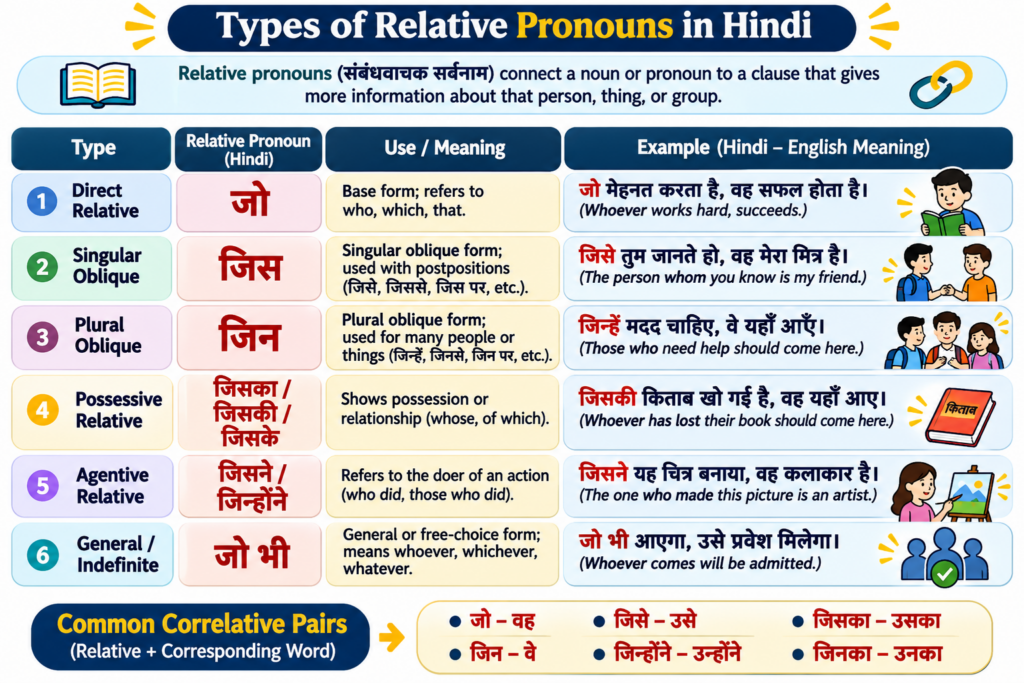
    Relative Pronouns Types in Hindi with Examples
    Relative Pronouns Types in Hindi with Examplesno gie

    Hindi relative pronouns are mainly based on जो (who, which, that) and its grammatical forms.

    Unlike English, which uses who, whom, whose, and which, Hindi frequently changes the same relative base according to number, case, and postpositions.

    1. Direct Relative Pronoun (जो)

    जो is the basic relative form. It can refer to people, objects, or things.

    Example: जो मेहनत करता है, वह सफल होता है।

    English: Whoever works hard succeeds.

    2. Singular Oblique Relative Pronoun (जिस)

    जिस is used for a singular referent in constructions involving postpositions and grammatical case.

    It produces forms such as जिसे, जिससे, जिसमें, and जिस पर.

    Example: जिसे तुम जानते हो, वह मेरा मित्र है।

    English: The person whom you know is my friend.

    3. Plural Oblique Relative Pronoun (जिन)

    जिन refers to plural or honorific antecedents in oblique constructions.

    It appears in forms such as जिन्हें, जिनसे, जिन्होंने, and जिनमें.

    Example: जिन्हें मदद चाहिए, वे यहाँ आएँ।

    English: Those who need help should come here.

    4. Possessive Relative Forms (जिसका, जिसकी, जिसके)

    These forms express ownership, association, or a relationship between nouns.

    They usually agree with the gender, number, and grammatical case of the noun describing the possession.

    Example: जिसकी किताब खो गई है, वह यहाँ आए।

    English: Whoever has lost their book should come here.

    5. General or Indefinite Relative Constructions

    Expressions such as जो भी, जिसे भी, and जो कोई भी mean whoever, whichever, or whatever in suitable contexts.

    They refer to any person or thing satisfying the condition in the relative clause.

    Example: जो भी आएगा, उसे प्रवेश मिलेगा।

    English: Whoever comes will be admitted.

    Relative Pronouns Types in Hindi Chart

    FormGrammatical RoleEnglish MeaningExample
    जोDirect/base relativeWho / Which / Thatजो आएगा
    जिसSingular oblique baseWho / Whichजिस पर
    जिनPlural oblique baseWho / Which, pluralजिनसे
    जिसनेSingular relative agentWho didजिसने लिखा
    जिन्होंनेPlural/honorific relative agentWho didजिन्होंने बनाया
    जिसका / जिसकी / जिसकेPossessive relativeWhose / Of whichजिसकी किताब
    जो भीGeneral relativeWhoever / Whicheverजो भी आए

    These are grammatical and functional forms of relative pronouns, not seven unrelated classes.

    Relative Pronoun Grammar Rules in Hindi

    Hindi relative pronouns connect two clauses and identify people, objects, or situations through their relationships.

    Their use depends on case, number, sentence structure, and the corresponding expression in the main clause.

    Rule 1: Relative Pronouns Connect Related Clauses

    A relative clause supplies information that identifies or describes a referent.

    Example: जो विद्यार्थी नियमित पढ़ता है, वह अच्छे अंक प्राप्त करता है।

    English: The student who studies regularly gets good marks.

    The clause beginning with जो identifies the student being discussed.

    Rule 2: Use जो with a Direct Relative Construction

    जो is often used when the relative referent appears in a direct grammatical position.

    Hindi SentenceEnglish Translation
    जो आया, वह बैठ गया।The one who came sat down.
    जो सही है, उसे चुनो।Choose what is correct.
    जो यहाँ रहता है, वह मेरा मित्र है।The person who lives here is my friend.

    Rule 3: Use जिस in Singular Oblique Constructions

    जिस combines with postpositions or case markers.

    Hindi FormEnglish Meaning
    जिसनेWho did
    जिसे / जिसकोWhom / To whom
    जिससेFrom / With whom or which
    जिसमेंIn which
    जिस परOn whom or which
    जिसके लिएFor whom or which

    Example: जिससे मैंने बात की, वह शिक्षक है।

    English: The person with whom I spoke is a teacher.

    Rule 4: Use जिन for Plural or Honorific Oblique Reference

    The plural oblique base जिन combines with different markers and postpositions.

    Hindi FormEnglish Meaning
    जिन्होंनेWho did, plural/honorific
    जिन्हें / जिनकोWhom, plural/honorific
    जिनसेWith / From whom
    जिनमेंIn whom or which, plural
    जिन परOn whom or which, plural
    जिनके लिएFor whom, plural

    Example: जिन्होंने प्रतियोगिता जीती, उन्हें पुरस्कार मिला।

    English: Those who won the competition received prizes.

    Rule 5: Possessive Relative Forms Agree with the Possessed Noun

    The forms जिसका, जिसकी, and जिसके commonly agree with the noun being possessed.

    Relative FormExampleEnglish
    जिसकाजिसका घरWhose house
    जिसकीजिसकी किताबWhose book
    जिसकेजिसके दोस्तWhose friends
    जिसकेजिसके घर मेंIn whose house

    Example: जिसका बैग यहाँ है, वह उसे ले जाए।

    English: Whoever owns the bag here should take it.

    Rule 6: Hindi Frequently Uses Correlative Pairs

    A relative expression is often matched with a corresponding word in the main clause.

    Relative PairGeneral Meaning
    जो – वहWho / That one
    जिसे – उसेWhom / That person
    जिसका – उसकाWhose / That person’s
    जिससे – उससेFrom/With whom – From/With that person
    जिन्होंने – उन्होंनेThose who – They
    जिन्हें – उन्हेंThose whom – Them

    Example: जो पढ़ेगा, वह सीखेगा।

    English: Whoever studies will learn.

    Rule 7: A Relative Clause May Follow Its Noun

    Not every Hindi relative clause must appear at the beginning of a sentence.

    Example: यह वही पुस्तक है जो मैंने कल खरीदी थी।

    English: This is the book that I bought yesterday.

    Rule 8: जो भी Adds a General or Free-Choice Meaning

    जो भी and related forms can refer to any suitable person or thing.

    Example: जो भी उत्तर सही हो, उसे लिखो।

    English: Write whichever answer is correct.

    Rule 9: Hindi Relative Pronouns Do Not Require Separate Masculine and Feminine Base Forms

    जो can refer to a male or female person.

    Gender may appear in the verb rather than in the relative pronoun itself.

    Hindi SentenceEnglish Meaning
    जो आया, वह मेरा भाई है।The one who came is my brother.
    जो आई, वह मेरी बहन है।The one who came is my sister.

    Rule 10: Not Every Related Question Word Is a Relative Pronoun

    जो and कौन have different grammatical functions.

    जो commonly introduces relative information, while कौन asks a question.

    Relative: जो आया, वह बैठ गया।

    Interrogative: कौन आया?

    Relative Pronoun in Hindi Examples By Categories

    Relative pronouns help identify people, objects, locations, relationships, and unspecified possibilities.

    The examples below show their forms with English meanings and commonly used combinations.

    Singular Relative Pronoun Examples in Hindi

    These expressions use singular relative forms based on जो and जिस.

    No.Hindi ExpressionEnglish Meaning
    1जोWho / Which / That
    2जिसWhom / Which, oblique
    3जिसनेWho did
    4जिसेWhom / Which, object
    5जिसकोTo whom / Which
    6जिससेFrom / With whom
    7जिसमेंIn which
    8जिस परOn whom / Which
    9जिसकाWhose, masculine possession
    10जिसकीWhose, feminine possession
    11जिसकेWhose, plural/oblique possession
    12जिसके लिएFor whom / Which
    13जिसके साथWith whom
    14जिसके पासWho has / With whom
    15जिसके बिनाWithout whom / Which
    16जिसके बारे मेंAbout whom / Which
    17जिसके कारणBecause of which
    18जिसके बादAfter which
    19जिसके पहलेBefore which
    20जिसके अंदरInside which
    21जिसके बाहरOutside which
    22जिसके नीचेUnder which
    23जिसके ऊपरAbove which
    24जिसके सामनेIn front of whom / Which
    25जिसके पीछेBehind whom / Which
    26जिस तकUp to which / Whom
    27जिससे होकरThrough which
    28जिसे देखकरUpon seeing whom / Which
    29जिसको लेकरConcerning whom / Which
    30जिसकी वजह सेBecause of whom / Which

    Plural Relative Pronoun Examples in Hindi

    Plural and honorific relative constructions commonly use जिन and its modified forms.

    No.Hindi ExpressionEnglish Meaning
    1जिनWhom / Which, plural oblique
    2जिन्होंनेThose who did
    3जिन्हेंWhom, plural/honorific
    4जिनकोTo whom, plural
    5जिनसेFrom / With whom, plural
    6जिनमेंIn which, plural
    7जिन परOn whom / Which, plural
    8जिनकाWhose, plural antecedent
    9जिनकीWhose, plural antecedent
    10जिनकेWhose, plural antecedent
    11जिनके लिएFor whom, plural
    12जिनके साथWith whom, plural
    13जिनके पासWho have / With whom
    14जिनके बिनाWithout whom, plural
    15जिनके बारे मेंAbout whom / Which, plural
    16जिनके कारणBecause of whom / Which
    17जिनके बादAfter which, plural
    18जिनके पहलेBefore which, plural
    19जिनके अंदरInside which, plural
    20जिनके बाहरOutside which, plural
    21जिनके नीचेUnder which, plural
    22जिनके ऊपरAbove which, plural
    23जिनके सामनेIn front of whom / Which
    24जिनके पीछेBehind whom / Which
    25जिन तकUp to whom / Which, plural
    26जिनसे होकरThrough which, plural
    27जिन्हें देखकरUpon seeing whom, plural
    28जिनको लेकरConcerning whom / Which, plural
    29जिनकी वजह सेBecause of whom / Which
    30जिनके बीचAmong whom / Which

    Correlative and General Relative Pronoun Examples

    These expressions show how Hindi relative forms work with corresponding demonstratives and general-reference words.

    No.Hindi ExpressionEnglish Meaning
    1जो – वहWhoever – That person
    2जो – वेThose who – They
    3जिसने – उसनेThe one who did – That person did
    4जिसे – उसेWhom – That person
    5जिसको – उसकोTo whom – To that person
    6जिससे – उससेWith whom – With that person
    7जिसका – उसकाWhose – That person’s
    8जिसकी – उसकीWhose – That person’s
    9जिसके – उसकेWhose – That person’s
    10जिसमें – उसमेंIn which – In that
    11जिस पर – उस परOn which – On that
    12जिन्होंने – उन्होंनेThose who did – They did
    13जिन्हें – उन्हेंThose whom – Them
    14जिनसे – उनसेWith whom – With them
    15जिनका – उनकाWhose – Their
    16जिनकी – उनकीWhose – Their
    17जिनके – उनकेWhose – Their
    18जिनमें – उनमेंIn which – In those
    19जिन पर – उन परOn which – On those
    20जो भीWhoever / Whichever
    21जिसे भीWhomever
    22जिसने भीWhoever did
    23जिसका भीWhosever
    24जिन्हें भीWhomever, plural
    25जो कोई भीWhoever
    26जो कुछ भीWhatever
    27जिस किसी कोTo whomever
    28जिस किसी नेWhoever did
    29जिस चीज़ को भीWhichever thing
    30जिस व्यक्ति ने भीWhichever person did

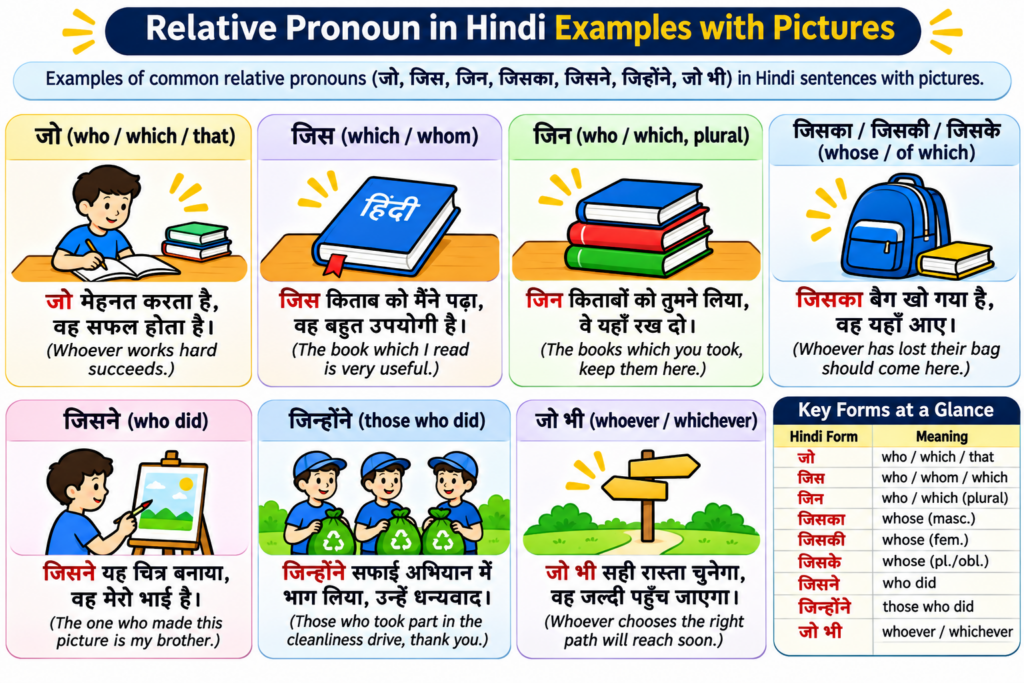
    Relative Pronoun in Hindi Examples with Pictures
    Relative Pronoun in Hindi Examples with Pictures

    Pictures make it easier to understand how relative pronouns identify an object, its owner, or a group of people.

    The table shows common relative forms with three example expressions each. The illustrations can focus on books, bags, keys, boxes, and other everyday objects.

    Relative FormThree Hindi ExamplesEnglish MeaningPicture Concept
    जोजो आया, जो पढ़ता है, जो सही हैWho came; who studies; which is correctA selected book among several
    जिसजिस पर, जिसमें, जिससेOn which; in which; with whichOne marked container
    जिनजिनमें, जिनसे, जिन परIn which; from which; on which, pluralSeveral marked boxes
    जिसका / जिसकी / जिसकेजिसका बैग, जिसकी किताब, जिसके दोस्तWhose bag; whose book; whose friendsBag, notebook, and belongings
    जिसनेजिसने लिखा, जिसने खोला, जिसने बनायाWho wrote; who opened; who madePencil, open box, finished model
    जिन्होंनेजिन्होंने पढ़ा, जिन्होंने बनाया, जिन्होंने चुनाThose who read, made, or choseSeveral completed tasks
    जो भीजो भी आए, जो भी सही हो, जो भी मिलेWhoever comes; whichever is correct; whatever is foundMultiple options with one selected

    Relative Pronoun Examples in Hindi Sentences

    Relative pronouns connect ideas without unnecessary repetition.

    The following sentences use singular, plural, possessive, and correlative structures. The relative words are highlighted for easy identification.

    No.Hindi SentenceEnglish Translation
    1जो मेहनत करता है, वह सफल होता है।Whoever works hard succeeds.
    2जो यहाँ रहता है, वह मेरा मित्र है।The one who lives here is my friend.
    3जो सही है, उसे चुनो।Choose what is correct.
    4जो पुस्तक चाहिए, उसे ले लो।Take the book you need.
    5जो पहले आएगा, उसे प्रवेश मिलेगा।Whoever comes first will be admitted.
    6जिसने पत्र लिखा, वह मेरा भाई है।The person who wrote the letter is my brother.
    7जिसने दरवाज़ा खोला, वह बाहर गया।Whoever opened the door went outside.
    8जिसने मदद की, उसका धन्यवाद करो।Thank the person who helped.
    9जिसने उत्तर दिया, उसे पुरस्कार मिला।The person who answered received a prize.
    10जिसने यह चित्र बनाया, वह कलाकार है।The person who made this picture is an artist.
    11जिसे तुम जानते हो, वह यहाँ आया है।The person whom you know has come here.
    12जिसे किताब चाहिए, वह हाथ उठाए।Whoever needs a book should raise their hand.
    13जिसे मैंने बुलाया, वह नहीं आया।The person whom I invited did not come.
    14जिसे यह पसंद है, वह इसे रख सकता है।Whoever likes this may keep it.
    15जिसे मदद मिली, वह खुश था।The person who received help was happy.
    16जिससे मैंने बात की, वह शिक्षक है।The person I spoke with is a teacher.
    17जिससे तुमने कल पूछा, वह मेरा मित्र है।The person you asked yesterday is my friend.
    18जिसमें पानी है, उसे उठाओ।Pick up the one containing water.
    19जिस पर नाम लिखा है, वह मेरा है।The one with a name written on it is mine.
    20जिसके लिए यह उपहार है, वह अभी नहीं आया।The person this gift is for has not arrived yet.
    21जिसका बैग खो गया है, वह यहाँ आए।Whoever lost their bag should come here.
    22जिसकी किताब यहाँ है, वह इसे ले जाए।Whoever owns the book here should take it.
    23जिसके दोस्त आए हैं, वह खुश है।The person whose friends arrived is happy.
    24जिसका घर बड़ा है, वह हमें जानता है।The person whose house is large knows us.
    25जिसकी चाबी मिली है, उसे बुलाओ।Call the person whose key was found.
    26जिन्होंने प्रतियोगिता जीती, उन्हें पुरस्कार मिला।Those who won the competition received prizes.
    27जिन्होंने काम पूरा किया, वे जा सकते हैं।Those who completed the work may leave.
    28जिन्होंने मदद की, उनका धन्यवाद करो।Thank those who helped.
    29जिन्होंने आवेदन किया, उन्हें संदेश मिलेगा।Those who applied will receive a message.
    30जिन्होंने पुस्तक पढ़ी, वे उत्तर दें।Those who read the book should answer.
    31जिन्हें मदद चाहिए, वे यहाँ आएँ।Those who need help should come here.
    32जिन्हें बुलाया गया है, वे अंदर जाएँ।Those who were invited should go inside.
    33जिनसे हम मिले, वे बहुत विनम्र थे।The people we met were very polite.
    34जिनसे तुमने बात की, वे मेरे शिक्षक हैं।Those you spoke with are my teachers.
    35जिनमें फल हैं, वे डिब्बे अलग रखो।Keep the boxes containing fruit separately.
    36जो भी आएगा, उसे बैठने दो।Let whoever comes sit down.
    37जो भी सही लगे, उसे चुनो।Choose whichever seems correct.
    38जिसे भी यह चाहिए, वह ले सकता है।Whoever needs this may take it.
    39जिसने भी नियम तोड़ा, उसे समझाया जाएगा।Whoever broke the rule will be given an explanation.
    40जो कुछ भी सीखो, उसका अभ्यास करो।Practice whatever you learn.

    Relative Pronoun vs Interrogative Pronoun in Hindi

    Relative and interrogative pronouns may refer to the same people or objects, but their grammatical functions differ.

    Relative pronouns connect clauses. Interrogative pronouns ask questions.

    Relative PronounInterrogative Pronoun
    जो — Who / Which / Thatकौन — Who?
    जिसने — The one who didकिसने — Who did?
    जिसे — Whomकिसे — Whom?
    जिसका — Whoseकिसका — Whose?
    जिससे — With whomकिससे — With whom?

    Relative: जिसने किताब ली, वह यहाँ आए।

    English: Whoever took the book should come here.

    Interrogative: किसने किताब ली?

    English: Who took the book?

    Common Mistakes with Relative Pronouns in Hindi

    Relative pronoun mistakes often involve incorrect case forms, possessive agreement, and confusion between relative and interrogative constructions.

    Common MistakeIncorrectCorrect / Explanation
    Using जो instead of जिसने for the agentजो ने किताब लिखी।जिसने किताब लिखी।
    Using जिस with a plural referent where plural agreement is requiredजिसने काम किया, वे छात्र आए।जिन्होंने काम किया, वे छात्र आए।
    Incorrect possessive agreementजिसका किताब खो गई।जिसकी किताब खो गई।
    Wrong object formजो को बुलाया।जिसे बुलाया।
    Incorrect relative form before सेजो से बात की।जिससे बात की।
    Confusing relative and interrogative pronounsकिसने मदद की, उसका धन्यवाद करो।जिसने मदद की, उसका धन्यवाद करो।
    Wrong correlative pairingजो आया, उसे बैठ गया।जो आया, वह बैठ गया।
    Confusing singular and plural relative objectsजिन्हें बुलाया, वह आए। when referring to several peopleजिन्हें बुलाया, वे आए।
    Using masculine possessive agreement with a feminine nounजिसका चाबी मिली।जिसकी चाबी मिली।
    Assuming every relative clause must precede the main clauseTreating a sentence-final relative clause as always wrongयह वही किताब है जो मैंने खरीदी थी। is correct.

    Relative Pronouns Exercises in Hindi

    Practice recognizing जो, जिस, जिन, जिसने, जिसे, जिसका, and जिन्होंने in different sentence structures.

    The interactive worksheet also covers correlative pairs, possessive agreement, case forms, and relative versus interrogative pronouns.

    ⋮⋮⋮⋮

    Download Relative Pronouns Worksheet with Answers PDF

    Use the printable worksheet to complete relative pronoun sentences, identify correct grammatical forms, and practice जो–वह constructions.

    The PDF includes an answer key to make classroom practice and independent revision easier.

    Download Relative Pronoun in Hindi Study Notes PDF

    Keep the main relative pronoun forms, correlative patterns, grammar rules, and Hindi-English examples together in one reference document.

    These notes are useful for offline study, sentence-writing practice, and quick grammar revision..

    Frequently Asked Questions

    Can जो refer to both people and objects?

    Yes. जो can refer to people, objects, or ideas. The correct interpretation depends on the antecedent and surrounding clause.

    Why does जो change to जिस or जिन?

    जिस and जिन are oblique forms used in particular case and postpositional constructions. जिस is generally singular, while जिन is plural or honorific.

    Is जो भी a separate basic type of relative pronoun?

    No. जो भी is an extended relative expression that often means whoever or whichever, rather than a separate foundational pronoun class.

    Can Hindi sentences omit the matching वह?

    Yes. A corresponding demonstrative is common in Hindi correlative constructions, but it is not obligatory in every relative-clause structure.

    Conclusion

    Relative pronouns are especially useful when one sentence must explain which person, object, or group we mean. जो introduces the relationship, while जिस and जिन help express different grammatical roles.

    Try completing these ideas: ___ मेहनत करेगा, वह सीखेगा, ___ किताब खो गई है, वह यहाँ आए, and ___ मदद चाहिए, वे हाथ उठाएँ. Share your answers in the comments.
  • What Is Indefinite Pronoun in Hindi with Examples

    A teacher walks into the classroom and notices a notebook on an empty desk. Nobody knows who left it there. One student says, “किसी ने यहाँ किताब रखी है” (Someone has left a book here). Another notices a few loose pages and says, “कुछ नीचे गिरा है” (Something has fallen on the floor).

    Neither student knows exactly who left the notebook or what fell. Words such as किसी (someone) and कुछ (something) help us talk about people and things without identifying them. In Hindi grammar, these are examples of indefinite pronouns (अनिश्चयवाचक सर्वनाम).

    But how does कोई become किसी, and why do expressions such as कोई भी, कुछ न कुछ, and कोई न कोई have slightly different meanings? These forms appear constantly in conversations, stories, and questions. Learning their patterns makes Hindi sentences more natural and precise.

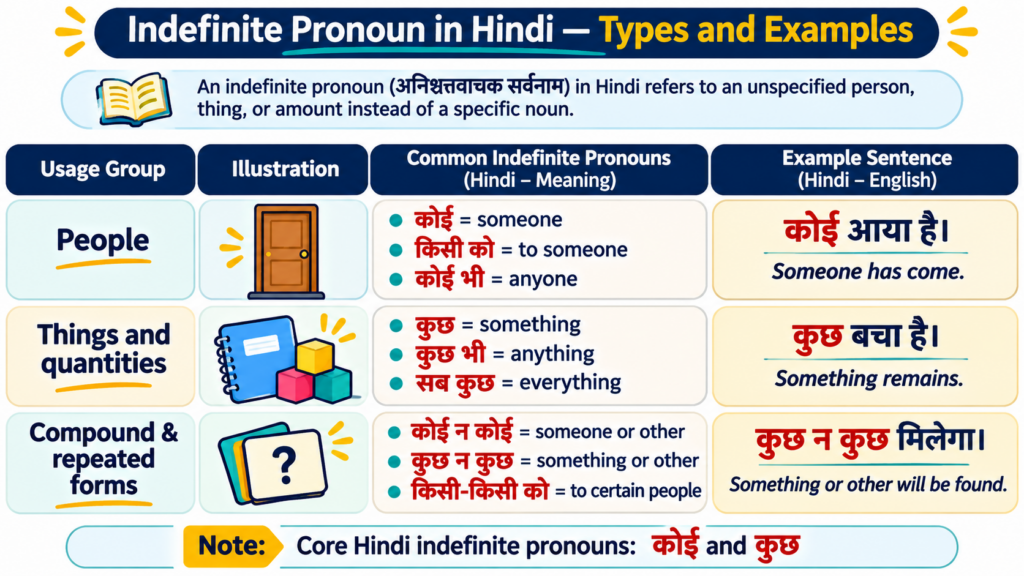
    Indefinite Pronoun Types in Hindi

    Indefinite Pronoun Types in Hindi

    Hindi indefinite pronouns are commonly grouped by their meaning and grammatical structure. The two basic forms are कोई and कुछ.

    For easier learning, their uses can be organized into three practical groups: reference to people, reference to things, and compound or repeated expressions.

    1. Indefinite Pronouns for People

    These pronouns refer to a person whose identity is unknown or not specified.

    The common form कोई changes to किसी in many oblique constructions.

    Examples:

    • कोई — Someone / Anyone
    • किसी ने — Someone, as the agent
    • किसी को — To someone

    Sentence: कोई दरवाज़े पर है।

    English: Someone is at the door.

    2. Indefinite Pronouns for Things and Quantities

    These forms refer to unidentified objects, unspecified amounts, or things not named precisely.

    कुछ is the most important basic form, while कई and similar quantifiers can indicate unspecified quantities.

    Examples:

    • कुछ — Something / Some
    • कुछ भी — Anything
    • सब कुछ — Everything

    Sentence: मुझे कुछ चाहिए।

    English: I need something.

    3. Compound and Repeated Indefinite Forms

    Hindi combines or repeats indefinite words to express uncertainty, general choice, or an unspecified member of a group.

    These are extended expressions rather than separate traditional grammatical subclasses.

    Examples:

    • कोई न कोई — Someone or other
    • कुछ न कुछ — Something or other
    • किसी न किसी को — To someone or other

    Sentence: कोई न कोई रास्ता मिल जाएगा।

    English: Some solution or other will be found.

    Indefinite Pronoun Types Comparison

    Usage GroupHindi NameMain FormsEnglish Meaning
    Peopleव्यक्ति के लिए अनिश्चित संदर्भकोई, किसी, किन्हींSomeone / Anyone / Certain people
    Things and quantitiesवस्तु या मात्रा के लिए अनिश्चित संदर्भकुछ, कुछ भी, सब कुछSomething / Anything / Everything
    Compound and repeated formsसंयुक्त और पुनरुक्त अनिश्चित रूपकोई न कोई, कुछ न कुछ, किसी-किसीSomeone or other / Something or other / Certain ones

    Grammar Note: Traditional Hindi grammar primarily identifies कोई and कुछ as the basic indefinite pronouns. Forms such as कई, सभी, and कुछ लोग can function as quantifiers or determiners rather than standalone pronouns.

    Indefinite Pronoun Grammar Rules in Hindi

    Indefinite pronouns allow speakers to refer to people or things without naming them.

    Their correct use depends on sentence meaning, postpositions, negation, and whether the word stands independently or modifies a noun.

    Rule 1: Use कोई for an Unspecified Person

    कोई commonly means someone or anyone, depending on context.

    Hindi SentenceEnglish Meaning
    कोई आया है।Someone has come.
    क्या कोई यहाँ है?Is anyone here?
    कोई मेरी मदद करेगा।Someone will help me.

    Rule 2: Use कुछ for an Unspecified Thing

    कुछ can refer to an unknown thing or an unspecified amount.

    Hindi SentenceEnglish Meaning
    कुछ हुआ है।Something has happened.
    मुझे कुछ बताओ।Tell me something.
    कुछ बचा है।Something remains.

    Rule 3: कोई Often Changes to किसी Before Postpositions

    In many oblique constructions, कोई takes the form किसी.

    Direct FormOblique ExpressionEnglish Meaning
    कोईकिसी नेSomeone did
    कोईकिसी कोTo someone
    कोईकिसी सेFrom / With someone
    कोईकिसी काSomeone’s
    कोईकिसी के लिएFor someone

    Example: किसी ने दरवाज़ा खोला।

    English: Someone opened the door.

    Rule 4: कुछ Usually Keeps the Same Basic Form

    Unlike कोई, the word कुछ generally remains unchanged before many constructions.

    Examples:

    • कुछ में — In some
    • कुछ से — From some
    • कुछ के लिए — For some
    • कुछ को — To some, in a suitable context

    Sentence: कुछ में पानी है।

    English: Some of them contain water.

    Rule 5: Use भी to Express Any or Anyone

    Adding भी often broadens the meaning of an indefinite expression.

    Hindi ExpressionEnglish Meaning
    कोई भीAnyone
    कुछ भीAnything
    किसी को भीTo anyone
    किसी से भीFrom / With anyone

    Example: कोई भी यह प्रश्न हल कर सकता है।

    English: Anyone can solve this question.

    Rule 6: Use नहीं for Negative Indefinite Statements

    Hindi commonly expresses negative indefinite meanings by combining an indefinite word with नहीं.

    Hindi ExpressionEnglish Meaning
    कोई नहींNobody
    कुछ नहींNothing
    किसी ने नहींNobody did
    किसी को नहींTo nobody / Not to anyone

    Example: यहाँ कोई नहीं है।

    English: Nobody is here.

    Rule 7: Repetition Can Express an Unspecified Choice

    Repeated or combined indefinite expressions often suggest that one or more unspecified possibilities exist.

    Example: कुछ न कुछ सीखने को मिलेगा।

    English: There will be something or other to learn.

    Example: किसी न किसी ने यह देखा होगा।

    English: Someone or other must have seen this.

    Rule 8: Distinguish Pronouns from Determiners

    An indefinite pronoun stands independently, while an indefinite determiner or quantifier appears with a noun.

    Indefinite PronounIndefinite Determiner / Quantifier
    कोई आया है। (Someone has come.)कोई व्यक्ति आया है। (Some person has come.)
    कुछ बचा है। (Something remains.)कुछ खाना बचा है। (Some food remains.)
    कई आए। (Several came.)कई छात्र आए। (Several students came.)

    The same word can serve different grammatical functions depending on its sentence position.

    Indefinite Pronoun Examples in Hindi

    Indefinite expressions are useful for talking about unknown people, unspecified things, choices, and quantities.

    The following tables organize common expressions by their practical meaning and use.

    Indefinite Pronouns for People with Hindi Meanings

    These examples use कोई and its related expressions for unspecified people.

    Some entries are complete phrases containing an indefinite pronoun rather than individual standalone pronouns.

    No.Hindi ExpressionEnglish Meaning
    1कोईSomeone / Anyone
    2किसी नेSomeone, as agent
    3किसी कोTo someone
    4किसी सेFrom / With someone
    5किसी काSomeone’s
    6किसी कीSomeone’s
    7किसी केSomeone’s / Of someone
    8किसी मेंIn someone
    9किसी परOn someone
    10किसी के पासWith someone / Someone has
    11किसी के लिएFor someone
    12किसी के साथWith someone
    13किसी के बिनाWithout someone
    14किसी तकUp to someone
    15कोई भीAnyone
    16किसी को भीTo anyone
    17किसी से भीFrom / With anyone
    18कोई औरSomeone else
    19किसी और कोTo someone else
    20किसी और सेWith someone else
    21कोई नहींNobody
    22किसी ने नहींNobody did
    23किसी को नहींNot to anyone
    24हर कोईEveryone
    25हर किसी कोTo everyone
    26कोई एकAny one
    27किन्हीं कोTo certain people
    28किन्हीं सेFrom certain people
    29कुछ लोगSome people
    30कई लोगSeveral people

    Note: कुछ लोग and कई लोग are noun phrases with quantifiers. Their inclusion helps compare related indefinite expressions without treating every expression as a separate pronoun.

    Indefinite Pronouns for Things and Quantities

    These expressions refer to unspecified objects, substances, amounts, or groups.

    कुछ is the core indefinite pronoun; several other entries are broader quantifier expressions.

    No.Hindi ExpressionEnglish Meaning
    1कुछSomething / Some
    2कुछ भीAnything
    3कुछ नहींNothing
    4सब कुछEverything
    5कुछ औरSomething else
    6कुछ नयाSomething new
    7कुछ अच्छाSomething good
    8कुछ पुरानाSomething old
    9कुछ खासSomething special
    10कुछ अलगSomething different
    11कुछ बचा हुआSomething remaining
    12कुछ खाने कोSomething to eat
    13कुछ पीने कोSomething to drink
    14कुछ पढ़ने कोSomething to read
    15कुछ लिखने कोSomething to write
    16कुछ मेंIn some
    17कुछ सेFrom some
    18कुछ के लिएFor some
    19कुछ काOf some
    20कुछ कीOf some
    21कुछ केOf some
    22कुछ हिस्सेSome parts
    23कुछ बातेंSome things / Matters
    24कुछ किताबेंSome books
    25कई चीज़ेंSeveral things
    26कई विकल्पSeveral options
    27कुछ मात्रा मेंIn some amount
    28बहुत कुछA lot of things
    29थोड़ा कुछA little something
    30कुछ और भीSomething more as well

    Compound and Repeated Indefinite Forms

    Hindi frequently combines indefinite words with न, भी, और, or repetition.

    These patterns express uncertainty, broad choice, partial distribution, or an unspecified possibility.

    No.Hindi ExpressionEnglish Meaning
    1कोई न कोईSomeone or other
    2कुछ न कुछSomething or other
    3किसी न किसी नेSomeone or other did
    4किसी न किसी कोTo someone or other
    5किसी न किसी सेWith someone or other
    6किसी न किसी काBelonging to someone or other
    7किसी न किसी केOf someone or other
    8किसी न किसी तरहSomehow or other
    9कोई न कोई रास्ताSome way or other
    10कोई न कोई उपायSome solution or other
    11कुछ न कुछ कामSome work or other
    12कुछ न कुछ बातSomething or other
    13कुछ न कुछ कारणSome reason or other
    14कुछ न कुछ बदलावSome change or other
    15कुछ न कुछ फायदाSome benefit or other
    16कोई-कोईSome individuals / Occasionally some
    17किसी-किसी कोTo certain people
    18किसी-किसी सेFrom / With certain people
    19कुछ-कुछA little / Somewhat
    20कुछ-कुछ यादRemembering a little
    21कुछ-कुछ समझPartial understanding
    22कोई और भीSomeone else too
    23कुछ और भीSomething else too
    24कोई भी नहींNot anyone
    25कुछ भी नहींNothing at all
    26हर कोईEveryone
    27हर किसी कोTo everyone
    28सब कुछEverything
    29जो कोई भीWhoever
    30जो कुछ भीWhatever

    These are related indefinite constructions. Expressions beginning with जो also involve relative-pronoun grammar, so they should not be treated as a separate basic indefinite category.

    Indefinite Pronoun Examples in Hindi Sentences

    Indefinite pronouns appear in questions, statements, negative sentences, requests, and everyday conversations.

    The important Hindi expressions and their English equivalents are highlighted in bold.

    No.Hindi SentenceEnglish Translation
    1कोई बाहर खड़ा है।Someone is standing outside.
    2किसी ने घंटी बजाई।Someone rang the bell.
    3कोई मेरी किताब ले गया।Someone took my book.
    4क्या कोई यहाँ है?Is anyone here?
    5किसी को मदद चाहिए।Someone needs help.
    6किसी से पूछ लो।Ask someone.
    7कोई और आएगा।Someone else will come.
    8यहाँ कोई नहीं है।There is nobody here.
    9किसी ने नहीं बताया।Nobody told me.
    10हर कोई सीख सकता है।Everyone can learn.
    11कुछ हुआ है।Something has happened.
    12मुझे कुछ चाहिए।I need something.
    13कुछ बचा है।Something remains.
    14उसने कुछ कहा।He or she said something.
    15क्या कुछ मिला?Did you find anything?
    16मुझे कुछ नहीं चाहिए।I need nothing.
    17सब कुछ ठीक है।Everything is fine.
    18मैंने कुछ नया सीखा।I learned something new.
    19कुछ भी चुन लो।Choose anything.
    20कुछ और बताओ।Tell me something else.
    21कोई भी आ सकता है।Anyone can come.
    22किसी को भी बुलाओ।Call anyone.
    23किसी से भी पूछ सकते हो।You can ask anyone.
    24कोई न कोई मदद करेगा।Someone or other will help.
    25कुछ न कुछ सीखने को मिलेगा।There will be something or other to learn.
    26किसी न किसी ने देखा होगा।Someone or other must have seen it.
    27कोई न कोई रास्ता मिलेगा।Some way or other will be found.
    28किसी-किसी को यह पसंद है।Some people like this.
    29मुझे कुछ-कुछ याद है।I remember a little.
    30कई आए, लेकिन कुछ लौट गए।Several came, but some returned.
    31कुछ लोग देर से आए।Some people arrived late.
    32कई छात्र अनुपस्थित थे।Several students were absent.
    33किसी ने दरवाज़ा खोला।Someone opened the door.
    34कोई भी यह कर सकता है।Anyone can do this.
    35कुछ भी नहीं बचा।Nothing at all remained.
    36हर किसी को अवसर मिलना चाहिए।Everyone should get an opportunity.
    37जो कोई भी आए, उसे अंदर भेजो।Send in whoever comes.
    38जो कुछ भी चाहिए, बता दो।Tell me whatever you need.
    39किसी और को यह दे दो।Give this to someone else.
    40कुछ न कुछ बदलना पड़ेगा।Something or other will have to change.

    Indefinite Pronoun vs Indefinite Determiner in Hindi

    An indefinite pronoun stands independently, while an indefinite determiner accompanies a noun.

    Understanding this difference prevents confusion when identifying words such as कोई, कुछ, and कई.

    Indefinite PronounIndefinite Determiner / Quantifier
    कोई आया है। (Someone has come.)कोई व्यक्ति आया है। (Some person has come.)
    कुछ बचा है। (Something remains.)कुछ खाना बचा है। (Some food remains.)
    कई लौट गए। (Several returned.)कई छात्र लौट गए। (Several students returned.)
    कुछ गिर गए। (Some fell.)कुछ फल गिर गए। (Some fruits fell.)

    The important question is whether the indefinite word stands in place of a noun or appears with one.

    Common Mistakes with Indefinite Pronouns in Hindi

    Errors commonly involve oblique forms, negative expressions, and confusing independent pronouns with noun modifiers.

    Common MistakeIncorrectCorrect / Explanation
    Using कोई instead of किसी before नेकोई ने दरवाज़ा खोला।किसी ने दरवाज़ा खोला।
    Using the wrong object formकोई को बुलाओ।किसी को बुलाओ।
    Incorrect form with सेकोई से पूछो।किसी से पूछो।
    Omitting नहीं in negative statementsयहाँ कोई है। when meaning nobodyयहाँ कोई नहीं है।
    Confusing कोई and कुछकुछ दरवाज़े पर है। when referring to an unknown personकोई दरवाज़े पर है।
    Treating every quantifier as a pronounCalling कई a pronoun in कई छात्र आए।Here कई is a quantifier modifying छात्र.
    Using a double negative incorrectly in EnglishTranslating कोई नहीं आया as Nobody didn’t comeNobody came.
    Confusing कुछ with कुछ भीAssuming both always mean anythingकुछ often means something/some; कुछ भी often means anything.

    Indefinite Pronoun in Hindi Worksheet

    Practice identifying indefinite pronouns, selecting कोई or कुछ, forming oblique expressions with किसी, and distinguishing pronouns from quantifiers.

    The exercises also cover negative, compound, and repeated forms.

    ⋮⋮⋮⋮

    Download Indefinite Pronoun Worksheet with Answers PDF

    Use the printable worksheet to practice indefinite references to people and things, correct sentence completion, and common grammar rules.

    The PDF includes multiple-choice questions and a complete answer key for checking responses independently.

    Download Indefinite Pronoun in Hindi PDF Study Notes

    Review the meaning of indefinite pronouns, the major usage groups, Hindi-English examples, and important grammar rules in one document.

    These notes are useful for offline reading, classroom revision, and exam preparation.

    Frequently Asked Questions

    Can कोई refer to both singular and plural people?

    Yes. कोई usually refers to an unspecified individual, but Hindi also has forms and constructions that refer to unspecified groups. Context determines the meaning.

    What is the difference between किसी and किन्हीं?

    किसी is commonly used for an unspecified singular referent in oblique contexts. किन्हीं is a plural oblique form used with unspecified people or things, often in more formal Hindi.

    Is कहीं an indefinite pronoun?

    No. कहीं generally functions as an adverb referring to an unspecified location, rather than as a pronoun replacing a noun.

    Can कुछ describe an amount rather than an object?

    Yes. कुछ can refer to an unspecified quantity in expressions such as कुछ पानी, where it functions as a quantifier modifying the noun.

    Time To Practice Now

    A conversation does not always need exact names or numbers. कोई helps when a person is unidentified, while कुछ is useful when a thing or amount remains unspecified.

    Try completing these three ideas in Hindi: Someone knocked, I need something, and Nobody came. Use किसी, कुछ, and कोई नहीं where appropriate, then share your sentences in the comments.

  • Demonstrative Pronoun in Hindi with Rules and Examples

    A teacher places one notebook on the desk and several others on a shelf across the classroom. Pointing to the notebook nearby, the teacher says, “यह मेरा है” (This is mine). Then, pointing to the distant notebooks, the teacher adds, “वे तुम्हारे हैं” (Those are yours). Two short sentences tell us which objects are being discussed without repeating their names.

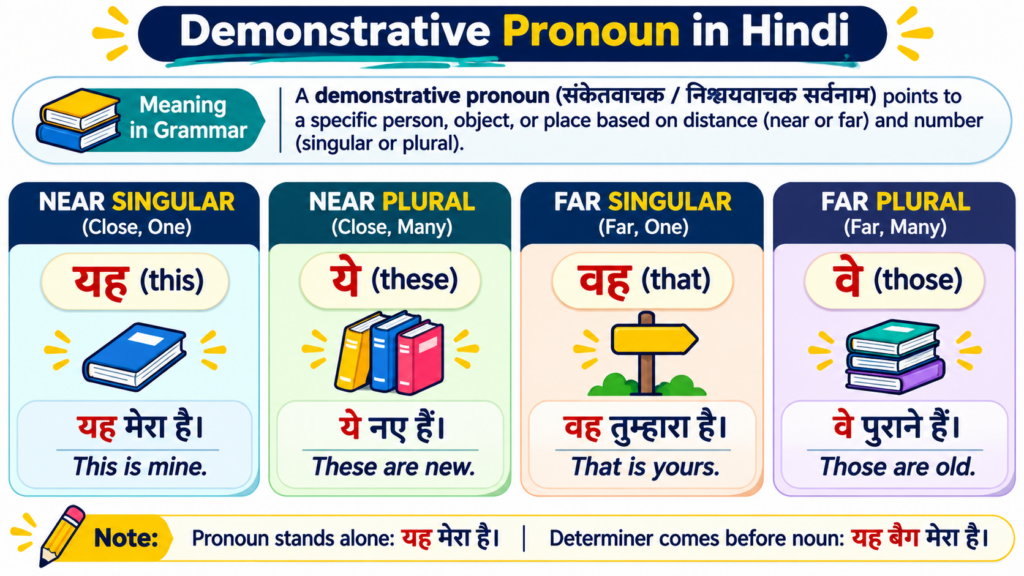
    Words such as यह, ये, वह, and वे are called demonstrative pronouns, known as संकेतवाचक सर्वनाम or निश्चयवाचक सर्वनाम in Hindi. They point to particular people, objects, or places and help distinguish nearby things from those farther away.

    But what happens when we say “यह किताब मेरी है” instead of “यह मेरी है”? The same word can act differently depending on whether it stands alone or appears before a noun. Understanding that difference, along with number and oblique forms, makes Hindi demonstrative pronouns easier to use correctly.

    Demonstrative Pronoun Types in Hindi

    Hindi demonstrative pronouns are commonly organized by distance and number. These two distinctions produce four main direct forms.

    The forms point to nearby or more distant referents and can also function as third-person pronouns.

    TypeHindi PronounEnglish MeaningExample
    Near SingularयहThisयह मेरा है।
    Near PluralयेTheseये मेरे हैं।
    Far SingularवहThatवह तुम्हारा है।
    Far PluralवेThoseवे तुम्हारे हैं।

    1. Near Singular Demonstrative Pronoun

    यह points to one nearby person, object, or thing already understood from context.

    Example: यह बहुत अच्छा है। (This is very good.)

    2. Near Plural Demonstrative Pronoun

    ये points to more than one nearby person or thing. It can also be used for a single person respectfully.

    Example: ये मेरे हैं। (These are mine.)

    3. Far Singular Demonstrative Pronoun

    वह identifies one person or object farther away, or someone or something already mentioned.

    Example: वह बहुत पुराना है। (That is very old.)

    4. Far Plural Demonstrative Pronoun

    वे identifies multiple more distant people or objects. It may also refer respectfully to one person.

    Example: वे अभी वहाँ हैं। (Those are still there.)

    Demonstrative Pronoun Grammar Rules in Hindi

    Demonstrative pronouns have different forms depending on their grammatical role and whether the referent is near, distant, singular, or plural.

    They also interact with Hindi postpositions, possessive forms, and verb agreement.

    Rule 1: Use यह and ये for Nearby Reference

    यह is the common direct singular form, while ये is the corresponding plural form.

    SingularPlural
    यह मेरा है।ये मेरे हैं।
    This is mine.These are mine.
    यह नया है।ये नए हैं।
    This is new.These are new.

    Rule 2: Use वह and वे for Distant Reference

    वह is the common direct singular form, while वे is the corresponding plural form.

    SingularPlural
    वह तुम्हारा है।वे तुम्हारे हैं।
    That is yours.Those are yours.
    वह पुराना है।वे पुराने हैं।
    That is old.Those are old.

    Rule 3: Pronouns May Change Before Postpositions

    Hindi demonstratives take oblique forms before many postpositions such as को, से, में, पर, and के लिए.

    Direct FormOblique StemExample
    यहइसइससे (from/with this)
    येइनइनमें (among/in these)
    वहउसउसको (to that one)
    वेउनउनसे (from/with those)

    For example, यह मेरा है uses the direct form, but इसमें पानी है uses the oblique form.

    Rule 4: Demonstrative Pronouns Do Not Change for Gender

    The pronouns यह and वह can refer to masculine or feminine people and objects.

    Verb forms or adjectives may reveal grammatical gender.

    Hindi SentenceEnglish Meaning
    यह अच्छा है।This is good. (masculine)
    यह अच्छी है।This is good. (feminine)
    वह आया।He came.
    वह आई।She came.

    Rule 5: Verbs and Adjectives May Show Number Agreement

    Singular demonstratives usually take singular agreement, while ordinary plural demonstratives take plural agreement.

    Examples:

    • यह नया है। (This is new.)
    • ये नए हैं। (These are new.)
    • वह तैयार है। (That is ready.)
    • वे तैयार हैं। (Those are ready.)

    Rule 6: ये and वे Can Express Respect

    In Hindi, plural-style demonstratives may refer to a single person respectfully.

    Example: ये हमारे शिक्षक हैं। (This person is our teacher.)

    Example: वे बहुत अनुभवी हैं। (He or she is very experienced, respectfully.)

    Rule 7: Emphatic Forms Identify a Particular Referent

    Adding ही creates emphatic forms such as यही and वही.

    Ordinary FormEmphatic FormMeaning
    यहयहीThis very one
    वहवहीThat very one
    इसकोइसी कोTo this very one
    उसकोउसी कोTo that very one

    Example: यही सही है। (This very one is correct.)

    Rule 8: Demonstratives Can Refer to Previously Mentioned Ideas

    Distance is not always physical. A demonstrative may refer to something discussed earlier in a conversation.

    Example: यह सही नहीं है। (This is not right.)

    Here, यह may refer to an action, decision, or idea rather than a visible object.

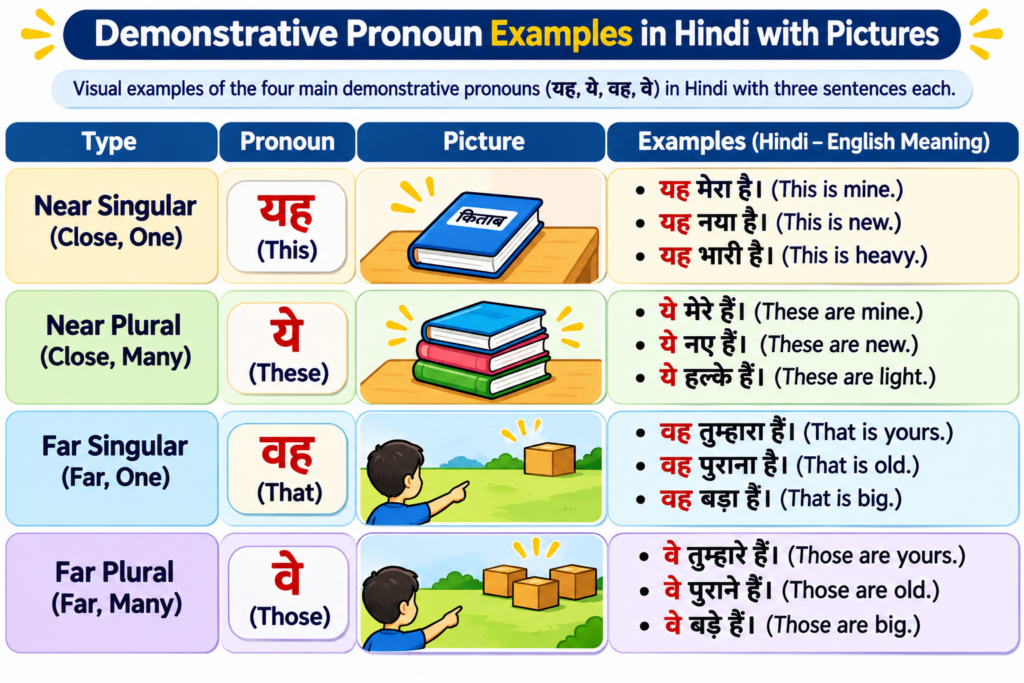
    Demonstrative Pronoun Examples in Hindi with Pictures

    Demonstrative Pronoun Examples in Hindi with Pictures

    Pictures help learners connect demonstrative pronouns with nearby and distant objects.

    The table includes three examples for each of the four main forms. The Hindi examples use the pronouns independently, with the referenced object understood.

    TypePronounThree ExamplesSuggested Picture
    Near Singularयहयह मेरा है। (This is mine.) यह नया है। (This is new.) यह भारी है। (This is heavy.)One nearby notebook
    Near Pluralयेये मेरे हैं। (These are mine.) ये नए हैं। (These are new.) ये हल्के हैं। (These are light.)Several nearby notebooks
    Far Singularवहवह तुम्हारा है। (That is yours.) वह पुराना है। (That is old.) वह बड़ा है। (That is big.)One distant box
    Far Pluralवेवे तुम्हारे हैं। (Those are yours.) वे पुराने हैं। (Those are old.) वे बड़े हैं। (Those are big.)Several distant boxes

    The picture chart can be placed directly beneath this table to reinforce distance and number visually.

    Demonstrative Pronoun Examples in Hindi

    Demonstrative pronouns appear in everyday statements, questions, comparisons, and instructions.

    The examples below demonstrate direct forms, oblique forms, and possessive constructions.

    Near Demonstrative Pronoun Examples

    These examples use यह, ये, इस, and इन to refer to nearby people, objects, or previously mentioned things.

    No.Hindi ExampleEnglish Meaning
    1यह मेरा है।This is mine.
    2यह नया है।This is new.
    3यह सुंदर है।This is beautiful.
    4यह भारी है।This is heavy.
    5यह हल्का है।This is light.
    6यह बहुत उपयोगी है।This is very useful.
    7यह किसका है?Whose is this?
    8यह क्या है?What is this?
    9यह कहाँ रखा था?Where was this kept?
    10यह यहाँ है।This is here.
    11ये मेरे हैं।These are mine.
    12ये नए हैं।These are new.
    13ये पुराने हैं।These are old.
    14ये साफ़ हैं।These are clean.
    15ये भारी हैं।These are heavy.
    16ये किसके हैं?Whose are these?
    17ये कहाँ मिले?Where were these found?
    18ये यहाँ रखे हैं।These are kept here.
    19इसको उठाओ।Pick this up.
    20इसे देखो।Look at this.
    21इससे काम होगा।This will be useful for the task.
    22इसमें पानी है।There is water in this.
    23इस पर लिखो।Write on this.
    24इसका रंग नीला है।Its color is blue.
    25इसी को चुनो।Choose this very one.
    26इनको अंदर रखो।Put these inside.
    27इन्हें संभालकर रखो।Keep these safely.
    28इनसे सीखो।Learn from these.
    29इनमें क्या है?What is inside these?
    30इनका आकार छोटा है।Their size is small.

    Far Demonstrative Pronoun Examples

    These examples use वह, वे, उस, and उन to refer to more distant or contextually established people and things.

    No.Hindi ExampleEnglish Meaning
    1वह तुम्हारा है।That is yours.
    2वह पुराना है।That is old.
    3वह बड़ा है।That is big.
    4वह बहुत ऊँचा है।That is very tall.
    5वह खाली है।That is empty.
    6वह कहाँ है?Where is that?
    7वह किसका है?Whose is that?
    8वह बहुत दूर है।That is very far away.
    9वह तैयार है।That is ready.
    10वह ठीक नहीं है।That is not right.
    11वे तुम्हारे हैं।Those are yours.
    12वे पुराने हैं।Those are old.
    13वे बड़े हैं।Those are big.
    14वे नए नहीं हैं।Those are not new.
    15वे बाहर हैं।Those are outside.
    16वे किसके हैं?Whose are those?
    17वे कहाँ रखे हैं?Where are those kept?
    18वे बहुत दूर हैं।Those are very far away.
    19उसको बुलाओ।Call that person.
    20उसे रख दो।Put that away.
    21उससे सावधान रहो।Be careful of that.
    22उसमें क्या रखा है?What is kept inside that?
    23उस पर मत बैठो।Do not sit on that.
    24उसका रंग लाल है।Its color is red.
    25उसी को ले आओ।Bring that very one.
    26उनको वापस रखो।Put those back.
    27उन्हें साफ़ करो।Clean those.
    28उनसे दूरी रखो।Keep a distance from those.
    29उनमें कुछ रखा है।Something is kept in those.
    30उनका आकार बड़ा है।Their size is large.

    Demonstrative Pronoun in Hindi Sentences with English Meaning

    Demonstratives make communication precise by showing which object, person, or idea is intended.

    The important demonstrative pronouns and corresponding English forms are highlighted below.

    No.Hindi SentenceEnglish Translation
    1यह मेरा है।This is mine.
    2ये मेरे हैं।These are mine.
    3वह तुम्हारा है।That is yours.
    4वे तुम्हारे हैं।Those are yours.
    5यह बहुत अच्छा है।This is very good.
    6ये बहुत अच्छे हैं।These are very good.
    7वह काफी पुराना है।That is quite old.
    8वे अभी नए हैं।Those are still new.
    9यह किसका है?Whose is this?
    10ये किसके हैं?Whose are these?
    11वह कहाँ गया?Where did that one go?
    12वे कहाँ गए?Where did those go?
    13इसे यहाँ रख दो।Put this here.
    14उसे वहाँ रख दो।Put that there.
    15इन्हें साफ़ करो।Clean these.
    16उन्हें वापस रखो।Put those back.
    17इसमें पानी है।There is water in this.
    18उसमें दूध है।There is milk in that.
    19इनमें किताबें हैं।There are books in these.
    20उनमें कपड़े हैं।There are clothes in those.
    21यह मेरे काम आएगा।This will be useful to me.
    22वह हमारे काम आएगा।That will be useful to us.
    23ये सही लगते हैं।These seem correct.
    24वे गलत लगते हैं।Those seem incorrect.
    25इससे मुझे मदद मिली।This helped me.
    26उससे मुझे नुकसान हुआ।That caused me harm.
    27इनसे बहुत कुछ सीखा जा सकता है।A lot can be learned from these.
    28उनसे सावधान रहना चाहिए।One should be careful of those.
    29यही सही उत्तर है।This very one is the correct answer.
    30वही मेरा पसंदीदा है।That very one is my favorite.
    31इसी को चुनना चाहिए।This very one should be chosen.
    32उसी को वापस लाओ।Bring that very one back.
    33ये मेरी पसंद के हैं।These are the ones I like.
    34वे मुझे पसंद नहीं हैं।I do not like those.
    35यह अभी उपलब्ध है।This is available now.
    36वह अब उपलब्ध नहीं है।That is no longer available.
    37इन्हें बाहर मत ले जाओ।Do not take these outside.
    38उन्हें अलग रखो।Keep those separately.
    39यह पहले से बेहतर है।This is better than before.
    40वे अभी भी वहीं हैं।Those are still there.

    Difference Between Demonstrative Pronoun and Demonstrative Adjective in Hindi

    A demonstrative pronoun stands independently in place of a noun. A demonstrative adjective, more precisely called a demonstrative determiner, appears before a noun and identifies it.

    The Hindi words may look identical, but their grammatical functions differ.

    Demonstrative PronounDemonstrative Adjective / Determiner
    यह मेरा है। (This is mine.)यह बैग मेरा है। (This bag is mine.)
    ये नए हैं। (These are new.)ये जूते नए हैं। (These shoes are new.)
    वह पुराना है। (That is old.)वह घर पुराना है। (That house is old.)
    वे खाली हैं। (Those are empty.)वे डिब्बे खाली हैं। (Those boxes are empty.)

    How to Identify the Difference

    Pronoun: यह मेरा है।

    Here, यह stands independently. The referenced object is understood.

    Determiner: यह बैग मेरा है।

    Here, यह appears before बैग and identifies a particular bag.

    Important: Hindi grammars may describe these uses through the terms सार्वनामिक विशेषण, संकेतवाचक विशेषण, or related labels.

    Common Mistakes with Demonstrative Pronouns

    Most mistakes involve confusing distance, number, oblique forms, or the grammatical role of demonstratives.

    Common MistakeIncorrectCorrect / Explanation
    Using singular demonstratives for plural objectsयह मेरे हैं।ये मेरे हैं।
    Using plural demonstratives with ordinary singular agreementये नया है।ये नए हैं। when referring to several masculine objects.
    Confusing near and far referenceUsing यह for a distant object without contextPrefer वह when clearly pointing to something farther away.
    Incorrect oblique formयह से काम करो।इससे काम करो।
    Incorrect far oblique formवह में पानी है।उसमें पानी है।
    Incorrect plural object constructionये को रखो।इन्हें रखो।
    Treating every यह as a pronounयह किताब मेरी है।Here यह acts as a demonstrative determiner.
    Assuming demonstratives change for genderUsing different demonstrative forms for he and sheवह can refer to either; agreement and context clarify gender.
    Ignoring honorific singular usageAssuming वे always means several peopleवे can refer respectfully to one person.
    Confusing यह and यहीTreating both as equally emphaticयही specifically emphasizes this very one.

    Demonstrative Pronoun in Hindi Worksheet

    Practice choosing यह, ये, वह, and वे, identifying near and distant references, and using correct oblique forms.

    The activities also help distinguish demonstrative pronouns from demonstrative adjectives in sentences.

    ⋮⋮⋮⋮

    Download Demonstrative Pronoun Worksheet with Answers PDF

    Use the printable exercises to review distance, number, sentence agreement, and demonstrative pronoun forms.

    The worksheet includes an answer key so learners can check their responses and review mistakes independently.

    Download Demonstrative Pronoun in Hindi PDF Study Notes

    Keep the four main demonstrative forms, their English meanings, grammar rules, and sentence examples together for revision.

    These study notes also explain oblique forms and the difference between demonstrative pronouns and demonstrative adjectives.

    Frequently Asked Questions

    Can यह and वह refer to people?

    Yes. यह and वह can refer to people as well as objects. The context and verb agreement help determine their meaning.

    Why is इसमें used instead of यह में?

    Hindi uses the oblique stem इस before the postposition में, producing इसमें.

    Can ये and वे refer to one person?

    Yes. Both may refer respectfully to one person in honorific contexts, with plural-style agreement.

    Is यही a separate basic demonstrative pronoun?

    यही is an emphatic form related to यह. It highlights a specific referent rather than introducing an entirely new near/far category.

    Final Lines

    A demonstrative pronoun helps the listener know exactly what you mean. यह and ये commonly point nearby, while वह and वे can identify more distant people or objects.

    Try describing four objects around your room using one sentence for each demonstrative.

    Then rewrite one sentence using a demonstrative determiner, such as यह किताब, and compare the structure.

  • Reflexive Pronouns in Hindi with Rules and Examples

    A student finishes a difficult homework assignment without asking anyone for help. When the teacher asks who completed it, the student replies, “मैंने यह काम खुद किया।” His friend says, “मैंने भी अपना काम अपने आप पूरा किया।” Both sentences emphasize doing something personally, but they use slightly different expressions.

    In Hindi grammar, words such as खुद (self), स्वयं (oneself), and अपने आप (by oneself) are associated with reflexive pronouns in hindi, known as निजवाचक सर्वनाम. They refer back to a person already identified in the sentence or emphasize that the person performs an action personally.

    Here is what makes Hindi interesting. English uses myself, yourself, himself, herself, and themselves, but Hindi can use खुद or स्वयं with different persons and genders.

    Meanwhile, अपना, अपनी, and अपने change according to grammatical agreement. These distinctions explain why reflexive expressions cannot always be translated word for word.

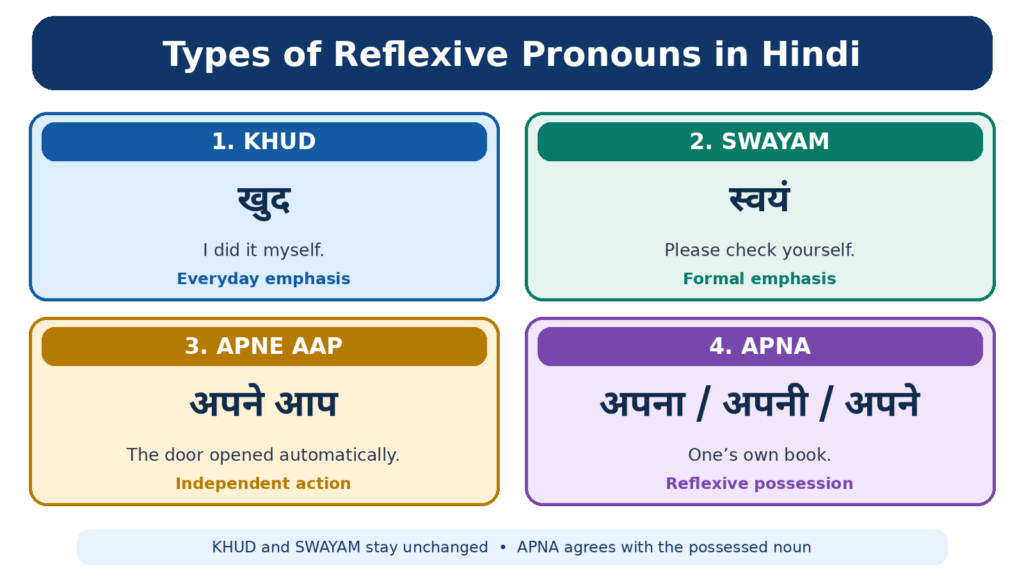
    Main Forms and Types of Reflexive Pronouns in Hindi

    Hindi reflexive expressions are usually studied through खुद, स्वयं, अपने आप, and the reflexive possessive अपना.

    These are forms with different uses, not four separate person-based grammatical types.

    Reflexive FormEnglish MeaningMain UseExample
    खुदSelf / PersonallyEveryday emphasis or self-referenceमैं खुद जाऊँगा।
    स्वयंOneself / PersonallyFormal emphasisआप स्वयं देखिए।
    अपने आपBy oneself / On one’s ownIndependent or spontaneous actionदरवाज़ा अपने आप खुल गया।
    अपना / अपनी / अपनेOne’s ownReflexive possessionउसने अपनी किताब उठाई।

    1. Khud (खुद) — Everyday Reflexive Form

    खुद is a common expression meaning self, personally, or oneself.

    It can be used with मैं, तुम, आप, वह, and हम without changing its spelling.

    Example: मैं यह काम खुद करूँगा।

    English: I will do this work myself.

    2. Swayam (स्वयं) — Formal Reflexive Form

    स्वयं expresses self-reference or personal involvement in a more formal or literary style.

    It is frequently found in instructions, speeches, formal writing, and educational texts.

    Example: आप स्वयं उत्तर जाँच सकते हैं।

    English: You can check the answer yourself.

    3. Apne Aap (अपने आप) — Independent Action

    अपने आप often means by oneself, on one’s own, or automatically, depending on context.

    With the object marker को, अपने आप को can also refer directly back to the subject.

    Example: बच्चा अपने आप चलने लगा।

    English: The child started walking on their own.

    4. Apna, Apni, Apne (अपना / अपनी / अपने) — Reflexive Possessive

    These forms express something associated with the subject, usually meaning one’s own.

    Unlike खुद and स्वयं, their endings change according to the gender, number, and grammatical case of the possessed noun.

    Examples:

    • अपना घर — One’s own house
    • अपनी किताब — One’s own book
    • अपने दोस्त — One’s own friends

    Reflexive Pronoun Grammar Rules in Hindi

    Reflexive expressions may emphasize the subject, function as an object referring back to it, or indicate ownership.

    The correct form depends on the role of the expression and the structure of the sentence.

    Rule 1: Reflexive Expressions Refer Back to the Subject

    A reflexive expression can indicate that the subject acts on itself.

    Example: मैंने अपने आप को शीशे में देखा।

    English: I saw myself in the mirror.

    Here, अपने आप को refers back to मैं.

    Rule 2: Khud and Swayam Do Not Change with Person or Gender

    The forms खुद and स्वयं normally remain unchanged regardless of who performs the action.

    SubjectExampleEnglish
    मैंमैं खुद करूँगा।I will do it myself.
    तुमतुम खुद करो।Do it yourself.
    आपआप स्वयं देखिए।See it yourself.
    वहवह खुद करेगी।She will do it herself.
    हमहम स्वयं करेंगे।We will do it ourselves.
    वेवे खुद करेंगे।They will do it themselves.

    The verb may change with person, gender, and number, but the reflexive expression remains the same.

    Rule 3: Apna Changes According to the Possessed Noun

    अपना, अपनी, and अपने generally agree with the noun describing the possession.

    Reflexive PossessiveExampleEnglish
    अपनाअपना कमराOne’s own room
    अपनीअपनी कुर्सीOne’s own chair
    अपनेअपने कपड़ेOne’s own clothes
    अपनीअपनी किताबेंOne’s own books
    अपनेअपने कमरे मेंIn one’s own room

    अपनी किताब remains feminine whether its owner is male or female.

    Rule 4: Use Apne Aap Ko for Direct Self-Reference

    When a person performs an action on themselves, अपने आप को or खुद को can express the reflexive object.

    Example: उसने खुद को संभाला।

    English: He or she composed themselves.

    Example: मैंने अपने आप को समझाया।

    English: I explained it to myself.

    Rule 5: Apne Aap Can Indicate an Action Without Help

    अपने आप often emphasizes that an action occurs independently.

    Example: वह अपने आप घर पहुँच गया।

    English: He reached home on his own.

    It can also describe an event happening automatically.

    Example: दरवाज़ा अपने आप बंद हो गया।

    English: The door closed automatically.

    Rule 6: Reflexive and Emphatic Uses Are Not Identical

    An actual reflexive object receives the action of its own subject.

    An emphatic expression simply stresses that the subject personally performed an action.

    FunctionHindi ExampleEnglish
    Reflexive objectउसने खुद को देखा।He saw himself.
    Emphasisउसने खुद देखा।He saw it himself.
    Independent actionउसने अपने आप सीखा।He learned on his own.
    Reflexive possessionउसने अपनी किताब उठाई।He picked up his own book.

    Rule 7: Reflexive Possession Depends on the Antecedent

    अपना often refers back to the subject, while उसका generally refers to another person or entity in the relevant context.

    Example: रवि ने अपनी किताब उठाई।

    English: Ravi picked up his own book.

    Example: रवि ने उसकी किताब उठाई।

    English: Ravi picked up his or her book, referring to someone else in the normal reading.

    Rule 8: Reflexive Expressions Work with Different Tenses

    Reflexive expressions can appear with past, present, or future actions.

    TenseHindi SentenceEnglish
    Presentमैं खुद करता हूँ।I do it myself.
    Pastमैंने खुद किया।I did it myself.
    Futureमैं खुद करूँगा।I will do it myself.
    Present continuousवह स्वयं पढ़ रही है।She is studying herself.
    Imperativeआप स्वयं जाँचिए।Please check it yourself.

    Reflexive Pronoun in Hindi Examples

    Reflexive expressions can be used with different subjects, objects, postpositions, and possessive constructions.

    The following groups illustrate their common forms and everyday meanings.

    Khud and Swayam Reflexive Pronoun Examples

    खुद is widely used in conversation, while स्वयं is common in formal or emphatic expression.

    Both can refer to personal involvement without changing according to grammatical person.

    No.Hindi ExpressionEnglish Meaning
    1मैं खुदI myself
    2तुम खुदYou yourself
    3आप खुदYou yourself, polite
    4वह खुदHe or she personally
    5हम खुदWe ourselves
    6वे खुदThey themselves
    7खुद कोOneself, object
    8खुद सेBy oneself / With oneself
    9खुद के लिएFor oneself
    10खुद परOn oneself
    11खुद हीPersonally / Without help
    12खुद काOne’s own, masculine
    13खुद कीOne’s own, feminine
    14खुद केOne’s own, plural or oblique
    15खुद करनाTo do personally
    16मैं स्वयंI myself
    17हम स्वयंWe ourselves
    18आप स्वयंYou yourself
    19वह स्वयंHe or she personally
    20वे स्वयंThey themselves
    21स्वयं कोOneself, object
    22स्वयं सेWith oneself
    23स्वयं के लिएFor oneself
    24स्वयं परOn oneself
    25स्वयं हीPersonally, emphatic
    26स्वयं काOne’s own, masculine
    27स्वयं कीOne’s own, feminine
    28स्वयं केOne’s own, plural or oblique
    29स्वयं करनाTo do oneself
    30स्वयं निर्णय लेनाTo decide personally

    Apne Aap Reflexive Pronoun Examples

    अपने आप often expresses independence, spontaneous action, or self-directed activity.

    Its interpretation depends on the verb and surrounding sentence.

    No.Hindi ExpressionEnglish Meaning
    1अपने आपBy oneself
    2अपने आप कोOneself, object
    3अपने आप सेWith oneself / By oneself
    4अपने आप परOn oneself
    5अपने आप हीAutomatically / On its own
    6अपने आप मेंIn itself
    7अपने आप के लिएFor oneself
    8अपने आप करनाTo do independently
    9अपने आप सीखनाTo learn independently
    10अपने आप चलनाTo walk on one’s own
    11अपने आप उठनाTo get up independently
    12अपने आप बैठनाTo sit independently
    13अपने आप पढ़नाTo study independently
    14अपने आप लिखनाTo write independently
    15अपने आप समझनाTo understand independently
    16अपने आप बननाTo form on its own
    17अपने आप खुलनाTo open automatically
    18अपने आप बंद होनाTo close automatically
    19अपने आप ठीक होनाTo get better on its own
    20अपने आप काम करनाTo work automatically
    21अपने आप बोलनाTo speak on one’s own
    22अपने आप सोचनाTo think independently
    23अपने आप निर्णय लेनाTo decide independently
    24अपने आप तैयार होनाTo get ready independently
    25अपने आप संभलनाTo regain control by oneself
    26अपने आप लौटनाTo return independently
    27अपने आप जानाTo go alone
    28अपने आप आनाTo come independently
    29अपने आप पूरा होनाTo be completed automatically
    30अपने आप बदलनाTo change on its own

    Apna, Apni and Apne Reflexive Possessive Examples

    The reflexive possessives अपना, अपनी, and अपने express relationships involving the subject.

    Their endings follow the grammatical gender, number, and case of the noun being modified.

    No.Hindi ExpressionEnglish Meaning
    1अपना घरOne’s own house
    2अपना कमराOne’s own room
    3अपना बैगOne’s own bag
    4अपना कामOne’s own work
    5अपना नामOne’s own name
    6अपना निर्णयOne’s own decision
    7अपना रास्ताOne’s own path
    8अपना समयOne’s own time
    9अपना लक्ष्यOne’s own goal
    10अपना परिवारOne’s own family
    11अपनी किताबOne’s own book
    12अपनी कॉपीOne’s own notebook
    13अपनी कुर्सीOne’s own chair
    14अपनी चाबीOne’s own key
    15अपनी गलतीOne’s own mistake
    16अपनी भाषाOne’s own language
    17अपनी ज़िम्मेदारीOne’s own responsibility
    18अपनी रायOne’s own opinion
    19अपनी योजनाOne’s own plan
    20अपनी पहचानOne’s own identity
    21अपने दोस्तOne’s own friends
    22अपने कपड़ेOne’s own clothes
    23अपने माता-पिताOne’s own parents
    24अपने विचारOne’s own thoughts
    25अपने अधिकारOne’s own rights
    26अपने शिक्षकOne’s own teachers
    27अपने सवालOne’s own questions
    28अपने कमरे मेंIn one’s own room
    29अपने घर सेFrom one’s own home
    30अपने काम परAt one’s own work

    Reflexive Pronoun in Hindi Examples in Sentences

    These examples show how reflexive expressions work in different situations, including independent actions, personal emphasis, and possession.

    The relevant Hindi reflexive expressions and English equivalents are bolded for easier identification.

    No.Hindi SentenceEnglish Translation
    1मैंने यह काम खुद किया।I did this work myself.
    2तुम खुद उत्तर लिखो।Write the answer yourself.
    3आप स्वयं निर्णय लीजिए।Make the decision yourself.
    4वह खुद बाज़ार गया।He went to the market himself.
    5हमने खाना खुद बनाया।We cooked the food ourselves.
    6वे स्वयं यहाँ आए।They came here themselves.
    7मैं खुद को जानता हूँ।I know myself.
    8उसने खुद को संभाला।She composed herself.
    9बच्चा अपने आप चलने लगा।The child started walking on their own.
    10दरवाज़ा अपने आप खुल गया।The door opened automatically.
    11मैंने अपने आप को शीशे में देखा।I saw myself in the mirror.
    12आप स्वयं उत्तर जाँच सकते हैं।You can check the answer yourself.
    13उसने अपना कमरा साफ़ किया।He cleaned his own room.
    14सीमा ने अपनी किताब उठाई।Seema picked up her own book.
    15बच्चों ने अपने खिलौने रख दिए।The children put away their own toys.
    16मैं अपने घर जा रहा हूँ।I am going to my own home.
    17वह अपनी गलती मान गई।She admitted her own mistake.
    18हमें अपने विचार बताने चाहिए।We should express our own ideas.
    19उसने खुद ही समस्या हल की।He solved the problem himself.
    20मशीन अपने आप बंद हो गई।The machine switched off automatically.
    21मैंने स्वयं यह पत्र लिखा।I wrote this letter myself.
    22वह अपने आप पढ़ना सीख गया।He learned to read on his own.
    23तुम अपने आप से यह प्रश्न पूछो।Ask yourself this question.
    24उन्होंने खुद नियम समझाए।They explained the rules themselves.
    25वह अपने काम पर ध्यान देता है।He focuses on his own work.
    26आप अपनी राय दीजिए।Please give your own opinion.
    27हमने अपनी योजना बदली।We changed our own plan.
    28वह खुद को दोष दे रहा था।He was blaming himself.
    29मैं अपने आप वहाँ पहुँचा।I reached there on my own.
    30शिक्षक ने स्वयं उदाहरण दिया।The teacher gave the example personally.
    31बच्चों ने खुद चित्र बनाए।The children drew the pictures themselves.
    32राधा ने अपने लिए समय निकाला।Radha made time for herself.
    33यह घड़ी अपने आप चलती है।This clock runs automatically.
    34उसने अपना वादा निभाया।She kept her own promise.
    35मैं खुद वहाँ मौजूद था।I was there myself.
    36वे अपनी तैयारी खुद करते हैं।They prepare by themselves.
    37उसने अपने आप को समझाया।She reassured herself.
    38आप स्वयं परिणाम देख सकते हैं।You can see the result yourself.
    39हमें अपनी ज़िम्मेदारी समझनी चाहिए।We should understand our own responsibility.
    40समस्या अपने आप ठीक नहीं होगी।The problem will not resolve on its own.

    Reflexive vs Emphatic Pronouns in Hindi

    Hindi uses similar forms for genuine reflexive reference and for emphasis.

    The distinction depends on whether the expression receives the action or simply stresses who performed it.

    FeatureReflexive UseEmphatic Use
    FunctionRefers back to the subject as an objectEmphasizes the person performing the action
    Typical formखुद को / अपने आप कोखुद / स्वयं
    Exampleमैंने खुद को देखा।मैंने खुद देखा।
    EnglishI saw myself.I saw it myself.

    Reflexive Possessive vs Ordinary Possessive

    Compare अपना and उसका in the same grammatical context.

    SentenceMeaning
    रवि ने अपनी किताब उठाई।Ravi picked up his own book.
    रवि ने उसकी किताब उठाई।Ravi picked up someone else’s book, in the usual reading.

    Common Mistakes with Reflexive Pronouns

    Most errors involve choosing an ordinary object pronoun instead of a reflexive expression or using the wrong possessive form.

    This table shows common mistakes and their corrections.

    Common MistakeIncorrectCorrect / Explanation
    Using an ordinary object form for self-referenceमैंने मुझे देखा।मैंने खुद को देखा।
    Incorrect agreement with a feminine nounसीमा ने अपना किताब उठाई।सीमा ने अपनी किताब उठाई।
    Confusing self-reference with independent actionवह खुद को स्कूल गया।वह अपने आप स्कूल गया।
    Using खुद as a possessive without the proper formयह खुद किताब है।यह उसकी अपनी किताब है।
    Using a masculine possessive with a feminine nounउसने अपना चाबी ली।उसने अपनी चाबी ली।
    Incorrect plural agreementवे अपना कपड़े लाए।वे अपने कपड़े लाए।
    Treating स्वयं as only first personAssuming स्वयं means only myselfस्वयं can refer to different persons, depending on context.
    Confusing emphasis with a reflexive objectAssuming मैं खुद गया means I went to myselfIt means I went myself.

    Reflexive Pronouns in Hindi Worksheet

    Practice choosing खुद, स्वयं, अपने आप, and अपना/अपनी/अपने in different sentence patterns.

    The exercises cover self-reference, independent actions, correct possessive agreement, and the difference between reflexive and emphatic uses.

    Download Reflexive Pronouns Worksheet with Answers PDF

    Use the printable worksheet to practice identifying reflexive expressions, completing Hindi sentences, and selecting the correct possessive forms.

    The PDF includes an answer key for independent checking and revision.

    Download Reflexive Pronouns in Hindi Study Notes PDF

    Review the main reflexive expressions, their English meanings, important grammar rules, and examples in a single document.

    These notes are designed for offline reading, classroom revision, and quick reference.

    Frequently Asked Questions

    Is खुद a reflexive pronoun or an emphatic word?

    खुद can serve a reflexive function in expressions such as खुद को, or emphasize the subject in sentences such as मैं खुद गया. Its function depends on the construction.

    Is स्वयं more formal than खुद?

    Yes. स्वयं is generally associated with more formal or literary Hindi, while खुद is common in everyday conversation.

    Does अपने आप always mean by oneself?

    No. It can mean independently, on one’s own, or automatically, depending on the verb and context.

    Why do अपना, अपनी, and अपने change?

    They agree with the gender, number, and grammatical case of the noun they modify rather than simply matching the gender of the owner.

    Lets Practice!

    Think of a familiar task such as preparing a meal, writing an answer, or organizing your room. You can say मैंने खुद किया to emphasize your involvement, or मैंने अपने आप किया to show that you worked independently.

    Try writing three new sentences: one using स्वयं, one using अपने आप, and one using अपनी.

    Check whether each expression matches its intended meaning, then share your sentences in the comments.

  • Pronoun in Hindi Grammar with Types and Examples

    The teacher writes “राहुल विद्यालय जाता है। राहुल किताब पढ़ता है। राहुल मेहनत करता है।” on the classroom board. A student notices that Rahul’s name appears three times. He changes the second and third sentences to “वह किताब पढ़ता है। वह मेहनत करता है।” Suddenly, the writing sounds much more natural.

    The word वह (he) replaces the repeated name. In Hindi grammar, such words are called pronouns (सर्वनाम). They help us refer to people, objects, and ideas without repeating the same nouns. Other familiar examples include मैं (I), तुम (you), कोई (someone), and कौन (who).

    But Hindi pronouns do more than replace names. तू, तुम, and आप express different levels of familiarity and respect, while यह and वह indicate proximity. Some pronouns ask questions, others connect ideas, and a few refer back to the subject itself. Understanding these differences makes everyday Hindi easier to read, speak, and write.

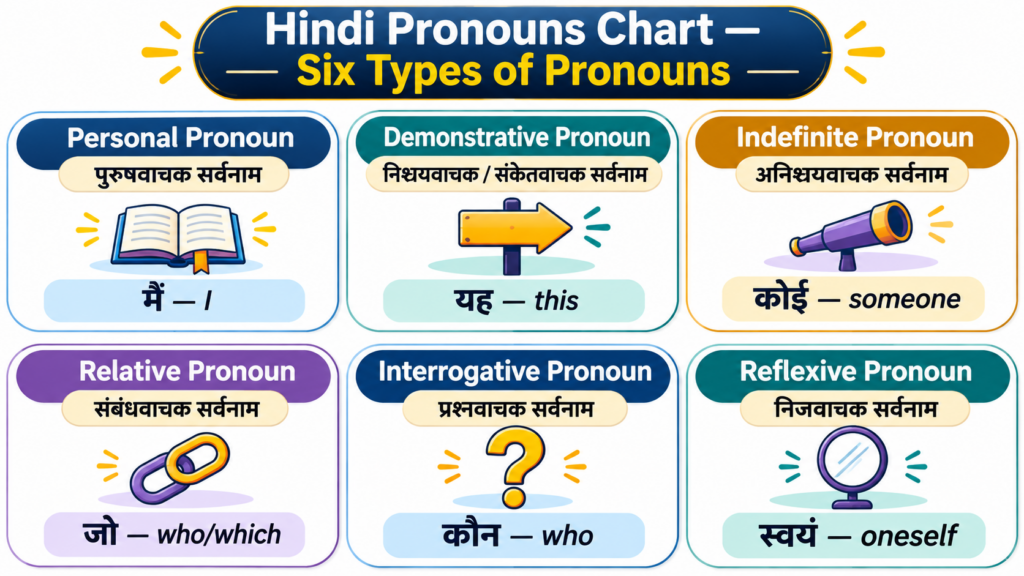
    How Many Types Of Pronoun In Hindi

    Lets explore the types of pronoun in Hindi with examples. A commonly taught school-level classification identifies six types of pronouns.

    Types Of Pronoun In Hindi

    These categories describe personal reference, indication, indefinite reference, relationships, questions, and self-reference. Some words can belong to different categories depending on their use.

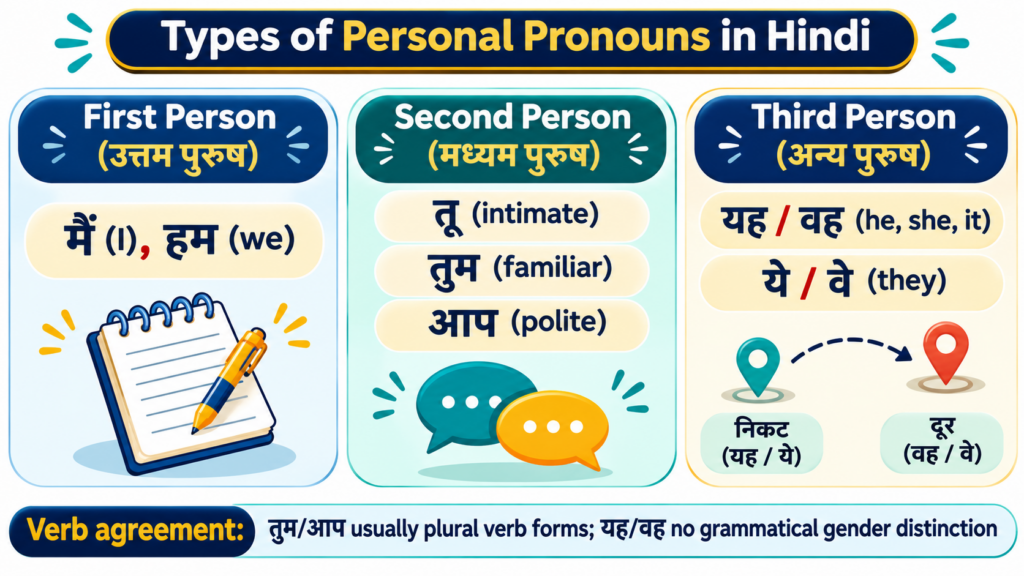
    1. Personal Pronoun (पुरुषवाचक सर्वनाम)

    Personal pronouns refer to the speaker, the listener, or someone being discussed.

    Examples: मैं (I), हम (we), तुम (you), आप (you), वह (he/she).

    2. Demonstrative Pronoun (निश्चयवाचक सर्वनाम)

    Demonstrative pronouns point to particular people or things, often indicating whether they are nearby or farther away.

    Examples: यह (this), वह (that), ये (these), वे (those).

    3. Indefinite Pronoun (अनिश्चयवाचक सर्वनाम)

    Indefinite pronouns refer to people or things without identifying them precisely.

    Examples: कोई (someone), कुछ (something), किसी (someone, in an oblique form).

    4. Relative Pronoun (संबंधवाचक सर्वनाम)

    Relative pronouns introduce clauses that identify or provide information about someone or something.

    Examples: जो (who/which/that), जिसने (who did), जिसका (whose).

    5. Interrogative Pronoun (प्रश्नवाचक सर्वनाम)

    Interrogative pronouns are used to ask about people, things, identity, or ownership.

    Examples: कौन (who), क्या (what), किसने (who did), किसका (whose).

    6. Reflexive Pronoun (निजवाचक सर्वनाम)

    Reflexive expressions refer back to the subject or emphasize that someone performed an action personally.

    Examples: स्वयं (oneself), खुद (self), अपने आप (by oneself).

    Important: Hindi grammar books sometimes use different labels or subdivisions.

    The six types above provide a useful learning framework, but some classifications also discuss reciprocal and other pronominal forms separately.

    Pronoun in Hindi Grammar Rules

    Hindi pronouns change according to grammatical person, number, respect, and sentence structure.

    Their object, possessive, and postpositional forms are especially important for correct communication.

    Rule 1: A Pronoun Refers to or Replaces a Noun

    Pronouns help avoid unnecessary repetition.

    Without pronoun: सीमा आई। सीमा बैठ गई।

    With pronoun: सीमा आई। वह बैठ गई।

    English: Seema arrived. She sat down.

    Rule 2: Personal Pronouns Have Three Persons

    PersonHindi PronounsEnglish
    First Personमैं, हमI, We
    Second Personतू, तुम, आपYou
    Third Personयह, वह, ये, वेHe, She, It, They

    First person refers to the speaker. Second person refers to the listener, and third person refers to someone or something else.

    Rule 3: Formality Changes Second-Person Verb Agreement

    Hindi uses different pronouns and verb forms according to familiarity and respect.

    PronounUsageExample
    तूVery intimateतू कहाँ है?
    तुमFamiliarतुम कहाँ हो?
    आपPolite / Respectfulआप कहाँ हैं?

    Use आप when speaking politely to an unfamiliar person or someone you wish to address respectfully.

    Rule 4: Hindi Third-Person Pronouns Do Not Separately Mark He and She

    The forms यह and वह do not themselves distinguish masculine and feminine gender.

    The verb and context often clarify the intended meaning.

    Hindi SentenceEnglish Translation
    वह जा रहा है।He is going.
    वह जा रही है।She is going.
    यह पढ़ रहा है।He is reading.
    यह पढ़ रही है।She is reading.

    Rule 5: Pronouns Change Before Postpositions

    Pronouns frequently take oblique forms with expressions such as को, से, में, पर, and के लिए.

    Direct FormCommon Modified FormExample
    मैंमुझे / मुझसेमुझसे पूछो।
    हमहमें / हमसेहमें बताओ।
    तुमतुम्हें / तुमसेतुमसे मिलकर खुशी हुई।
    आपआपको / आपसेआपको क्या चाहिए?
    यहइसे / इससेइसे रख दो।
    वहउसे / उससेउसे बुलाओ।
    येइन्हें / इनसेइन्हें देखो।
    वेउन्हें / उनसेउनसे बात करो।

    Rule 6: Pronouns Have Related Possessive Forms

    Possessive forms express ownership, association, or a relationship.

    PronounPossessive FormEnglish
    मैंमेरा / मेरी / मेरेMy / Mine
    हमहमारा / हमारी / हमारेOur / Ours
    तुमतुम्हारा / तुम्हारी / तुम्हारेYour
    आपआपका / आपकी / आपकेYour
    यहइसका / इसकी / इसकेThis person’s / Its
    वहउसका / उसकी / उसकेHis / Her / Its
    वेउनका / उनकी / उनकेTheir

    Example: यह मेरी किताब है। (This is my book.)

    Rule 7: Relative Pronouns Often Form Correlative Pairs

    Hindi commonly connects relative and main clauses using pairs such as जो–वह, जिसका–उसका, and जैसा–वैसा.

    Example: जो मेहनत करेगा, वह सफल होगा।

    English: Whoever works hard will succeed.

    Rule 8: Reflexive Expressions Refer Back to the Subject

    Use खुद, स्वयं, or अपने आप when the subject performs an action personally or without help.

    Example: मैंने यह काम स्वयं किया।

    English: I did this work myself.

    Rule 9: Pronouns Can Appear with the Ergative Marker ने

    Many perfective transitive sentences use ने with the agent.

    PronounForm with ने
    मैंमैंने
    हमहमने
    तुमतुमने
    आपआपने
    यहइसने
    वहउसने
    वेउन्होंने

    Example: उसने पत्र लिखा। (He or she wrote a letter.)

    Not every past-tense sentence requires ने. Its use depends on the verb and grammatical construction.

    Pronoun in Hindi Examples with Pictures

    Pictures can help learners connect pronouns with pointing, questioning, relationships, and self-reference.

    For instance, यह may identify a nearby book, while कौन asks about an unknown person. A pronoun’s exact meaning still depends on context.

    Pronoun in Hindi Examples with Pictures

    Hindi Pronouns Examples by Type

    The following tables provide practical Hindi pronoun forms and phrases with English meanings.

    They include subject forms, object forms, possessives, relative constructions, and self-reference expressions.

    Personal Pronoun Examples in Hindi

    Personal pronouns include first-, second-, and third-person forms.

    Their endings and associated words change according to grammatical function.

    No.Hindi Form or PhraseEnglish Meaning
    1मैंI
    2हमWe
    3तूYou, intimate
    4तुमYou, familiar
    5आपYou, polite
    6यहThis / He / She
    7वहThat / He / She
    8येThese / They
    9वेThose / They
    10मुझेMe / To me
    11हमेंUs / To us
    12तुझेYou, intimate object
    13तुम्हेंYou, familiar object
    14आपकोYou, polite object
    15इसेThis person or thing, object
    16उसेThat person or thing, object
    17इन्हेंThese / Them, object
    18उन्हेंThose / Them, object
    19मैंनेI, with ergative marker
    20हमनेWe, with ergative marker
    21तूनेYou, intimate ergative
    22तुमनेYou, familiar ergative
    23आपनेYou, polite ergative
    24इसनेThis person, ergative
    25उसनेThat person, ergative
    26इन्होंनेThese people / Honorific person, ergative
    27उन्होंनेThose people / Honorific person, ergative
    28मुझसेFrom / With me
    29तुमसेFrom / With you
    30आपसेFrom / With you, polite

    Demonstrative Pronoun Examples in Hindi

    Demonstrative pronouns point towards particular people or things.

    Their meanings may involve distance, number, grammatical case, or context.

    No.Hindi Form or PhraseEnglish Meaning
    1यहThis
    2येThese
    3वहThat
    4वेThose
    5इसेThis one, object
    6उसेThat one, object
    7इन्हेंThese ones, object
    8उन्हेंThose ones, object
    9इसकाOf this one
    10उसकाOf that one
    11इनकाOf these
    12उनकाOf those
    13इसमेंIn this
    14उसमेंIn that
    15इनमेंIn these
    16उनमेंIn those
    17इससेFrom / With this
    18उससेFrom / With that
    19इनसेFrom / With these
    20उनसेFrom / With those
    21इस परOn this
    22उस परOn that
    23इन परOn these
    24उन परOn those
    25इसी कोThis very one
    26उसी कोThat very one
    27यही हैThis is the one
    28वही हैThat is the one
    29ये दोनोंThese two
    30वे सभीAll those

    Indefinite Pronoun Examples in Hindi

    Indefinite pronouns refer to people or things whose identity or number is not precisely specified.

    Some forms change depending on the sentence and the postposition used.

    No.Hindi Form or PhraseEnglish Meaning
    1कोईSomeone / Anyone
    2कुछSomething / Some
    3किसी नेSomeone, as agent
    4किसी कोTo someone
    5किसी सेFrom / With someone
    6किसी काSomeone’s
    7किसी के लिएFor someone
    8कोई भीAnyone / Any one
    9कुछ भीAnything
    10कोई नहींNobody
    11कुछ नहींNothing
    12कोई औरSomeone else
    13कुछ औरSomething else
    14हर कोईEveryone
    15हर किसी कोTo everyone
    16सब कोईEverybody
    17सब कुछEverything
    18कुछ लोगSome people
    19कई लोगSeveral people
    20कोई एकAny one person
    21दूसरा कोईSomeone else
    22कुछ न कुछSomething or other
    23कोई न कोईSomeone or other
    24किसी भी व्यक्ति कोTo any person
    25किसी और कोTo someone else
    26कुछ में सेFrom among some
    27सबमें सेFrom among all
    28कुछ के लिएFor some
    29किसी के पासWith someone / Someone has
    30और कोई नहींNobody else

    Some rows contain indefinite pronouns within larger phrases rather than being standalone pronouns. For example, कई functions as a quantifier in कई लोग.

    Relative Pronoun Examples in Hindi

    Relative pronouns connect information about a person or thing with another part of the sentence.

    Hindi frequently uses जो and its forms in relative constructions.

    No.Hindi Form or PhraseEnglish Meaning
    1जोWho / Which / That
    2जिसनेWho did
    3जिसकोWhom / To whom
    4जिसेWhom / Which
    5जिससेFrom / With whom
    6जिसकाWhose, masculine possessum
    7जिसकीWhose, feminine possessum
    8जिसकेWhose, plural/oblique possessum
    9जिसमेंIn which
    10जिस परOn which
    11जिसके लिएFor whom / For which
    12जिसके पासWith whom / Who has
    13जिन्होंनेWho did, plural/honorific
    14जिन्हेंWhom, plural/honorific
    15जिनसेFrom / With whom, plural
    16जिनकाWhose, plural owners
    17जिनकीWhose, plural owners
    18जिनकेWhose, plural owners
    19जिनमेंAmong / In which
    20जिन परOn whom / Which
    21जो भीWhoever / Whichever
    22जिसे भीWhomever
    23जिसने भीWhoever did
    24जिसका भीWhosever
    25जिन्हें भीWhomever, plural
    26जिसके साथWith whom
    27जिसके बिनाWithout whom / Which
    28जिनके साथWith whom, plural
    29जिनके बीचAmong whom / Which
    30जो कुछWhatever

    Interrogative Pronoun Examples in Hindi

    Interrogative pronouns ask about identity, people, objects, or ownership.

    Forms such as कौन, क्या, किसने, and किसका help learners frame questions.

    No.Hindi Form or PhraseEnglish Meaning
    1कौनWho
    2क्याWhat
    3किसनेWho did
    4किसकोWhom / To whom
    5किसेWhom
    6किससेFrom / With whom
    7किसकाWhose, masculine
    8किसकीWhose, feminine
    9किसकेWhose, plural/oblique
    10किसमेंIn what / In which
    11किस परOn what / On whom
    12किसके लिएFor whom
    13किसके पासWho has / With whom
    14किन्होंनेWhich people did
    15किन्हेंWhom, plural
    16किनसेFrom / With whom, plural
    17किनकाWhose, plural
    18किनकीWhose, plural
    19किनकेWhose, plural
    20किनमेंIn which ones
    21किन परOn which ones
    22कौन-कौनWho all
    23क्या-क्याWhat all
    24किस-किस नेWhich people did
    25किस-किस कोTo which people
    26किस-किस सेFrom / With which people
    27किसका भीWhose at all
    28कौन-साWhich one, masculine
    29कौन-सीWhich one, feminine
    30कौन-सेWhich ones / Which one, oblique

    Forms such as कौन-सा can function as interrogative determiners before nouns or pronominally when the noun is understood.

    Reflexive Pronoun Examples in Hindi

    Reflexive expressions show that the subject refers to itself or performs an action independently.

    Hindi uses खुद, स्वयं, अपने आप, and related expressions in this role.

    No.Hindi ExpressionEnglish Meaning
    1खुदSelf / Personally
    2स्वयंOneself
    3अपने आपBy oneself
    4अपने आप कोOneself, object
    5खुद कोOneself, object
    6स्वयं कोOneself, object
    7खुद सेBy oneself / From oneself
    8अपने आप सेWith oneself / By oneself
    9स्वयं सेWith oneself
    10मैं खुदI myself
    11हम खुदWe ourselves
    12तू खुदYou yourself, intimate
    13तुम खुदYou yourself, familiar
    14आप स्वयंYou yourself, polite
    15वह खुदHe / She himself/herself
    16वे स्वयंThey themselves
    17यह खुदThis person himself/herself
    18ये खुदThese people themselves
    19खुद हीPersonally / On one’s own
    20स्वयं हीOneself, emphatic
    21अपने आप हीBy itself / Automatically
    22खुद के लिएFor oneself
    23अपने लिएFor oneself
    24खुद परOn oneself
    25अपने आप परOn oneself
    26खुद की मददHelping oneself
    27स्वयं की पहचानOne’s own identity
    28खुद का कामOne’s own work
    29अपना निर्णयOne’s own decision
    30अपनी ज़िम्मेदारीOne’s own responsibility

    अपना, अपनी, and अपने are reflexive possessive forms. They are related to self-reference but are not interchangeable with independent expressions such as स्वयं.

    Pronoun in Hindi Sentences with English Meaning

    Pronouns make Hindi sentences clearer by replacing repeated nouns and identifying people, objects, or ideas.

    The following sentences cover all six pronoun types, with pronouns highlighted in bold and English translations for easy understanding.

    No.Hindi SentenceEnglish Translation
    1मैं आज विद्यालय जा रहा हूँ।I am going to school today.
    2हम साथ पढ़ते हैं।We study together.
    3तुम कहाँ रहते हो?Where do you live?
    4आप कैसे हैं?How are you?
    5वह किताब पढ़ रही है।She is reading a book.
    6यह मेरा बैग है।This is my bag.
    7ये मेरी किताबें हैं।These are my books.
    8वे मैदान में खेल रहे हैं।They are playing in the field.
    9मुझे मदद चाहिए।I need help.
    10हमें समय चाहिए।We need time.
    11आपको क्या पसंद है?What do you like?
    12उसे घर जाना है।He or she needs to go home.
    13इन्हें अंदर रख दो।Put these inside.
    14उनसे बात करो।Talk to them.
    15यह बहुत उपयोगी है।This is very useful.
    16वह मेरा नहीं है।That is not mine.
    17ये नए हैं।These are new.
    18वे पुराने हैं।Those are old.
    19कोई दरवाज़े पर है।Someone is at the door.
    20कुछ मेज़ पर रखा है।Something is on the table.
    21किसी ने घंटी बजाई।Someone rang the bell.
    22यहाँ कोई नहीं है।There is nobody here.
    23सब कुछ ठीक है।Everything is fine.
    24कोई भी आ सकता है।Anyone can come.
    25जो मेहनत करेगा, वह सफल होगा।Whoever works hard will succeed.
    26जिसने यह लिखा, वह अच्छा लेखक है।Whoever wrote this is a good writer.
    27जिसका बैग खो गया है, वह यहाँ आए।Whoever lost their bag should come here.
    28जिसे मदद चाहिए, वह पूछ सकता है।Whoever needs help may ask.
    29जो तुमने कहा, वह सही है।What you said is correct.
    30जो कुछ चाहिए, बता दो।Tell me whatever you need.
    31कौन आया है?Who has come?
    32क्या हुआ?What happened?
    33किसने किताब उठाई?Who picked up the book?
    34किसकी चाबी यहाँ है?Whose key is here?
    35कौन-सा तुम्हारा है?Which one is yours?
    36मैंने यह काम स्वयं किया।I did this work myself.
    37उसने खुद को संभाला।He or she composed themselves.
    38बच्चा अपने आप चलने लगा।The child started walking on their own.
    39हमें अपना काम खुद करना चाहिए।We should do our own work ourselves.
    40आप स्वयं निर्णय ले सकते हैं।You can make the decision yourself.

    Grammar Tip: Some Hindi pronouns change their form according to their grammatical role.

    For example, मैं becomes मुझे in certain object constructions, while वह changes to उसे, उसने, or उससे depending on the sentence.

    Common Mistakes with Pronouns in Hindi

    Hindi pronoun mistakes often involve formality, oblique forms, gender agreement, and confusion between demonstrative and interrogative expressions.

    The following table compares common errors with corrected usage.

    Common MistakeIncorrectCorrect / Explanation
    Using intimate address in a formal settingतू कहाँ है?Prefer आप कहाँ हैं? when respectful address is appropriate.
    Incorrect agreement with आपआप आता है।आप आते हैं।
    Incorrect familiar verb endingतुम जाते हैं।तुम जाते हो। in ordinary familiar usage.
    Mixing first-person verb endingsमैं पढ़ता है।मैं पढ़ता हूँ।
    Using an incorrect object formमैंको बुलाओ।मुझे बुलाओ।
    Incorrect oblique constructionवह से बात करो।उससे बात करो।
    Wrong plural object formवे को बुलाओ।उन्हें बुलाओ।
    Treating वह as always masculineवह means only he.It can refer to he, she, it, or that, depending on context.
    Confusing possession with object formsउसे किताब for his bookउसकी किताब
    Confusing pronoun with question adverbCalling कहाँ an interrogative pronoun in every sentenceकहाँ typically functions as an interrogative adverb; कौन and क्या are common interrogative pronouns.

    Pronoun in Hindi Worksheet

    Practice recognizing all six pronoun types, choosing correct Hindi forms, completing sentences, and identifying pronouns by meaning.

    This Hindi pronouns worksheet also covers formality, possession, and object forms through interactive exercises.

    Download Pronoun in Hindi Worksheet PDF

    Use the printable worksheet to revise personal, demonstrative, indefinite, relative, interrogative, and reflexive pronouns.

    It includes multiple-choice practice and an answer key to help learners check their understanding independently.

    Download Pronoun in Hindi PDF Study Notes

    Keep the six pronoun types, important grammar rules, Hindi meanings, and example sentences together in one reference document.

    The notes are designed for offline revision, classroom use, and quick review before grammar exercises.

    Frequently Asked Questions

    Can the same Hindi pronoun belong to two types?

    Yes. यह and वह can function as personal or demonstrative pronouns depending on how they are used.

    Does Hindi have separate pronouns for he and she?

    Not in the same way as English. वह can refer to either, while verb agreement and context often indicate gender.

    Is अपना a personal pronoun?

    अपना is generally a reflexive possessive form. It refers back to an appropriate subject or antecedent and changes according to the noun it modifies.

    Can आप refer to more than one person?

    Yes. आप can address one person respectfully or several people. It uses honorific or plural-style verb agreement.

    Conclusion

    A sentence becomes easier to follow when its pronouns are chosen carefully. मैं identifies the speaker, आप shows respectful address, कौन asks about identity, and स्वयं adds self-reference.

    For a quick challenge, write one sentence using कोई, another using जो, and a third using अपने आप.

    Then check whether each pronoun matches its intended meaning. Share your sentences in the comments.

  • Hindi Six Letter Words with Meaning and Examples

    A student writes पंखा on the classroom board. His friend writes PANKHA underneath it. Both words mean fan, but their lengths look different. The Hindi word is written with two अक्षर groups, while the Roman spelling has six English letters. The teacher smiles and asks, “So, which one is a six-letter word?”

    This small question reveals something important about hindi six letter words. In Hindi, छह अक्षर वाले शब्द are counted according to Hindi writing and pronunciation units. But when Hindi words are written using English letters, their length depends on Roman spelling.

    Words such as अवसरवादी (opportunistic) and कड़कड़ाहट (rattling sound) can be divided into six written akshar groups. Meanwhile, PANKHA, BHINDI, and KITAAB each contain six Roman letters.

    Lets learn.

    Types of Hindi Six Letter Words

    Six-letter words can be studied through Hindi अक्षर and Roman alphabet letters.

    Hindi Six Letter Words

    These are two counting methods, not two grammatical word classes.

    1. Six Akshar Hindi Words (छह अक्षर वाले शब्द)

    These words are divided into six Hindi akshar groups.

    Example: अवसरवादी (Opportunistic)

    Akshar breakdown: अ + व + स + र + वा + दी

    2. Six-Letter Romanized Hindi Words

    These are Hindi words written using exactly six letters of the Roman alphabet.

    Example: PANKHA (पंखा) — Fan

    Letter breakdown: P + A + N + K + H + A

    Difference Between Hindi Akshar and Roman Letters

    FeatureHindi AksharRoman Letters
    Writing systemDevanagariRoman alphabet
    Counting methodAkshar unitsIndividual A–Z letters
    ExampleअवसरवादीPANKHA
    Word meaningOpportunisticFan
    Count6 akshar groups6 letters

    A Hindi word may contain fewer akshar units than its Roman spelling contains letters.

    Rules for Counting 6 Letter Words in Hindi

    Hindi words are not counted in exactly the same way as English words.

    Their vowels, vowel signs, and conjunct consonants require special attention.

    Rule 1: Count Matras with Their Akshar

    Hindi vowel signs, called मात्राएँ, combine with consonants to form written syllabic units.

    For example, कि, का, कु, and की are each treated as one written akshar group.

    Rule 2: Recognize Independent Vowels

    Independent vowels such as अ, आ, इ, and उ can form their own akshar units.

    Example: अवसरवादी

    अ + व + स + र + वा + दी

    Rule 3: Handle Conjunct Consonants Carefully

    Combined consonants such as क्त, त्र, and श्र can form part of a single written akshar group.

    However, pronunciation-based syllable division can differ from a simple visual division. Longer words should be checked carefully.

    Rule 4: Count Every Roman Letter Separately

    For Romanized Hindi, count each alphabetic letter from left to right.

    Example: BAZAAR

    B + A + Z + A + A + R = 6 letters

    Rule 5: Roman Spelling Can Vary

    Hindi words do not always have one fixed informal Roman spelling.

    For example, बाज़ार may be written as bazaar or bazar. The first contains six letters, while the second contains five.

    6 Letter Words in Hindi with English Meaning

    Hindi words containing six written akshar groups are useful for advanced reading and spelling practice.

    The following examples include a variety of nouns, adjectives, and other common or literary vocabulary.

    No.Hindi WordEnglish Meaning
    1अवसरवादीOpportunistic
    2कड़कड़ाहटRattling or crackling sound
    3अमानवीयताInhumanity
    4अनुपयोगिताLack of usefulness
    5असहयोगिताNon-cooperation
    6असमझदारीLack of understanding
    7दखलअंदाजीInterference
    8बृहस्पतिवारThursday
    9महापंचायतLarge community council
    10अजीबोगरीबStrange or unusual
    11आपत्तिजनकObjectionable
    12उपसभापतिVice-chairperson
    13गलतफहमीMisunderstanding
    14व्यावहारिकताPracticality
    15महानिदेशकDirector general
    16अविश्वसनीयUnbelievable
    17अनुकरणीयExemplary
    18जनसाधारणGeneral public
    19निराशाजनकDisappointing
    20रचनात्मकताCreativity
    21अवसरवादOpportunism
    22उपयोगकर्ताUser
    23आवश्यकताएँNeeds or requirements
    24अनुभवहीनInexperienced
    25सार्वजनिकताPublic character
    26संवेदनशीलSensitive
    27सकारात्मकताPositivity
    28नकारात्मकताNegativity
    29अनुपातिकताProportionality
    30उपकारकर्ताBenefactor

    Note: This table uses written Devanagari akshar groups. In formal phonetic analysis, syllable boundaries can differ, especially when words contain consonant clusters or unstressed vowels.

    6 Letter Words in Hindi Written in Roman English

    Hindi words written in Roman letters are common in messages, online searches, and everyday informal writing.

    Each Roman spelling below contains exactly six English alphabet letters.

    No.Romanized WordHindi WordEnglish Meaning
    1PANKHAपंखाFan
    2BHINDIभिंडीOkra
    3KACHUAकछुआTurtle
    4BANDARबंदरMonkey
    5BAZAARबाज़ारMarket
    6MAKAANमकानHouse
    7DUKAANदुकानShop
    8KITAABकिताबBook
    9TALAABतालाबPond
    10BAADALबादलCloud
    11PATANGपतंगKite
    12CHAWALचावलRice
    13CHADARचादरSheet
    14CHAABIचाबीKey
    15ANGOORअंगूरGrapes
    16AMROODअमरूदGuava
    17PAPITAपपीताPapaya
    18KHABARख़बरNews
    19KAHANIकहानीStory
    20ROSHNIरोशनीLight
    21BARISHबारिशRain
    22SAMOSAसमोसाSamosa
    23JALEBIजलेबीJalebi
    24PALANGपलंगBedstead
    25PAHADIपहाड़ीHill
    26MAUSAMमौसमWeather
    27BACCHAबच्चाChild
    28PYAALAप्यालाCup
    29PAHELIपहेलीRiddle
    30THANDAठंडाCold

    Roman spelling is useful for beginners, but reading Devanagari is more reliable for learning Hindi pronunciation and spelling.

    List of All 6 Letter Words in English for Practice

    Six-letter English vocabulary helps learners recognize letter patterns and build useful everyday vocabulary.

    The following is a selection of common English words with exactly six letters, rather than an exhaustive dictionary list.

    No.English WordHindi Meaning
    1Animalजानवर
    2Bananaकेला
    3Bottleबोतल
    4Bridgeपुल
    5Cameraकैमरा
    6Candleमोमबत्ती
    7Carrotगाजर
    8Castleकिला
    9Circleवृत्त
    10Cottonकपास
    11Doctorचिकित्सक
    12Familyपरिवार
    13Fatherपिता
    14Fingerउँगली
    15Flowerफूल
    16Forestजंगल
    17Friendमित्र
    18Gardenबगीचा
    19Hammerहथौड़ा
    20Islandद्वीप
    21Jacketजैकेट
    22Kittenबिल्ली का बच्चा
    23Laptopलैपटॉप
    24Letterपत्र
    25Marketबाज़ार
    26Mirrorदर्पण
    27Motherमाँ
    28Orangeसंतरा
    29Pencilपेंसिल
    30Windowखिड़की

    Hindi Six Letter Words in Sentences

    Learning words through sentences makes spelling, pronunciation, and meaning easier to remember.

    These examples show longer Hindi vocabulary and common Romanized words in everyday contexts.

    No.Hindi SentenceEnglish Meaning
    1अवसरवादी व्यक्ति केवल अपना लाभ देखता है।An opportunistic person only looks after personal gain.
    2दरवाज़े से कड़कड़ाहट की आवाज़ आई।A rattling sound came from the door.
    3अमानवीयता का विरोध करना चाहिए।Inhumanity should be opposed.
    4इस वस्तु की अनुपयोगिता स्पष्ट है।The uselessness of this object is clear.
    5असहयोगिता से काम रुक सकता है।Non-cooperation can stop work.
    6असमझदारी से विवाद बढ़ जाता है।A lack of understanding makes disputes worse.
    7दूसरों के काम में दखलअंदाजी मत करो।Do not interfere in other people’s work.
    8बृहस्पतिवार को हमारी परीक्षा है।Our examination is on Thursday.
    9गाँव में महापंचायत हुई।A large community council meeting was held in the village.
    10उसने अजीबोगरीब कहानी सुनाई।He told an unusual story.
    11उसकी टिप्पणी आपत्तिजनक थी।His comment was objectionable.
    12उपसभापति ने बैठक शुरू की।The vice-chairperson opened the meeting.
    13गलतफहमी बातचीत से दूर हो सकती है।A misunderstanding can be resolved through conversation.
    14हमें व्यावहारिकता पर ध्यान देना चाहिए।We should pay attention to practicality.
    15महानिदेशक ने नई योजना की घोषणा की।The director general announced a new plan.
    16यह कहानी अविश्वसनीय लगती है।This story seems unbelievable.
    17उसका व्यवहार अनुकरणीय है।His behavior is exemplary.
    18यह सुविधा जनसाधारण के लिए है।This facility is for the general public.
    19परीक्षा का परिणाम निराशाजनक था।The examination result was disappointing.
    20रचनात्मकता से नए विचार मिलते हैं।Creativity brings new ideas.
    21कमरे में पंखा चल रहा है।The fan is running in the room.
    22आज भिंडी की सब्ज़ी बनी है।Okra has been cooked today.
    23कछुआ धीरे चलता है।A turtle moves slowly.
    24बाज़ार में बहुत भीड़ है।The market is very crowded.
    25मैंने एक नई किताब खरीदी।I bought a new book.
    26तालाब में पानी भरा है।The pond is full of water.
    27आसमान में काले बादल हैं।There are dark clouds in the sky.
    28पतंग हवा में उड़ रही है।The kite is flying in the air.
    29मुझे जलेबी पसंद है।I like jalebi.
    30मौसम आज बहुत अच्छा है।The weather is very pleasant today.

    Common Mistakes When Learning Six Letter Words

    Counting Hindi akshars and Roman letters by the same method can lead to spelling errors.

    These mistakes are especially common when learners move between Devanagari and Roman writing.

    Mistake 1: Counting Every Matra as a Separate Letter

    A matra forms part of its written akshar group.

    For example, वा is one written akshar group, not two separate Roman letters.

    Mistake 2: Assuming Every Long Hindi Word Has Six Akshars

    A word may look long because it contains several vowel signs or consonant combinations.

    Always check its akshar division instead of relying on visual length.

    Mistake 3: Treating Roman Spellings as Fixed

    BAZAAR has six letters, but BAZAR has five.

    Both can be encountered in informal Romanized Hindi.

    Mistake 4: Confusing English Six-Letter Words with Hindi Six-Akshar Words

    FLOWER contains six English letters, but फूल is not a six-akshar Hindi word.

    The translation preserves the meaning, not the number of letters.

    Mistake 5: Ignoring Conjunct Consonants

    A conjunct such as क्त or त्र may be part of a single akshar group.

    Counting its constituent consonant symbols separately can produce misleading results.

    Hindi Six Letter Words Worksheet

    Practice identifying six-akshar Hindi words, counting Roman letters, matching Hindi words with English meanings, and recognizing common spelling patterns.

    The interactive exercises build vocabulary and reading confidence.

    ⋮⋮⋮⋮

    Download Hindi Six Letter Words Worksheet PDF

    Test your knowledge with exercises on Hindi akshar division, Romanized Hindi spelling, and six-letter English vocabulary.

    The printable worksheet includes multiple-choice questions and an answer key for checking your work.

    Download Hindi Six Letter Words Study Notes PDF

    Keep the Hindi word lists, English meanings, akshar breakdowns, and Roman spelling examples together for offline revision.

    These study notes are useful for classroom practice, spelling exercises, and regular vocabulary review.

    Frequently Asked Questions

    What are six-letter words called in Hindi?

    Words containing six Hindi akshar units are commonly called छह अक्षर वाले शब्द.

    Their exact division should be checked using the writing and pronunciation rules of Hindi.

    Is PANKHA a six-letter Hindi word?

    PANKHA contains six Roman letters and represents the Hindi word पंखा.

    However, पंखा does not contain six Devanagari akshars.

    Are six-letter English words the same as six-akshar Hindi words?

    No. Hindi and English use different writing systems.

    A translation does not necessarily preserve the number of letters or akshars.

    Can one Hindi word have different Roman letter counts?

    Yes. Informal Roman spellings may differ.

    For example, BAZAAR and BAZAR are alternative spellings of बाज़ार, but they contain different numbers of letters.

    Conclusion

    The next time you see a long Hindi word, try dividing it into meaningful akshar groups before counting it. This method is more useful than judging word length by appearance alone.

    For a quick challenge, count the Roman letters in KITAAB, PAHELI, and MAUSAM. Then write their Hindi forms and compare the two writing systems.

    Share your answers in the comments and try finding another six-akshar Hindi word from your schoolbook.

  • Personal Pronoun in Hindi with Types and Examples

    A student raises his hand and says, “मैं तैयार हूँ” (I am ready). His teacher replies, “आप शुरू कर सकते हैं” (You may begin). A classmate then points towards a notebook and says, “वह मेरी है” (That one is mine). Three short sentences, but each uses a different pronoun to identify someone or something.

    In Hindi grammar, these words are called personal pronouns (पुरुषवाचक सर्वनाम). They replace nouns and refer to the speaker, the listener, or someone being discussed. Common examples include मैं (I), हम (we), तुम (you), and वह (he, she, or that).

    Hindi pronouns have an interesting feature: choosing between तू, तुम, and आप depends on familiarity and respect. Similarly, यह and वह can refer to people or objects without separate masculine and feminine pronoun forms. Their types, grammar rules, and sentence patterns reveal how these differences work.

    Personal Pronouns Types in Hindi

    Hindi Personal Pronouns Infographic

    Hindi personal pronouns are divided into First Person, Second Person, and Third Person according to their role in communication.

    Second-person pronouns also express familiarity and politeness, while third-person forms often distinguish nearby and distant referents.

    1. First Person Pronouns (उत्तम पुरुष)

    First-person pronouns refer to the speaker or a group that includes the speaker.

    Hindi PronounEnglish MeaningNumberExample
    मैंISingularमैं पढ़ता हूँ।
    हमWePluralहम पढ़ते हैं।

    मैं normally refers to one speaker. हम refers to a group, although it can also be used for one speaker in certain regional, modest, or formal styles.

    2. Second Person Pronouns (मध्यम पुरुष)

    Second-person pronouns refer to the person or people being addressed.

    Hindi uses three common forms to express different levels of familiarity and respect.

    Hindi PronounEnglish MeaningLevel of FormalityExample
    तूYouVery intimateतू कहाँ है?
    तुमYouFamiliar / Informalतुम कहाँ हो?
    आपYouFormal / Respectfulआप कहाँ हैं?

    आप is generally the safest choice when speaking politely to adults or unfamiliar people.

    तू is appropriate only in certain close relationships or cultural contexts. It may sound disrespectful if used carelessly.

    3. Third Person Pronouns (अन्य पुरुष)

    Third-person pronouns refer to people or things being discussed rather than the speaker or listener.

    Hindi commonly uses demonstrative forms to distinguish nearby and more distant referents.

    Hindi PronounEnglish MeaningReference
    यहHe / She / It / ThisNearby singular
    येThey / TheseNearby plural
    वहHe / She / It / ThatMore distant singular
    वेThey / ThoseMore distant plural

    Example: यह मेरी किताब है। (This is my book.)

    Example: वे मेरे दोस्त हैं। (They are my friends.)

    The forms ये and वे can also refer respectfully to a single person in honorific usage.

    Personal Pronoun Types Comparison

    PersonHindi NameMain PronounsEnglish Meaning
    First Personउत्तम पुरुषमैं, हमI, We
    Second Personमध्यम पुरुषतू, तुम, आपYou
    Third Personअन्य पुरुषयह, ये, वह, वेHe, She, It, They

    Personal Pronoun Grammar Rules in Hindi

    Hindi personal pronouns change according to grammatical person, number, respect, and their role in the sentence.

    Their forms may also change before postpositions or when used as objects.

    Rule 1: First-Person Pronouns Use Different Verb Forms

    मैं commonly takes हूँ, while हम generally takes हैं in the present tense.

    SingularPlural
    मैं विद्यार्थी हूँ।हम विद्यार्थी हैं।
    मैं जाता हूँ।हम जाते हैं।
    मैं लिख रहा हूँ।हम लिख रहे हैं।

    Verb forms also reflect gender where the verb or participle requires it.

    Example: मैं पढ़ रही हूँ। (I am studying, spoken by a female speaker.)

    Rule 2: तू, तुम, and आप Require Different Verb Agreement

    Hindi second-person pronouns use different verb endings according to familiarity and respect.

    PronounCorrect SentenceEnglish
    तूतू पढ़ता है।You study.
    तुमतुम पढ़ते हो।You study.
    आपआप पढ़ते हैं।You study.

    The examples use masculine agreement. Feminine forms include पढ़ती है, पढ़ती हो, and पढ़ती हैं.

    Rule 3: Hindi Third-Person Pronouns Do Not Encode He and She Separately

    Unlike English, Hindi does not ordinarily have separate third-person subject pronouns for he and she.

    The verb or surrounding context usually indicates the intended gender.

    Hindi SentenceEnglish Meaning
    वह जा रहा है।He is going.
    वह जा रही है।She is going.
    यह पढ़ रहा है।He is reading.
    यह पढ़ रही है।She is reading.

    The pronoun stays the same while the participle changes.

    Rule 4: Near and Far Reference Affects Pronoun Choice

    यह / ये generally refer to nearby people or things, while वह / वे generally refer to more distant people or things.

    Examples:

    • यह मेरा बैग है। (This is my bag.)
    • वह मेरा बैग है। (That is my bag.)
    • ये मेरी किताबें हैं। (These are my books.)
    • वे मेरी किताबें हैं। (Those are my books.)

    Actual usage also depends on context, discourse, and register.

    Rule 5: Pronouns Change in Object and Oblique Forms

    Personal pronouns often have different forms when used as objects or with postpositions.

    Subject FormCommon Object FormExample
    मैंमुझेमुझे बुलाओ।
    हमहमेंहमें बताओ।
    तूतुझेतुझे पता है।
    तुमतुम्हेंतुम्हें बुलाया।
    आपआपकोआपको धन्यवाद।
    यहइसेइसे रख दो।
    वहउसेउसे बुलाओ।
    येइन्हेंइन्हें देखो।
    वेउन्हेंउन्हें बुलाओ।

    Rule 6: ने Appears with Many Perfective Transitive Verbs

    In standard Hindi, the postposition ने commonly marks the agent of a perfective transitive clause.

    PronounForm with ने
    मैंमैंने
    हमहमने
    तूतूने
    तुमतुमने
    आपआपने
    यहइसने
    वहउसने
    येइन्होंने
    वेउन्होंने

    Example: मैंने किताब पढ़ी। (I read the book.)

    Example: उसने पत्र लिखा। (He or she wrote a letter.)

    Not every past-tense sentence takes ने. Its use depends on the verb and grammatical construction.

    Rule 7: Possessive Forms Express Ownership

    Personal pronouns have related possessive forms.

    Personal PronounPossessive FormEnglish
    मैंमेरा / मेरी / मेरेMy / Mine
    हमहमारा / हमारी / हमारेOur / Ours
    तूतेरा / तेरी / तेरेYour
    तुमतुम्हारा / तुम्हारी / तुम्हारेYour
    आपआपका / आपकी / आपकेYour
    वहउसका / उसकी / उसकेHis / Her / Its
    यहइसका / इसकी / इसकेHis / Her / Its / This one’s
    वेउनका / उनकी / उनकेTheir

    Example: यह मेरी किताब है। (This is my book.)

    Example: वह उनका घर है। (That is their house.)

    Rule 8: आप Can Refer to One Person or Several People

    आप uses respectful or honorific verb agreement whether it addresses one person or multiple people.

    Example: आप कैसे हैं? (How are you?)

    The same sentence can address one respected person or a group.

    Personal Pronoun Examples in Hindi with English Meaning

    Personal pronouns have several subject, object, possessive, and postpositional forms.

    These examples show how pronoun forms change according to their grammatical function.

    Personal Pronoun Forms with Hindi Meanings

    No.Hindi FormEnglish Meaning
    1मैंI
    2हमWe
    3तूYou (intimate)
    4तुमYou (familiar)
    5आपYou (polite)
    6यहThis / He / She / It
    7येThese / They
    8वहThat / He / She / It
    9वेThose / They
    10मुझेMe / To me
    11हमेंUs / To us
    12तुझेYou / To you (intimate)
    13तुम्हेंYou / To you (familiar)
    14आपकोYou / To you (polite)
    15इसेThis person or thing / To this
    16उसेThat person or thing / To that
    17इन्हेंThese people or things / To these
    18उन्हेंThose people or things / To those
    19मैंनेI (with ergative marker)
    20हमनेWe (with ergative marker)
    21तुमनेYou (with ergative marker)
    22आपनेYou, polite (with ergative marker)
    23इसनेThis person (with ergative marker)
    24उसनेThat person (with ergative marker)
    25इन्होंनेThese people / honorific person (ergative)
    26उन्होंनेThose people / honorific person (ergative)
    27मुझसेFrom me / With me
    28हमसेFrom us / With us
    29तुमसेFrom you / With you (familiar)
    30आपसेFrom you / With you (polite)

    Note: English translations vary with the sentence. For example, मुझसे may mean from me, than me, or with me, depending on the verb and construction.

    Personal Pronoun Examples in Sentences

    Personal pronouns appear in everyday conversations, questions, requests, and descriptions.

    These sentences show how the speaker, listener, and third-person forms work with Hindi verbs and postpositions.

    First Person Pronoun Examples

    No.Hindi SentenceEnglish Meaning
    1मैं घर जा रहा हूँ।I am going home.
    2मैं किताब पढ़ रही हूँ।I am reading a book.
    3मैं हिंदी सीखता हूँ।I learn Hindi.
    4मैं रोज़ लिखती हूँ।I write every day.
    5मैं आज व्यस्त हूँ।I am busy today.
    6मुझे पानी चाहिए।I need water.
    7मुझे यह गीत पसंद है।I like this song.
    8मैंने काम पूरा किया।I completed the work.
    9मेरे पास एक कलम है।I have a pen.
    10मुझसे यह प्रश्न पूछो।Ask me this question.
    11हम विद्यालय जाते हैं।We go to school.
    12हम साथ पढ़ते हैं।We study together.
    13हम समय पर पहुँचे।We arrived on time.
    14हम आज खुश हैं।We are happy today.
    15हमें मदद चाहिए।We need help.
    16हमने नया पाठ सीखा।We learned a new lesson.
    17हमारे पास समय है।We have time.
    18हमसे बात करो।Talk to us.
    19मैं कल आऊँगा।I will come tomorrow.
    20मैं जल्दी उठती हूँ।I get up early.
    21मुझे उत्तर पता है।I know the answer.
    22मैंने दरवाज़ा खोला।I opened the door.
    23मैं यहाँ रहता हूँ।I live here.
    24हम बाहर खेल रहे हैं।We are playing outside.
    25हमने खाना बनाया।We cooked food.
    26हमें यह जगह पसंद है।We like this place.
    27हम अगली बस लेंगे।We will take the next bus.
    28मैंने एक पत्र लिखा।I wrote a letter.
    29हमारा घर पास है।Our house is nearby.
    30हम फिर मिलेंगे।We will meet again.

    Second Person Pronoun Examples

    No.Hindi SentenceEnglish Meaning
    1तू कहाँ है?Where are you? (intimate)
    2तू जल्दी आ।Come quickly. (intimate)
    3तू क्या कर रहा है?What are you doing? (intimate, masculine)
    4तू मेरे साथ चल।Come with me. (intimate)
    5तुझे यह पसंद है?Do you like this? (intimate)
    6तू अभी बैठ।Sit down now. (intimate)
    7तू बहुत अच्छा गाता है।You sing very well. (intimate, masculine)
    8तू यहाँ रह।Stay here. (intimate)
    9तूने सही कहा।You said the right thing. (intimate)
    10तेरा बैग कहाँ है?Where is your bag? (intimate)
    11तुम कैसे हो?How are you? (familiar)
    12तुम कहाँ रहते हो?Where do you live? (familiar)
    13तुम अच्छी हिंदी बोलते हो।You speak good Hindi. (familiar, masculine)
    14तुम आज जल्दी आए।You came early today. (familiar, masculine)
    15तुम्हें कौन-सी किताब चाहिए?Which book do you need?
    16तुमने दरवाज़ा बंद किया।You closed the door.
    17तुम कल आओगे?Will you come tomorrow? (familiar, masculine)
    18तुम मेरे मित्र हो।You are my friend.
    19तुम्हारा घर सुंदर है।Your house is beautiful.
    20तुमसे मिलकर खुशी हुई।It was nice meeting you.
    21आप कैसे हैं?How are you? (polite)
    22आप कहाँ रहते हैं?Where do you live? (polite, masculine)
    23आप कृपया बैठिए।Please sit down.
    24आप क्या पढ़ रहे हैं?What are you reading? (polite, masculine)
    25आपको चाय चाहिए?Would you like tea?
    26आपने बहुत मदद की।You helped a lot.
    27आपका नाम क्या है?What is your name?
    28आप यहाँ आ सकते हैं।You may come here. (polite, masculine)
    29आपसे एक प्रश्न पूछ सकता हूँ?May I ask you a question? (male speaker)
    30आपका बहुत धन्यवाद।Thank you very much.

    Third Person Pronoun Examples

    No.Hindi SentenceEnglish Meaning
    1यह मेरी किताब है।This is my book.
    2यह नया बैग है।This is a new bag.
    3यह बहुत उपयोगी है।This is very useful.
    4यह यहाँ रहता है।He lives here.
    5यह अच्छा गाती है।She sings well.
    6इसे मेज़ पर रखो।Put this on the table.
    7इसने काम पूरा किया।This person completed the work.
    8इसका रंग नीला है।Its color is blue.
    9ये मेरी चाबियाँ हैं।These are my keys.
    10ये किताबें नई हैं।These books are new.
    11ये मेरे दोस्त हैं।These are my friends.
    12इन्हें अंदर बुलाओ।Call them inside.
    13इन्होंने हमारी मदद की।They helped us.
    14इनका घर पास है।Their house is nearby.
    15ये कल आए थे।They came yesterday. (masculine/mixed group)
    16वह मेरा विद्यालय है।That is my school.
    17वह बाहर खड़ा है।He is standing outside.
    18वह पुस्तक पढ़ रही है।She is reading a book.
    19वह पेड़ बहुत ऊँचा है।That tree is very tall.
    20उसे मदद चाहिए।He or she needs help.
    21उसने पत्र लिखा।He or she wrote a letter.
    22उसका कमरा साफ़ है।His or her room is clean.
    23वे मैदान में खेल रहे हैं।They are playing in the field.
    24वे मेरे शिक्षक हैं।He or she is my teacher. (honorific)
    25वे दूर खड़े हैं।They are standing far away.
    26उन्हें यह पुस्तक पसंद है।They like this book.
    27उन्होंने नया घर खरीदा।They bought a new house.
    28उनका विद्यालय बड़ा है।Their school is large.
    29वे कल यहाँ आएँगे।They will come here tomorrow.
    30उनसे बात करना आसान है।It is easy to talk to them.

    Personal Pronouns vs Possessive Pronouns in Hindi

    Personal pronouns identify participants in a sentence, while possessive forms express ownership or association.

    These functions are closely related, but they are not grammatically identical.

    Personal PronounPossessive FormExample
    मैंमेरा / मेरीमेरी किताब
    हमहमारा / हमारीहमारा विद्यालय
    तुमतुम्हारा / तुम्हारीतुम्हारी कलम
    आपआपका / आपकीआपका घर
    यहइसका / इसकीइसकी चाबी
    वहउसका / उसकीउसका कमरा
    वेउनका / उनकीउनकी दुकान

    Personal pronoun: वह यहाँ है। (He or she is here.)

    Possessive form: उसका बैग यहाँ है। (His or her bag is here.)

    Common Mistakes with Personal Pronouns in Hindi

    Hindi pronoun errors often arise from incorrect verb agreement, unsuitable levels of politeness, and confusion between direct and object forms.

    Understanding these differences makes conversation clearer and more respectful.

    Mistake 1: Using तू in Formal Situations

    Using तू with an unfamiliar adult may sound rude.

    In polite conversation, prefer आप unless the relationship and context clearly justify another form.

    Mistake 2: Using Singular Verb Agreement with आप

    Incorrect: आप अच्छा है।

    Correct: आप अच्छे हैं। (Masculine)

    Correct: आप अच्छी हैं। (Feminine)

    Mistake 3: Mixing तुम and आप Verb Endings

    Incorrect: तुम कहाँ हैं? (When addressing a single familiar person using ordinary तुम agreement.)

    Standard familiar form: तुम कहाँ हो?

    Respectful form: आप कहाँ हैं?

    Mistake 4: Using the Wrong Object Form

    Incorrect: मैं बुलाओ। when the meaning is Call me.

    Correct: मुझे बुलाओ।

    Mistake 5: Assuming वह Always Means He

    वह can mean he, she, it, or that, depending on the context.

    Compare वह आया (he came) and वह आई (she came).

    Mistake 6: Confusing यह and इस

    यह is a common direct form, while इस appears before various postpositions and grammatical markers.

    Example: यह किताब है।

    Example: इस किताब में चित्र हैं।

    Mistake 7: Confusing Their and Them

    उन्हें is used in object or indirect-object constructions, while उनका / उनकी / उनके express possession.

    Example: उन्हें बुलाओ। (Call them.)

    Example: उनकी किताब लाओ। (Bring their book.)

    Personal Pronoun Worksheet

    Practice first, second, and third-person pronouns through exercises on person, number, politeness, verb agreement, and oblique forms.

    The activities help learners choose the correct Hindi pronoun in everyday sentences.

    ⋮⋮⋮⋮

    Download Personal Pronoun Worksheet with Answers PDF

    Practice personal pronouns with exercises on grammatical person, verb agreement, and correct pronoun usage.

    The printable PDF includes an answer key for self-assessment.

    Frequently Asked Questions

    Can हम refer to only one speaker?

    Yes. In some regional, formal, or stylistic contexts, हम can refer to a single speaker. In standard everyday usage, it usually means we.

    Why do आप and तुम use different verb endings?

    Hindi distinguishes familiar and respectful forms of address. तुम generally takes हो, while respectful आप takes हैं in the present tense.

    Is वह a demonstrative or a personal pronoun?

    वह can function as a demonstrative or a third-person pronoun depending on context. Hindi commonly uses the same pronominal forms for both functions.

    Why does मैंने contain ने?

    ने is an ergative marker used in many perfective transitive constructions. मैंने combines मैं with this marker to identify the agent.

    Download Personal Pronoun in Hindi Study Notes PDF

    Keep the important personal pronoun types, grammar rules, Hindi meanings, and sentence examples together in one PDF.

    These notes are useful for offline reading, revision, and exam preparation.

    Conclusion

    A pronoun can change the tone of an entire Hindi sentence. तू, तुम, and आप may all translate as you, yet they express different relationships between speakers.

    Try describing the same action using मैं, तुम, आप, and वह. Notice how the verb endings change. Then share two sentences using मुझे and उन्हें in the comments.

  • Appositive Noun in Hindi with Types and Examples

    During a school assembly, the principal introduces a guest: “Mr. Sharma, a famous scientist, will speak today.” The students already know the guest’s name, but the words a famous scientist tell them something more. That extra description makes the introduction clearer and more interesting.

    English grammar uses this structure frequently. An appositive noun in Hindi can be explained through समानाधिकरण, where a noun or noun phrase stands beside another noun to identify, rename, or explain it. For example, “Ravi, my best friend, lives in Delhi” tells us that Ravi is the speaker’s best friend.

    Sometimes this additional information needs commas, and sometimes it does not. Compare “My brother Amit is a teacher” with “Amit, my brother, is a teacher.”

    The words look similar, but their punctuation serves different purposes. Understanding that difference makes appositives much easier to recognize and use.

    Appositive Noun Types in Hindi with Examples

    Appositive Noun Types

    Appositives are mainly classified by whether they provide essential or additional information. They can also be identified by their structure.

    1. Restrictive Appositive (Essential Appositive)

    A restrictive appositive identifies exactly which person, place, or thing is being discussed.

    It is usually written without commas because the identifying information is essential.

    Example: My friend Ravi called yesterday.

    Hindi: मेरे मित्र रवि ने कल फ़ोन किया।

    Here, Ravi identifies which friend the speaker means.

    2. Non-Restrictive Appositive (Nonessential Appositive)

    A non-restrictive appositive adds information about a noun that is already sufficiently identified.

    It is normally separated from the sentence with commas.

    Example: Ravi, my best friend, lives in Delhi.

    Hindi: रवि, मेरा सबसे अच्छा मित्र, दिल्ली में रहता है।

    The phrase my best friend provides extra information about Ravi.

    3. Single-Word Appositive

    A single-word appositive consists of one noun or name used to identify another noun.

    It may be restrictive or non-restrictive depending on the sentence.

    Example: My sister Neha studies English.

    Hindi: मेरी बहन नेहा अंग्रेज़ी पढ़ती है।

    4. Appositive Phrase

    An appositive phrase contains a noun together with words that modify or describe it.

    It functions as one complete noun phrase beside another noun.

    Example: Delhi, the capital of India, is a busy city.

    Hindi: दिल्ली, भारत की राजधानी, एक व्यस्त शहर है।

    Appositive Types Comparison

    TypeMain FunctionExampleCommas
    Restrictive AppositiveEssential identificationMy friend RaviUsually no
    Non-Restrictive AppositiveAdditional informationRavi, my friend,Usually yes
    Single-Word AppositiveIdentifies through one noun or nameMy brother AmitDepends on meaning
    Appositive PhraseIdentifies through a noun phraseDelhi, India’s capital,Depends on meaning

    Note: These are two overlapping ways of describing appositives, not four completely separate grammatical classes. A single-word appositive or an appositive phrase can be either restrictive or non-restrictive.

    Appositive Noun Grammar Rules

    Appositive nouns follow clear rules involving noun identification, punctuation, placement, and sentence meaning.

    The most important distinction is whether the appositive is necessary to identify the noun.

    Rule 1: An Appositive Renames or Identifies a Noun

    The appositive stands beside another noun and refers to the same person, place, or thing.

    Example: My cousin Aman plays cricket.

    Hindi: मेरा चचेरा भाई अमन क्रिकेट खेलता है।

    The name Aman identifies the cousin.

    Rule 2: Use Commas Around Nonessential Appositives

    When an appositive adds optional information in the middle of a sentence, place commas on both sides.

    Example: Jaipur, the Pink City, attracts tourists.

    Hindi: जयपुर, गुलाबी नगर, पर्यटकों को आकर्षित करता है।

    Rule 3: Do Not Use Commas Around Essential Appositives

    An essential appositive identifies which specific person or thing is intended.

    Example: The poet Rabindranath Tagore won the Nobel Prize in Literature.

    Hindi: कवि रवीन्द्रनाथ टैगोर ने साहित्य का नोबेल पुरस्कार जीता।

    The name identifies the particular poet.

    Rule 4: An Appositive May Appear at the End of a Sentence

    A nonessential appositive at the end usually needs only one preceding comma.

    Example: We visited the Taj Mahal, a famous monument.

    Hindi: हमने ताजमहल, एक प्रसिद्ध स्मारक, का दौरा किया।

    Rule 5: An Appositive Can Be a Word or a Phrase

    Both single nouns and longer noun phrases can work as appositives.

    StructureExample
    Single noun or nameMy brother Rohan
    Short noun phraseRohan, a student,
    Expanded noun phraseRohan, a student at our school,
    Proper-name appositiveThe planet Mars

    Rule 6: Removing a Nonessential Appositive Preserves the Core Identification

    A sentence should remain understandable when optional identifying details are removed.

    Original: The Ganga, a major river in India, is considered sacred.

    Without appositive: The Ganga is considered sacred.

    Both sentences identify the same river.

    Rule 7: Dashes or Parentheses Can Sometimes Replace Commas

    Nonessential appositives may also be set off with dashes or parentheses for different emphasis.

    Commas: My city, a popular tourist destination, is growing.

    Dashes: My city — a popular tourist destination — is growing.

    Parentheses: My city (a popular tourist destination) is growing.

    Rule 8: An Appositive Should Clearly Refer to the Correct Noun

    Keep an appositive close to the noun it identifies to avoid confusion.

    Clear: The principal, Mr. Das, addressed the students.

    Unclear: The principal addressed the students, Mr. Das.

    The second sentence can incorrectly suggest that Mr. Das identifies the students.

    Appositive Noun Examples

    Appositives commonly identify relatives, professions, places, buildings, books, and organizations.

    The following examples distinguish essential identification from extra information through punctuation.

    Restrictive Appositive Noun Examples in Hindi

    These examples use identifying appositives without commas. The highlighted names or noun phrases help specify which person or thing is meant.

    No.English ExampleHindi Meaning
    1My friend Arjunमेरा मित्र अर्जुन
    2My brother Rohanमेरा भाई रोहन
    3My sister Priyaमेरी बहन प्रिया
    4My cousin Amanमेरा चचेरा भाई अमन
    5My teacher Mr. Guptaमेरे शिक्षक श्री गुप्ता
    6The doctor Dr. Mehtaडॉक्टर मेहता
    7The author Premchandलेखक प्रेमचंद
    8The poet Kabirकवि कबीर
    9The scientist C. V. Ramanवैज्ञानिक सी. वी. रमन
    10The artist M. F. Husainकलाकार एम. एफ. हुसैन
    11The actor Amitabh Bachchanअभिनेता अमिताभ बच्चन
    12The singer Arijit Singhगायक अरिजीत सिंह
    13The athlete Neeraj Chopraखिलाड़ी नीरज चोपड़ा
    14The cricketer Virat Kohliक्रिकेट खिलाड़ी विराट कोहली
    15The emperor Ashokaसम्राट अशोक
    16The king Akbarराजा अकबर
    17The planet Venusशुक्र ग्रह
    18The river Yamunaयमुना नदी
    19The mountain Kangchenjungaकंचनजंगा पर्वत
    20The city Mumbaiमुंबई शहर
    21The state Rajasthanराजस्थान राज्य
    22The country Nepalनेपाल देश
    23The monument India Gateइंडिया गेट स्मारक
    24The festival Diwaliदीवाली त्योहार
    25The month Januaryजनवरी महीना
    26The novel Godanगोदान उपन्यास
    27The newspaper The Hinduद हिंदू समाचारपत्र
    28The language Sanskritसंस्कृत भाषा
    29The company Infosysइन्फोसिस कंपनी
    30The university Banaras Hindu Universityबनारस हिंदू विश्वविद्यालय

    Non-Restrictive Appositive Noun Examples in Hindi

    These appositives provide additional information about nouns that are already identified.

    Notice how commas separate the descriptive phrases from the rest of the sentence.

    No.English ExampleHindi Meaning
    1Delhi, India’s capital,दिल्ली, भारत की राजधानी
    2The Taj Mahal, a famous monument,ताजमहल, एक प्रसिद्ध स्मारक
    3The Ganga, a sacred river,गंगा, एक पवित्र नदी
    4Mount Everest, the world’s highest mountain above sea level,माउंट एवरेस्ट, समुद्र तल से विश्व का सबसे ऊँचा पर्वत
    5Jaipur, the Pink City,जयपुर, गुलाबी नगर
    6Bengaluru, a major technology hub,बेंगलुरु, एक प्रमुख प्रौद्योगिकी केंद्र
    7Kolkata, a historic city,कोलकाता, एक ऐतिहासिक शहर
    8Mumbai, a major financial center,मुंबई, एक प्रमुख वित्तीय केंद्र
    9The Sun, a star,सूर्य, एक तारा
    10The Moon, Earth’s natural satellite,चंद्रमा, पृथ्वी का प्राकृतिक उपग्रह
    11Earth, our home planet,पृथ्वी, हमारा गृह ग्रह
    12Mars, the Red Planet,मंगल, लाल ग्रह
    13Hindi, an Indo-Aryan language,हिंदी, एक हिंद-आर्य भाषा
    14Sanskrit, an ancient Indian language,संस्कृत, एक प्राचीन भारतीय भाषा
    15Chess, a strategy game,शतरंज, एक रणनीतिक खेल
    16Football, a popular sport,फ़ुटबॉल, एक लोकप्रिय खेल
    17Yoga, a traditional system of practice,योग, एक पारंपरिक अभ्यास पद्धति
    18The peacock, India’s national bird,मोर, भारत का राष्ट्रीय पक्षी
    19The lotus, India’s national flower,कमल, भारत का राष्ट्रीय फूल
    20The banyan, India’s national tree,बरगद, भारत का राष्ट्रीय वृक्ष
    21My laptop, a useful study tool,मेरा लैपटॉप, पढ़ाई का एक उपयोगी साधन
    22This library, a quiet learning space,यह पुस्तकालय, सीखने की एक शांत जगह
    23Our classroom, a bright room,हमारा कक्षा-कक्ष, एक रोशन कमरा
    24The school garden, a green open space,विद्यालय का बगीचा, एक हरा खुला स्थान
    25My bicycle, a birthday gift,मेरी साइकिल, जन्मदिन का एक उपहार
    26The old clock, a family heirloom,पुरानी घड़ी, परिवार की विरासत में मिली वस्तु
    27Our village, a peaceful settlement,हमारा गाँव, एक शांत बस्ती
    28This bridge, a major transport link,यह पुल, एक प्रमुख यातायात संपर्क मार्ग
    29The national museum, an important cultural institution,राष्ट्रीय संग्रहालय, एक महत्वपूर्ण सांस्कृतिक संस्था
    30My notebook, a collection of grammar notes,मेरी नोटबुक, व्याकरण के नोट्स का एक संग्रह

    Appositive Noun Examples in Sentences

    Appositive nouns make writing more precise by adding a name or explanation beside another noun.

    The following sentences show how appositives function in English, with their Hindi translations.

    No.English SentenceHindi Translation
    1My friend Rahul called yesterday.मेरे मित्र राहुल ने कल फ़ोन किया।
    2Rahul, my closest friend, helped me.राहुल, मेरे सबसे करीबी मित्र, ने मेरी मदद की।
    3My sister Anjali studies science.मेरी बहन अंजलि विज्ञान पढ़ती है।
    4Anjali, a college student, lives nearby.अंजलि, जो महाविद्यालय की छात्रा है, पास में रहती है।
    5The writer Ruskin Bond wrote many stories.लेखक रस्किन बॉन्ड ने अनेक कहानियाँ लिखीं।
    6Ruskin Bond, a well-known author, writes about life and nature.रस्किन बॉन्ड, एक प्रसिद्ध लेखक, जीवन और प्रकृति पर लिखते हैं।
    7The river Narmada flows westward.नर्मदा नदी पश्चिम की ओर बहती है।
    8The Narmada, an important Indian river, flows towards the Arabian Sea.नर्मदा, भारत की एक महत्वपूर्ण नदी, अरब सागर की ओर बहती है।
    9The planet Jupiter is very large.बृहस्पति ग्रह बहुत बड़ा है।
    10Jupiter, the largest planet in our solar system, has many moons.बृहस्पति, हमारे सौरमंडल का सबसे बड़ा ग्रह, के कई उपग्रह हैं।
    11My uncle Suresh runs a shop.मेरे चाचा सुरेश एक दुकान चलाते हैं।
    12Suresh, my uncle, runs a shop.सुरेश, मेरे चाचा, एक दुकान चलाते हैं।
    13The poet Tulsidas wrote the Ramcharitmanas.कवि तुलसीदास ने रामचरितमानस की रचना की।
    14Tulsidas, a devotional poet, wrote in Awadhi.तुलसीदास, एक भक्तिकालीन कवि, ने अवधी में रचनाएँ लिखीं।
    15The city Chennai lies on India’s southeastern coast.चेन्नई शहर भारत के दक्षिण-पूर्वी तट पर स्थित है।
    16Chennai, the capital of Tamil Nadu, is a major city.चेन्नई, तमिलनाडु की राजधानी, एक प्रमुख शहर है।
    17My neighbor Vikram owns a bookstore.मेरे पड़ोसी विक्रम की एक किताबों की दुकान है।
    18Vikram, my neighbor, owns a bookstore.विक्रम, मेरे पड़ोसी, की एक किताबों की दुकान है।
    19The month February has 28 or 29 days.फरवरी महीने में 28 या 29 दिन होते हैं।
    20February, the second month of the year, follows January.फरवरी, वर्ष का दूसरा महीना, जनवरी के बाद आता है।
    21The scientist Homi Bhabha contributed to India’s nuclear program.वैज्ञानिक होमी भाभा ने भारत के परमाणु कार्यक्रम में योगदान दिया।
    22Homi Bhabha, an Indian physicist, worked on nuclear research.होमी भाभा, एक भारतीय भौतिक विज्ञानी, ने परमाणु अनुसंधान पर काम किया।
    23My cousin Meera plays badminton.मेरी चचेरी बहन मीरा बैडमिंटन खेलती है।
    24Meera, a talented badminton player, practices daily.मीरा, एक प्रतिभाशाली बैडमिंटन खिलाड़ी, प्रतिदिन अभ्यास करती है।
    25The monument Qutub Minar is in Delhi.कुतुब मीनार स्मारक दिल्ली में है।
    26Qutub Minar, a historic tower, attracts visitors.कुतुब मीनार, एक ऐतिहासिक मीनार, पर्यटकों को आकर्षित करती है।
    27The poet Sarojini Naidu was also a freedom fighter.कवयित्री सरोजिनी नायडू एक स्वतंत्रता सेनानी भी थीं।
    28Sarojini Naidu, the Nightingale of India, was a poet and political leader.सरोजिनी नायडू, भारत कोकिला, एक कवयित्री और राजनीतिक नेता थीं।
    29My teacher Mr. Verma explains grammar clearly.मेरे शिक्षक श्री वर्मा व्याकरण स्पष्ट रूप से समझाते हैं।
    30Mr. Verma, our English teacher, gives useful examples.श्री वर्मा, हमारे अंग्रेज़ी शिक्षक, उपयोगी उदाहरण देते हैं।
    31The lake Dal Lake is in Srinagar.डल झील श्रीनगर में है।
    32Dal Lake, a famous lake in Kashmir, is known for houseboats.डल झील, कश्मीर की एक प्रसिद्ध झील, हाउसबोट के लिए जानी जाती है।
    33My colleague Aditi designed the poster.मेरी सहकर्मी अदिति ने पोस्टर डिज़ाइन किया।
    34Aditi, our graphic designer, created the poster.अदिति, हमारी ग्राफ़िक डिज़ाइनर, ने पोस्टर बनाया।
    35The festival Holi is celebrated in spring.होली का त्योहार वसंत ऋतु में मनाया जाता है।
    36Holi, the festival of colors, is celebrated across India.होली, रंगों का त्योहार, पूरे भारत में मनाई जाती है।
    37My grandfather Mohan loves gardening.मेरे दादा मोहन को बागवानी पसंद है।
    38Mohan, my grandfather, grows vegetables.मोहन, मेरे दादा, सब्ज़ियाँ उगाते हैं।
    39The spacecraft Chandrayaan-3 landed on the Moon.चंद्रयान-3 अंतरिक्षयान चंद्रमा पर उतरा।
    40Chandrayaan-3, an Indian lunar mission, achieved a successful landing in 2023.चंद्रयान-3, भारत का एक चंद्र मिशन, 2023 में सफलतापूर्वक चंद्रमा पर उतरा।

    Restrictive vs Non-Restrictive Appositive in Hindi

    Both types place identifying information beside a noun, but they differ in importance and punctuation.

    A restrictive appositive helps identify the referent, while a non-restrictive appositive supplies optional detail.

    FeatureRestrictive AppositiveNon-Restrictive Appositive
    InformationEssentialAdditional
    CommasUsually absentUsually required
    Main purposeSpecifies identityAdds explanation
    ExampleMy friend RaviRavi, my friend,
    RemovalMay change or weaken identificationUsually preserves the intended identity

    Compare These Two Sentences

    Restrictive: My brother Amit lives in Mumbai.

    Hindi: मेरा भाई अमित मुंबई में रहता है।

    Non-restrictive: Amit, my brother, lives in Mumbai.

    Hindi: अमित, मेरा भाई, मुंबई में रहता है।

    The first sentence uses the name to identify the brother. The second adds the brother relationship to an already named person.

    How to Identify an Appositive in a Sentence

    Appositives are easier to recognize when you check the relationship between neighboring noun expressions.

    Use these steps when analyzing a sentence.

    1. Find the main noun or name.
    2. Look for another noun or noun phrase beside it.
    3. Check whether both expressions refer to the same person, place, or thing.
    4. Decide whether the second expression is essential or optional.
    5. Check that the punctuation reflects its role.

    Example: The museum, a popular tourist attraction, opens at nine.

    The appositive is a popular tourist attraction because it renames the museum.

    Common Mistakes with Appositive Nouns

    Most errors involve misplaced commas, unclear identification, or confusing appositives with ordinary descriptive phrases.

    Mistake 1: Omitting Commas Around Extra Information

    Incorrect: Delhi the capital of India is a busy city.

    Correct: Delhi, the capital of India, is a busy city.

    Mistake 2: Unnecessarily Separating Essential Identification

    Usually incorrect for essential identification: My friend, Ravi, called.

    Correct: My friend Ravi called.

    The punctuation can change when Ravi is intended as additional information rather than essential identification.

    Mistake 3: Using Only One Comma for a Medial Nonessential Appositive

    Incorrect: The Ganga, a major river flows through India.

    Correct: The Ganga, a major river, flows through India.

    Mistake 4: Confusing an Appositive with an Adjective

    The beautiful garden contains an adjective modifying a noun.

    The garden, a peaceful place, contains an appositive noun phrase.

    Mistake 5: Placing an Appositive Too Far from Its Noun

    Unclear: The teacher met the students, Mr. Sharma.

    Clear: Mr. Sharma, the teacher, met the students.

    Mistake 6: Assuming Every Appositive Requires Commas

    Not all appositives are nonessential.

    The author Premchand contains essential identification and normally does not need commas.

    Appositive Noun in Hindi Worksheet

    Practice identifying restrictive and non-restrictive appositives, choosing correct punctuation, and finding single-word appositives and appositive phrases in sentences.

    The exercises also help distinguish essential information from optional descriptions.

    ⋮⋮⋮⋮

    Frequently Asked Questions

    Can an appositive appear before the noun it identifies?

    Yes. Appositive constructions can sometimes be placed before a noun for emphasis.

    Example: A talented musician, Ravi performed at the event.

    Here, a talented musician describes Ravi through an introductory appositive expression.

    Can an appositive refer to an object rather than a person?

    Yes. Appositives can identify objects, places, institutions, and concepts.

    Example: My new laptop, a lightweight model, is easy to carry.

    Are appositives the same as relative clauses?

    No. Appositives are nouns or noun phrases, while relative clauses contain a clause structure.

    Compare Ravi, a teacher, with Ravi, who is a teacher,.

    Can an appositive come after a pronoun?

    Yes, appositives can occur with pronouns in certain constructions.

    Example: We, the students, requested extra practice.

    Conclusion

    A good appositive can make a sentence more informative without adding an entirely new sentence. The key is recognizing whether the information identifies someone or simply tells us more about someone already identified.

    Try punctuating these two examples: My cousin Rohan plays football and Rohan my cousin plays football.

    Notice why the comma placement differs, then share your answers in the comments.
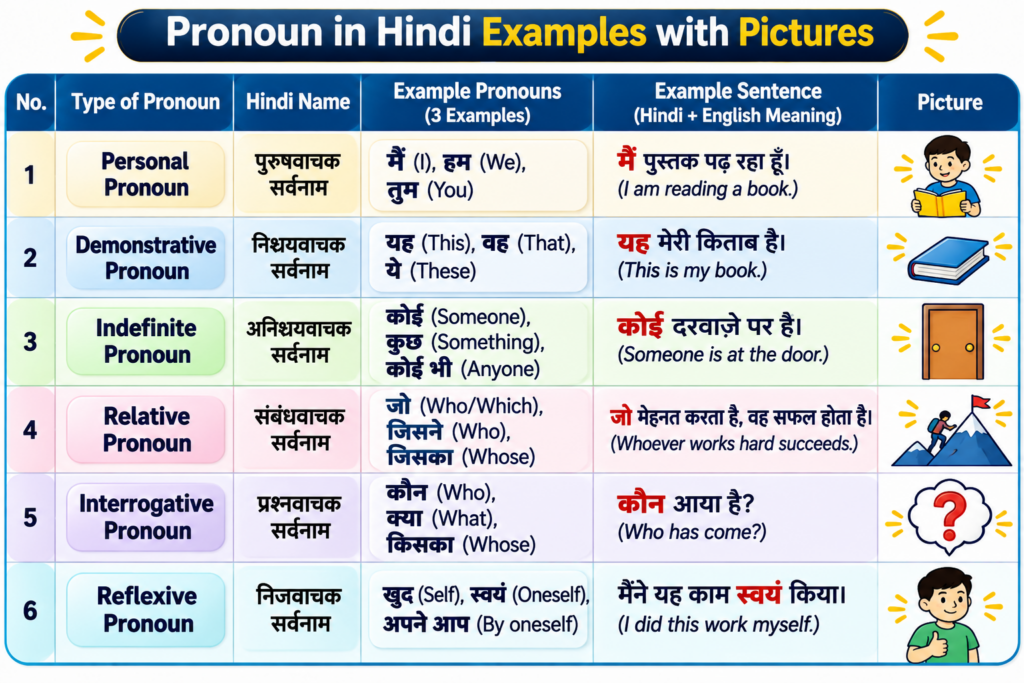
  • Singular and Plural in Hindi with Rules and 50 Examples

    A teacher places one book (किताब) on a desk. A few minutes later, several more books arrive. The teacher first says एक किताब, then पाँच किताबें. The object is the same, but its Hindi word changes because the number has changed.

    This difference is called singular and plural in Hindi, or एकवचन और बहुवचन. A singular noun refers to one person, animal, place, or thing, while a plural noun refers to more than one. For example, लड़का becomes लड़के, and कुर्सी becomes कुर्सियाँ.

    However, not every Hindi noun changes in the same way. घर can mean both house and houses, while किताब becomes किताबें. Some forms also change when used with में, से, को, or पर. These patterns make Hindi singular and plural grammar especially interesting.

    Types of Singular and Plural Nouns in Hindi

    types of Singular and Plural in Hindietara ge pore add kore title e varioation anbe. kintu meaning ok thakle main kw ta ss it is rakhar try korbe

    Hindi nouns have two grammatical numbers: Singular (एकवचन) and Plural (बहुवचन).

    Their forms also depend on gender, word endings, and how they are used in a sentence.

    1. Singular Nouns (एकवचन)

    A singular noun refers to one person, animal, place, object, or individual entity.

    Examples: एक लड़का (one boy), एक किताब (one book), एक कमरा (one room).

    2. Plural Nouns (बहुवचन)

    A plural noun refers to more than one person, animal, place, object, or entity.

    Examples: दो लड़के (two boys), तीन किताबें (three books), चार कमरे (four rooms).

    Main Singular and Plural Patterns

    Hindi singular and plural nouns follow several common patterns.

    PatternSingularPlural
    Masculine nouns ending in आकमराकमरे
    Feminine nouns ending in ईकुर्सीकुर्सियाँ
    Feminine nouns ending in a consonantकिताबकिताबें
    Feminine nouns ending in आमहिलामहिलाएँ
    Nouns with unchanged direct pluralsघरघर

    These are common patterns rather than rules for every word. Hindi also has exceptions, irregular forms, and nouns that are normally used only in particular numbers.

    Singular and Plural Grammar Rules in Hindi

    Hindi nouns change according to gender, number, and sentence structure.

    The most important rules concern masculine and feminine endings, unchanged plurals, and direct versus oblique forms.

    Rule 1: Masculine Nouns Ending in आ Usually Change to ए

    Many masculine nouns ending in आ change their ending to ए in the direct plural form.

    Pattern: आ → ए

    SingularPluralEnglish Meaning
    लड़कालड़केBoy / Boys
    कमराकमरेRoom / Rooms
    बच्चाबच्चेChild / Children
    घोड़ाघोड़ेHorse / Horses
    तालातालेLock / Locks

    Example: एक कमरा बड़ा है। (One room is big.)

    Plural: दो कमरे बड़े हैं। (Two rooms are big.)

    Rule 2: Feminine Nouns Ending in ई Usually Change to इयाँ

    Many feminine nouns ending in the long ई sound form their direct plurals with इयाँ.

    Pattern: ई → इयाँ

    SingularPluralEnglish Meaning
    लड़कीलड़कियाँGirl / Girls
    कुर्सीकुर्सियाँChair / Chairs
    चाबीचाबियाँKey / Keys
    नदीनदियाँRiver / Rivers
    तितलीतितलियाँButterfly / Butterflies

    Example: एक कुर्सी खाली है। (One chair is empty.)

    Plural: तीन कुर्सियाँ खाली हैं। (Three chairs are empty.)

    Rule 3: Many Feminine Consonant-Ending Nouns Add एँ

    Many feminine nouns ending in consonants form their direct plurals by adding एँ.

    Pattern: Add एँ.

    SingularPluralEnglish Meaning
    किताबकिताबेंBook / Books
    सड़कसड़केंRoad / Roads
    दुकानदुकानेंShop / Shops
    रातरातेंNight / Nights
    आँखआँखेंEye / Eyes

    Example: यह किताब नई है। (This book is new.)

    Plural: ये किताबें नई हैं। (These books are new.)

    Rule 4: Feminine आ-Ending Nouns Often Add एँ

    Many feminine nouns ending in आ take एँ in their direct plural forms.

    Examples:

    • महिला → महिलाएँ (Woman → Women)
    • माता → माताएँ (Mother → Mothers)
    • भाषा → भाषाएँ (Language → Languages)
    • कक्षा → कक्षाएँ (Class → Classes)
    • दिशा → दिशाएँ (Direction → Directions)

    Rule 5: Some Nouns Keep the Same Direct Singular and Plural Forms

    Not every plural noun changes spelling. Several masculine nouns retain the same form in direct singular and plural contexts.

    SingularDirect PluralEnglish Meaning
    घरघरHouse / Houses
    पेड़पेड़Tree / Trees
    फलफलFruit / Fruits
    आदमीआदमीMan / Men
    दोस्तदोस्तFriend / Friends

    Example: एक घर बड़ा है। (One house is big.)

    Plural: तीन घर बड़े हैं। (Three houses are big.)

    Rule 6: Direct and Oblique Plural Forms Are Different

    Hindi nouns can change form before postpositions such as में, पर, से, को, and के.

    These forms are known as oblique forms (परसर्ग के साथ प्रयुक्त रूप).

    SingularDirect PluralOblique Plural
    कमराकमरेकमरों
    लड़कालड़केलड़कों
    कुर्सीकुर्सियाँकुर्सियों
    किताबकिताबेंकिताबों
    घरघरघरों

    Direct plural: तीन कमरे खाली हैं। (Three rooms are empty.)

    Oblique plural: तीन कमरों में पंखे हैं। (There are fans in three rooms.)

    Rule 7: Verbs Often Change with Singular and Plural Subjects

    Hindi verbs frequently agree with the number and gender of the subject.

    Agreement also depends on tense, aspect, and sentence structure.

    Singular SentencePlural Sentence
    लड़का खेलता है।लड़के खेलते हैं।
    लड़की गाती है।लड़कियाँ गाती हैं।
    बच्चा सो रहा है।बच्चे सो रहे हैं।
    किताब नई है।किताबें नई हैं।
    कमरा साफ़ है।कमरे साफ़ हैं।

    Rule 8: Not Every Hindi Noun Is Normally Counted

    Some words refer to substances or abstract ideas rather than separate objects.

    Examples: पानी (water), दूध (milk), ईमानदारी (honesty).

    When needed, count their units or containers instead.

    Example: दो गिलास पानी (Two glasses of water).

    Singular And Plural in Hindi – 50 Words

    Hindi singular and plural words are useful for learning vocabulary alongside noun formation.

    The following 50 examples show common direct singular and plural forms with English meanings.

    No.SingularPluralEnglish Meaning
    1लड़कालड़केBoy / Boys
    2बच्चाबच्चेChild / Children
    3कमराकमरेRoom / Rooms
    4घोड़ाघोड़ेHorse / Horses
    5कुत्ताकुत्तेDog / Dogs
    6जूताजूतेShoe / Shoes
    7पौधापौधेPlant / Plants
    8तालातालेLock / Locks
    9रास्तारास्तेRoad / Paths
    10बेटाबेटेSon / Sons
    11लड़कीलड़कियाँGirl / Girls
    12कुर्सीकुर्सियाँChair / Chairs
    13चाबीचाबियाँKey / Keys
    14नदीनदियाँRiver / Rivers
    15तितलीतितलियाँButterfly / Butterflies
    16रोटीरोटियाँFlatbread / Flatbreads
    17खिड़कीखिड़कियाँWindow / Windows
    18टोपीटोपियाँCap / Caps
    19थालीथालियाँPlate / Plates
    20गाड़ीगाड़ियाँVehicle / Vehicles
    21किताबकिताबेंBook / Books
    22सड़कसड़केंRoad / Roads
    23रातरातेंNight / Nights
    24आँखआँखेंEye / Eyes
    25दुकानदुकानेंShop / Shops
    26बहनबहनेंSister / Sisters
    27मेज़मेज़ेंTable / Tables
    28दीवारदीवारेंWall / Walls
    29बोतलबोतलेंBottle / Bottles
    30बातबातेंStatement / Statements
    31महिलामहिलाएँWoman / Women
    32मातामाताएँMother / Mothers
    33भाषाभाषाएँLanguage / Languages
    34कथाकथाएँStory / Stories
    35सभासभाएँAssembly / Assemblies
    36दिशादिशाएँDirection / Directions
    37कक्षाकक्षाएँClass / Classes
    38शाखाशाखाएँBranch / Branches
    39प्रार्थनाप्रार्थनाएँPrayer / Prayers
    40आशाआशाएँHope / Hopes
    41घरघरHouse / Houses
    42पेड़पेड़Tree / Trees
    43फलफलFruit / Fruits
    44फूलफूलFlower / Flowers
    45आदमीआदमीMan / Men
    46हाथहाथHand / Hands
    47दिनदिनDay / Days
    48शहरशहरCity / Cities
    49दोस्तदोस्तFriend / Friends
    50किसानकिसानFarmer / Farmers

    These are direct plural forms. Some words change when followed by Hindi postpositions.

    For example, घर remains घर in the direct plural, but becomes घरों in phrases such as घरों में.

    Singular Noun in Hindi: 30 Sentence Examples

    A singular noun refers to one person, animal, place, or thing. These sentences use singular nouns in familiar contexts.

    No.Hindi SentenceEnglish Translation
    1एक लड़का पढ़ रहा है।One boy is studying.
    2एक बच्चा सो रहा है।One child is sleeping.
    3यह कमरा बड़ा है।This room is big.
    4एक घोड़ा दौड़ रहा है।A horse is running.
    5वह जूता नया है।That shoe is new.
    6एक पौधा बढ़ रहा है।A plant is growing.
    7यह ताला मज़बूत है।This lock is strong.
    8वह रास्ता लंबा है।That path is long.
    9मेरा बेटा पढ़ता है।My son studies.
    10एक कुर्सी खाली है।One chair is empty.
    11यह चाबी छोटी है।This key is small.
    12नदी गहरी है।The river is deep.
    13एक तितली उड़ रही है।A butterfly is flying.
    14यह रोटी गर्म है।This flatbread is hot.
    15खिड़की खुली है।The window is open.
    16यह टोपी लाल है।This cap is red.
    17थाली साफ़ है।The plate is clean.
    18एक किताब मेज़ पर है।One book is on the table.
    19यह सड़क चौड़ी है।This road is wide.
    20आज रात ठंडी है।Tonight is cold.
    21मेरी बहन घर पर है।My sister is at home.
    22दुकान बंद है।The shop is closed.
    23यह बोतल खाली है।This bottle is empty.
    24एक महिला बोल रही है।A woman is speaking.
    25यह भाषा कठिन है।This language is difficult.
    26एक सभा चल रही है।An assembly is taking place.
    27कक्षा शुरू हो गई है।The class has started.
    28एक घर सुंदर है।One house is beautiful.
    29यह पेड़ ऊँचा है।This tree is tall.
    30एक किसान खेत में है।One farmer is in the field.

    Plural Noun in Hindi: 30 Sentence Examples

    Plural nouns refer to more than one person, animal, place, or thing. Their endings and accompanying verbs may change.

    No.Hindi SentenceEnglish Translation
    1दो लड़के पढ़ रहे हैं।Two boys are studying.
    2तीन बच्चे सो रहे हैं।Three children are sleeping.
    3चार कमरे बड़े हैं।Four rooms are big.
    4दो घोड़े दौड़ रहे हैं।Two horses are running.
    5ये जूते नए हैं।These shoes are new.
    6पाँच पौधे बढ़ रहे हैं।Five plants are growing.
    7ये ताले मज़बूत हैं।These locks are strong.
    8दो रास्ते लंबे हैं।Two paths are long.
    9मेरे बेटे पढ़ते हैं।My sons study.
    10तीन कुर्सियाँ खाली हैं।Three chairs are empty.
    11ये चाबियाँ छोटी हैं।These keys are small.
    12दो नदियाँ गहरी हैं।Two rivers are deep.
    13तितलियाँ उड़ रही हैं।Butterflies are flying.
    14ये रोटियाँ गर्म हैं।These flatbreads are hot.
    15खिड़कियाँ खुली हैं।The windows are open.
    16ये टोपियाँ लाल हैं।These caps are red.
    17थालियाँ साफ़ हैं।The plates are clean.
    18तीन किताबें मेज़ पर हैं।Three books are on the table.
    19ये सड़कें चौड़ी हैं।These roads are wide.
    20सर्दियों की रातें ठंडी हैं।Winter nights are cold.
    21मेरी बहनें घर पर हैं।My sisters are at home.
    22दुकानें बंद हैं।The shops are closed.
    23ये बोतलें खाली हैं।These bottles are empty.
    24तीन महिलाएँ बोल रही हैं।Three women are speaking.
    25ये भाषाएँ कठिन हैं।These languages are difficult.
    26कई सभाएँ चल रही हैं।Several assemblies are taking place.
    27कक्षाएँ शुरू हो गई हैं।The classes have started.
    28ये घर सुंदर हैं।These houses are beautiful.
    29वे पेड़ ऊँचे हैं।Those trees are tall.
    30किसान खेतों में हैं।Farmers are in the fields.

    Singular and Plural in Hindi vs English

    Both Hindi and English distinguish singular and plural nouns. However, their word endings and sentence agreement rules differ.

    FeatureEnglishHindi
    SingularBookकिताब
    PluralBooksकिताबें
    Masculine exampleBoy / Boysलड़का / लड़के
    Feminine exampleGirl / Girlsलड़की / लड़कियाँ
    Unchanged pluralSheep / Sheepघर / घर
    Oblique pluralUsually no separate formकिताबों, लड़कों, घरों

    English often adds -s or -es to form a plural. Hindi uses several patterns influenced by grammatical gender and noun endings.

    Hindi also has separate oblique forms, which appear with many postpositions.

    Common Mistakes in Hindi Singular and Plural

    Learners often confuse direct plural forms with oblique forms or apply the same ending to every noun.

    These examples show how to avoid the most frequent errors.

    Mistake 1: Using a Masculine Plural Ending with a Feminine Noun

    Incorrect: दो कुर्से

    Correct: दो कुर्सियाँ

    Mistake 2: Adding an Unnecessary Ending to an Unchanged Plural

    Incorrect: तीन घरें

    Correct: तीन घर

    Mistake 3: Using a Direct Plural Before a Postposition

    Incorrect: कमरे में when referring to several rooms.

    Correct: कमरों में

    Mistake 4: Using a Singular Verb with a Plural Subject

    Incorrect: दो लड़के खेलता है।

    Correct: दो लड़के खेलते हैं।

    Mistake 5: Confusing Feminine Direct and Oblique Plurals

    Direct plural: लड़कियाँ पढ़ रही हैं।

    Oblique plural: लड़कियों के पास किताबें हैं।

    Mistake 6: Assuming Every Masculine Noun Ending in आ Changes to ए

    Some words, particularly certain kinship terms and borrowed or exceptional nouns, do not follow the basic pattern.

    For example, राजा normally remains राजा in the direct plural rather than becoming राजे.

    Singular and Plural in Hindi Worksheet

    Practice एकवचन और बहुवचन through exercises on noun endings, masculine and feminine plurals, unchanged word forms, and direct versus oblique usage.

    The activities also help improve Hindi sentence formation.

    Frequently Asked Questions

    Can a Hindi noun have the same singular and plural form?

    Yes. Nouns such as घर, पेड़, and आदमी can retain the same form in the direct singular and plural. The sentence context helps indicate the number.

    Why does किताबें become किताबों?

    किताबें is the direct plural, while किताबों is the oblique plural. The oblique form commonly appears before postpositions, as in किताबों में.

    Do Hindi adjectives change with plural nouns?

    Some adjectives change according to gender and number, while others remain unchanged. For example, बड़ा कमरा becomes बड़े कमरे, but सुंदर कमरा becomes सुंदर कमरे.

    Are all Hindi nouns used in both singular and plural?

    No. Some mass nouns and abstract nouns are not normally pluralized in their ordinary meanings. Other words may have special plural uses depending on context.

    Lets End!

    A useful way to learn Hindi plurals is to compare complete phrases instead of memorizing word endings alone. एक किताब, दो किताबें, and किताबों में demonstrate how number and sentence structure work together.

    Try forming plurals of चाबी, कमरा, and दुकान. Then use their plural forms with में or के.

    Share your answers in the comments to check whether you have understood both direct and oblique forms.

  • Compound Noun in Hindi: Types, Rules & Examples

    A schoolbag rests beside a notebook, while a raincoat hangs near the door. Outside, a school bus stops beside a traffic light. These familiar objects have interesting names: schoolbag (स्कूल बैग), notebook (नोटबुक), raincoat (बरसाती), and traffic light (यातायात संकेत बत्ती).

    Each name combines two or more words to express one meaning. In English grammar, these are called compound nouns, known as संयुक्त संज्ञा or यौगिक संज्ञा in Hindi. Some appear as single words, some remain separate, and others use hyphens.

    But why is notebook written together, bus stop written separately, and mother-in-law joined with hyphens? Their structures follow different spelling and grammar patterns. Recognizing these patterns helps you identify compound nouns, form their plurals, and use them naturally in sentences.

    Types of Compound Nouns in Hindi

    Types of Compound Nouns

    English compound nouns have three main written forms: closed, open, and hyphenated.

    All three combine words into one meaningful noun, but their spelling patterns differ.

    1. Closed Compound Nouns

    Closed compound nouns combine two or more elements into one word, without spaces or hyphens.

    Examples:

    • Notebook (नोटबुक)
    • Toothbrush (टूथब्रश)
    • Sunflower (सूरजमुखी)

    2. Open Compound Nouns

    Open compound nouns contain two or more separate words that function together as a single noun.

    Examples:

    • Bus stop (बस स्टॉप)
    • Post office (डाकघर)
    • Dining table (खाने की मेज़)

    3. Hyphenated Compound Nouns

    Hyphenated compound nouns connect their elements with a hyphen (-).

    Examples:

    • Mother-in-law (सास)
    • Editor-in-chief (प्रधान संपादक)
    • Runner-up (उपविजेता)

    Types of Compound Nouns at a Glance

    TypeWritten FormExampleHindi Meaning
    ClosedOne wordNotebookनोटबुक
    OpenSeparate wordsBus stopबस स्टॉप
    HyphenatedWords joined by hyphensMother-in-lawसास

    Compound Noun Grammar Rules

    Compound nouns function as single nouns, even when written as two or more words.

    Their plural forms, articles, and verb agreement depend on their grammatical structure.

    Rule 1: Two or More Words Form One Noun

    The elements of a compound noun work together to name a person, place, object, or concept.

    Examples:

    • Toothbrush = tooth + brush
    • Football = foot + ball
    • Swimming pool = swimming + pool
    • Mother-in-law = mother + in + law

    Rule 2: Use the Correct Written Form

    Compound nouns do not follow one universal spelling pattern.

    ClosedOpenHyphenated
    BedroomLiving roomMother-in-law
    ToothpasteBus stopEditor-in-chief
    RaincoatIce creamPasser-by
    BlackboardPost officeRunner-up
    AirportRailway stationMerry-go-round

    Use a reliable dictionary when a compound’s spelling is uncertain. Accepted forms may also change over time.

    Rule 3: Make the Main Noun Plural

    Most compound nouns form their plurals by adding -s or -es to the main noun.

    SingularPlural
    NotebookNotebooks
    ToothbrushToothbrushes
    Bus stopBus stops
    School busSchool buses
    Mother-in-lawMothers-in-law
    Editor-in-chiefEditors-in-chief
    Passer-byPassers-by
    Runner-upRunners-up

    Rule 4: Articles Depend on Countability

    Use a or an with singular countable compound nouns. Plural and uncountable compounds follow their usual determiner rules.

    Examples:

    • A notebook — एक नोटबुक
    • An airport — एक हवाई अड्डा
    • Two school buses — दो स्कूल बसें
    • Some ice cream — थोड़ी आइसक्रीम

    Rule 5: Compound Nouns Can Be Subjects or Objects

    A compound noun can perform the same grammatical functions as an ordinary noun.

    Subject: The school bus arrived early.

    Object: She bought a new toothbrush.

    Complement: This building is a post office.

    Rule 6: The Whole Compound Determines Verb Agreement

    Compound nouns take singular or plural verbs according to their number.

    SingularPlural
    The notebook is new.The notebooks are new.
    The bus stop is crowded.The bus stops are crowded.
    The runner-up was happy.The runners-up were happy.

    Rule 7: Possessive Forms Usually Follow the Entire Compound

    Add the possessive ending to the complete compound noun.

    Examples:

    • My brother-in-law’s car — मेरे साले / जीजा की कार
    • The editor-in-chief’s office — प्रधान संपादक का कार्यालय
    • The bus driver’s seat — बस चालक की सीट

    Compound Nouns Examples in Hindi

    Compound nouns appear in everyday vocabulary, including transportation, household objects, workplaces, food, and family relationships.

    The following tables contain 90 examples, with 30 for each written form.

    30 Closed Compound Nouns with Hindi Meaning

    No.Compound NounHindi Meaning
    1Notebookनोटबुक / कॉपी
    2Toothbrushदाँत साफ़ करने का ब्रश
    3Raincoatबरसाती
    4Sunflowerसूरजमुखी
    5Classroomकक्षा-कक्ष
    6Footballफ़ुटबॉल
    7Bedroomशयनकक्ष
    8Bookshelfकिताबों की अलमारी
    9Playgroundखेल का मैदान
    10Airportहवाई अड्डा
    11Keyboardकीबोर्ड
    12Smartphoneस्मार्टफ़ोन
    13Lighthouseप्रकाशस्तंभ
    14Haircutबाल कटवाना / बालों की कटाई
    15Toothpasteटूथपेस्ट
    16Backpackपीठ पर लटकाने वाला बैग
    17Waterfallझरना
    18Snowmanबर्फ़ का पुतला
    19Birthdayजन्मदिन
    20Newspaperअख़बार
    21Handbagहैंडबैग
    22Sidewalkफुटपाथ
    23Greenhouseपौधशाला का काँचघर
    24Blackboardश्यामपट्ट
    25Armchairहाथ रखने वाली कुर्सी
    26Doorbellदरवाज़े की घंटी
    27Mailboxडाक-पेटी
    28Headacheसिरदर्द
    29Countrysideग्रामीण इलाक़ा
    30Lifetimeजीवनकाल

    30 Open Compound Nouns with Hindi Meaning

    No.Compound NounHindi Meaning
    1Bus stopबस स्टॉप
    2Post officeडाकघर
    3Railway stationरेलवे स्टेशन
    4Dining tableखाने की मेज़
    5Coffee tableछोटी बैठक की मेज़
    6Ice creamआइसक्रीम
    7Swimming poolतैराकी का तालाब
    8Washing machineकपड़े धोने की मशीन
    9Traffic lightयातायात संकेत बत्ती
    10Police stationपुलिस थाना
    11Fire stationअग्निशमन केंद्र
    12High schoolउच्च विद्यालय
    13Living roomबैठक का कमरा
    14Dining roomभोजन कक्ष
    15Bus driverबस चालक
    16Parking lotवाहन खड़ा करने की जगह
    17Credit cardक्रेडिट कार्ड
    18Mobile phoneमोबाइल फ़ोन
    19Water bottleपानी की बोतल
    20Train ticketरेलगाड़ी का टिकट
    21Shopping mallशॉपिंग मॉल
    22City hallनगर भवन
    23Science fictionविज्ञान-कथा साहित्य
    24Phone numberफ़ोन नंबर
    25Book clubपुस्तक क्लब
    26Coffee shopकॉफ़ी की दुकान
    27Train stationरेलगाड़ी का स्टेशन
    28School busस्कूल बस
    29Computer scienceकंप्यूटर विज्ञान
    30Movie theaterसिनेमाघर

    30 Hyphenated Compound Nouns with Hindi Meaning

    No.Compound NounHindi Meaning
    1Mother-in-lawसास
    2Father-in-lawससुर
    3Sister-in-lawननद / भाभी / साली (संबंध के अनुसार)
    4Brother-in-lawसाला / जीजा / देवर (संबंध के अनुसार)
    5Son-in-lawदामाद
    6Daughter-in-lawबहू
    7Editor-in-chiefप्रधान संपादक
    8Commander-in-chiefसर्वोच्च सेनापति
    9Passer-byराहगीर
    10Runner-upउपविजेता
    11Go-betweenमध्यस्थ
    12Stand-inस्थानापन्न व्यक्ति
    13Check-inआगमन-पंजीकरण
    14Walk-inबिना पूर्व नियुक्ति का आगंतुक
    15Drive-inवाहन से सेवा लेने का स्थान
    16Follow-upअनुवर्ती कार्रवाई
    17Warm-upअभ्यास से पहले की तैयारी
    18Sign-upपंजीकरण
    19Merry-go-roundघूमने वाला झूला
    20Jack-in-the-boxडिब्बे से उछलने वाला खिलौना
    21Hand-me-downपुराना इस्तेमाल किया हुआ सामान
    22Know-howव्यावहारिक जानकारी
    23Self-esteemआत्मसम्मान
    24Self-controlआत्मसंयम
    25Well-beingकल्याण / स्वस्थ अवस्था
    26T-shirtटी-शर्ट
    27U-turnयू-टर्न
    28X-rayएक्स-रे
    29Right-of-wayरास्ते के उपयोग का अधिकार
    30Court-martialसैन्य न्यायालय / सैनिक अदालत में मुक़दमा

    Compound Noun Examples with Pictures in Hindi

    Compound nouns become easier to recognize when their meanings are connected to familiar objects.

    Compound Noun Examples with Pictures

    Hindi Compound Words: Types of Samas (समास)

    English compound nouns are classified as Closed, Open, and Hyphenated based on spelling.

    Hindi grammar uses Samas (समास) to classify compounds according to the relationship between their parts. The six commonly taught types are listed below.

    Six Types of Samas with English Names

    Hindi TypeEnglish NameExampleMeaning
    अव्ययीभाव समासAdverbial Compoundप्रतिदिनEvery day
    तत्पुरुष समासDeterminative Compoundराजपुत्रKing’s son
    कर्मधारय समासDescriptive CompoundनीलकमलBlue lotus
    द्विगु समासNumeral Compoundनवरत्नNine gems
    द्वंद्व समासCopulative / Coordinative Compoundमाता-पिताParents
    बहुव्रीहि समासExocentric CompoundदशाननTen-faced; Ravana

    How Hindi Samas Differs from English Compound Nouns

    English compound types describe how words are written, while Hindi Samas types describe how their meanings are connected.

    For example, notebook is a closed compound in English. माता-पिता is a Dvandva (Copulative) Compound in Hindi because both parts have equal importance.

    Compound Noun Examples in Sentences

    These 30 sentences demonstrate closed, open, and hyphenated compound nouns in natural English with Hindi translations.

    No.English SentenceHindi Translation
    1I bought a new notebook.मैंने एक नई नोटबुक खरीदी।
    2The toothbrush is on the shelf.टूथब्रश शेल्फ़ पर है।
    3He wore a raincoat in the rain.उसने बारिश में बरसाती पहनी।
    4A sunflower grew in the garden.बगीचे में एक सूरजमुखी उगा।
    5Our classroom is bright.हमारा कक्षा-कक्ष रोशन है।
    6The children played football.बच्चों ने फ़ुटबॉल खेला।
    7My bedroom has two windows.मेरे शयनकक्ष में दो खिड़कियाँ हैं।
    8The bookshelf is full of books.किताबों की अलमारी किताबों से भरी है।
    9We arrived at the airport early.हम हवाई अड्डे पर जल्दी पहुँचे।
    10The doorbell rang twice.दरवाज़े की घंटी दो बार बजी।
    11The bus stop is near my house.बस स्टॉप मेरे घर के पास है।
    12She went to the post office.वह डाकघर गई।
    13The railway station was crowded.रेलवे स्टेशन पर भीड़ थी।
    14We placed the plates on the dining table.हमने खाने की मेज़ पर प्लेटें रखीं।
    15The ice cream melted quickly.आइसक्रीम जल्दी पिघल गई।
    16The swimming pool is closed today.आज तैराकी का तालाब बंद है।
    17Our washing machine needs repair.हमारी कपड़े धोने की मशीन को मरम्मत की ज़रूरत है।
    18The traffic light turned red.यातायात संकेत बत्ती लाल हो गई।
    19The school bus arrived on time.स्कूल बस समय पर पहुँची।
    20I lost my train ticket.मेरा रेलगाड़ी का टिकट खो गया।
    21My mother-in-law lives nearby.मेरी सास पास में रहती हैं।
    22His father-in-law owns a shop.उसके ससुर की एक दुकान है।
    23The editor-in-chief reviewed the article.प्रधान संपादक ने लेख की समीक्षा की।
    24A passer-by helped the driver.एक राहगीर ने चालक की मदद की।
    25The runner-up received a medal.उपविजेता को पदक मिला।
    26We completed the check-in early.हमने आगमन-पंजीकरण जल्दी पूरा कर लिया।
    27Please send a follow-up tomorrow.कृपया कल एक अनुवर्ती संदेश भेजें।
    28The players began their warm-up.खिलाड़ियों ने अभ्यास से पहले की तैयारी शुरू की।
    29The merry-go-round stopped suddenly.घूमने वाला झूला अचानक रुक गया।
    30The lawyer explained the right-of-way.वकील ने रास्ते के उपयोग का अधिकार समझाया।

    Common Mistakes with Compound Nouns

    Compound noun errors usually involve spelling, hyphens, plurals, and confusion with other grammatical structures.

    Mistake 1: Joining Every Compound into One Word

    Incorrect: Busstop

    Correct: Bus stop

    Mistake 2: Separating Closed Compound Nouns

    Incorrect: Tooth brush

    Correct: Toothbrush

    Mistake 3: Omitting Necessary Hyphens

    Incorrect: Mother in law

    Correct: Mother-in-law

    Mistake 4: Making the Wrong Element Plural

    Incorrect: Mother-in-laws

    Correct: Mothers-in-law

    Mistake 5: Assuming Every Compound Noun Contains Two Words

    Some compound nouns contain more than two elements.

    Examples: Editor-in-chief, mother-in-law, and jack-in-the-box.

    Mistake 6: Confusing Compound Nouns with Compound Sentences

    Compound noun: The school bus is late.

    Compound sentence: The bus is late, so we will walk.

    Mistake 7: Using a Compound Adjective as a Noun

    Well-known normally functions as an adjective, as in a well-known writer.

    It should not be classified as an ordinary compound noun simply because it contains a hyphen.

    Compound Nouns Worksheet

    Practice identifying compound noun forms, choosing correct spellings, making plurals, and distinguishing compound nouns from compound sentences.

    FAQ’s

    Can a compound noun be uncountable?

    Yes. Ice cream, software, and self-esteem commonly have uncountable uses. Countability depends on meaning, not merely on the compound’s spelling.

    Can compound nouns change spelling over time?

    Yes. Some compounds evolve from separate words to hyphenated or closed forms. Dictionaries and regional usage may differ.

    Can a compound noun contain more than two words?

    Yes. Mother-in-law, editor-in-chief, and jack-in-the-box contain multiple elements that function together as one noun.

    Are all hyphenated words compound nouns?

    No. Hyphens also appear in compound adjectives and other expressions. Part-time in a part-time job is an adjective, not a noun.

    Practice Offline With Compound Nouns Pdf

    Conclusion

    The easiest way to recognize a compound noun is to notice when familiar words combine to create one name. Raincoat, bus stop, and runner-up look different on the page, but each functions as a noun.

    For a quick challenge, classify waterfall, coffee table, and sister-in-law by their written forms. Then try making each noun plural. Share your answers in the comments.