A student finds an old notebook in the classroom. The teacher asks who owns it, and another student replies, “जो लड़का पहली बेंच पर बैठता है, यह उसकी किताब है।” The answer identifies the boy without repeating his name. The word जो (who) connects the description of the boy with the main sentence.
Now consider another sentence: “यह वही किताब है जिसे मैंने कल खरीदा था।” Here, जिसे connects the book with the action of buying it. Both sentences use words that introduce additional information about a person or object.
In Hindi grammar, these words are called relative pronouns (संबंधवाचक सर्वनाम). The most important forms include जो, जिस, जिन, जिसने, जिसे, जिसका, and जिन्होंने. They often work with matching words such as वह, उसे, उसका, and उन्होंने, making longer Hindi sentences clearer and more natural.
Relative Pronouns Types in Hindi with Examples
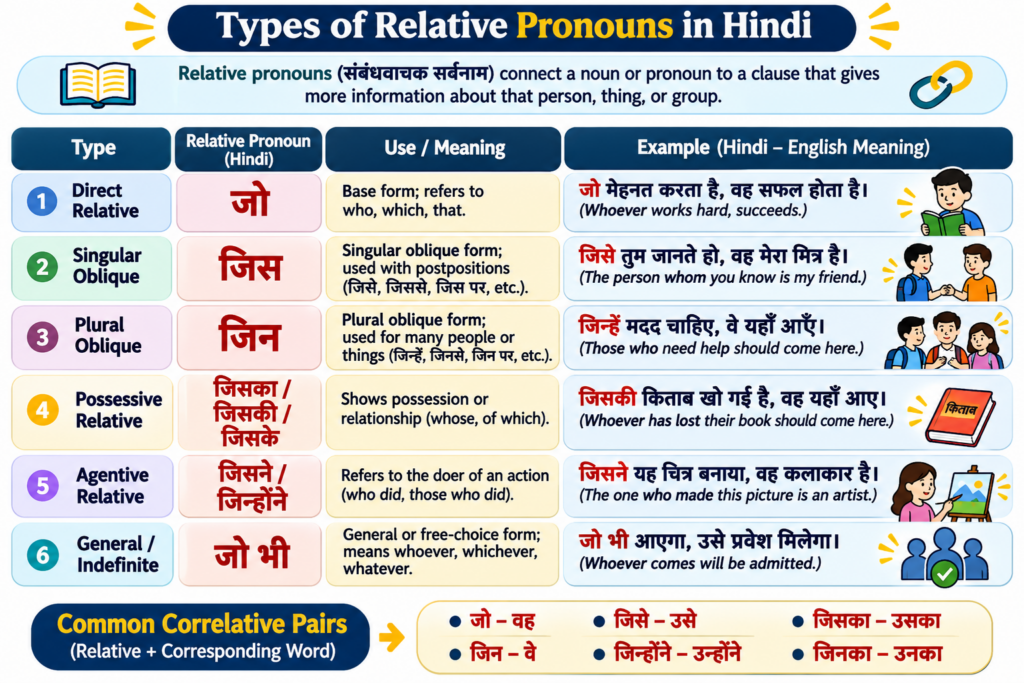
Hindi relative pronouns are mainly based on जो (who, which, that) and its grammatical forms.
Unlike English, which uses who, whom, whose, and which, Hindi frequently changes the same relative base according to number, case, and postpositions.
1. Direct Relative Pronoun (जो)
जो is the basic relative form. It can refer to people, objects, or things.
Example: जो मेहनत करता है, वह सफल होता है।
English: Whoever works hard succeeds.
2. Singular Oblique Relative Pronoun (जिस)
जिस is used for a singular referent in constructions involving postpositions and grammatical case.
It produces forms such as जिसे, जिससे, जिसमें, and जिस पर.
Example: जिसे तुम जानते हो, वह मेरा मित्र है।
English: The person whom you know is my friend.
3. Plural Oblique Relative Pronoun (जिन)
जिन refers to plural or honorific antecedents in oblique constructions.
It appears in forms such as जिन्हें, जिनसे, जिन्होंने, and जिनमें.
Example: जिन्हें मदद चाहिए, वे यहाँ आएँ।
English: Those who need help should come here.
4. Possessive Relative Forms (जिसका, जिसकी, जिसके)
These forms express ownership, association, or a relationship between nouns.
They usually agree with the gender, number, and grammatical case of the noun describing the possession.
Example: जिसकी किताब खो गई है, वह यहाँ आए।
English: Whoever has lost their book should come here.
5. General or Indefinite Relative Constructions
Expressions such as जो भी, जिसे भी, and जो कोई भी mean whoever, whichever, or whatever in suitable contexts.
They refer to any person or thing satisfying the condition in the relative clause.
Example: जो भी आएगा, उसे प्रवेश मिलेगा।
English: Whoever comes will be admitted.
Relative Pronouns Types in Hindi Chart
| Form | Grammatical Role | English Meaning | Example |
|---|---|---|---|
| जो | Direct/base relative | Who / Which / That | जो आएगा |
| जिस | Singular oblique base | Who / Which | जिस पर |
| जिन | Plural oblique base | Who / Which, plural | जिनसे |
| जिसने | Singular relative agent | Who did | जिसने लिखा |
| जिन्होंने | Plural/honorific relative agent | Who did | जिन्होंने बनाया |
| जिसका / जिसकी / जिसके | Possessive relative | Whose / Of which | जिसकी किताब |
| जो भी | General relative | Whoever / Whichever | जो भी आए |
These are grammatical and functional forms of relative pronouns, not seven unrelated classes.
Relative Pronoun Grammar Rules in Hindi
Hindi relative pronouns connect two clauses and identify people, objects, or situations through their relationships.
Their use depends on case, number, sentence structure, and the corresponding expression in the main clause.
Rule 1: Relative Pronouns Connect Related Clauses
A relative clause supplies information that identifies or describes a referent.
Example: जो विद्यार्थी नियमित पढ़ता है, वह अच्छे अंक प्राप्त करता है।
English: The student who studies regularly gets good marks.
The clause beginning with जो identifies the student being discussed.
Rule 2: Use जो with a Direct Relative Construction
जो is often used when the relative referent appears in a direct grammatical position.
| Hindi Sentence | English Translation |
|---|---|
| जो आया, वह बैठ गया। | The one who came sat down. |
| जो सही है, उसे चुनो। | Choose what is correct. |
| जो यहाँ रहता है, वह मेरा मित्र है। | The person who lives here is my friend. |
Rule 3: Use जिस in Singular Oblique Constructions
जिस combines with postpositions or case markers.
| Hindi Form | English Meaning |
|---|---|
| जिसने | Who did |
| जिसे / जिसको | Whom / To whom |
| जिससे | From / With whom or which |
| जिसमें | In which |
| जिस पर | On whom or which |
| जिसके लिए | For whom or which |
Example: जिससे मैंने बात की, वह शिक्षक है।
English: The person with whom I spoke is a teacher.
Rule 4: Use जिन for Plural or Honorific Oblique Reference
The plural oblique base जिन combines with different markers and postpositions.
| Hindi Form | English Meaning |
|---|---|
| जिन्होंने | Who did, plural/honorific |
| जिन्हें / जिनको | Whom, plural/honorific |
| जिनसे | With / From whom |
| जिनमें | In whom or which, plural |
| जिन पर | On whom or which, plural |
| जिनके लिए | For whom, plural |
Example: जिन्होंने प्रतियोगिता जीती, उन्हें पुरस्कार मिला।
English: Those who won the competition received prizes.
Rule 5: Possessive Relative Forms Agree with the Possessed Noun
The forms जिसका, जिसकी, and जिसके commonly agree with the noun being possessed.
| Relative Form | Example | English |
|---|---|---|
| जिसका | जिसका घर | Whose house |
| जिसकी | जिसकी किताब | Whose book |
| जिसके | जिसके दोस्त | Whose friends |
| जिसके | जिसके घर में | In whose house |
Example: जिसका बैग यहाँ है, वह उसे ले जाए।
English: Whoever owns the bag here should take it.
Rule 6: Hindi Frequently Uses Correlative Pairs
A relative expression is often matched with a corresponding word in the main clause.
| Relative Pair | General Meaning |
|---|---|
| जो – वह | Who / That one |
| जिसे – उसे | Whom / That person |
| जिसका – उसका | Whose / That person’s |
| जिससे – उससे | From/With whom – From/With that person |
| जिन्होंने – उन्होंने | Those who – They |
| जिन्हें – उन्हें | Those whom – Them |
Example: जो पढ़ेगा, वह सीखेगा।
English: Whoever studies will learn.
Rule 7: A Relative Clause May Follow Its Noun
Not every Hindi relative clause must appear at the beginning of a sentence.
Example: यह वही पुस्तक है जो मैंने कल खरीदी थी।
English: This is the book that I bought yesterday.
Rule 8: जो भी Adds a General or Free-Choice Meaning
जो भी and related forms can refer to any suitable person or thing.
Example: जो भी उत्तर सही हो, उसे लिखो।
English: Write whichever answer is correct.
Rule 9: Hindi Relative Pronouns Do Not Require Separate Masculine and Feminine Base Forms
जो can refer to a male or female person.
Gender may appear in the verb rather than in the relative pronoun itself.
| Hindi Sentence | English Meaning |
|---|---|
| जो आया, वह मेरा भाई है। | The one who came is my brother. |
| जो आई, वह मेरी बहन है। | The one who came is my sister. |
Rule 10: Not Every Related Question Word Is a Relative Pronoun
जो and कौन have different grammatical functions.
जो commonly introduces relative information, while कौन asks a question.
Relative: जो आया, वह बैठ गया।
Interrogative: कौन आया?
Relative Pronoun in Hindi Examples By Categories
Relative pronouns help identify people, objects, locations, relationships, and unspecified possibilities.
The examples below show their forms with English meanings and commonly used combinations.
Singular Relative Pronoun Examples in Hindi
These expressions use singular relative forms based on जो and जिस.
| No. | Hindi Expression | English Meaning |
|---|---|---|
| 1 | जो | Who / Which / That |
| 2 | जिस | Whom / Which, oblique |
| 3 | जिसने | Who did |
| 4 | जिसे | Whom / Which, object |
| 5 | जिसको | To whom / Which |
| 6 | जिससे | From / With whom |
| 7 | जिसमें | In which |
| 8 | जिस पर | On whom / Which |
| 9 | जिसका | Whose, masculine possession |
| 10 | जिसकी | Whose, feminine possession |
| 11 | जिसके | Whose, plural/oblique possession |
| 12 | जिसके लिए | For whom / Which |
| 13 | जिसके साथ | With whom |
| 14 | जिसके पास | Who has / With whom |
| 15 | जिसके बिना | Without whom / Which |
| 16 | जिसके बारे में | About whom / Which |
| 17 | जिसके कारण | Because of which |
| 18 | जिसके बाद | After which |
| 19 | जिसके पहले | Before which |
| 20 | जिसके अंदर | Inside which |
| 21 | जिसके बाहर | Outside which |
| 22 | जिसके नीचे | Under which |
| 23 | जिसके ऊपर | Above which |
| 24 | जिसके सामने | In front of whom / Which |
| 25 | जिसके पीछे | Behind whom / Which |
| 26 | जिस तक | Up to which / Whom |
| 27 | जिससे होकर | Through which |
| 28 | जिसे देखकर | Upon seeing whom / Which |
| 29 | जिसको लेकर | Concerning whom / Which |
| 30 | जिसकी वजह से | Because of whom / Which |
Plural Relative Pronoun Examples in Hindi
Plural and honorific relative constructions commonly use जिन and its modified forms.
| No. | Hindi Expression | English Meaning |
|---|---|---|
| 1 | जिन | Whom / Which, plural oblique |
| 2 | जिन्होंने | Those who did |
| 3 | जिन्हें | Whom, plural/honorific |
| 4 | जिनको | To whom, plural |
| 5 | जिनसे | From / With whom, plural |
| 6 | जिनमें | In which, plural |
| 7 | जिन पर | On whom / Which, plural |
| 8 | जिनका | Whose, plural antecedent |
| 9 | जिनकी | Whose, plural antecedent |
| 10 | जिनके | Whose, plural antecedent |
| 11 | जिनके लिए | For whom, plural |
| 12 | जिनके साथ | With whom, plural |
| 13 | जिनके पास | Who have / With whom |
| 14 | जिनके बिना | Without whom, plural |
| 15 | जिनके बारे में | About whom / Which, plural |
| 16 | जिनके कारण | Because of whom / Which |
| 17 | जिनके बाद | After which, plural |
| 18 | जिनके पहले | Before which, plural |
| 19 | जिनके अंदर | Inside which, plural |
| 20 | जिनके बाहर | Outside which, plural |
| 21 | जिनके नीचे | Under which, plural |
| 22 | जिनके ऊपर | Above which, plural |
| 23 | जिनके सामने | In front of whom / Which |
| 24 | जिनके पीछे | Behind whom / Which |
| 25 | जिन तक | Up to whom / Which, plural |
| 26 | जिनसे होकर | Through which, plural |
| 27 | जिन्हें देखकर | Upon seeing whom, plural |
| 28 | जिनको लेकर | Concerning whom / Which, plural |
| 29 | जिनकी वजह से | Because of whom / Which |
| 30 | जिनके बीच | Among whom / Which |
Correlative and General Relative Pronoun Examples
These expressions show how Hindi relative forms work with corresponding demonstratives and general-reference words.
| No. | Hindi Expression | English Meaning |
|---|---|---|
| 1 | जो – वह | Whoever – That person |
| 2 | जो – वे | Those who – They |
| 3 | जिसने – उसने | The one who did – That person did |
| 4 | जिसे – उसे | Whom – That person |
| 5 | जिसको – उसको | To whom – To that person |
| 6 | जिससे – उससे | With whom – With that person |
| 7 | जिसका – उसका | Whose – That person’s |
| 8 | जिसकी – उसकी | Whose – That person’s |
| 9 | जिसके – उसके | Whose – That person’s |
| 10 | जिसमें – उसमें | In which – In that |
| 11 | जिस पर – उस पर | On which – On that |
| 12 | जिन्होंने – उन्होंने | Those who did – They did |
| 13 | जिन्हें – उन्हें | Those whom – Them |
| 14 | जिनसे – उनसे | With whom – With them |
| 15 | जिनका – उनका | Whose – Their |
| 16 | जिनकी – उनकी | Whose – Their |
| 17 | जिनके – उनके | Whose – Their |
| 18 | जिनमें – उनमें | In which – In those |
| 19 | जिन पर – उन पर | On which – On those |
| 20 | जो भी | Whoever / Whichever |
| 21 | जिसे भी | Whomever |
| 22 | जिसने भी | Whoever did |
| 23 | जिसका भी | Whosever |
| 24 | जिन्हें भी | Whomever, plural |
| 25 | जो कोई भी | Whoever |
| 26 | जो कुछ भी | Whatever |
| 27 | जिस किसी को | To whomever |
| 28 | जिस किसी ने | Whoever did |
| 29 | जिस चीज़ को भी | Whichever thing |
| 30 | जिस व्यक्ति ने भी | Whichever person did |
Relative Pronoun in Hindi Examples with Pictures
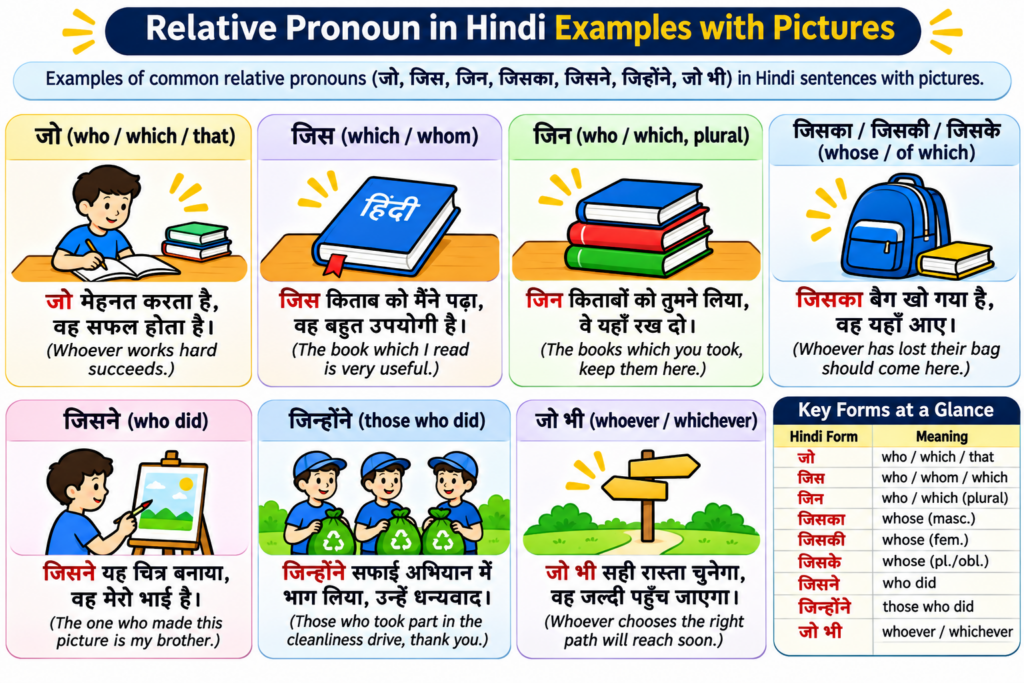
Pictures make it easier to understand how relative pronouns identify an object, its owner, or a group of people.
The table shows common relative forms with three example expressions each. The illustrations can focus on books, bags, keys, boxes, and other everyday objects.
| Relative Form | Three Hindi Examples | English Meaning | Picture Concept |
|---|---|---|---|
| जो | जो आया, जो पढ़ता है, जो सही है | Who came; who studies; which is correct | A selected book among several |
| जिस | जिस पर, जिसमें, जिससे | On which; in which; with which | One marked container |
| जिन | जिनमें, जिनसे, जिन पर | In which; from which; on which, plural | Several marked boxes |
| जिसका / जिसकी / जिसके | जिसका बैग, जिसकी किताब, जिसके दोस्त | Whose bag; whose book; whose friends | Bag, notebook, and belongings |
| जिसने | जिसने लिखा, जिसने खोला, जिसने बनाया | Who wrote; who opened; who made | Pencil, open box, finished model |
| जिन्होंने | जिन्होंने पढ़ा, जिन्होंने बनाया, जिन्होंने चुना | Those who read, made, or chose | Several completed tasks |
| जो भी | जो भी आए, जो भी सही हो, जो भी मिले | Whoever comes; whichever is correct; whatever is found | Multiple options with one selected |
Relative Pronoun Examples in Hindi Sentences
Relative pronouns connect ideas without unnecessary repetition.
The following sentences use singular, plural, possessive, and correlative structures. The relative words are highlighted for easy identification.
| No. | Hindi Sentence | English Translation |
|---|---|---|
| 1 | जो मेहनत करता है, वह सफल होता है। | Whoever works hard succeeds. |
| 2 | जो यहाँ रहता है, वह मेरा मित्र है। | The one who lives here is my friend. |
| 3 | जो सही है, उसे चुनो। | Choose what is correct. |
| 4 | जो पुस्तक चाहिए, उसे ले लो। | Take the book you need. |
| 5 | जो पहले आएगा, उसे प्रवेश मिलेगा। | Whoever comes first will be admitted. |
| 6 | जिसने पत्र लिखा, वह मेरा भाई है। | The person who wrote the letter is my brother. |
| 7 | जिसने दरवाज़ा खोला, वह बाहर गया। | Whoever opened the door went outside. |
| 8 | जिसने मदद की, उसका धन्यवाद करो। | Thank the person who helped. |
| 9 | जिसने उत्तर दिया, उसे पुरस्कार मिला। | The person who answered received a prize. |
| 10 | जिसने यह चित्र बनाया, वह कलाकार है। | The person who made this picture is an artist. |
| 11 | जिसे तुम जानते हो, वह यहाँ आया है। | The person whom you know has come here. |
| 12 | जिसे किताब चाहिए, वह हाथ उठाए। | Whoever needs a book should raise their hand. |
| 13 | जिसे मैंने बुलाया, वह नहीं आया। | The person whom I invited did not come. |
| 14 | जिसे यह पसंद है, वह इसे रख सकता है। | Whoever likes this may keep it. |
| 15 | जिसे मदद मिली, वह खुश था। | The person who received help was happy. |
| 16 | जिससे मैंने बात की, वह शिक्षक है। | The person I spoke with is a teacher. |
| 17 | जिससे तुमने कल पूछा, वह मेरा मित्र है। | The person you asked yesterday is my friend. |
| 18 | जिसमें पानी है, उसे उठाओ। | Pick up the one containing water. |
| 19 | जिस पर नाम लिखा है, वह मेरा है। | The one with a name written on it is mine. |
| 20 | जिसके लिए यह उपहार है, वह अभी नहीं आया। | The person this gift is for has not arrived yet. |
| 21 | जिसका बैग खो गया है, वह यहाँ आए। | Whoever lost their bag should come here. |
| 22 | जिसकी किताब यहाँ है, वह इसे ले जाए। | Whoever owns the book here should take it. |
| 23 | जिसके दोस्त आए हैं, वह खुश है। | The person whose friends arrived is happy. |
| 24 | जिसका घर बड़ा है, वह हमें जानता है। | The person whose house is large knows us. |
| 25 | जिसकी चाबी मिली है, उसे बुलाओ। | Call the person whose key was found. |
| 26 | जिन्होंने प्रतियोगिता जीती, उन्हें पुरस्कार मिला। | Those who won the competition received prizes. |
| 27 | जिन्होंने काम पूरा किया, वे जा सकते हैं। | Those who completed the work may leave. |
| 28 | जिन्होंने मदद की, उनका धन्यवाद करो। | Thank those who helped. |
| 29 | जिन्होंने आवेदन किया, उन्हें संदेश मिलेगा। | Those who applied will receive a message. |
| 30 | जिन्होंने पुस्तक पढ़ी, वे उत्तर दें। | Those who read the book should answer. |
| 31 | जिन्हें मदद चाहिए, वे यहाँ आएँ। | Those who need help should come here. |
| 32 | जिन्हें बुलाया गया है, वे अंदर जाएँ। | Those who were invited should go inside. |
| 33 | जिनसे हम मिले, वे बहुत विनम्र थे। | The people we met were very polite. |
| 34 | जिनसे तुमने बात की, वे मेरे शिक्षक हैं। | Those you spoke with are my teachers. |
| 35 | जिनमें फल हैं, वे डिब्बे अलग रखो। | Keep the boxes containing fruit separately. |
| 36 | जो भी आएगा, उसे बैठने दो। | Let whoever comes sit down. |
| 37 | जो भी सही लगे, उसे चुनो। | Choose whichever seems correct. |
| 38 | जिसे भी यह चाहिए, वह ले सकता है। | Whoever needs this may take it. |
| 39 | जिसने भी नियम तोड़ा, उसे समझाया जाएगा। | Whoever broke the rule will be given an explanation. |
| 40 | जो कुछ भी सीखो, उसका अभ्यास करो। | Practice whatever you learn. |
Relative Pronoun vs Interrogative Pronoun in Hindi
Relative and interrogative pronouns may refer to the same people or objects, but their grammatical functions differ.
Relative pronouns connect clauses. Interrogative pronouns ask questions.
| Relative Pronoun | Interrogative Pronoun |
|---|---|
| जो — Who / Which / That | कौन — Who? |
| जिसने — The one who did | किसने — Who did? |
| जिसे — Whom | किसे — Whom? |
| जिसका — Whose | किसका — Whose? |
| जिससे — With whom | किससे — With whom? |
Relative: जिसने किताब ली, वह यहाँ आए।
English: Whoever took the book should come here.
Interrogative: किसने किताब ली?
English: Who took the book?
Common Mistakes with Relative Pronouns in Hindi
Relative pronoun mistakes often involve incorrect case forms, possessive agreement, and confusion between relative and interrogative constructions.
| Common Mistake | Incorrect | Correct / Explanation |
|---|---|---|
| Using जो instead of जिसने for the agent | जो ने किताब लिखी। | जिसने किताब लिखी। |
| Using जिस with a plural referent where plural agreement is required | जिसने काम किया, वे छात्र आए। | जिन्होंने काम किया, वे छात्र आए। |
| Incorrect possessive agreement | जिसका किताब खो गई। | जिसकी किताब खो गई। |
| Wrong object form | जो को बुलाया। | जिसे बुलाया। |
| Incorrect relative form before से | जो से बात की। | जिससे बात की। |
| Confusing relative and interrogative pronouns | किसने मदद की, उसका धन्यवाद करो। | जिसने मदद की, उसका धन्यवाद करो। |
| Wrong correlative pairing | जो आया, उसे बैठ गया। | जो आया, वह बैठ गया। |
| Confusing singular and plural relative objects | जिन्हें बुलाया, वह आए। when referring to several people | जिन्हें बुलाया, वे आए। |
| Using masculine possessive agreement with a feminine noun | जिसका चाबी मिली। | जिसकी चाबी मिली। |
| Assuming every relative clause must precede the main clause | Treating a sentence-final relative clause as always wrong | यह वही किताब है जो मैंने खरीदी थी। is correct. |
Relative Pronouns Exercises in Hindi
Practice recognizing जो, जिस, जिन, जिसने, जिसे, जिसका, and जिन्होंने in different sentence structures.
The interactive worksheet also covers correlative pairs, possessive agreement, case forms, and relative versus interrogative pronouns.
⋮⋮⋮⋮Download Relative Pronouns Worksheet with Answers PDF
Use the printable worksheet to complete relative pronoun sentences, identify correct grammatical forms, and practice जो–वह constructions.
The PDF includes an answer key to make classroom practice and independent revision easier.
Download Relative Pronoun in Hindi Study Notes PDF
Keep the main relative pronoun forms, correlative patterns, grammar rules, and Hindi-English examples together in one reference document.
These notes are useful for offline study, sentence-writing practice, and quick grammar revision..
Frequently Asked Questions
Can जो refer to both people and objects?
Yes. जो can refer to people, objects, or ideas. The correct interpretation depends on the antecedent and surrounding clause.
Why does जो change to जिस or जिन?
जिस and जिन are oblique forms used in particular case and postpositional constructions. जिस is generally singular, while जिन is plural or honorific.
Is जो भी a separate basic type of relative pronoun?
No. जो भी is an extended relative expression that often means whoever or whichever, rather than a separate foundational pronoun class.
Can Hindi sentences omit the matching वह?
Yes. A corresponding demonstrative is common in Hindi correlative constructions, but it is not obligatory in every relative-clause structure.
Conclusion
Relative pronouns are especially useful when one sentence must explain which person, object, or group we mean. जो introduces the relationship, while जिस and जिन help express different grammatical roles.
Try completing these ideas: ___ मेहनत करेगा, वह सीखेगा, ___ किताब खो गई है, वह यहाँ आए, and ___ मदद चाहिए, वे हाथ उठाएँ. Share your answers in the comments.
Leave a Reply