A teacher walks into the classroom and notices a notebook on an empty desk. Nobody knows who left it there. One student says, “किसी ने यहाँ किताब रखी है” (Someone has left a book here). Another notices a few loose pages and says, “कुछ नीचे गिरा है” (Something has fallen on the floor).
Neither student knows exactly who left the notebook or what fell. Words such as किसी (someone) and कुछ (something) help us talk about people and things without identifying them. In Hindi grammar, these are examples of indefinite pronouns (अनिश्चयवाचक सर्वनाम).
But how does कोई become किसी, and why do expressions such as कोई भी, कुछ न कुछ, and कोई न कोई have slightly different meanings? These forms appear constantly in conversations, stories, and questions. Learning their patterns makes Hindi sentences more natural and precise.
Indefinite Pronoun Types in Hindi
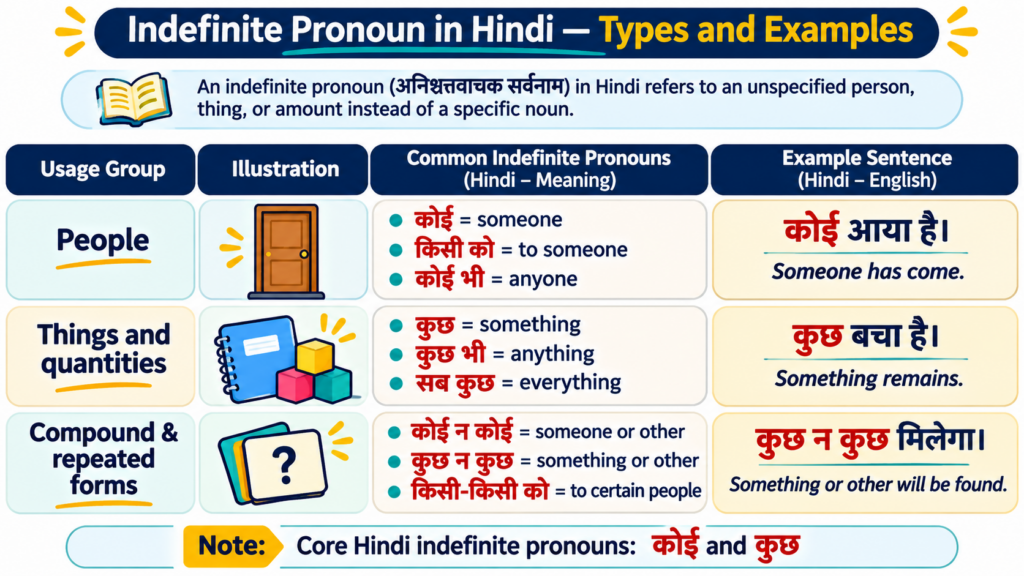
Hindi indefinite pronouns are commonly grouped by their meaning and grammatical structure. The two basic forms are कोई and कुछ.
For easier learning, their uses can be organized into three practical groups: reference to people, reference to things, and compound or repeated expressions.
1. Indefinite Pronouns for People
These pronouns refer to a person whose identity is unknown or not specified.
The common form कोई changes to किसी in many oblique constructions.
Examples:
- कोई — Someone / Anyone
- किसी ने — Someone, as the agent
- किसी को — To someone
Sentence: कोई दरवाज़े पर है।
English: Someone is at the door.
2. Indefinite Pronouns for Things and Quantities
These forms refer to unidentified objects, unspecified amounts, or things not named precisely.
कुछ is the most important basic form, while कई and similar quantifiers can indicate unspecified quantities.
Examples:
- कुछ — Something / Some
- कुछ भी — Anything
- सब कुछ — Everything
Sentence: मुझे कुछ चाहिए।
English: I need something.
3. Compound and Repeated Indefinite Forms
Hindi combines or repeats indefinite words to express uncertainty, general choice, or an unspecified member of a group.
These are extended expressions rather than separate traditional grammatical subclasses.
Examples:
- कोई न कोई — Someone or other
- कुछ न कुछ — Something or other
- किसी न किसी को — To someone or other
Sentence: कोई न कोई रास्ता मिल जाएगा।
English: Some solution or other will be found.
Indefinite Pronoun Types Comparison
| Usage Group | Hindi Name | Main Forms | English Meaning |
|---|---|---|---|
| People | व्यक्ति के लिए अनिश्चित संदर्भ | कोई, किसी, किन्हीं | Someone / Anyone / Certain people |
| Things and quantities | वस्तु या मात्रा के लिए अनिश्चित संदर्भ | कुछ, कुछ भी, सब कुछ | Something / Anything / Everything |
| Compound and repeated forms | संयुक्त और पुनरुक्त अनिश्चित रूप | कोई न कोई, कुछ न कुछ, किसी-किसी | Someone or other / Something or other / Certain ones |
Grammar Note: Traditional Hindi grammar primarily identifies कोई and कुछ as the basic indefinite pronouns. Forms such as कई, सभी, and कुछ लोग can function as quantifiers or determiners rather than standalone pronouns.
Indefinite Pronoun Grammar Rules in Hindi
Indefinite pronouns allow speakers to refer to people or things without naming them.
Their correct use depends on sentence meaning, postpositions, negation, and whether the word stands independently or modifies a noun.
Rule 1: Use कोई for an Unspecified Person
कोई commonly means someone or anyone, depending on context.
| Hindi Sentence | English Meaning |
|---|---|
| कोई आया है। | Someone has come. |
| क्या कोई यहाँ है? | Is anyone here? |
| कोई मेरी मदद करेगा। | Someone will help me. |
Rule 2: Use कुछ for an Unspecified Thing
कुछ can refer to an unknown thing or an unspecified amount.
| Hindi Sentence | English Meaning |
|---|---|
| कुछ हुआ है। | Something has happened. |
| मुझे कुछ बताओ। | Tell me something. |
| कुछ बचा है। | Something remains. |
Rule 3: कोई Often Changes to किसी Before Postpositions
In many oblique constructions, कोई takes the form किसी.
| Direct Form | Oblique Expression | English Meaning |
|---|---|---|
| कोई | किसी ने | Someone did |
| कोई | किसी को | To someone |
| कोई | किसी से | From / With someone |
| कोई | किसी का | Someone’s |
| कोई | किसी के लिए | For someone |
Example: किसी ने दरवाज़ा खोला।
English: Someone opened the door.
Rule 4: कुछ Usually Keeps the Same Basic Form
Unlike कोई, the word कुछ generally remains unchanged before many constructions.
Examples:
- कुछ में — In some
- कुछ से — From some
- कुछ के लिए — For some
- कुछ को — To some, in a suitable context
Sentence: कुछ में पानी है।
English: Some of them contain water.
Rule 5: Use भी to Express Any or Anyone
Adding भी often broadens the meaning of an indefinite expression.
| Hindi Expression | English Meaning |
|---|---|
| कोई भी | Anyone |
| कुछ भी | Anything |
| किसी को भी | To anyone |
| किसी से भी | From / With anyone |
Example: कोई भी यह प्रश्न हल कर सकता है।
English: Anyone can solve this question.
Rule 6: Use नहीं for Negative Indefinite Statements
Hindi commonly expresses negative indefinite meanings by combining an indefinite word with नहीं.
| Hindi Expression | English Meaning |
|---|---|
| कोई नहीं | Nobody |
| कुछ नहीं | Nothing |
| किसी ने नहीं | Nobody did |
| किसी को नहीं | To nobody / Not to anyone |
Example: यहाँ कोई नहीं है।
English: Nobody is here.
Rule 7: Repetition Can Express an Unspecified Choice
Repeated or combined indefinite expressions often suggest that one or more unspecified possibilities exist.
Example: कुछ न कुछ सीखने को मिलेगा।
English: There will be something or other to learn.
Example: किसी न किसी ने यह देखा होगा।
English: Someone or other must have seen this.
Rule 8: Distinguish Pronouns from Determiners
An indefinite pronoun stands independently, while an indefinite determiner or quantifier appears with a noun.
| Indefinite Pronoun | Indefinite Determiner / Quantifier |
|---|---|
| कोई आया है। (Someone has come.) | कोई व्यक्ति आया है। (Some person has come.) |
| कुछ बचा है। (Something remains.) | कुछ खाना बचा है। (Some food remains.) |
| कई आए। (Several came.) | कई छात्र आए। (Several students came.) |
The same word can serve different grammatical functions depending on its sentence position.
Indefinite Pronoun Examples in Hindi
Indefinite expressions are useful for talking about unknown people, unspecified things, choices, and quantities.
The following tables organize common expressions by their practical meaning and use.
Indefinite Pronouns for People with Hindi Meanings
These examples use कोई and its related expressions for unspecified people.
Some entries are complete phrases containing an indefinite pronoun rather than individual standalone pronouns.
| No. | Hindi Expression | English Meaning |
|---|---|---|
| 1 | कोई | Someone / Anyone |
| 2 | किसी ने | Someone, as agent |
| 3 | किसी को | To someone |
| 4 | किसी से | From / With someone |
| 5 | किसी का | Someone’s |
| 6 | किसी की | Someone’s |
| 7 | किसी के | Someone’s / Of someone |
| 8 | किसी में | In someone |
| 9 | किसी पर | On someone |
| 10 | किसी के पास | With someone / Someone has |
| 11 | किसी के लिए | For someone |
| 12 | किसी के साथ | With someone |
| 13 | किसी के बिना | Without someone |
| 14 | किसी तक | Up to someone |
| 15 | कोई भी | Anyone |
| 16 | किसी को भी | To anyone |
| 17 | किसी से भी | From / With anyone |
| 18 | कोई और | Someone else |
| 19 | किसी और को | To someone else |
| 20 | किसी और से | With someone else |
| 21 | कोई नहीं | Nobody |
| 22 | किसी ने नहीं | Nobody did |
| 23 | किसी को नहीं | Not to anyone |
| 24 | हर कोई | Everyone |
| 25 | हर किसी को | To everyone |
| 26 | कोई एक | Any one |
| 27 | किन्हीं को | To certain people |
| 28 | किन्हीं से | From certain people |
| 29 | कुछ लोग | Some people |
| 30 | कई लोग | Several people |
Note: कुछ लोग and कई लोग are noun phrases with quantifiers. Their inclusion helps compare related indefinite expressions without treating every expression as a separate pronoun.
Indefinite Pronouns for Things and Quantities
These expressions refer to unspecified objects, substances, amounts, or groups.
कुछ is the core indefinite pronoun; several other entries are broader quantifier expressions.
| No. | Hindi Expression | English Meaning |
|---|---|---|
| 1 | कुछ | Something / Some |
| 2 | कुछ भी | Anything |
| 3 | कुछ नहीं | Nothing |
| 4 | सब कुछ | Everything |
| 5 | कुछ और | Something else |
| 6 | कुछ नया | Something new |
| 7 | कुछ अच्छा | Something good |
| 8 | कुछ पुराना | Something old |
| 9 | कुछ खास | Something special |
| 10 | कुछ अलग | Something different |
| 11 | कुछ बचा हुआ | Something remaining |
| 12 | कुछ खाने को | Something to eat |
| 13 | कुछ पीने को | Something to drink |
| 14 | कुछ पढ़ने को | Something to read |
| 15 | कुछ लिखने को | Something to write |
| 16 | कुछ में | In some |
| 17 | कुछ से | From some |
| 18 | कुछ के लिए | For some |
| 19 | कुछ का | Of some |
| 20 | कुछ की | Of some |
| 21 | कुछ के | Of some |
| 22 | कुछ हिस्से | Some parts |
| 23 | कुछ बातें | Some things / Matters |
| 24 | कुछ किताबें | Some books |
| 25 | कई चीज़ें | Several things |
| 26 | कई विकल्प | Several options |
| 27 | कुछ मात्रा में | In some amount |
| 28 | बहुत कुछ | A lot of things |
| 29 | थोड़ा कुछ | A little something |
| 30 | कुछ और भी | Something more as well |
Compound and Repeated Indefinite Forms
Hindi frequently combines indefinite words with न, भी, और, or repetition.
These patterns express uncertainty, broad choice, partial distribution, or an unspecified possibility.
| No. | Hindi Expression | English Meaning |
|---|---|---|
| 1 | कोई न कोई | Someone or other |
| 2 | कुछ न कुछ | Something or other |
| 3 | किसी न किसी ने | Someone or other did |
| 4 | किसी न किसी को | To someone or other |
| 5 | किसी न किसी से | With someone or other |
| 6 | किसी न किसी का | Belonging to someone or other |
| 7 | किसी न किसी के | Of someone or other |
| 8 | किसी न किसी तरह | Somehow or other |
| 9 | कोई न कोई रास्ता | Some way or other |
| 10 | कोई न कोई उपाय | Some solution or other |
| 11 | कुछ न कुछ काम | Some work or other |
| 12 | कुछ न कुछ बात | Something or other |
| 13 | कुछ न कुछ कारण | Some reason or other |
| 14 | कुछ न कुछ बदलाव | Some change or other |
| 15 | कुछ न कुछ फायदा | Some benefit or other |
| 16 | कोई-कोई | Some individuals / Occasionally some |
| 17 | किसी-किसी को | To certain people |
| 18 | किसी-किसी से | From / With certain people |
| 19 | कुछ-कुछ | A little / Somewhat |
| 20 | कुछ-कुछ याद | Remembering a little |
| 21 | कुछ-कुछ समझ | Partial understanding |
| 22 | कोई और भी | Someone else too |
| 23 | कुछ और भी | Something else too |
| 24 | कोई भी नहीं | Not anyone |
| 25 | कुछ भी नहीं | Nothing at all |
| 26 | हर कोई | Everyone |
| 27 | हर किसी को | To everyone |
| 28 | सब कुछ | Everything |
| 29 | जो कोई भी | Whoever |
| 30 | जो कुछ भी | Whatever |
These are related indefinite constructions. Expressions beginning with जो also involve relative-pronoun grammar, so they should not be treated as a separate basic indefinite category.
Indefinite Pronoun Examples in Hindi Sentences
Indefinite pronouns appear in questions, statements, negative sentences, requests, and everyday conversations.
The important Hindi expressions and their English equivalents are highlighted in bold.
| No. | Hindi Sentence | English Translation |
|---|---|---|
| 1 | कोई बाहर खड़ा है। | Someone is standing outside. |
| 2 | किसी ने घंटी बजाई। | Someone rang the bell. |
| 3 | कोई मेरी किताब ले गया। | Someone took my book. |
| 4 | क्या कोई यहाँ है? | Is anyone here? |
| 5 | किसी को मदद चाहिए। | Someone needs help. |
| 6 | किसी से पूछ लो। | Ask someone. |
| 7 | कोई और आएगा। | Someone else will come. |
| 8 | यहाँ कोई नहीं है। | There is nobody here. |
| 9 | किसी ने नहीं बताया। | Nobody told me. |
| 10 | हर कोई सीख सकता है। | Everyone can learn. |
| 11 | कुछ हुआ है। | Something has happened. |
| 12 | मुझे कुछ चाहिए। | I need something. |
| 13 | कुछ बचा है। | Something remains. |
| 14 | उसने कुछ कहा। | He or she said something. |
| 15 | क्या कुछ मिला? | Did you find anything? |
| 16 | मुझे कुछ नहीं चाहिए। | I need nothing. |
| 17 | सब कुछ ठीक है। | Everything is fine. |
| 18 | मैंने कुछ नया सीखा। | I learned something new. |
| 19 | कुछ भी चुन लो। | Choose anything. |
| 20 | कुछ और बताओ। | Tell me something else. |
| 21 | कोई भी आ सकता है। | Anyone can come. |
| 22 | किसी को भी बुलाओ। | Call anyone. |
| 23 | किसी से भी पूछ सकते हो। | You can ask anyone. |
| 24 | कोई न कोई मदद करेगा। | Someone or other will help. |
| 25 | कुछ न कुछ सीखने को मिलेगा। | There will be something or other to learn. |
| 26 | किसी न किसी ने देखा होगा। | Someone or other must have seen it. |
| 27 | कोई न कोई रास्ता मिलेगा। | Some way or other will be found. |
| 28 | किसी-किसी को यह पसंद है। | Some people like this. |
| 29 | मुझे कुछ-कुछ याद है। | I remember a little. |
| 30 | कई आए, लेकिन कुछ लौट गए। | Several came, but some returned. |
| 31 | कुछ लोग देर से आए। | Some people arrived late. |
| 32 | कई छात्र अनुपस्थित थे। | Several students were absent. |
| 33 | किसी ने दरवाज़ा खोला। | Someone opened the door. |
| 34 | कोई भी यह कर सकता है। | Anyone can do this. |
| 35 | कुछ भी नहीं बचा। | Nothing at all remained. |
| 36 | हर किसी को अवसर मिलना चाहिए। | Everyone should get an opportunity. |
| 37 | जो कोई भी आए, उसे अंदर भेजो। | Send in whoever comes. |
| 38 | जो कुछ भी चाहिए, बता दो। | Tell me whatever you need. |
| 39 | किसी और को यह दे दो। | Give this to someone else. |
| 40 | कुछ न कुछ बदलना पड़ेगा। | Something or other will have to change. |
Indefinite Pronoun vs Indefinite Determiner in Hindi
An indefinite pronoun stands independently, while an indefinite determiner accompanies a noun.
Understanding this difference prevents confusion when identifying words such as कोई, कुछ, and कई.
| Indefinite Pronoun | Indefinite Determiner / Quantifier |
|---|---|
| कोई आया है। (Someone has come.) | कोई व्यक्ति आया है। (Some person has come.) |
| कुछ बचा है। (Something remains.) | कुछ खाना बचा है। (Some food remains.) |
| कई लौट गए। (Several returned.) | कई छात्र लौट गए। (Several students returned.) |
| कुछ गिर गए। (Some fell.) | कुछ फल गिर गए। (Some fruits fell.) |
The important question is whether the indefinite word stands in place of a noun or appears with one.
Common Mistakes with Indefinite Pronouns in Hindi
Errors commonly involve oblique forms, negative expressions, and confusing independent pronouns with noun modifiers.
| Common Mistake | Incorrect | Correct / Explanation |
|---|---|---|
| Using कोई instead of किसी before ने | कोई ने दरवाज़ा खोला। | किसी ने दरवाज़ा खोला। |
| Using the wrong object form | कोई को बुलाओ। | किसी को बुलाओ। |
| Incorrect form with से | कोई से पूछो। | किसी से पूछो। |
| Omitting नहीं in negative statements | यहाँ कोई है। when meaning nobody | यहाँ कोई नहीं है। |
| Confusing कोई and कुछ | कुछ दरवाज़े पर है। when referring to an unknown person | कोई दरवाज़े पर है। |
| Treating every quantifier as a pronoun | Calling कई a pronoun in कई छात्र आए। | Here कई is a quantifier modifying छात्र. |
| Using a double negative incorrectly in English | Translating कोई नहीं आया as Nobody didn’t come | Nobody came. |
| Confusing कुछ with कुछ भी | Assuming both always mean anything | कुछ often means something/some; कुछ भी often means anything. |
Indefinite Pronoun in Hindi Worksheet
Practice identifying indefinite pronouns, selecting कोई or कुछ, forming oblique expressions with किसी, and distinguishing pronouns from quantifiers.
The exercises also cover negative, compound, and repeated forms.
⋮⋮⋮⋮Download Indefinite Pronoun Worksheet with Answers PDF
Use the printable worksheet to practice indefinite references to people and things, correct sentence completion, and common grammar rules.
The PDF includes multiple-choice questions and a complete answer key for checking responses independently.
Download Indefinite Pronoun in Hindi PDF Study Notes
Review the meaning of indefinite pronouns, the major usage groups, Hindi-English examples, and important grammar rules in one document.
These notes are useful for offline reading, classroom revision, and exam preparation.
Frequently Asked Questions
Can कोई refer to both singular and plural people?
Yes. कोई usually refers to an unspecified individual, but Hindi also has forms and constructions that refer to unspecified groups. Context determines the meaning.
What is the difference between किसी and किन्हीं?
किसी is commonly used for an unspecified singular referent in oblique contexts. किन्हीं is a plural oblique form used with unspecified people or things, often in more formal Hindi.
Is कहीं an indefinite pronoun?
No. कहीं generally functions as an adverb referring to an unspecified location, rather than as a pronoun replacing a noun.
Can कुछ describe an amount rather than an object?
Yes. कुछ can refer to an unspecified quantity in expressions such as कुछ पानी, where it functions as a quantifier modifying the noun.
Time To Practice Now
A conversation does not always need exact names or numbers. कोई helps when a person is unidentified, while कुछ is useful when a thing or amount remains unspecified.
Try completing these three ideas in Hindi: Someone knocked, I need something, and Nobody came. Use किसी, कुछ, and कोई नहीं where appropriate, then share your sentences in the comments.
Leave a Reply