A teacher places three closed boxes on a table. One student wants to know what is inside them and asks, “इसमें क्या है?” Another notices that a box is missing and asks, “किसने डिब्बा उठाया?” A third points to a bag and says, “यह किसका है?” Each question asks for different information.
Words such as कौन (who), क्या (what), किसे (whom), and किसका (whose) are examples of an interrogative pronoun in hindi, called प्रश्नवाचक सर्वनाम. They replace an unknown person, object, or owner in a question. Instead of naming something, they help us discover its identity.
One small change can make a big difference. कौन आया? asks who arrived, while किसने दरवाज़ा खोला? asks who performed a particular action. Similarly, कौन-सी तुम्हारी है? asks someone to choose between known options.
These distinctions make interrogative pronouns useful in everyday Hindi conversations and writing.
Interrogative Pronouns Types in Hindi
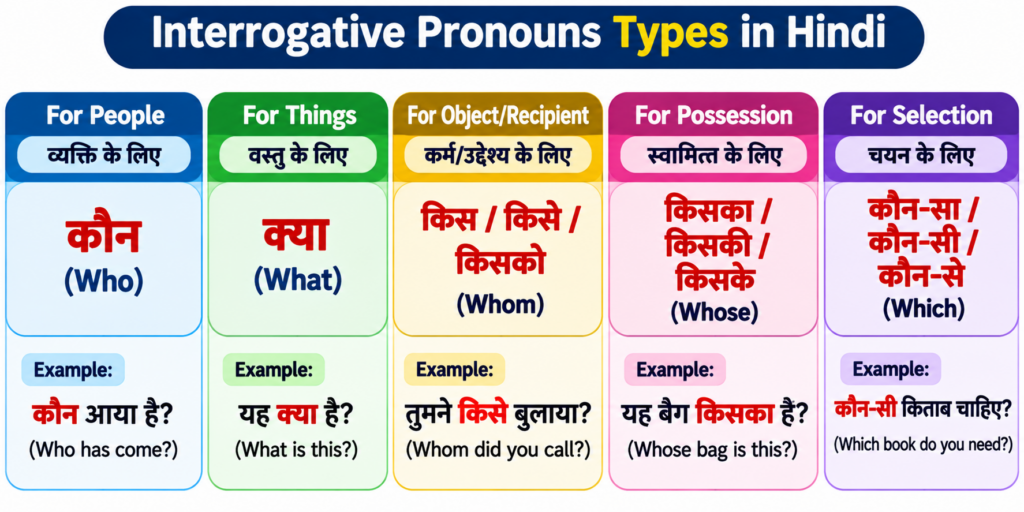
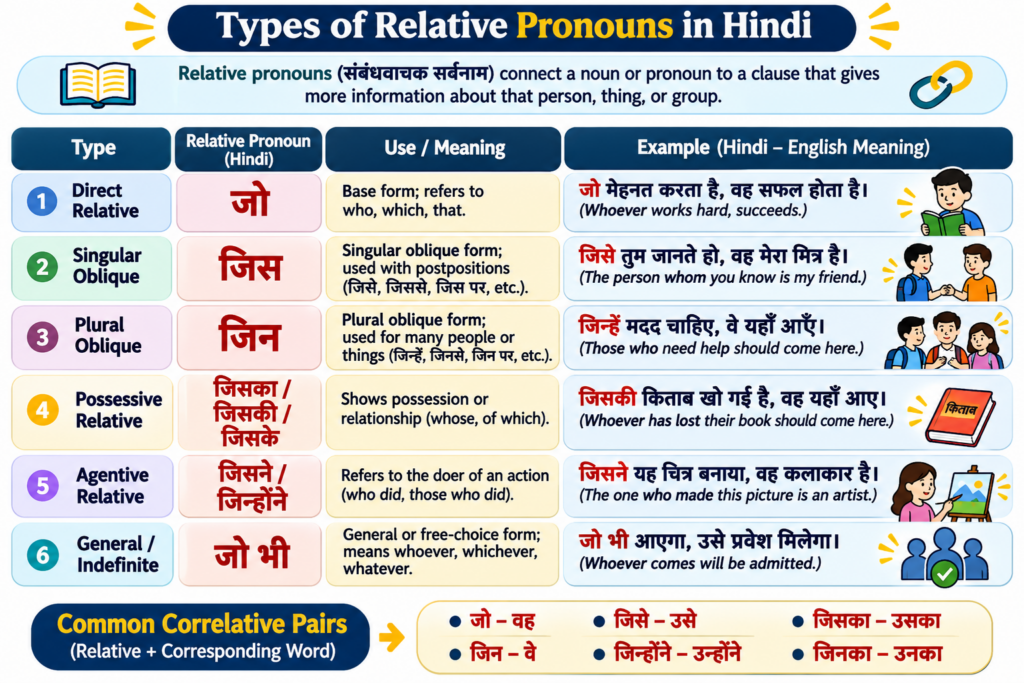
Hindi interrogative pronouns are commonly grouped according to what a question asks: a person, a thing, an object, an owner, or a choice.
These are practical usage groups rather than five completely independent grammatical classes. Many forms come from कौन and क्या.
| Usage Group | Hindi Form | English Meaning | Example |
|---|---|---|---|
| Person or identity | कौन | Who | कौन आया? |
| Thing or information | क्या | What | क्या हुआ? |
| Object or recipient | किस / किसे / किसको | Whom | तुमने किसे बुलाया? |
| Ownership | किसका / किसकी / किसके | Whose | यह किसका है? |
| Selection | कौन-सा / कौन-सी / कौन-से | Which one | कौन-सी तुम्हारी है? |
1. Interrogative Pronouns for People
कौन asks about the identity of a person or group of people.
It can function as the subject of a question.
Example: कौन दरवाज़े पर है?
English: Who is at the door?
2. Interrogative Pronouns for Things
क्या asks about an unidentified object, action, event, or piece of information.
Its grammatical function depends on the sentence.
Example: तुमने क्या खरीदा?
English: What did you buy?
3. Object and Oblique Interrogative Forms
किस is an oblique form used with postpositions and grammatical markers.
It appears in expressions such as किसे, किसको, किससे, and किसने.
Example: तुमने किसे देखा?
English: Whom did you see?
4. Possessive Interrogative Forms
किसका, किसकी, and किसके ask about ownership or association.
Their endings follow the gender, number, and grammatical case of the possessed noun.
Example: यह किसकी है?
English: Whose is this?
5. Interrogative Forms for Selection
कौन-सा, कौन-सी, and कौन-से help select one or more options from a known group.
When these forms stand independently, they can function pronominally. Before a noun, they function as interrogative determiners.
Example: तुम्हें कौन-सा चाहिए?
English: Which one do you need?
Interrogative Pronoun Grammar Rules in Hindi
Hindi interrogative pronouns change according to grammatical case, gender agreement, and sentence structure.
Some forms stand independently, while others are used with postpositions or nouns.
Rule 1: Use कौन to Ask About Identity
कौन is commonly used when asking who a person is or who performs an action.
| Hindi Sentence | English Meaning |
|---|---|
| कौन आया? | Who came? |
| कौन बोल रहा है? | Who is speaking? |
| कौन तैयार है? | Who is ready? |
| कौन जीतेगा? | Who will win? |
Rule 2: Use क्या for Unknown Things or Information
क्या often means what when it stands in place of unknown information or an object.
| Hindi Sentence | English Meaning |
|---|---|
| क्या हुआ? | What happened? |
| तुमने क्या देखा? | What did you see? |
| तुम क्या चाहते हो? | What do you want? |
| यह क्या है? | What is this? |
क्या can also be a question particle in yes/no questions.
Example: क्या तुम तैयार हो? (Are you ready?)
In this sentence, क्या introduces a yes/no question rather than replacing an unknown noun.
Rule 3: Use किसने to Ask Who Performed an Action
किसने is used when asking about the agent in many perfective transitive constructions.
Example: किसने किताब लिखी?
English: Who wrote the book?
Compare कौन आया? (Who came?) with किसने दरवाज़ा खोला? (Who opened the door?).
Rule 4: Use किसे and किसको for Object or Recipient Questions
Both forms can ask who received an action or to whom something was given.
| Hindi Sentence | English Meaning |
|---|---|
| तुमने किसे बुलाया? | Whom did you call? |
| तुमने किसको देखा? | Whom did you see? |
| पुरस्कार किसे मिला? | Who received the prize? |
| यह किसको देना है? | To whom should this be given? |
Rule 5: Use किस with Postpositions
The oblique base किस combines with postpositions to express different relationships.
| Hindi Expression | English Meaning |
|---|---|
| किससे | From whom / With whom / With what |
| किसमें | In what / In which |
| किस पर | On whom / On what |
| किसके लिए | For whom |
| किसके साथ | With whom |
| किसके पास | Who has / With whom |
| किसके बारे में | About whom / What |
Example: तुम किससे बात कर रहे हो?
English: With whom are you speaking?
Rule 6: Possessive Interrogatives Agree with the Possessed Noun
The endings of किसका, किसकी, and किसके generally agree with the noun being possessed.
| Hindi Expression | English Meaning |
|---|---|
| किसका कमरा | Whose room |
| किसकी किताब | Whose book |
| किसके जूते | Whose shoes |
| किसके कमरे में | In whose room |
Example: यह किताब किसकी है?
English: Whose book is this?
Rule 7: Use कौन-सा, कौन-सी, and कौन-से for Choosing
These forms change according to gender, number, and case.
| Hindi Form | Example | English |
|---|---|---|
| कौन-सा | कौन-सा सही है? | Which one is correct? |
| कौन-सी | कौन-सी नई है? | Which one is new? |
| कौन-से | कौन-से तुम्हारे हैं? | Which ones are yours? |
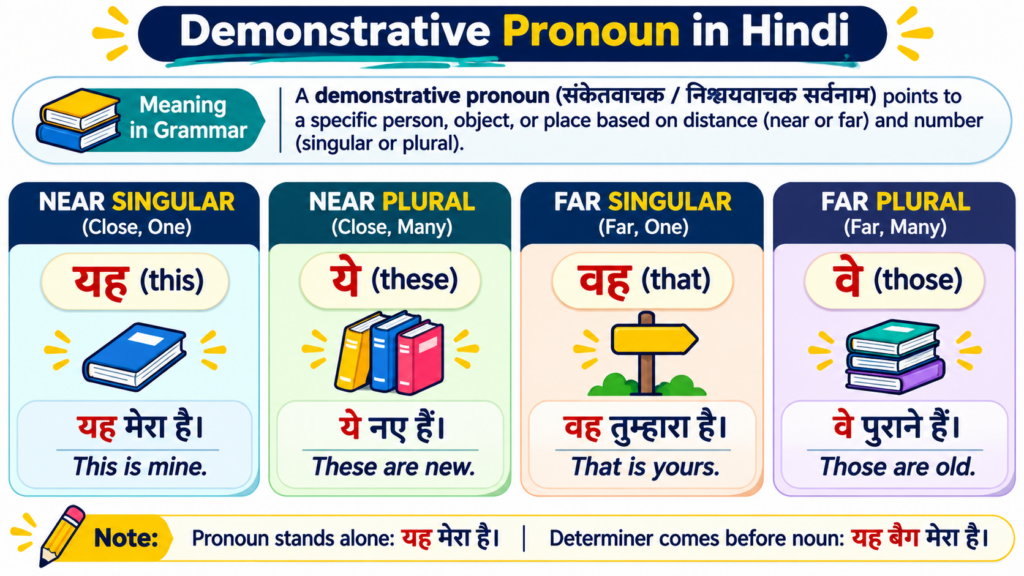
Rule 8: Distinguish Pronouns from Interrogative Determiners
An interrogative pronoun stands in place of an unknown noun. An interrogative determiner accompanies a noun.
| Interrogative Pronoun | Interrogative Determiner |
|---|---|
| कौन-सा तुम्हारा है? | कौन-सा बैग तुम्हारा है? |
| Which one is yours? | Which bag is yours? |
| कौन-सी नई है? | कौन-सी किताब नई है? |
| Which one is new? | Which book is new? |
Rule 9: Not Every Question Word Is a Pronoun
Hindi uses several question words that belong to other grammatical categories.
| Question Word | English Meaning | Usual Function |
|---|---|---|
| कहाँ | Where | Interrogative adverb |
| कब | When | Interrogative adverb |
| क्यों | Why | Interrogative adverb |
| कैसे | How | Interrogative adverb |
| कितना | How much / How many | Quantifier or determiner; sometimes pronominal |
Their ability to ask questions does not automatically make them interrogative pronouns.
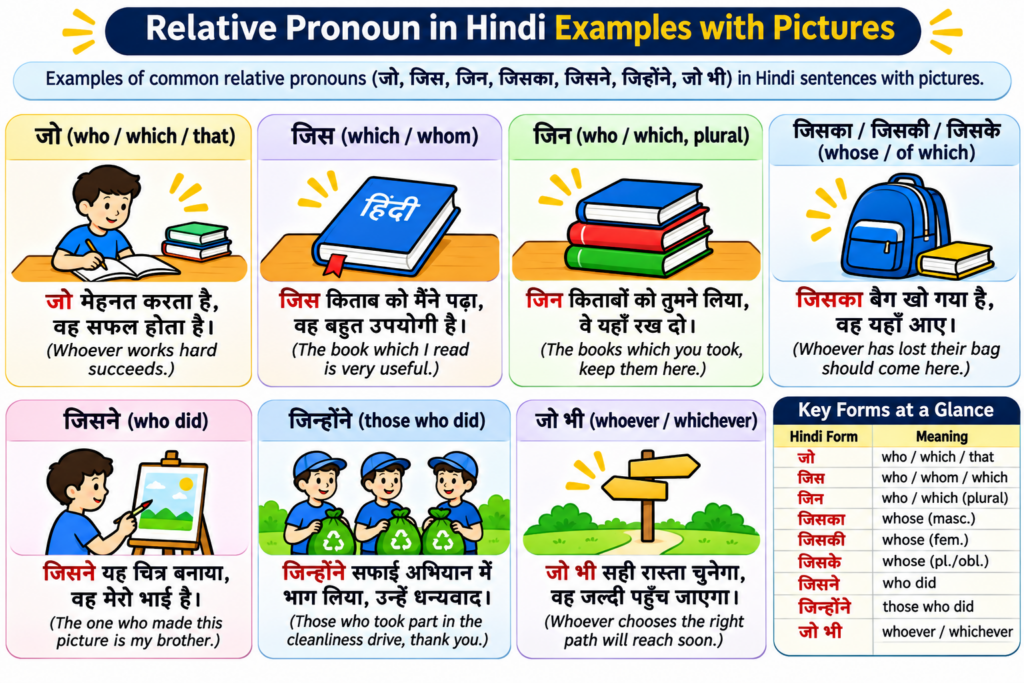
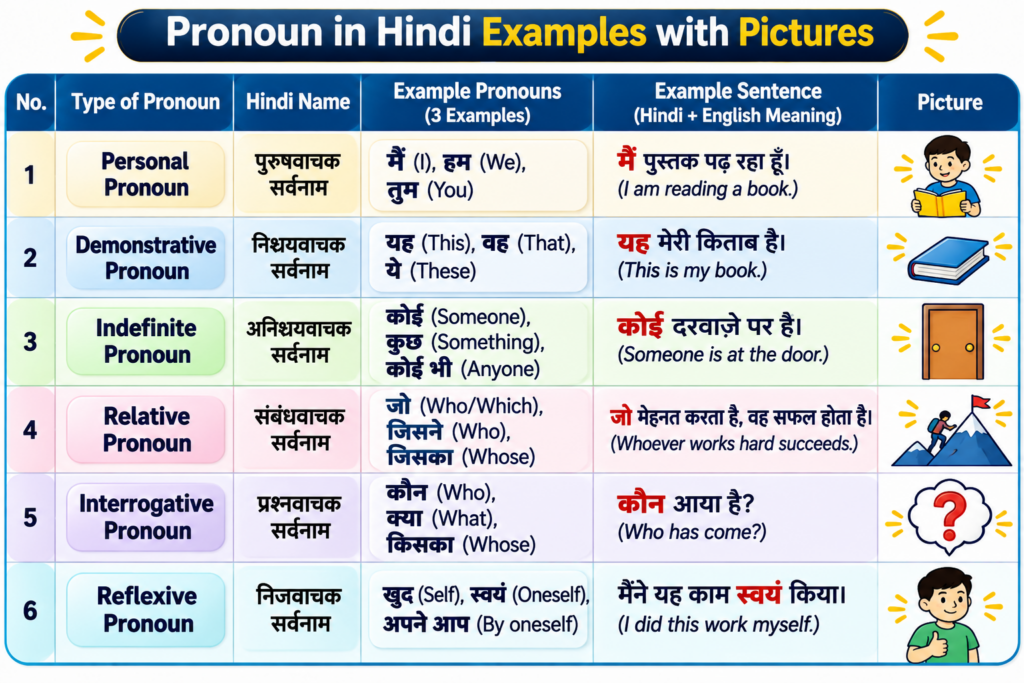
Interrogative Pronouns Examples in Hindi with Pictures
Lets connect pictures with people, objects, ownership, and selection.
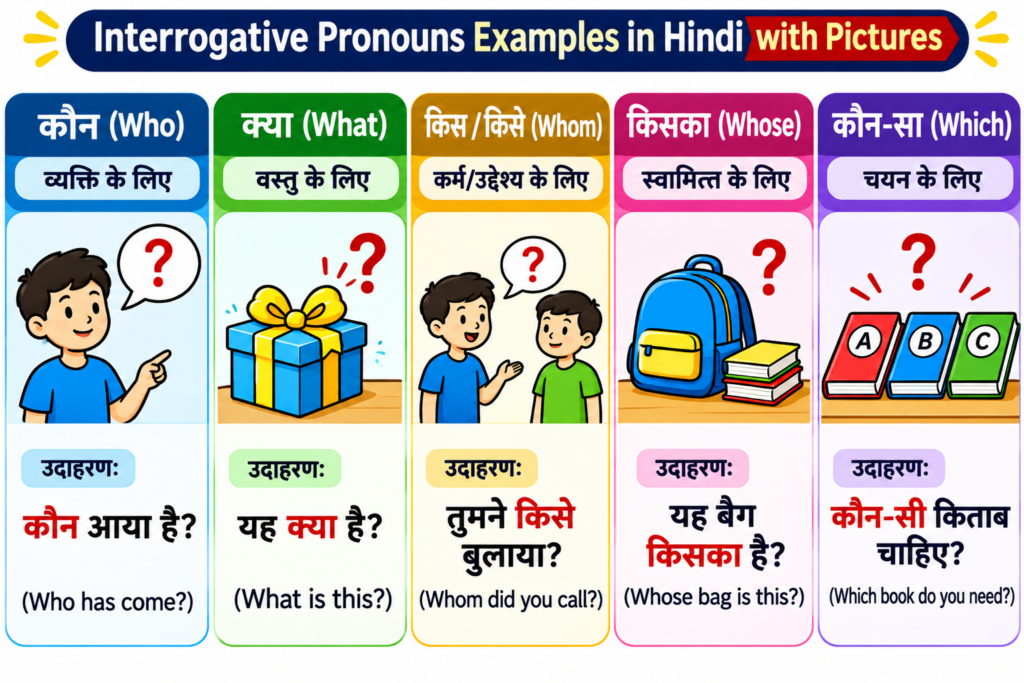
Common Interrogative Pronoun Forms with Hindi Meanings
Interrogative pronouns appear with different grammatical markers, possessive endings, and postpositions.
These expressions help learners form accurate questions about people, objects, ownership, and choices.
Interrogative Forms for People and Objects
| No. | Hindi Expression | English Meaning |
|---|---|---|
| 1 | कौन | Who |
| 2 | क्या | What |
| 3 | किस | Whom / Which, oblique |
| 4 | किसने | Who did |
| 5 | किसे | Whom / To whom |
| 6 | किसको | Whom / To whom |
| 7 | किससे | From / With whom or what |
| 8 | किसमें | In what / Which |
| 9 | किस पर | On whom / What |
| 10 | किसके लिए | For whom / What |
| 11 | किसके साथ | With whom |
| 12 | किसके पास | Who has / With whom |
| 13 | किसके बिना | Without whom |
| 14 | किसके बारे में | About whom / What |
| 15 | किसकी ओर | Towards whom |
| 16 | किसके सामने | In front of whom |
| 17 | किसके पीछे | Behind whom |
| 18 | किसके कारण | Because of whom / What |
| 19 | किसके बाद | After whom / What |
| 20 | किसके पहले | Before whom / What |
| 21 | किसके ऊपर | Above whom / What |
| 22 | किसके नीचे | Under whom / What |
| 23 | किसके अंदर | Inside what |
| 24 | किसके बाहर | Outside what |
| 25 | किससे होकर | Through what |
| 26 | किसे देखकर | Upon seeing whom |
| 27 | किसको लेकर | Regarding whom / What |
| 28 | किसने बनाया | Who made it |
| 29 | किससे पूछा | Asked whom |
| 30 | किसे चाहिए | Who needs it |
Possessive and Selection Interrogative Forms
These expressions ask about ownership or identify one option among several possibilities.
| No. | Hindi Expression | English Meaning |
|---|---|---|
| 1 | किसका | Whose, masculine |
| 2 | किसकी | Whose, feminine |
| 3 | किसके | Whose, plural/oblique |
| 4 | किसका बैग | Whose bag |
| 5 | किसकी किताब | Whose book |
| 6 | किसके जूते | Whose shoes |
| 7 | किसका घर | Whose house |
| 8 | किसकी चाबी | Whose key |
| 9 | किसके कपड़े | Whose clothes |
| 10 | किसकी कॉपी | Whose notebook |
| 11 | किसका नाम | Whose name |
| 12 | किसकी गलती | Whose mistake |
| 13 | किसके दोस्त | Whose friends |
| 14 | किसके कमरे में | In whose room |
| 15 | किसकी वजह से | Because of whom / What |
| 16 | कौन-सा | Which one, masculine |
| 17 | कौन-सी | Which one, feminine |
| 18 | कौन-से | Which ones / Oblique masculine |
| 19 | कौन-सा चुनूँ | Which one should I choose |
| 20 | कौन-सी लूँ | Which one should I take, feminine |
| 21 | कौन-से सही हैं | Which ones are correct |
| 22 | कौन-सा बैग | Which bag |
| 23 | कौन-सी किताब | Which book |
| 24 | कौन-से जूते | Which shoes |
| 25 | कौन-सा रास्ता | Which path |
| 26 | कौन-सी कुर्सी | Which chair |
| 27 | कौन-से कमरे | Which rooms |
| 28 | कौन-सी चाबी | Which key |
| 29 | कौन-सा उत्तर | Which answer |
| 30 | कौन-से विकल्प | Which options |
Some entries contain interrogative determiners and complete phrases, not independent pronouns. They are included to clarify how these forms behave in actual sentences.
Interrogative Pronoun Examples in Hindi Sentences
Interrogative pronouns help speakers ask about unknown people, things, ownership, and choices.
The important Hindi interrogative forms and their English equivalents are highlighted in bold.
| No. | Hindi Sentence | English Translation |
|---|---|---|
| 1 | कौन आया है? | Who has come? |
| 2 | कौन दरवाज़े पर है? | Who is at the door? |
| 3 | कौन पढ़ रहा है? | Who is studying? |
| 4 | कौन तैयार है? | Who is ready? |
| 5 | कौन जीता? | Who won? |
| 6 | कौन बोलेगा? | Who will speak? |
| 7 | कौन वहाँ गया? | Who went there? |
| 8 | कौन मदद करेगा? | Who will help? |
| 9 | क्या हुआ? | What happened? |
| 10 | तुमने क्या देखा? | What did you see? |
| 11 | यह क्या है? | What is this? |
| 12 | तुम्हें क्या चाहिए? | What do you need? |
| 13 | तुम क्या पढ़ रहे हो? | What are you reading? |
| 14 | उसने क्या कहा? | What did he or she say? |
| 15 | तुम्हारे पास क्या है? | What do you have? |
| 16 | तुमने क्या चुना? | What did you choose? |
| 17 | किसने दरवाज़ा खोला? | Who opened the door? |
| 18 | किसने किताब उठाई? | Who picked up the book? |
| 19 | किसने उत्तर लिखा? | Who wrote the answer? |
| 20 | किसने यह बनाया? | Who made this? |
| 21 | तुमने किसे बुलाया? | Whom did you call? |
| 22 | तुमने किसको देखा? | Whom did you see? |
| 23 | पुरस्कार किसे मिला? | Who received the prize? |
| 24 | यह किसको देना है? | To whom should this be given? |
| 25 | तुम किससे बात कर रहे हो? | With whom are you talking? |
| 26 | तुमने किससे पूछा? | Whom did you ask? |
| 27 | तुम किसके साथ जाओगे? | With whom will you go? |
| 28 | यह किसके लिए है? | For whom is this? |
| 29 | यह बैग किसका है? | Whose bag is this? |
| 30 | यह किताब किसकी है? | Whose book is this? |
| 31 | ये जूते किसके हैं? | Whose shoes are these? |
| 32 | यह कमरा किसका है? | Whose room is this? |
| 33 | यह चाबी किसकी है? | Whose key is this? |
| 34 | ये खिलौने किसके हैं? | Whose toys are these? |
| 35 | कौन-सा तुम्हारा है? | Which one is yours? |
| 36 | कौन-सी नई है? | Which one is new? |
| 37 | कौन-से सही हैं? | Which ones are correct? |
| 38 | तुम कौन-सा चुनोगे? | Which one will you choose? |
| 39 | तुम्हें कौन-सी चाहिए? | Which one do you need? |
| 40 | इनमें से कौन-से बेहतर हैं? | Which ones among these are better? |
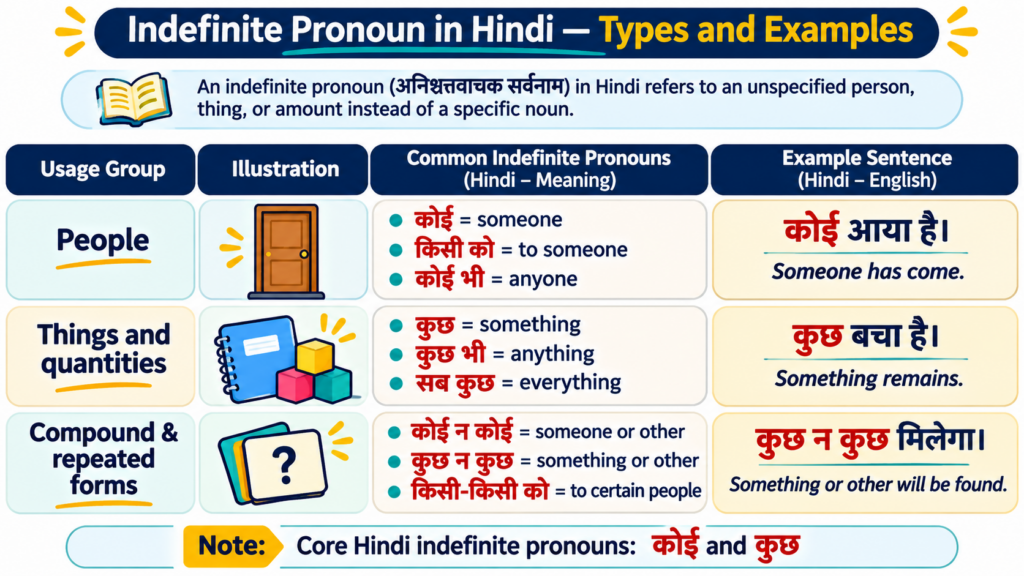
Interrogative Pronoun vs Interrogative Adjective in Hindi
Interrogative pronouns replace an unknown noun, while interrogative adjectives or determiners appear with nouns.
The distinction is especially useful with कौन-सा, कौन-सी, and कौन-से.
| Interrogative Pronoun | Interrogative Determiner |
|---|---|
| कौन-सा तुम्हारा है? | कौन-सा बैग तुम्हारा है? |
| Which one is yours? | Which bag is yours? |
| कौन-सी नई है? | कौन-सी किताब नई है? |
| Which one is new? | Which book is new? |
| कौन-से सही हैं? | कौन-से उत्तर सही हैं? |
| Which ones are correct? | Which answers are correct? |
Grammar Tip: A word’s function depends on the sentence, not simply on whether it appears in a list of question words.
Common Mistakes with Interrogative Pronouns in Hindi
Interrogative pronoun mistakes often involve incorrect oblique forms, possessive agreement, or confusion with interrogative adverbs.
| Common Mistake | Incorrect | Correct / Explanation |
|---|---|---|
| Using कौन with ने | कौन ने किताब लिखी? | किसने किताब लिखी? |
| Using कौन before को | कौन को बुलाया? | किसको बुलाया? or किसे बुलाया? |
| Wrong form before से | कौन से बात की? when asking with whom | किससे बात की? |
| Incorrect possessive agreement | यह किसका किताब है? | यह किसकी किताब है? |
| Masculine form with a feminine selection | कौन-सा कुर्सी चाहिए? | कौन-सी कुर्सी चाहिए? |
| Wrong agreement with masculine plural options | कौन-सा जूते तुम्हारे हैं? | कौन-से जूते तुम्हारे हैं? |
| Confusing कौन and क्या | क्या आया? when asking which person arrived | कौन आया? |
| Treating कहाँ as a pronoun | Calling कहाँ an interrogative pronoun | कहाँ normally functions as an interrogative adverb. |
| Treating question-particle क्या as always pronominal | Calling क्या a pronoun in क्या तुम आओगे? | Here it introduces a yes/no question. |
| Confusing pronoun and determiner | Calling कौन-सी a standalone pronoun in कौन-सी किताब | It modifies किताब, so it functions as a determiner. |
Interrogative Pronouns in Hindi Worksheet
Practice identifying कौन, क्या, किसने, किसे, किसका, and कौन-सा through interactive questions on sentence completion, ownership, grammatical case, and selection.
The exercises also help distinguish interrogative pronouns from determiners and adverbs.
⋮⋮⋮⋮Download Interrogative Pronouns Worksheet with Answers PDF
Strengthen your understanding of interrogative pronouns with printable exercises on identifying unknown people, objects, and owners.
The worksheet includes an answer key for independent practice, classroom activities, and revision.
Download Interrogative Pronoun in Hindi PDF Study Notes
Keep the major interrogative forms, English meanings, grammar rules, and sentence examples together in one reference document.
These notes are useful for offline reading, question-formation practice, and quick grammar revision.
Frequently Asked Questions
Can कौन refer to more than one person?
Yes. कौन can ask about a person or a group, depending on context. कौन-कौन is also used to ask which people are included.
Is क्या always an interrogative pronoun?
No. क्या can stand for an unknown thing or piece of information, but it also introduces yes/no questions without replacing a noun.
Why does कौन change to किसने or किसे?
These are different grammatical forms used according to case and sentence structure. किसने marks the agent in many perfective transitive constructions, while किसे marks an object or recipient.
Is कौन-सा always a pronoun?
No. It is pronominal when it stands independently, but it functions as an interrogative determiner when it accompanies a noun.
Conclusion
The easiest way to choose the correct Hindi interrogative pronoun is to decide what information is missing. If you need a person’s identity, use कौन. For an unknown thing, use क्या. If you want to ask about ownership, choose the appropriate form of किसका.
Try writing questions about a missing book, an unopened box, and three possible answers. Use किसने, क्या, and कौन-सा in your sentences, then share them in the comments.